India and the USA are two large democracies. Examine the basic tenets on which the two political systems are based.
India and the USA are two large democracies. Examine the basic tenets on which the two political systems are based.
India and the USA represent two of the world's largest democracies, each founded on distinct constitutional principles shaped by their unique historical experiences.
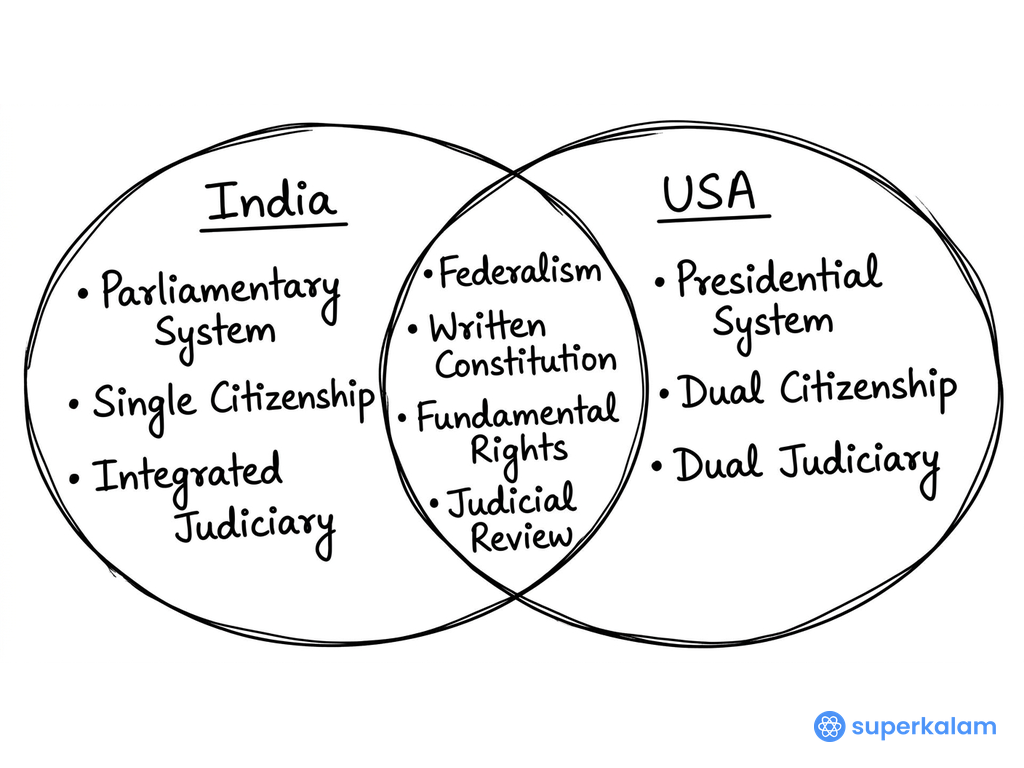
India and Parl Venn Diagram Overlap
Constitutional Foundation and Structure
- US Constitution (1787): World's oldest written constitution emphasizing federalism and separation of powers
- Indian Constitution (1950): Comprehensive document blending parliamentary democracy with federal structure
- Both guarantee rule of law and constitutional supremacy over arbitrary governance
- Judicial review serves as constitutional guardian in both systems, though more explicit in India (Articles 13, 32)
- Amendment processes differ - US requires supermajorities, India has varied procedures under Article 368
Electoral Systems and Representation
| Aspect | USA | India |
|---|---|---|
| Presidential Election | Electoral College System | Indirect election by Electoral College |
| Legislative Elections | Direct popular vote (House/Senate) | FPTP system (Lok Sabha/Rajya Sabha) |
| Party System | Two-party dominance | Multi-party coalition politics |
| Term Limits | President: 2 terms maximum | No term limits for PM |
Separation of Powers and Governance
- USA: Strict separation with checks and balances between Executive, Legislature, and Judiciary
- India: Parliamentary system with Executive accountable to Legislature, following Westminster model
- Both uphold bicameralism - US Senate/House vs. India's Rajya Sabha/Lok Sabha
- Federalism practiced differently - US dual federalism vs. India's cooperative federalism
- Emergency powers more elaborate in India due to partition trauma and security concerns
Fundamental Rights and Civil Liberties
- Bill of Rights in US vs. Fundamental Rights (Part III) in Indian Constitution
- Both guarantee freedom of speech, religion, and equal protection
- India uniquely includes Directive Principles (Part IV) and Fundamental Duties (Part IVA)
- Due process (US) parallels procedure established by law (India, post-Meneka Gandhi case)
- India's reservation system for social justice contrasts with US affirmative action debates
Both democracies demonstrate that constitutional principles can adapt to diverse social contexts while preserving democratic essence. Recent initiatives like India's Digital India and US infrastructure modernization show continued democratic evolution.
Answer Length
Model answers may exceed the word limit for better clarity and depth. Use them as a guide, but always frame your final answer within the exam’s prescribed limit.
Evaluate this PYQ now
Write your answer & evaluate in just 60 seconds




500+ students evaluated
Model Answers from
- 2018Indian Polity15 MarksView Answer
Multiplicity of various commissions for the vulnerable sections of the society leads to problems of overlapping jurisdiction and duplication of functions. Is it better to merge all commissions into an umbrella Human Rights Commission? Argue your case.
- 2018Indian Polity15 MarksView Answer
Assess the importance of the Panchayat system in India as a part of local government. Apart from government grants, what sources can the Panchayats look out for financing developmental projects?
- 2018Indian Polity15 MarksView Answer
How is the Finance Commission of India constituted? What do you know about the terms of reference of the recently constituted Finance Commission? Discuss.
- 2018Indian Polity15 MarksView Answer
How far do you agree with the view that tribunals curtail the jurisdiction of ordinary courts? In view of the above, discuss the constitutional validity and competency of the tribunals in India.
- 2018Indian Polity15 MarksView Answer
Whether the Supreme Court Judgement (July 2018) can settle the political tussle between the Lt. Governor and elected government of Delhi? Examine.
- 2018Indian Polity10 MarksView Answer
“The Comptroller and Auditor General (CAG) has a very vital role to play.” Explain how this is reflected in the method and terms of his appointment as well as the range of powers he can exercise.
Model Answers by Subject


Crack UPSC with your
Personal AI Mentor
An AI-powered ecosystem to learn, practice, and evaluate with discipline



