How far do you agree with the view that tribunals curtail the jurisdiction of ordinary courts? In view of the above, discuss the constitutional validity and competency of the tribunals in India.
How far do you agree with the view that tribunals curtail the jurisdiction of ordinary courts? In view of the above, discuss the constitutional validity and competency of the tribunals in India.
The establishment of tribunals as specialized judicial bodies has sparked ongoing debates about their constitutional validity and impact on India's traditional court system.
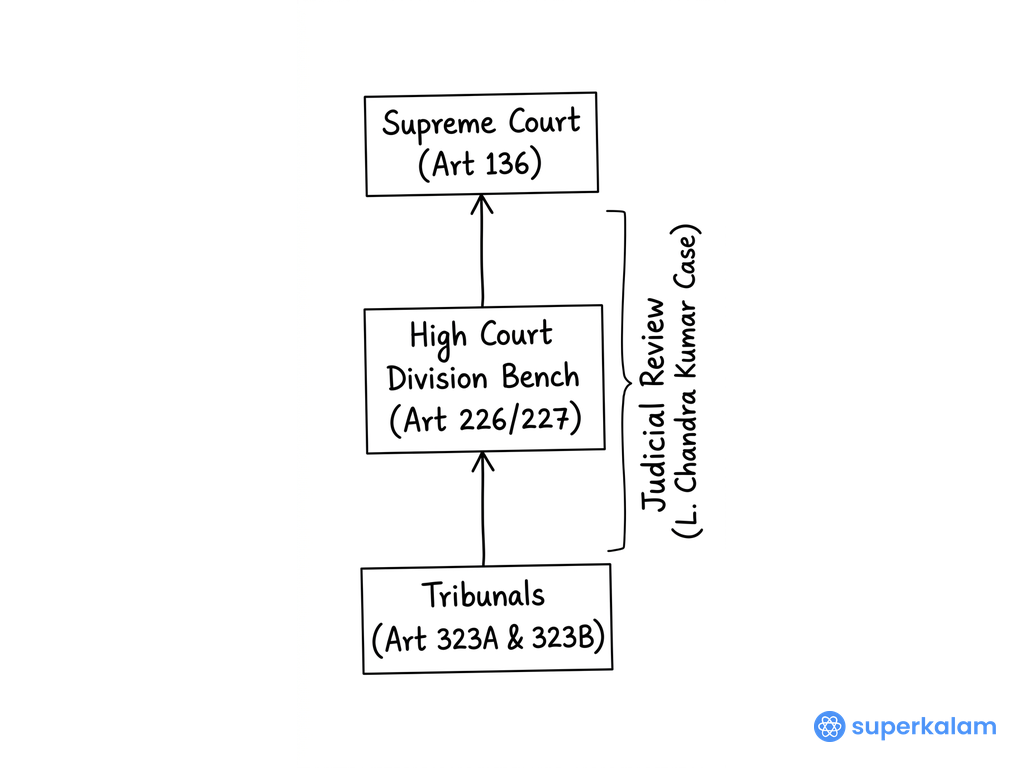
2018 Hierarchical flowchart with three boxes
Agreement with the View: Tribunals Curtailing Court Jurisdiction
-
Exclusive Jurisdiction Transfer: Tribunals possess exclusive jurisdiction over specific matters, directly removing cases from regular courts (e.g., Central Administrative Tribunal handling all service matters of central government employees)
-
Reduced High Court Powers: Articles 323A and 323B explicitly exclude High Court jurisdiction in matters assigned to tribunals, limiting their traditional supervisory role
-
Appeal Restrictions: Many tribunal acts restrict appeals to High Courts, channeling cases directly to Supreme Court, bypassing traditional hierarchical structure
-
Specialized Domain Control: Tribunals like National Green Tribunal, Income Tax Appellate Tribunal, and Competition Appellate Tribunal have complete control over their respective domains
-
Time-bound Disposal: Tribunals' mandate for speedy disposal creates pressure on parties to avoid regular courts despite broader remedial powers
Constitutional Validity of Tribunals
-
Constitutional Foundation: Articles 323A (Administrative Tribunals) and 323B (Other Tribunals) provide explicit constitutional backing for tribunal establishment
-
Parliamentary Competency: Parliament derives power from Entry 95 of Union List and Article 246 to create specialized adjudicatory bodies
-
Judicial Validation: Supreme Court in L. Chandra Kumar v. Union of India (1997) upheld tribunals' constitutional validity while preserving judicial review
-
Alternative Justice Mechanism: Tribunals serve as constitutionally recognized alternative to traditional court system for specialized matters
-
Separation of Powers: Tribunals maintain independence through judicial members and quasi-judicial procedures, satisfying constitutional requirements
Constitutional Competency and Limitations
| Aspect | Tribunals' Competency | Constitutional Limitations |
|---|---|---|
| Jurisdiction | Exclusive in assigned matters | Cannot exclude judicial review completely |
| Powers | Administrative and quasi-judicial | Cannot exercise pure judicial functions |
| Appeals | Limited appeal structure | Must provide effective appeal mechanism |
| Independence | Judicial members required | Cannot compromise judicial independence |
| Review | Subject to High Court oversight | Article 226/227 powers cannot be excluded |
Tribunals represent a constitutional evolution balancing efficiency with justice. While they do curtail regular courts' jurisdiction in specific domains, this limitation serves the constitutional goal of accessible, specialized justice delivery within the framework of judicial review and constitutional supremacy.
Answer Length
Model answers may exceed the word limit for better clarity and depth. Use them as a guide, but always frame your final answer within the exam’s prescribed limit.
Evaluate this PYQ now
Write your answer & evaluate in just 60 seconds




500+ students evaluated
Model Answers from
- 2018Indian Polity15 MarksView Answer
Multiplicity of various commissions for the vulnerable sections of the society leads to problems of overlapping jurisdiction and duplication of functions. Is it better to merge all commissions into an umbrella Human Rights Commission? Argue your case.
- 2018Indian Polity15 MarksView Answer
Assess the importance of the Panchayat system in India as a part of local government. Apart from government grants, what sources can the Panchayats look out for financing developmental projects?
- 2018Indian Polity15 MarksView Answer
How is the Finance Commission of India constituted? What do you know about the terms of reference of the recently constituted Finance Commission? Discuss.
- 2018Indian Polity15 MarksView Answer
India and the USA are two large democracies. Examine the basic tenets on which the two political systems are based.
- 2018Indian Polity15 MarksView Answer
Whether the Supreme Court Judgement (July 2018) can settle the political tussle between the Lt. Governor and elected government of Delhi? Examine.
- 2018Indian Polity10 MarksView Answer
“The Comptroller and Auditor General (CAG) has a very vital role to play.” Explain how this is reflected in the method and terms of his appointment as well as the range of powers he can exercise.
Model Answers by Subject


Crack UPSC with your
Personal AI Mentor
An AI-powered ecosystem to learn, practice, and evaluate with discipline