Safeguarding the Indian art heritage is the need of the moment. Comment.
Safeguarding the Indian art heritage is the need of the moment. Comment.
India's artistic heritage, spanning over 5,000 years of cultural evolution, faces unprecedented threats in the modern era, making immediate safeguarding measures essential for preserving our civilizational identity.
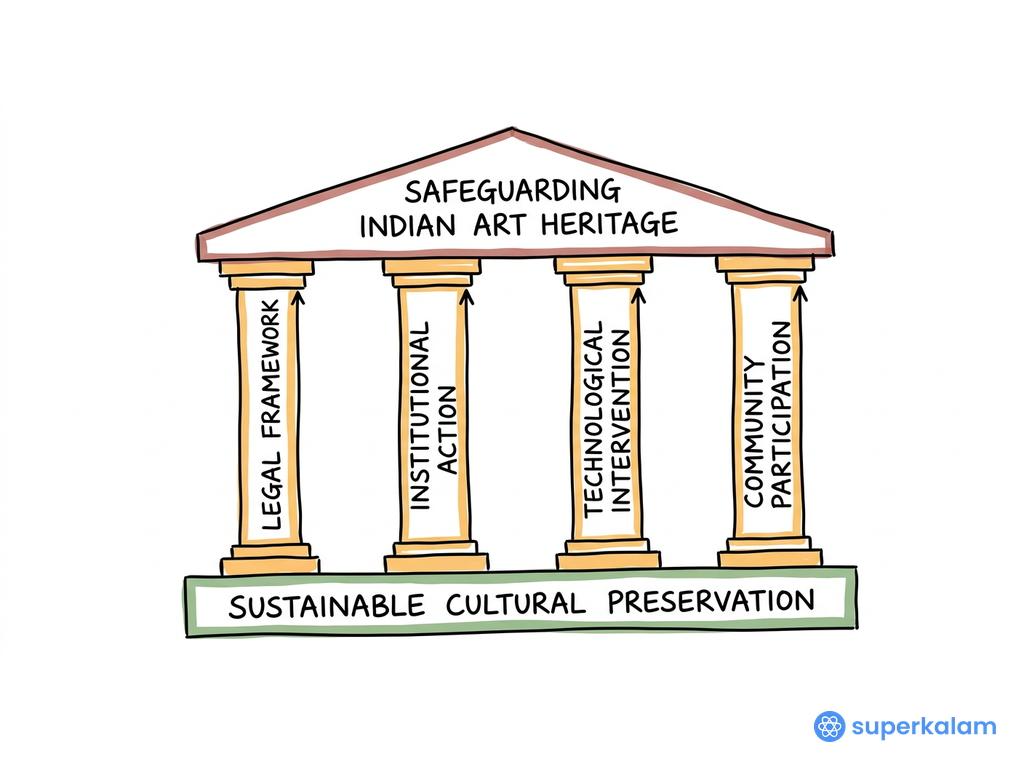
Safeguarding Indian Art Heritage Pillar Framework
Current Threats to Indian Art Heritage
- Theft and Illegal Trafficking: The 2024 theft of S.H. Raza's Prakriti painting and ongoing smuggling networks highlight vulnerabilities in art security systems.
- Environmental Degradation: Monuments like the Taj Mahal suffer from air pollution, while coastal heritage sites face rising sea levels and extreme weather events.
- Urban Encroachment: Rapid urbanization threatens archaeological sites, with over 40% of ASI monuments facing encroachment issues across India.
- Inadequate Documentation: Many artifacts remain undocumented, making them susceptible to loss without proper cataloguing and digital preservation.
- Resource Constraints: Despite ₹1,191.99 crore allocation to ASI (2024-25), maintaining 3,685 centrally protected monuments requires significantly higher investment.
Government Initiatives and Measures
- Digital Preservation: The National Mission on Monuments and Antiquities (NMMA) has digitized over 12.3 lakh antiquities and 11,406 heritage sites.
- International Cooperation: Successfully repatriated 297 artifacts from the US in 2024, including the precious 10th-century Vishnu sandstone sculpture.
- Public-Private Partnership: 'Adopt a Heritage 2.0' program enables corporate and community participation in monument conservation and maintenance.
- Museum Development: The upcoming 'Yuga Yugeen Bharat National Museum' project aims to showcase India's complete cultural timeline.
- Legislative Framework: Antiquities and Art Treasures Act, 1972 provides legal protection, while recent amendments strengthen enforcement mechanisms.
Strategic Way Forward
- Enhanced Security Infrastructure: Installing AI-powered surveillance systems and implementing biometric access controls at heritage sites.
- Community Engagement: Training local communities as heritage guardians, similar to successful models in Hampi and Khajuraho.
- Sustainable Heritage Tourism: Developing carrying capacity-based tourism models that generate revenue while ensuring conservation.
- International Collaboration: Strengthening partnerships with countries like France and UK for artifact repatriation and conservation expertise.
The protection of Indian art heritage is not merely about preserving objects but safeguarding the soul of our civilization. Through coordinated efforts involving Article 51A(f) constitutional duty, international cooperation, and innovative conservation technologies, India can ensure its artistic treasures continue inspiring future generations.
Answer Length
Model answers may exceed the word limit for better clarity and depth. Use them as a guide, but always frame your final answer within the exam’s prescribed limit.
Evaluate this PYQ now
Write your answer & evaluate in just 60 seconds




500+ students evaluated
Model Answers from
- 2018Art & Culture15 MarksView Answer
The Bhakti movement received a remarkable re-orientation with the advent of Sri Chaitanya Mahaprabhu. Discuss.
- 2018Art & Culture10 MarksView Answer
Assess the importance of the accounts of the Chinese and Arab travellers in the reconstruction of the history of India.
Model Answers by Subject


Crack UPSC with your
Personal AI Mentor
An AI-powered ecosystem to learn, practice, and evaluate with discipline