How are the principles followed by NITI Aayog different from those followed by the erstwhile planning commission in India?
How are the principles followed by NITI Aayog different from those followed by the erstwhile planning commission in India?
The transformation from Planning Commission to NITI Aayog in 2015 represents India's shift toward cooperative federalism and market-oriented development planning. This change reflects the evolving needs of a dynamic economy requiring decentralized governance.
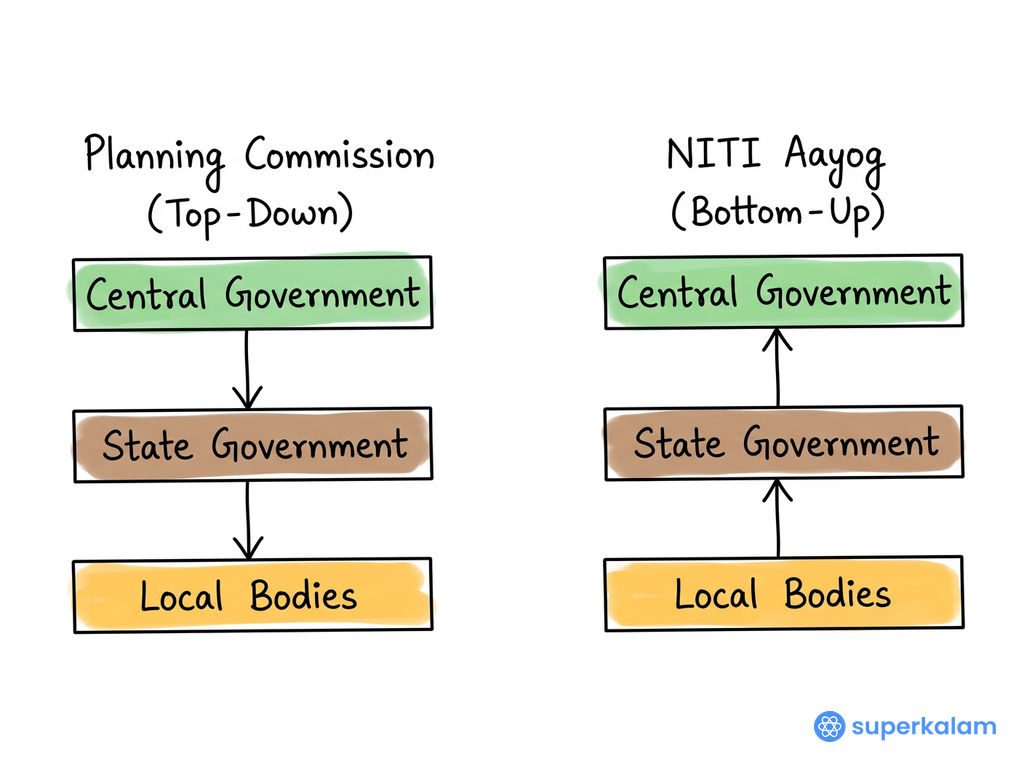
Planning Commission Top Down Comparative Flowchart
Governance and Decision-Making Structure
| Aspect | Planning Commission | NITI Aayog |
|---|---|---|
| Approach | Top-down centralized planning | Bottom-up collaborative framework |
| State Role | Limited participation through NDC | Chief Ministers in Governing Council |
| Decision Authority | Central government dominance | Shared responsibility model |
| Policy Formulation | Uniform national policies | State-specific customized strategies |
| Institutional Nature | Constitutional body with executive powers | Policy think tank and advisory body |
Resource Allocation and Financial Powers
- Planning Commission Era: Direct control over plan expenditure and state allocations through Gadgil-Mukherjee formula
- NITI Aayog Framework: No direct financial allocation powers; Finance Commission handles resource distribution
- Budgeting Approach: Shifted from plan vs non-plan classification to capital vs revenue expenditure
- Funding Mechanism: Emphasis on public-private partnerships and innovative financing models
- Performance Monitoring: Outcome-based evaluation replacing input-focused assessments
Policy Philosophy and Implementation
- Development Strategy: Move from centralized five-year plans to flexible three-year action agendas and 15-year vision documents
- Federalism Model: Competitive federalism through rankings and performance-based incentives like Sustainable Development Goals Index
- Innovation Focus: Atal Innovation Mission and startup ecosystem development versus traditional industrial licensing
- Technology Integration: Digital India alignment and data-driven policy making through real-time monitoring systems
- Stakeholder Engagement: Extensive consultation with private sector, academia, and civil society organizations
Monitoring and Evaluation Framework
- Assessment Method: Real-time performance tracking through digital dashboards versus periodic plan reviews
- Success Metrics: Outcome indicators and impact assessment rather than expenditure-based evaluation
- State Rankings: Introduction of competitive indices like Ease of Doing Business and Innovation Index
- Implementation Tools: Aspirational Districts Programme and Development Support Services to States (DSSS)
This institutional evolution reflects India's transition toward a more flexible, technology-enabled, and participatory governance model. The NITI Aayog framework promotes innovation-driven growth while strengthening center-state cooperation through constitutional federalism principles.
Answer Length
Model answers may exceed the word limit for better clarity and depth. Use them as a guide, but always frame your final answer within the exam’s prescribed limit.
Evaluate this PYQ now
Write your answer & evaluate in just 60 seconds




500+ students evaluated
Model Answers from
- 2018Economy15 MarksView Answer
With growing energy needs should India keep on expanding its nuclear energy programme? Discuss the facts and fears associated with nuclear energy.
- 2018Economy15 MarksView Answer
How has the emphasis on certain crops brought about changes in cropping patterns in the recent past? Elaborate the emphasis on millet production and consumption.
- 2018Economy15 MarksView Answer
Assess the role of the National Horticulture Mission (NHM) in boosting the production, productivity and income of horticulture farms. How far has it succeeded in increasing the income of farmers?
- 2018Economy15 MarksView Answer
How would the recent phenomena of protectionism and currency manipulations in world trade affect the macroeconomic stability of India?
- 2018Economy10 MarksView Answer
Sikkim is the first ‘Organic State’ in India. What are the ecological and economic benefits of an Organic State?
- 2018Economy10 MarksView Answer
Examine the role of supermarkets in supply chain management of fruits, vegetables and food items. How do they eliminate the number of intermediaries?
Model Answers by Subject


Crack UPSC with your
Personal AI Mentor
An AI-powered ecosystem to learn, practice, and evaluate with discipline



