Describe various measures taken in India for Disaster Risk Reduction (DRR) before and after signing ‘Sendai Framework for DRR (2015-2030)’. How is this framework different from the ‘Hyogo Framework for Action, 2005’?
Describe various measures taken in India for Disaster Risk Reduction (DRR) before and after signing ‘Sendai Framework for DRR (2015-2030)’. How is this framework different from the ‘Hyogo Framework for Action, 2005’?
India's disaster management approach has evolved significantly, transitioning from reactive relief measures to proactive risk reduction strategies, especially after adopting international frameworks.
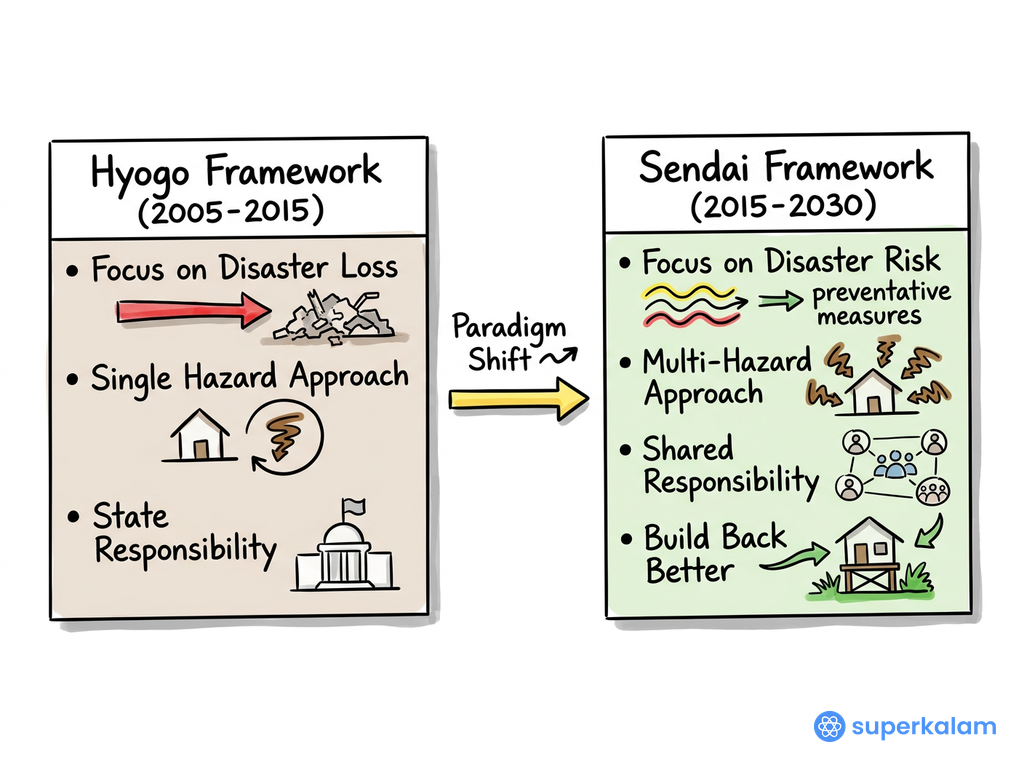
Hyogo Framework comparative diagram 2018
Pre-Sendai Framework Measures in India (Before 2015)
-
Institutional Framework
- Establishment of National Disaster Management Authority (NDMA) in 2005 as apex coordinating body
- Creation of State Disaster Management Authorities (SDMAs) and District Disaster Management Authorities (DDMAs)
- Formation of National Disaster Response Force (NDRF) in 2006 with specialized battalions
- Setting up National Institute of Disaster Management (NIDM) for capacity building and training
- Implementation of Disaster Management Act, 2005 providing legal framework
-
Early Warning Systems
- Strengthening Indian Meteorological Department (IMD) for weather forecasting
- Establishment of National Centre for Medium Range Weather Forecasting (NCMRWF)
- Development of tsunami warning systems post-2004 Indian Ocean tsunami
- Creation of cyclone warning systems along coastal areas
Post-Sendai Framework Measures (After 2015)
-
Policy and Financial Enhancement
- Launch of National Disaster Management Plan (NDMP) 2016 aligned with Sendai priorities
- Enhanced State Disaster Response Fund (SDRF) allocation of ₹1,28,122 crore (2021-2026) by 15th Finance Commission
- Introduction of National Disaster Mitigation Fund (NDMF) for large-scale mitigation projects
- Allocation of $6 billion for DRR mitigation (2021-2025) in Union Budget
-
Technology and Innovation
- Implementation of Common Alerting Protocol (CAP) for multi-hazard early warnings
- Launch of SACHET mobile app for real-time disaster communication
- Development of National Database for Emergency Management (NDEM)
- Introduction of drone technology and artificial intelligence in disaster response
Sendai vs Hyogo Framework: Key Differences
| Aspect | Hyogo Framework (2005-2015) | Sendai Framework (2015-2030) |
|---|---|---|
| Scope | Focused on natural disasters | Covers all hazards including man-made, technological, biological |
| Targets | General expected outcomes | Seven specific global targets with measurable indicators |
| Approach | Disaster risk reduction | Comprehensive disaster risk management with "Build Back Better" |
| Monitoring | Limited accountability mechanisms | Strong monitoring through Sendai Framework Monitor |
| Focus Areas | 5 priority areas | 4 priority areas with enhanced stakeholder engagement |
India's adoption of the Sendai Framework has significantly strengthened its disaster resilience through enhanced institutional capacity, increased financial commitments, and integration of climate change adaptation with DRR strategies, positioning the nation as a global leader in disaster risk reduction.
Answer Length
Model answers may exceed the word limit for better clarity and depth. Use them as a guide, but always frame your final answer within the exam’s prescribed limit.
Evaluate this PYQ now
Write your answer & evaluate in just 60 seconds




500+ students evaluated
Model Answers from
- 2018Economy15 MarksView Answer
With growing energy needs should India keep on expanding its nuclear energy programme? Discuss the facts and fears associated with nuclear energy.
- 2018Economy15 MarksView Answer
How has the emphasis on certain crops brought about changes in cropping patterns in the recent past? Elaborate the emphasis on millet production and consumption.
- 2018Economy15 MarksView Answer
Assess the role of the National Horticulture Mission (NHM) in boosting the production, productivity and income of horticulture farms. How far has it succeeded in increasing the income of farmers?
- 2018Economy15 MarksView Answer
How would the recent phenomena of protectionism and currency manipulations in world trade affect the macroeconomic stability of India?
- 2018Economy15 MarksView Answer
How are the principles followed by NITI Aayog different from those followed by the erstwhile planning commission in India?
- 2018Economy10 MarksView Answer
Sikkim is the first ‘Organic State’ in India. What are the ecological and economic benefits of an Organic State?
Model Answers by Subject


Crack UPSC with your
Personal AI Mentor
An AI-powered ecosystem to learn, practice, and evaluate with discipline



