The China-Pakistan Economic Corridor (CPEC) is viewed as a cardinal subset of China’s larger ‘One Belt One Road’ initiative. Give a brief description of CPEC and enumerate the reasons why India has distanced itself from the same.
The China-Pakistan Economic Corridor (CPEC) is viewed as a cardinal subset of China’s larger ‘One Belt One Road’ initiative. Give a brief description of CPEC and enumerate the reasons why India has distanced itself from the same.
The China-Pakistan Economic Corridor (CPEC) is a flagship infrastructure project launched in 2015 as part of China's Belt and Road Initiative (BRI), with investments exceeding $62 billion for Pakistan's economic development.
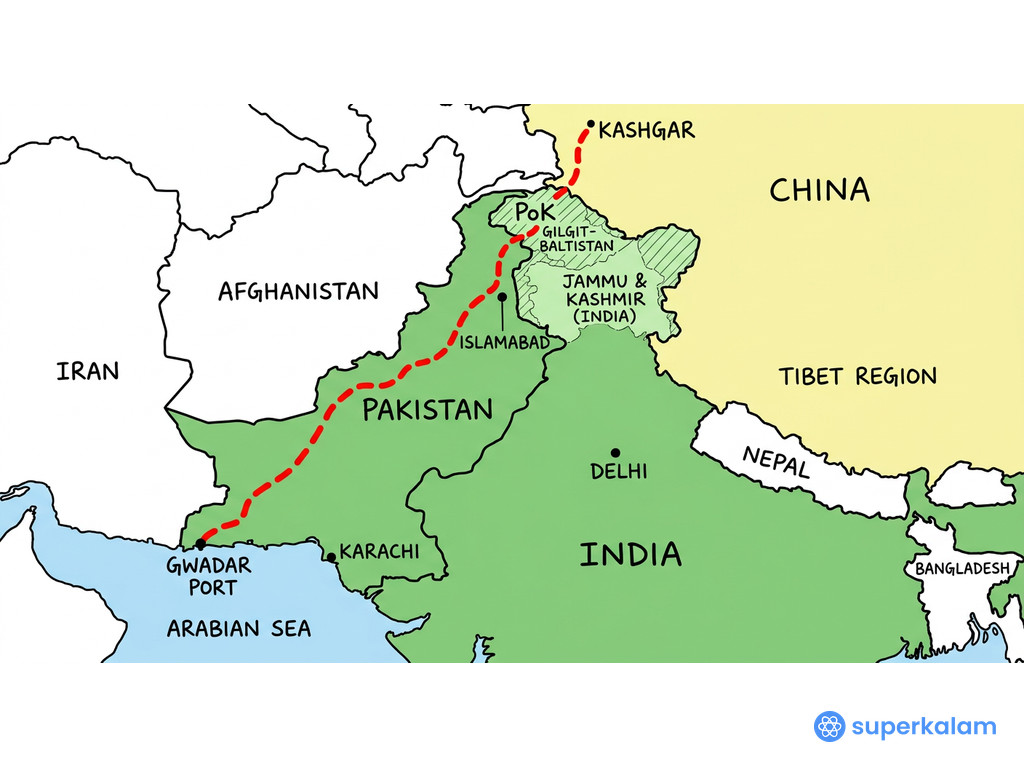
Northwestern India Pakistan and China Map
Overview of CPEC
Infrastructure Components
- Transportation Networks: Development of highways, railways, and ports connecting Kashgar (China) to Gwadar Port (Pakistan)
- Energy Projects: Power plants including Sahiwal Coal Power Plant and Karot Hydropower Project addressing Pakistan's energy deficit
- Industrial Zones: Establishment of Special Economic Zones (SEZs) in Faisalabad, Dhabeji, and other locations
- Digital Connectivity: Fiber optic cables and telecommunications infrastructure for enhanced connectivity
- Gwadar Port Development: Strategic deep-water port providing China access to Arabian Sea and Indian Ocean
Economic Significance
- Trade Facilitation: Reduces Chinese shipping time to Middle East and Africa by 12 days
- Regional Integration: Creates economic corridor spanning 3,000 kilometers from Kashgar to Gwadar
- Employment Generation: Over 75,000 jobs created for Pakistani workforce
- GDP Impact: Projected to add 2.5% to Pakistan's GDP by 2030
- Debt Dynamics: Represents 27% of Pakistan's total debt as of 2024
India's Opposition to CPEC
Sovereignty and Territorial Integrity
- PoK Transit: CPEC passes through Pakistan-occupied Kashmir (PoK), violating India's territorial sovereignty
- Constitutional Position: Contradicts India's claim over entire Jammu & Kashmir under Article 370 (before abrogation)
- Legal Framework: Violates Simla Agreement (1972) bilateral framework for Kashmir dispute resolution
- International Law: India cites UN Charter provisions on territorial integrity and sovereignty
- Precedent Concerns: Legitimizes Pakistan's illegal occupation of Indian territory
Strategic and Security Implications
- Military Encirclement: Creates "String of Pearls" strategy enabling Chinese naval presence in Indian Ocean
- Dual-Use Infrastructure: Potential conversion of civilian infrastructure for military purposes
- Intelligence Concerns: Enhanced Chinese surveillance capabilities near Indian borders
- Regional Balance: Alters South Asian power equilibrium in China's favor
- Nuclear Dimension: Strengthens China-Pakistan nuclear cooperation and technology transfer
India's alternative approach includes the International North-South Transport Corridor (INSTC) and Chabahar Port development in Iran, while advocating for transparent, sustainable connectivity projects respecting sovereignty principles.
Answer Length
Model answers may exceed the word limit for better clarity and depth. Use them as a guide, but always frame your final answer within the exam’s prescribed limit.
Evaluate this PYQ now
Write your answer & evaluate in just 60 seconds




500+ students evaluated
Model Answers from
- 2018Internal Security15 MarksView Answer
India’s proximity to two of the world’s biggest illicit
opium-growing states has enhanced her internal
security concerns. Explain the linkages between
drug trafficking and other illicit activities such as
gunrunning, money laundering and human
trafficking. What countermeasures should be
taken to prevent the same? - 2018Internal Security15 MarksView Answer
Data security has assumed significant importance in
the digitised world due to rising cyber crimes. The
Justice B. N. Srikrishna Committee Report
addresses issues related to data security. What,
in your view, are the strengths and weaknesses
of the Report relating to the protection of personal
data in cyberspace? - 2018Internal Security10 MarksView Answer
Left-wing extremism (LWE) is showing a downward trend but still affects many parts of the country. Briefly explain the Government of India’s approach to counter the challenges posed by LWE.
Model Answers by Subject


Crack UPSC with your
Personal AI Mentor
An AI-powered ecosystem to learn, practice, and evaluate with discipline