Explain the factors responsible for the origin of ocean currents. How do they influence regional climates, fishing and navigation?
Explain the factors responsible for the origin of ocean currents. How do they influence regional climates, fishing and navigation?
Ocean currents, driven by multiple natural forces, significantly influence global climate patterns and human maritime activities.
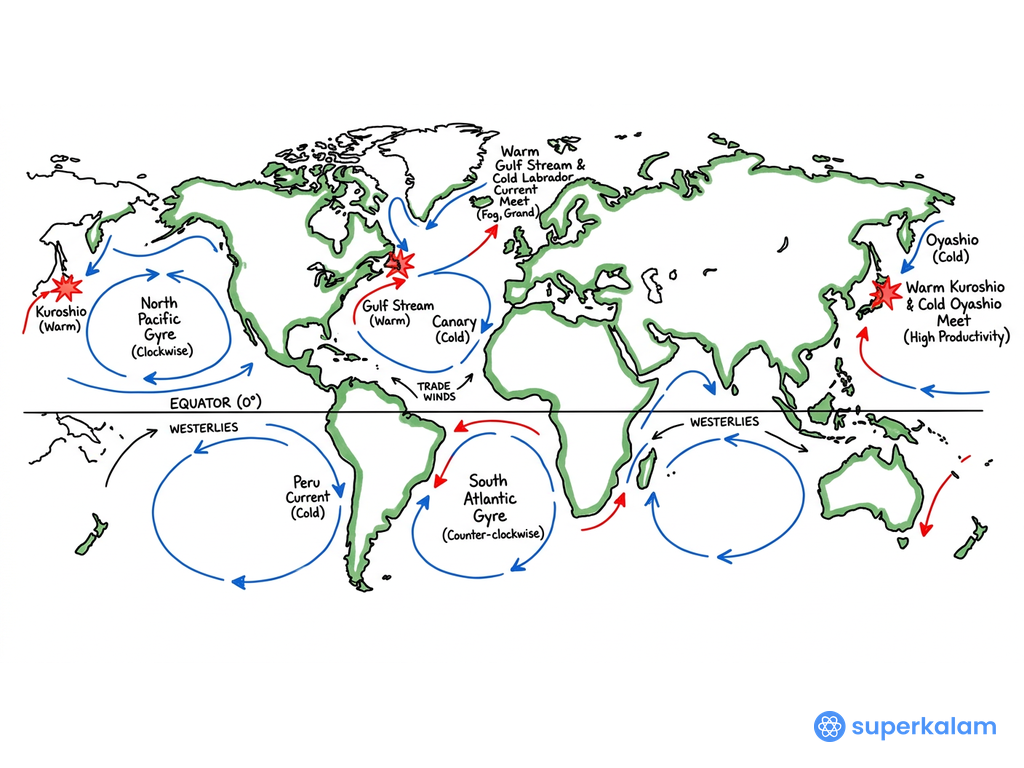
World Map of Major Ocean Currents
Factors Responsible for Ocean Currents Origin
Primary Driving Forces:
- Wind Systems: Trade winds and westerlies create surface currents through frictional drag on ocean surfaces. Example: Northeast trade winds drive the North Equatorial Current westward across the Pacific.
- Earth's Rotation: Coriolis Effect deflects moving water masses, creating clockwise gyres in Northern Hemisphere and counterclockwise in Southern Hemisphere.
- Density Differences: Temperature and salinity variations create thermohaline circulation. Cold, saline water sinks while warm water rises, driving deep ocean currents.
- Gravity: Creates pressure gradients that drive water from high to low pressure areas.
- Tidal Forces: Gravitational pull of moon and sun generates tidal currents in coastal areas.
Secondary Factors:
- Ocean Basin Configuration: Continental shelves, mid-ocean ridges, and underwater topography channel and modify current flows.
- Seasonal Temperature Changes: Monsoon winds reverse current directions, particularly evident in the Indian Ocean.
Influence on Regional Climates
Temperature Regulation:
- Warm Currents: Gulf Stream moderates Western Europe's climate, making it 5-10°C warmer than similar latitudes
- Cold Currents: California Current brings cooling effect to US West Coast, creating Mediterranean climate
- Heat Transfer: Currents transport approximately 40% of global heat from equator to poles
Precipitation Patterns:
- Warm currents increase evaporation and rainfall along coasts
- Cold currents reduce precipitation, creating arid coastal regions like Atacama Desert
- El Niño-La Niña: Pacific current changes affect global weather patterns, influencing monsoons and droughts
Seasonal Climate Modifications:
- Indian Ocean currents reverse with monsoons, affecting rainfall patterns across South Asia
- Upwelling currents bring nutrient-rich cold water, moderating coastal temperatures
Impact on Fishing and Navigation
Fishing Activities:
- Convergence Zones: Meeting points of warm and cold currents create rich fishing grounds like Grand Banks off Newfoundland
- Upwelling Areas: Peru Current brings nutrients to surface, supporting world's largest anchovy fishery
- Seasonal Migration: Current patterns guide fish migration routes, affecting fishing seasons and locations
- Marine Productivity: Nutrient distribution through currents determines fish population density
Navigation Benefits:
- Fuel Efficiency: Ships utilizing favorable currents save up to 15-20% fuel costs on major shipping routes
- Time Optimization: Proper current utilization reduces transit time significantly on routes like Cape of Good Hope passage
- Safety Enhancement: Understanding current patterns helps avoid dangerous areas and optimize routes during storms
- Economic Impact: Container ships through Strait of Malacca leverage monsoon currents for efficient cargo movement
Understanding ocean current dynamics through modern technologies like Argo floats and satellite altimetry remains crucial for climate prediction, sustainable fishing, and efficient maritime transportation in our interconnected global economy.
Answer Length
Model answers may exceed the word limit for better clarity and depth. Use them as a guide, but always frame your final answer within the exam’s prescribed limit.
Evaluate this PYQ now
Write your answer & evaluate in just 60 seconds




500+ students evaluated
Model Answers from
- 2015Modern History12.5 MarksView Answer
It would have been difficult for the Constituent Assembly to complete its historic task of drafting the Constitution for Independent India in just three years, but its experience gained with the Government of India Act, 1935 .Discuss.
- 2015Modern History12.5 MarksView Answer
Mahatma Gandhi and Dr. B R Ambedkar, despite having divergent approaches and strategies, had a common goal of amelioration of the downtrodden. Elucidate.
- 2015Modern History12.5 MarksView Answer
How difficult would have been the achievement of Indian independence without Mahatma Gandhi? Discuss.
Model Answers by Subject


Crack UPSC with your
Personal AI Mentor
An AI-powered ecosystem to learn, practice, and evaluate with discipline



