Taxila University was one of the oldest universities in the world with which were associated several renowned learned personalities of different disciplines. Its strategic location caused its fame to flourish, but unlike Nalanda, it is not considered a university in the modern sense. Discuss.
Taxila University was one of the oldest universities in the world with which were associated several renowned learned personalities of different disciplines. Its strategic location caused its fame to flourish, but unlike Nalanda, it is not considered a university in the modern sense. Discuss.
Taxila, strategically positioned at the crossroads of ancient trade routes, emerged as a prominent center of learning that attracted scholars from across the known world, yet its educational model differed fundamentally from the structured university system epitomized by Nalanda.
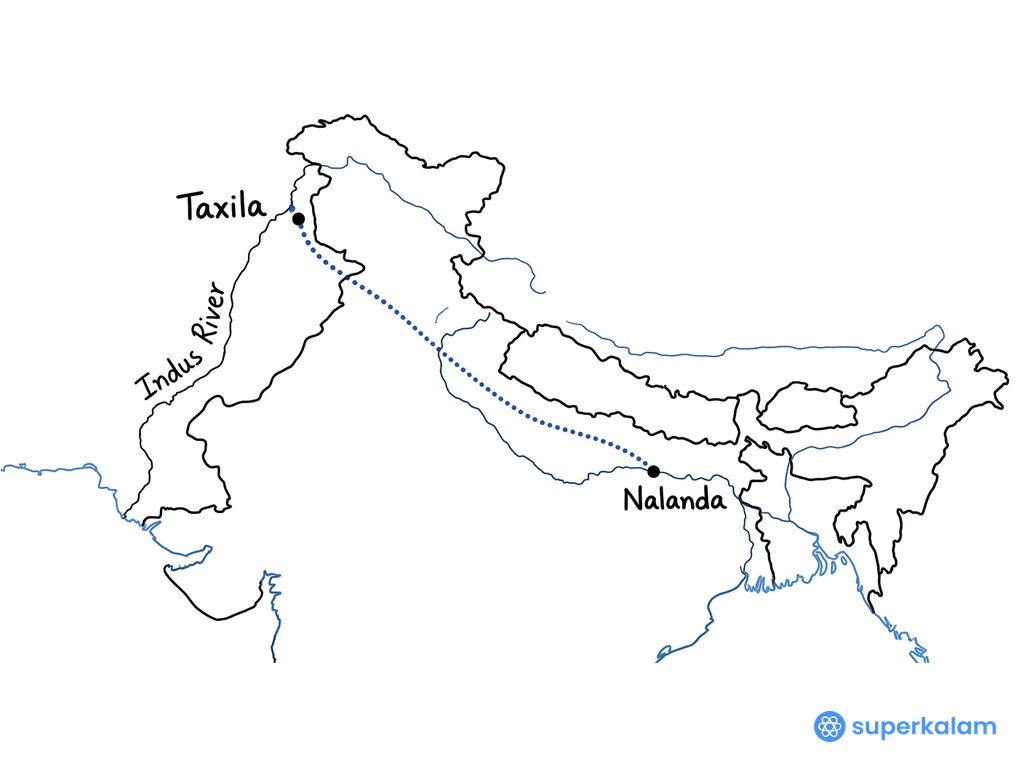
Northern Indian Subcontinent Line Map
Strategic Location and Its Impact
- Geographic Advantage: Located at the confluence of three major trade routes connecting Central Asia, India, and Mediterranean regions
- Cultural Convergence: Position facilitated exchange between Hellenistic, Persian, and Indian civilizations, creating a cosmopolitan intellectual environment
- Economic Prosperity: Trade revenues supported patronage of learning and attracted diverse scholarly communities
- Political Significance: Served as capital of Gandhara, ensuring royal patronage from various dynasties including Mauryans and Kushans
- Archaeological Evidence: Sir John Marshall's excavations (1913-1934) revealed three distinct settlements (Bhir Mound, Sirkap, Sirsukh) spanning different periods
Renowned Personalities and Academic Excellence
| Scholar | Discipline | Contribution |
|---|---|---|
| Chanakya (Kautilya) | Political Science & Economics | Authored Arthashastra; mentor to Chandragupta Maurya |
| Panini | Grammar & Linguistics | Composed Ashtadhyayi, foundational Sanskrit grammar text |
| Charaka | Medicine (Ayurveda) | Systematized medical knowledge in Charaka Samhita |
| Jivaka | Medicine | Royal physician; pioneer in surgery and therapeutics |
Comparison with Nalanda's University Structure
Taxila's Characteristics:
- Decentralized Learning: Multiple gurukulas operating independently without unified administration
- Practical Orientation: Emphasis on vocational training, crafts, and trade skills alongside theoretical knowledge
- Informal Structure: Lacked standardized curriculum, examination system, or degree-granting authority
- Flexible Duration: Students could study for varying periods based on individual needs
- Open Access: No formal admission procedures or residential requirements
Nalanda's Modern Features:
- Centralized Administration: Single institution with organized faculties and departments
- Systematic Curriculum: Structured courses with formal evaluation and graduation systems
- Residential Campus: Dedicated infrastructure with libraries, dormitories, and lecture halls
- International Recognition: Attracted students globally with standardized academic credentials
Limitations in Modern University Recognition
- Documentation Gap: Absence of comprehensive records about institutional frameworks and academic processes
- Archaeological Constraints: Limited evidence of dedicated educational infrastructure compared to Nalanda's extensive ruins
- Structural Differences: Functioned more as an educational hub than a single, organized institution
- Discontinuity: Multiple destructions by invaders disrupted educational traditions
While Taxila's contribution to ancient learning remains unparalleled, its guru-centric, decentralized model represents an earlier phase of higher education that evolved into the more structured university systems exemplified by Nalanda.
Answer Length
Model answers may exceed the word limit for better clarity and depth. Use them as a guide, but always frame your final answer within the exam’s prescribed limit.
Evaluate this PYQ now
Write your answer & evaluate in just 60 seconds




500+ students evaluated
Model Answers from
- 2014Art & Culture10 MarksView Answer
Sufis and medieval mystic saints failed to modify either the religious ideas and practices or the outward structure of Hindu / Muslim societies to any appreciable extent. Comment.
- 2014Art & Culture10 MarksView Answer
Gandhara sculpture owed as much to the Romans as to the Greeks. Explain.
- 2014Art & Culture10 MarksView Answer
To what extent has the urban planning and culture of the Indus Valley Civilization provided inputs to present-day urbanisation? Discuss.
Model Answers by Subject


Crack UPSC with your
Personal AI Mentor
An AI-powered ecosystem to learn, practice, and evaluate with discipline



