The New Economic Policy – 1921 of Lenin influenced the policies adopted by India soon after independence. Evaluate.
The New Economic Policy – 1921 of Lenin influenced the policies adopted by India soon after independence. Evaluate.
Lenin's New Economic Policy (1921) provided a pragmatic blueprint that significantly influenced India's post-independence economic framework, though adapted to suit democratic governance and specific developmental needs.
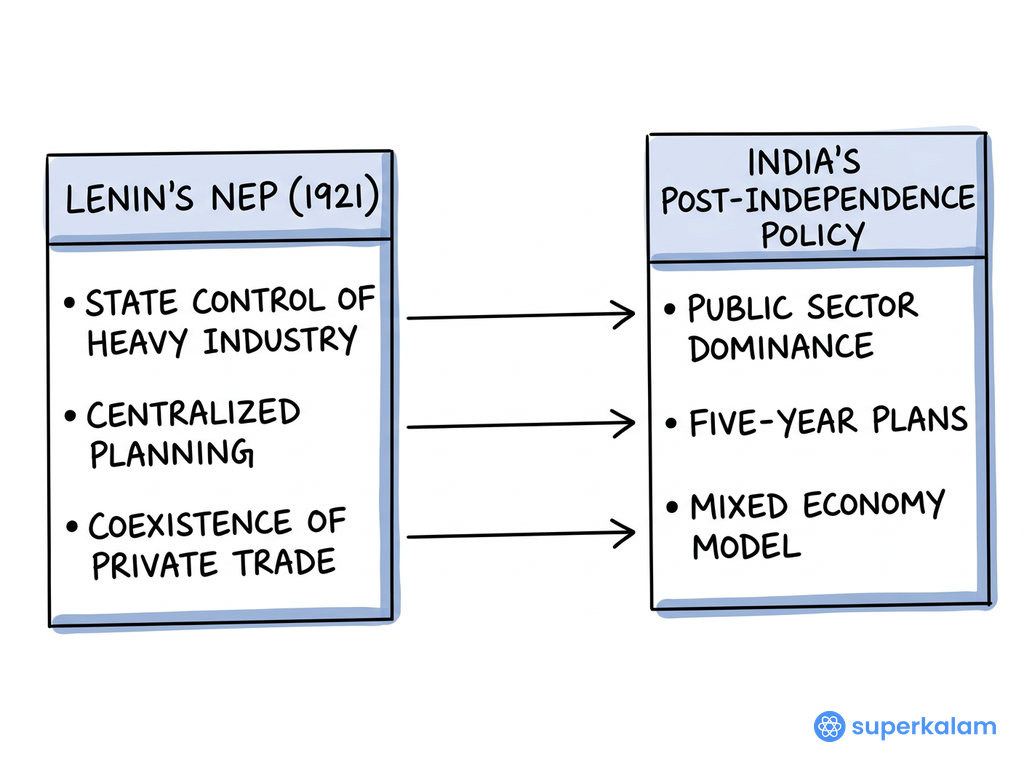
Lenin's NEP 1921 comparative flowchart diagram
Similarities between NEP and India's Economic Policies
-
Mixed Economy Framework
- NEP's combination of state control and private enterprise directly inspired India's Industrial Policy Resolution 1948
- Both maintained state dominance in commanding heights while allowing private sector participation in consumer goods
- India's License Raj system mirrored NEP's regulated private sector approach
- Strategic sectors remained under government control in both models
- Gradual transition from colonial/war economy to planned development
-
Agricultural Development Strategy
- NEP's emphasis on peasant agriculture influenced India's Community Development Programme (1952)
- Both prioritized food security through agricultural productivity enhancement
- Land redistribution policies aimed at empowering small farmers
- Market-oriented agricultural reforms while maintaining state oversight
- Focus on rural cooperatives and institutional credit systems
-
Industrial Planning Approach
- State-led heavy industrialization under Second Five Year Plan (1956-61) followed NEP's industrial priorities
- Mahalanobis model emphasized capital goods production similar to Soviet approach
- Public sector enterprises in steel, heavy machinery, and infrastructure development
- Technology transfer and technical collaboration with USSR (Bhilai, Bokaro steel plants)
- Import substitution strategy to achieve self-reliance
Key Differences and Indian Adaptations
-
Democratic Implementation
- India's approach was consensual and gradual unlike NEP's revolutionary implementation
- Parliamentary democracy ensured policy continuity without authoritarian control
- Federal structure allowed state-level policy variations
- Constitutional framework provided legal basis for economic planning
- Civil society participation in development planning
-
International Engagement
- Unlike NEP's limited foreign participation, India actively pursued Non-Aligned Movement principles
- Balanced foreign collaboration with both Western and Eastern blocs
- World Bank and IMF engagement alongside Soviet technical assistance
- Export promotion alongside import substitution policies
- Technology transfer agreements with multiple countries
| Aspect | NEP (1921) | Indian Policies (1947-1960s) |
|---|---|---|
| Implementation | Revolutionary/Temporary | Democratic/Long-term |
| Private Sector | Limited scope | Regulated but significant |
| Agriculture | Peasant-focused | Cooperative-based |
| Industry | State monopoly in key sectors | Mixed ownership model |
India's post-independence economic strategy, while drawing inspiration from NEP's pragmatic socialism, evolved into a unique democratic socialist model that balanced rapid industrialization with inclusive development through constitutional democracy.
Answer Length
Model answers may exceed the word limit for better clarity and depth. Use them as a guide, but always frame your final answer within the exam’s prescribed limit.
Evaluate this PYQ now
Write your answer & evaluate in just 60 seconds




500+ students evaluated
Model Answers by Subject


Crack UPSC with your
Personal AI Mentor
An AI-powered ecosystem to learn, practice, and evaluate with discipline



