China and Pakistan have entered into an agreement for development of an economic corridor. What threat does this pose for India’s security? Critically examine
China and Pakistan have entered into an agreement for development of an economic corridor. What threat does this pose for India’s security? Critically examine
The China-Pakistan Economic Corridor (CPEC), valued at $62 billion under China's Belt and Road Initiative, poses multifaceted security challenges for India through strategic encirclement and territorial implications.
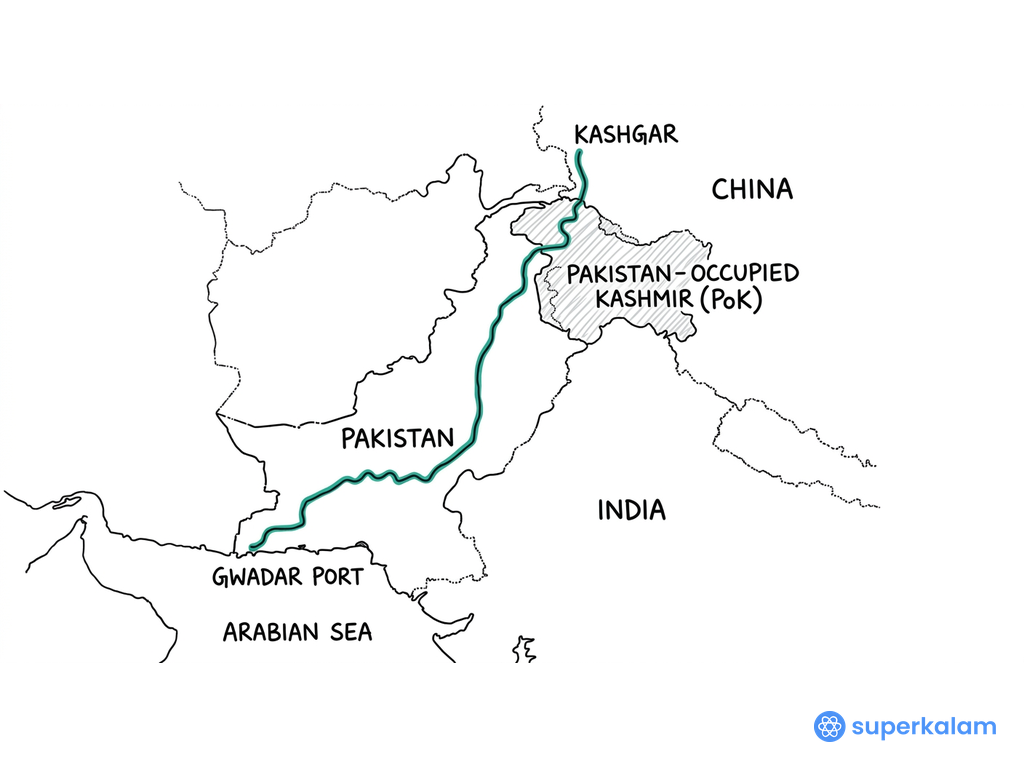
Map of Pakistan India China Route
Territorial and Sovereignty Threats
-
Sovereignty Violation: CPEC passes through Pakistan-occupied Kashmir (PoK) and Gilgit-Baltistan, territories India considers integral parts, legitimizing Pakistan's illegal occupation and undermining India's territorial claims.
-
Border Infrastructure Enhancement: Development of roads, railways, and communication networks in disputed territories strengthens Pakistan's military logistics and mobility along India's western border.
-
Permanent Settlement Risk: Chinese investments and infrastructure development may lead to demographic changes in PoK, making future territorial resolution more complex.
-
International Recognition: CPEC implicitly grants international legitimacy to Pakistan's control over disputed territories, weakening India's diplomatic position.
-
Strategic Depth: Enhanced connectivity provides Pakistan greater strategic depth and operational flexibility against India.
| Security Threat | Immediate Impact | Long-term Consequence |
|---|---|---|
| Territorial Sovereignty | Legitimizes PoK occupation | Complicates Kashmir resolution |
| Military Encirclement | Two-front war scenario | Strategic disadvantage |
| Maritime Security | Arabian Sea presence | Energy route vulnerability |
| Economic Leverage | Regional marginalization | Reduced influence |
Strategic and Military Implications
-
Two-Front Challenge: CPEC strengthens China-Pakistan military cooperation, creating potential for coordinated military pressure on India's eastern and western borders simultaneously.
-
Maritime Encirclement: Gwadar Port development provides China strategic foothold in Arabian Sea, threatening India's sea lanes of communication and energy security routes.
-
Intelligence Sharing: Enhanced China-Pakistan cooperation facilitates better intelligence coordination against Indian interests, particularly regarding Kashmir and border areas.
-
Advanced Weaponry Access: CPEC revenues enable Pakistan to acquire sophisticated Chinese military technology, altering regional military balance.
-
Surveillance Capabilities: Chinese-built infrastructure may include surveillance systems monitoring Indian activities across borders.
Economic and Regional Security Concerns
-
Regional Isolation: CPEC bypasses India, potentially marginalizing its role in regional connectivity and economic integration initiatives.
-
Dependency Creation: Other South Asian nations may become economically dependent on China, reducing India's regional influence and leverage.
-
Counter-connectivity: CPEC competes with Indian initiatives like International North-South Transport Corridor (INSTC) and Chabahar Port development.
-
Energy Security: Chinese control over Gwadar could threaten India's energy imports from Gulf nations, comprising 85% of crude oil requirements.
India's Strategic Response
-
Alternative Connectivity: Development of Chabahar Port in Iran and International North-South Transport Corridor to counter CPEC's regional influence.
-
Border Infrastructure: Accelerated construction through Border Roads Organisation and National Highways & Infrastructure Development Corporation along disputed borders.
-
Strategic Partnerships: Strengthening Quad Alliance, Indo-Pacific strategy, and defense cooperation with United States, Japan, and Australia.
-
Regional Engagement: Enhanced connectivity with Central Asian nations through initiatives like Connect Central Asia Policy and Shanghai Cooperation Organisation participation.
India must balance territorial integrity concerns with regional cooperation needs. The government's Neighborhood First Policy combined with robust border infrastructure development and strategic partnerships provides a comprehensive framework to address CPEC-related security challenges while maintaining regional stability.
Answer Length
Model answers may exceed the word limit for better clarity and depth. Use them as a guide, but always frame your final answer within the exam’s prescribed limit.
Evaluate this PYQ now
Write your answer & evaluate in just 60 seconds




500+ students evaluated
Model Answers from
- 2014Internal Security12.5 MarksView Answer
In 2012, the longitudinal marking for high-risk areas for piracy was moved from 65 degrees east to 78 degrees east in the Arabian Sea by the International Maritime Organisation. What impact does this have on India’s maritime security concerns?
- 2014Internal Security12.5 MarksView Answer
How does illegal trans-border migration pose a threat to India’s security? Discuss the strategies to curb this, bringing out the factors which give impetus to such migration
- 2014Internal Security12.5 MarksView Answer
The diverse nature of India as a multi-religious and multi-ethnic society is not immune to the impact of radicalism which is seen in her neighbourhood? Discuss along with strategies to be adopted to counter this environment
Model Answers by Subject


Crack UPSC with your
Personal AI Mentor
An AI-powered ecosystem to learn, practice, and evaluate with discipline