What do you understand by a run-of-the-ride hydroelectricity project? How is it different from any other hydroelectricity project?
What do you understand by a run-of-the-ride hydroelectricity project? How is it different from any other hydroelectricity project?
A run-of-the-river hydroelectricity project harnesses flowing water without creating large reservoirs, utilizing natural river flow to generate electricity through minimal intervention. This sustainable approach represents modern hydropower development that balances energy generation with environmental preservation.
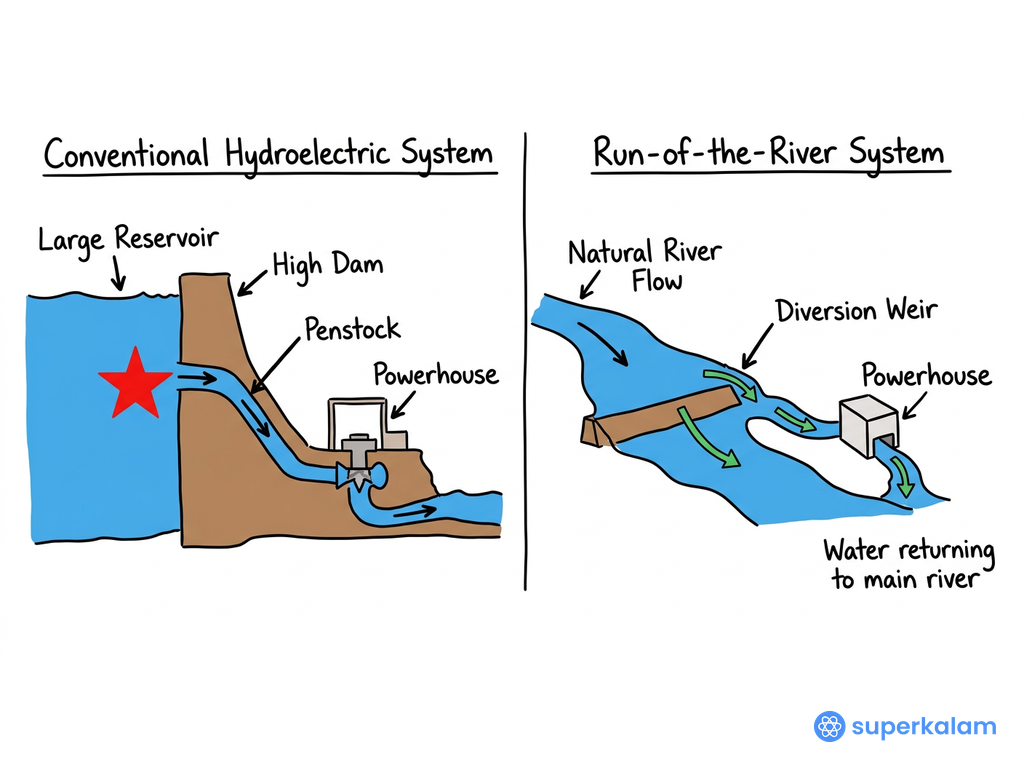
Comparative cross section of hydroelectric systems
Key Characteristics of Run-of-the-River Projects
- Natural Flow Utilization: Diverts portion of river water through turbines and channels, returning it downstream without significant storage
- Minimal Infrastructure: Uses small weirs, intake structures, and penstocks instead of massive dams
- Continuous Operation: Generates electricity based on available river flow, with seasonal variations
- Reduced Environmental Impact: Maintains natural river ecosystem, fish migration patterns, and downstream water availability
- Lower Capital Investment: Requires less construction material, land acquisition, and shorter development timeline
Major Differences from Conventional Hydroelectric Projects
| Aspect | Run-of-the-River | Conventional Hydroelectric |
|---|---|---|
| Water Storage | Minimal/No reservoir | Large reservoirs created |
| Power Generation | Flow-dependent, variable | Consistent, controllable |
| Environmental Impact | Low ecological disruption | Significant habitat alteration |
| Land Requirement | Minimal submergence | Extensive land flooding |
| Construction Time | 3-5 years | 8-15 years |
Technical and Operational Differences
-
Power Output Stability:
- Run-of-river: Variable output based on seasonal flow (example: Uttarakhand's 24 MW Vishnugad Pipalkoti project)
- Conventional: Stable baseload power (example: Tehri Dam - 1,000 MW capacity)
-
Grid Integration:
- Run-of-river: Requires backup power sources during low-flow periods
- Conventional: Provides grid stability and peak power management
-
Cost Considerations:
- Run-of-river: Lower per MW installation cost but higher per unit energy cost
- Conventional: Higher capital cost but lower operational expenses
Recent Policy Framework
India's National Hydroelectric Policy 2008 and recent amendments promote run-of-the-river projects through budgetary support for northeastern states, carbon credit mechanisms, and renewable energy certificates. The government targets 175 GW renewable capacity by 2030, with small hydro contributing significantly.
Run-of-the-river projects offer sustainable hydropower development while preserving river ecosystems, making them crucial for India's clean energy transition and climate commitments under Paris Agreement.
Answer Length
Model answers may exceed the word limit for better clarity and depth. Use them as a guide, but always frame your final answer within the exam’s prescribed limit.
Evaluate this PYQ now
Write your answer & evaluate in just 60 seconds




500+ students evaluated
Model Answers from
- 2013Science & Technology10 MarksView Answer
What are social networking site and what security implications do these sites present?
- 2013Science & Technology5 MarksView Answer
What is an FRP composite material? How are they manufactured? Discuss their applications in the aviation and automobile industry
- 2013Science & Technology5 MarksView Answer
How does the 3D printing technology work? List out the advantages and disadvantages of the technology.
- 2013Science & Technology5 MarksView Answer
What is a digital signature? What does its authentication mean? Giver various salient built-in features of a digital signature.
- 2013Science & Technology10 MarksView Answer
What do you understand by the Umpire decision review in cricket? Discuss its various components. Explain how silicon tape on the edge of a bat may fool the system.
- 2013Science & Technology10 MarksView Answer
What do you understand by fixed-dose drug combinations (FDCs)? Discuss their merits and demerits.
Model Answers by Subject


Crack UPSC with your
Personal AI Mentor
An AI-powered ecosystem to learn, practice, and evaluate with discipline



