Money laundering poses a serious threat to a country’s economic sovereignty. What is its significance for India and what steps are required to be taken to control this menace?
Money laundering poses a serious threat to a country’s economic sovereignty. What is its significance for India and what steps are required to be taken to control this menace?
Recent data shows India loses approximately ₹1.3 lakh crore annually to money laundering, threatening the nation's economic sovereignty. Money laundering involves converting illegally obtained funds into legitimate assets through complex financial transactions.
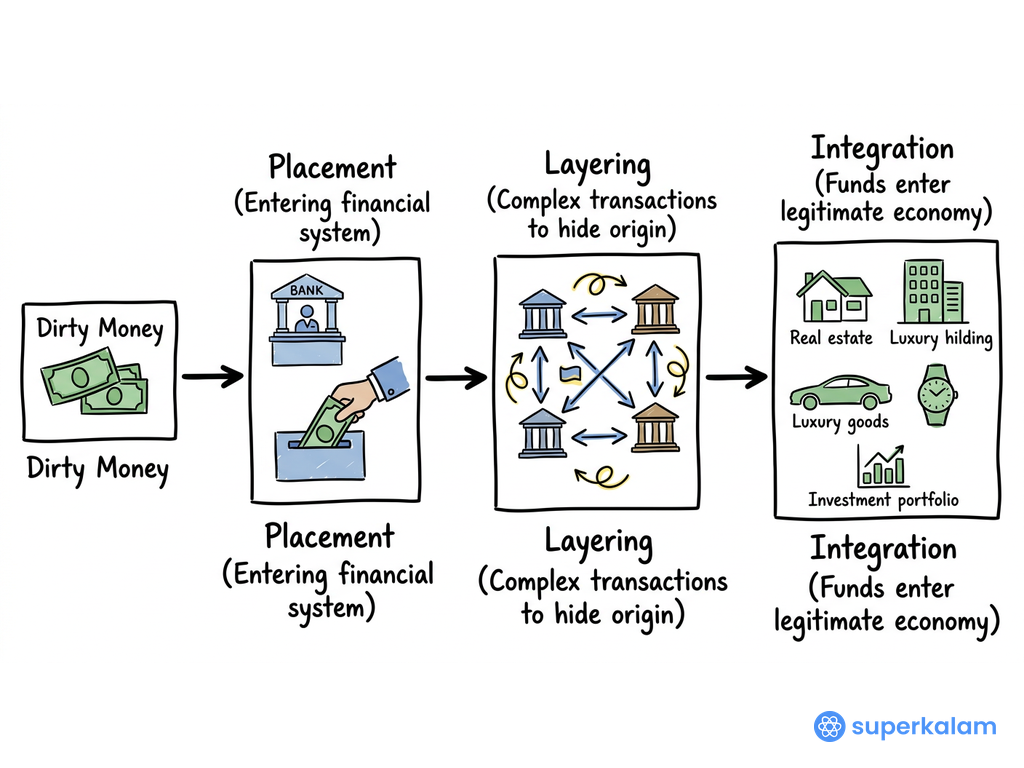
Money Laundering's Three Stages Flowchart
Significance of Money Laundering for India
-
Economic Sovereignty Threat: Undermines monetary policy effectiveness and distorts legitimate market mechanisms, reducing government's control over economic indicators and fiscal planning.
-
National Security Risk: Finances terrorism, insurgency, and organized crime networks, as seen in recent Hawala operations funding separatist activities in J&K and Northeast.
-
Financial System Integrity: Erodes trust in banking institutions and capital markets, affecting India's global credit rating and foreign investment inflows worth $83.57 billion in FY 2023-24.
-
Tax Revenue Loss: The Financial Intelligence Unit-India (FIU-IND) detected ₹15,000 crore in tax evasion through money laundering in 2024, impacting public welfare spending.
-
Corruption Facilitation: Enables political corruption and corporate fraud, as evidenced by recent ₹3,200 crore bank fraud cases linked to shell companies.
Steps Required to Control Money Laundering
Legislative and Regulatory Strengthening
- Expand Prevention of Money Laundering Act (PMLA) 2002 coverage to include cryptocurrency transactions and digital payment platforms
- Implement Beneficial Ownership disclosure norms for all corporate entities by 2025
- Strengthen Know Your Customer (KYC) requirements with Aadhaar-based verification
Technological Solutions
- Deploy Artificial Intelligence for real-time suspicious transaction monitoring across 450+ banks
- Integrate blockchain technology for transparent cross-border transaction tracking
- Enhance FIU-IND's analytical capabilities with machine learning algorithms
International Cooperation
- Strengthen partnerships with Financial Action Task Force (FATF) and maintain India's compliance rating
- Expand Mutual Legal Assistance Treaties with tax havens like Switzerland and Mauritius
- Enhanced information sharing through Egmont Group of financial intelligence units
India's success is evident in Enforcement Directorate's attachment of ₹1.04 lakh crore assets in 2023-24, demonstrating robust enforcement aligned with G20 commitments on financial transparency.
Answer Length
Model answers may exceed the word limit for better clarity and depth. Use them as a guide, but always frame your final answer within the exam’s prescribed limit.
Evaluate this PYQ now
Write your answer & evaluate in just 60 seconds




500+ students evaluated
Model Answers from
- 2013Internal Security10 MarksView Answer
How far are India’s internal security challenges linked with border management, particularly given the long porous borders with most countries of South Asia and Myanmar?
- 2013Internal Security10 MarksView Answer
Article 244 of the Indian Constitution relates to the Administration of Scheduled areas and tribal areas. Analyze the impact of non-implementation of the provisions of the fifth schedule on the growth of Left Wing Extremism.
- 2013Internal Security10 MarksView Answer
Cyber warfare is considered by some defense analysts to be a larger threat than even Al Qaeda or terrorism. What do you understand by Cyberwarfare? Outline the cyber threats that India is vulnerable to and highlight the state of the country’s preparedness to deal with them.
Model Answers by Subject


Crack UPSC with your
Personal AI Mentor
An AI-powered ecosystem to learn, practice, and evaluate with discipline