The product diversification of financial institutions and insurance companies, resulting in overlapping of products and services strengthens the case for the merger of the two regulatory agencies, namely SEBI and IRDA. Justify.
The product diversification of financial institutions and insurance companies, resulting in overlapping of products and services strengthens the case for the merger of the two regulatory agencies, namely SEBI and IRDA. Justify.
Recent developments in India's financial sector show increasing convergence between banking, insurance, and securities products, with institutions like HDFC offering both mutual funds and insurance policies under one roof.
Case for SEBI-IRDA Merger
Product Convergence and Regulatory Overlap
- Hybrid Products: ULIPs combine insurance with investment features, creating jurisdictional disputes between SEBI and IRDA
- Bancassurance Growth: Banks now distribute insurance products alongside securities, requiring dual regulatory compliance
- Digital Platforms: Fintech companies offer integrated financial services spanning both regulators' domains
- Pension Products: Market-linked pension schemes blur boundaries between insurance and securities regulation
- Regulatory Confusion: The 2010 ULIP controversy demonstrated how dual regulation creates market uncertainty
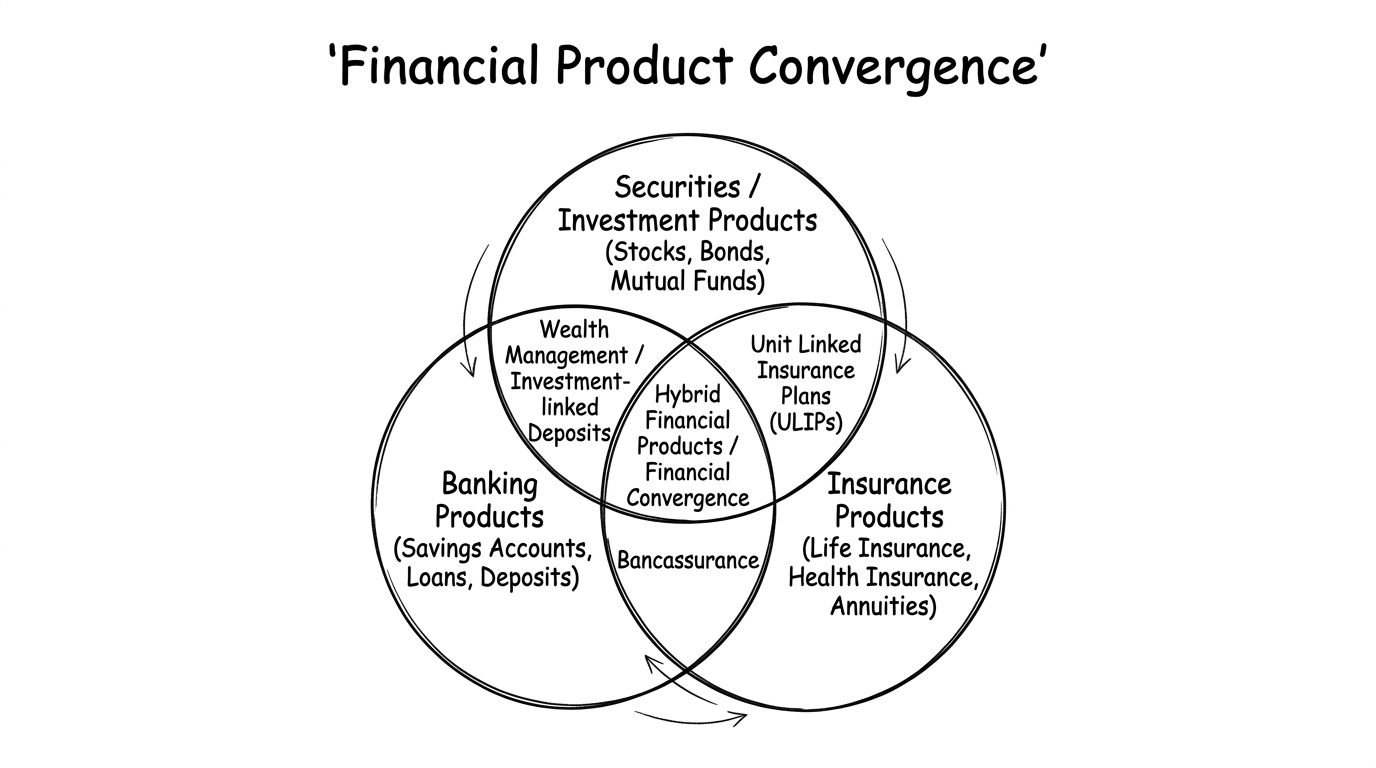
Financial Product Convergence showing overlap between securities, insurance, and banking products
Operational Efficiency Benefits
| Aspect | Current System | Merged Regulator |
|---|---|---|
| Approval Process | Dual clearance required | Single-window clearance |
| Compliance Cost | Higher due to multiple regulations | Reduced compliance burden |
| Market Oversight | Fragmented supervision | Unified risk assessment |
| Consumer Protection | Different standards | Consistent protection norms |
Global Best Practices
- UK's FCA Model: Successfully regulates diverse financial products under single authority since 2013
- Australia's ASIC: Unified regulation of corporations, financial markets, and consumer credit
- Singapore's MAS: Integrated supervision of banking, insurance, and securities sectors
- Regulatory Efficiency: Studies show 15-20% cost reduction in unified regulatory systems
- Market Development: Integrated regulators facilitate faster product innovation and market growth
Implementation Framework
- Phased Integration: Start with overlapping product categories like ULIPs and pension schemes
- Specialized Divisions: Create insurance and securities wings within unified regulator
- Legislative Support: Amend SEBI Act, IRDA Act to enable structural integration
- Stakeholder Consultation: Involve industry players in designing new regulatory framework
- International Cooperation: Leverage expertise from countries with unified financial regulators
The merger would align India's regulatory structure with global trends while addressing current inefficiencies. This integration would strengthen financial market supervision, reduce regulatory arbitrage, and enhance consumer protection across all financial products, supporting India's vision of becoming a $5 trillion economy.
Answer Length
Model answers may exceed the word limit for better clarity and depth. Use them as a guide, but always frame your final answer within the exam’s prescribed limit.
Evaluate this PYQ now
Write your answer & evaluate in just 60 seconds




500+ students evaluated
Model Answers from
- 2013Social Justice10 MarksView Answer
Identify the Millennium Development Goals (MDGs) that are related to health.Discuss the success of the actions taken by the Government to achieve the same.
- 2013Social Justice10 MarksView Answer
The basis of providing urban amenities in rural areas (PURA) is rooted in establishing connectivity. Comment.
- 2013Social Justice10 MarksView Answer
An electronic cash transfer system for welfare schemes is an ambitious project to minimize corruption, eliminate wastage, and facilitate reforms. Comment.
- 2013Social Justice10 MarksView Answer
The Central Government frequently complains about the poor performance of the State Governments in eradicating the suffering of the vulnerable sections of the society. Restructuring of Centrally sponsored schemes across the sectors for ameliorating the cause of vulnerable sections of the population aims at providing flexibility to the States in better implementation. Critically evaluate.
- 2013Social Justice10 MarksView Answer
The concept of the Mid-Day Meal (MDM) scheme is almost a century old in India with early beginnings in the Madras Presidency in pre-independent India. The scheme has again been given impetus in most states in the last two decades. Critically examine its twin objectives, latest mandates, and success.
Model Answers by Subject


Crack UPSC with your
Personal AI Mentor
An AI-powered ecosystem to learn, practice, and evaluate with discipline



