Summer Solstice and Winter Solstice [UPSC Notes]
Solstices mark the longest and shortest days of the year. Understand Summer & Winter Solstice, Solstice vs Equinox UPSC-ready notes with diagrams. Read now!
Dec, 2025
•4 min read
The solstice is an important astronomical event when the Sun appears to stand still at its farthest point north or south of the equator. It happens twice a year and marks the longest and shortest days, helping define seasons. The solstice affects climate, agriculture, and human activities across the world.
For UPSC candidates, understanding solstices is important as it frequently appears in the Prelims and Mains exams, and connects to broader environmental and geographical concepts.
What is a Solstice?
A solstice is the astronomical event when the Sun's rays fall directly over either the Tropic of Cancer or the Tropic of Capricorn, creating the year's longest day (summer solstice) or shortest day (winter solstice).
It represents the moment when one of Earth's hemispheres receives the maximum amount of direct solar radiation while the other receives the minimum.
- There are two solstices each year, one in June and one in December, marking key points in Earth’s movement around the Sun.
- The primary reason for solstices is the 23.5-degree tilt of Earth's rotational axis relative to its orbital plane (the ecliptic plane).
- During the summer solstice, the Sun is directly overhead at the Tropic of Cancer (23.5°N), and during the winter solstice, it's directly overhead at the Tropic of Capricorn (23.5°S).
- The summer solstice brings the longest day and shortest night, while the winter solstice brings the shortest day and longest night in a hemisphere.
- On solstice days, the solar declination (latitude where the Sun is directly overhead) reaches its maximum northerly (23.5°N) or southerly (23.5°S) position.
Also read: Largest Lakes in the World & Their Features | UPSC Notes
Types of Solstices
Solstices are classified into two primary categories based on their timing and hemispheric effects. Let’s understand!
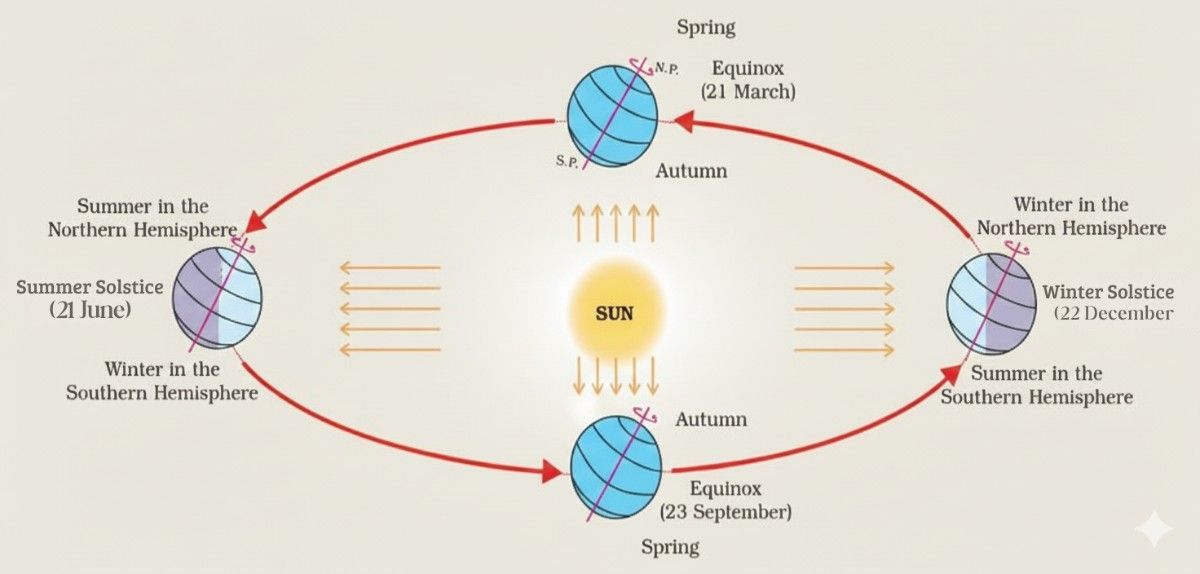
1. Summer Solstice (June Solstice)
The summer solstice occurs when the North Pole of Earth is tilted closest to the Sun, resulting in the longest day and shortest night of the year in the Northern Hemisphere.
- Occurs around June 21 in the Northern Hemisphere.
- Marks the longest day of the year in the hemisphere experiencing summer.
- The Sun appears directly overhead at the Tropic of Cancer (23.5°N).
- In the northern hemisphere, the longest day and shortest night mark the beginning of the summer season.
- In the southern hemisphere, the shortest day and longest night mark the beginning of the winter season.
- Arctic regions experience 24 hours of continuous daylight (midnight sun phenomenon), and Antarctic regions experience 24 hours of continuous darkness.
2. Winter Solstice (December Solstice)
The winter solstice occurs when the South Pole of Earth is tilted closest to the Sun, resulting in the shortest day and longest night of the year in the Northern Hemisphere.
- Occurs around December 21 in the Northern Hemisphere.
- The Sun appears directly overhead at the Tropic of Capricorn (23.5°S).
- Marks the shortest day of the year in the hemisphere experiencing winter.
- In the northern hemisphere, the shortest day and longest night mark the beginning of the winter season.
- In the southern hemisphere, the longest day and shortest night begin the summer season.
- Arctic regions experience continuous darkness, and Antarctic regions experience continuous daylight.
Also read: List of Major Dams of India for UPSC: Oldest, Longest & Highest Dams in India
Solstice vs Equinox: Key Differences
While solstices and equinoxes are both important astronomical events marking seasonal transitions, they differ significantly in their characteristics and effects on Earth's day-night cycles.
| Aspect | Solstice | Equinox |
|---|---|---|
| Definition | Time when the Sun is farthest from Earth's equatorial plane. | Time when the Sun is nearest to Earth's equatorial plane. |
| Day-Night Duration | Unequal lengths, either the longest or shortest day of the year. | Nearly equal length of day and night (approximately 12 hours each). |
| Sun's Position | Directly overhead at the Tropic of Cancer (23.5°N) or Capricorn (23.5°S). | Directly overhead at the Equator (0°). |
| Frequency per Year | Occurs twice yearly | Occurs twice yearly |
| Northern Hemisphere Dates | June 20-21 (Summer); December 21-22 (Winter) | March 20-21 (Spring/Vernal); September 22-23 (Autumn/Autumnal) |
| Seasonal Significance | Marks the beginning of summer and winter | Marks the beginning of spring and autumn |
| Earth's Axial Tilt Effect | Tilt is at maximum effect | Tilt is at the neutral position (neither toward nor away). |
| Duration of Daylight | Longest day = Summer Solstice; Shortest day = Winter Solstice | Both days have approximately equal duration |
| Degrees of Latitude | 23.5° North or South | 0° (Equator) |
| Solar Energy Distribution | Highly unequal-concentrated in one hemisphere | Relatively equal distribution across both hemispheres |
| Higher Latitude Effects | More pronounced variations in day length at higher latitudes | More uniform conditions across all latitudes |
| Phenomenon Example | Arctic regions experience midnight sun (summer) or polar night (winter) | Arctic regions experience dawn/dusk patterns, but not continuous day/night |
Also read: El NINO and LA NINA UPSC Notes: Meaning, Impact and Important Terms
Importance of Solstices: Why They Matter
Solstices are also important in daily life. They affect climate patterns, agricultural seasons, monsoon behaviour, and many cultural practices in India and across the world.
1. Importance of Summer Solstice
The summer solstice, which occurs around 21 June in the Northern Hemisphere, is an important point in Earth’s yearly cycle. It affects agriculture, climate, and human life in many ways.
- Marks the peak growing season when crops receive maximum sunlight for photosynthesis and growth.
- The northward shift of the ITCZ during the summer solstice period is directly responsible for the onset of the Southwest Monsoon in India (typically in early June).
- The summer solstice period coincides with the beginning of the Kharif (monsoon) cropping season, when farmers plant crops that depend on the monsoon, such as rice, cotton, sugarcane, and pulses.
- The summer solstice delivers maximum solar radiation to the Northern Hemisphere, driving atmospheric circulation patterns and wind systems.
- Maximum evaporation and precipitation occur around this period, replenishing groundwater and reservoirs.
- Marks the activation period for plant growth, insect emergence, and animal breeding cycles in temperate regions.
2. Importance of Winter Solstice
The winter solstice, which occurs around December 21–22 in the Northern Hemisphere, marks a significant change in the year. It affects farming, water availability, and many cultural traditions.
- Winter solstice marks the peak period for the Rabi (winter) cropping season, when crops like wheat, barley, pulses, and oilseeds are in their growth phase.
- The late monsoon season (September-November) marks the withdrawal of the Southwest Monsoon and the onset of the Northeast Monsoon.
- While the Northern Hemisphere receives minimum sunlight during the winter solstice, the Southern Hemisphere experiences its summer, demonstrating Earth's hemispherical seasonality.
- The winter solstice period (December-January) is when Kharif crops are harvested, and Rabi crops reach maturity.
- In India, the winter solstice is celebrated as Makar Sankranti (January 14), an important festival marking the start of the harvest season and the Sun's northward movement (Uttarayan).
UPSC Prelims PYQ on Summer Solstice and Winter Solstice
QUESTION 1
On June 21 every year, which of the following latitude(s) experience(s) a sunlight of more than 12 hours?
- Equator
- Tropic of Cancer
- Tropic of Capricorn
- Arctic Circle
Select the correct answer using the code given below :
UPSC Mains Practice Question
What is a solstice? Explain its cause using Earth's tilt in simple terms.
Evaluate Your Answer Now!Conclusion
Solstices are two days in a year when the Sun is farthest from the equator, giving us the longest day in June and the shortest day in December. This happens due to Earth’s 23.5° tilt. In June, the Sun is overhead at the Tropic of Cancer, and in December at the Tropic of Capricorn. Solstices help determine seasons and influence climate and natural cycles.
Start Your UPSC Preparation with SuperKalam
SuperKalam is your AI-powered personal mentor, keeping your preparation disciplined, focused, and effective with:
- Instant Mains answer evaluation
- Instant doubt resolution
- Personalised guidance
- Unlimited MCQs and PYQs
- Progress tracking through daily goals, streaks, and leaderboards.