Largest Lakes in the World & Their Features | UPSC Notes
Learn about the largest lakes in the world for UPSC Prelims & Mains. Study the significance, threats, and conservation of lakes. Read now!
Dec, 2025
•4 min read
Lakes are known as the "thermometers" of our planet's health and vital economic zones. Whether it's the shrinking Aral Sea or the floating Loktak Lake in Manipur, this topic frequently appears in Prelims and Mains (GS-1 Geography & GS-3 Environment). So, let’s quickly learn about these biodiversity hotspots of the world!
What is a Lake?
A lake is a naturally occurring, relatively large body of water that occupies a basin or depression on Earth's surface and is surrounded by land. Lakes are generally larger and deeper than ponds and represent one of the most important freshwater resources on our planet.
- The scientific study of lakes is called Limnology.
- Lakes are formed through various natural processes, including tectonic activity, volcanic eruptions, glacial movements, and the action of rivers.
- It may be freshwater or saline (endorheic basins where water evaporates, leaving salt behind), and its water is generally static compared to flowing rivers.
- Lakes serve as crucial habitats for a diverse array of wildlife, including fish, birds, amphibians, and aquatic plants, which form interconnected food chains.
- Lakes support essential economic activities, including fishing, agriculture, hydroelectric power generation, and tourism.
- Lakes can be natural or artificial (man-made reservoirs).
Also read: List of Major Dams of India for UPSC: Oldest, Longest & Highest Dams in India
Top 10 Largest Lakes in the World
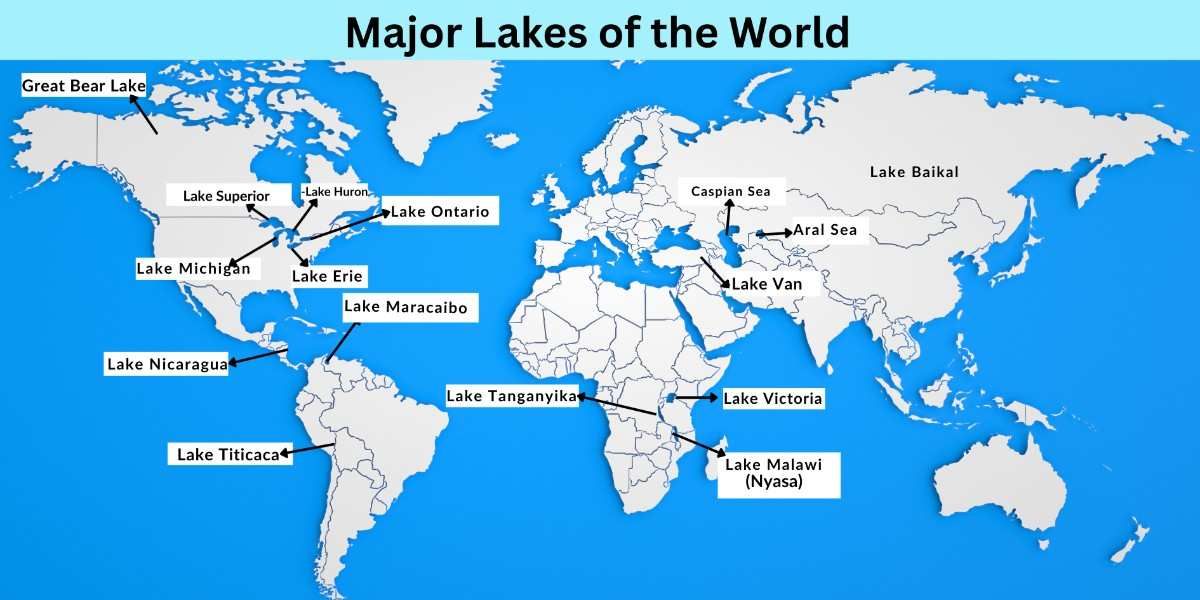
The world is home to magnificent water bodies that shape regional climates, support biodiversity, and influence human civilisations. Here are the ten largest lakes by surface area:
| Rank | Lake Name | Type | Bordering Countries |
|---|---|---|---|
| 1 | Caspian Sea | Saline | Russia, Kazakhstan, Iran,Turkmenistan, Azerbaijan |
| 2 | Lake Superior | Freshwater | USA, Canada |
| 3 | Lake Victoria | Freshwater | Tanzania, Uganda, Kenya |
| 4 | Lake Huron | Freshwater | USA, Canada |
| 5 | Lake Michigan | Freshwater | USA |
| 6 | Lake Tanganyika | Freshwater | Tanzania, DR Congo, Burundi, Zambia |
| 7 | Lake Baikal | Freshwater | Russia |
| 8 | Great Bear Lake | Freshwater | Canada |
| 9 | Lake Malawi | Freshwater | Malawi, Mozambique, Tanzania |
| 10 | Great Slave Lake | Freshwater | Canada |
Important: There is often confusion between the Caspian Sea and Lake Superior. The Caspian Sea is technically a lake (enclosed by land), making it the largest. However, if the question specifically asks for "Freshwater," Lake Superior takes the top spot.
Highest and Lowest Lakes of the World
The world’s highest lakes are tiny mountain or volcanic lakes at extreme altitudes, while the lowest lakes lie below sea level in rift valleys or basins.
1. Highest Lakes:
- Ojos del Salado (Pool): Located in the Andes (Argentina/Chile). It is technically the highest body of water at ~6,390m, but it is tiny (a crater pool).
- Lake Titicaca: Located on the border of Peru and Bolivia.
2. Lowest Lakes:
- The Dead Sea: Located between Israel and Jordan. It sits about 430 meters below sea level, making it the lowest point on Earth’s land surface.
- Sea of Galilee: Also in Israel. It is the lowest freshwater lake on Earth (~214m below sea level).
Also read: El NINO and LA NINA UPSC Notes: Meaning, Impact and Important Terms
Important Lakes in India for UPSC
India's diverse geography encompasses a range of lakes, from Himalayan high-altitude lakes to coastal lagoons. These water bodies are crucial for ecology, culture, and economy.
| Lake Name | State/UT | Type | Significance |
|---|---|---|---|
| Wular Lake | Jammu & Kashmir | Freshwater | The largest freshwater lake in India |
| Chilika Lake | Odisha | Brackish Water | Largest brackish water lake, Ramsar site |
| Sambhar Lake | Rajasthan | Saltwater | Largest saltwater lake, source of salt production |
| Loktak Lake | Manipur | Freshwater | Only the floating national park (Keibul Lamjao) |
| Vembanad Lake | Kerala | Brackish Water | Longest lake in India, Ramsar site |
| Govind Ballabh Pant Sagar | Uttar Pradesh | Artificial | Largest artificial lake in India |
| Dal Lake | Jammu & Kashmir | Freshwater | Famous for houseboats, the "Jewel of Kashmir" |
| Pangong Tso | Ladakh | Saltwater | High-altitude lake extends to China |
| Hussain Sagar | Telangana | Artificial | Historical tank connecting two cities |
| Kolleru Lake | Andhra Pradesh | Freshwater | An important wetland for migratory birds |
Difference Between Lake and Sea
Lakes and seas are two important water bodies that differ mainly in their location, connection to oceans, and salinity. Knowing these differences helps in understanding basic physical geography.
| Aspect | Lake | Sea |
|---|---|---|
| Connection to Ocean | No direct connection to the ocean; isolated from open waters. | Directly connected to the ocean through straits or passages. |
| Water Salinity | Can be freshwater or saltwater (e.g., Caspian Sea, Dead Sea). | Always saltwater |
| Formation | Natural (glacial, tectonic, volcanic) or man-made (reservoirs). | Naturally formed only |
| Depth | Relatively shallow; most < 100 sq miles surface area. | Deeper than lakes; average depth ~12,000 feet. |
| Water Movement | Stagnant; minimal currents; water levels relatively constant. | Strong currents driven by wind and temperature variations. |
| Geographic Location | Enclosed basins, mountain valleys, rift zones, glacial areas. | Partially enclosed by land; often at coastlines. |
| Inflow/Outflow | May have natural outflow (rivers/streams) or be endorheic (no outlet). | Continuous exchange with ocean waters; regulated by tides. |
| Aquatic Life | Limited species; freshwater organisms like fish, ducks | Diverse marine species: octopuses, sharks, whales |
| Examples | Lake Superior, Lake Baikal, Lake Victoria, Lake Titicaca | Mediterranean Sea, Red Sea, Black Sea, Caribbean Sea |
Significance of Lakes
Large lakes are important for planetary health and human civilisation. Their importance extends far beyond being mere water bodies.
- Climate Regulation: Large lakes (like the Great Lakes) moderate the local climate, making summers cooler and winters warmer.
- Transportation: The Great Lakes of North America are connected by canals (St. Lawrence Seaway), allowing massive ships to travel deep inland.
- Freshwater Reservoir: Lakes hold a massive percentage of the world's unfrozen surface freshwater (Lake Baikal alone holds ~20% of it).
- Fisheries: Lakes like Victoria and Chilika support millions of livelihoods through fishing.
- Energy: High-altitude lakes are often used for generating Hydroelectricity (e.g., reservoirs)
Also read: Climate Change UPSC Notes: Meaning, Types, Causes & Key Initiatives
Challenges Facing the World’s Lakes
Lakes are precious, but many are polluted or drying up. To protect them, we must understand the problems and take the right steps to restore them.
- Eutrophication: Excess runoff of fertilisers (nitrogen/phosphorus) causes algae blooms, which consume all the oxygen and kill fish (creation of "Dead Zones").
- The "Aral Sea" Syndrome: Diversion of rivers for irrigation caused the Aral Sea (once the 4th largest) to shrink by over 90%.
- Invasive Species: Alien species (like the Water Hyacinth in Indian lakes) destroy native biodiversity.
- Climate Change: Rising temperatures increase evaporation. Shallow lakes are drying up faster than they can be replenished by rain.
- Urbanisation pressure: Encroachment, construction and solid waste dumping around lakes.
- Glacial melt and altered rainfall: Changes in meltwater and monsoon patterns affect lake inflows.
- Unsustainable tourism: Littering, boating, and unregulated infrastructure around popular lakes.
UPSC Prelims PYQ on Largest Lakes in the World
QUESTION 1
Q1. Which one of the following is an artificial lake?
Conservation and Initiatives
Recognising the critical importance of lakes, global and national initiatives aim to protect these precious water bodies.
- Ramsar Convention (1971): Global treaty for wetland conservation with 172 member countries.
- Sustainable Development Goals (SDGs): Goal 6 focuses on clean water and sanitation.
- National Plan for Conservation of Aquatic Ecosystems (NPCA): Integrates National Lake Conservation Plan and National Wetlands Conservation Program.
- India's First Water Bodies Census (2017-18): Comprehensive database of ponds, tanks, lakes, and reservoirs across 33 States/UTs.
- Technological Interventions: Remote sensing monitors lake extent and water quality.
UPSC Mains Previous Year Question
Discuss the consequences of Climate Change on food security in tropical countries. (2023)
Evaluate Your Answer Now!Way Forward
Protecting the world's lakes requires urgent, coordinated action at all levels.
- Treat entire catchment areas as single management units.
- Control soil erosion through terracing and vegetation cover.
- Establish buffer zones around lakes with restricted activities.
- Promote water-efficient agricultural practices.
- Engage industries in adopting cleaner production technologies.
Achieve your UPSC dream with SuperKalam, your personal AI mentor providing instant Mains answer evaluation, PYQ practice, and unlimited Subject-wise MCQs.
Start learning smarter today!