Right to Education (RTE) Act 2009 - UPSC Notes
Right to Education (RTE) Act 2009 guarantees free and compulsory education for children aged 6–14 years. Study its features, provisions, amendments, and challenges for UPSC Prelims and GS Paper II.
Apr, 2026
•6 min read
The Right to Education (RTE) Act 2009, is a landmark law that makes free and compulsory education a fundamental right for children aged 6–14 years under Article 21A. It operationalises the vision of inclusive and equitable education in India, focusing on access, quality, and equity in schooling.
For UPSC Prelims and Mains (GS Paper II), the RTE Act is important for understanding issues related to education policy, social justice, and governance, as well as its provisions, challenges, and implementation. Let's study this topic in detail!
Background of the Right to Education Act
The journey of the Right to Education (RTE) Act, 2009 reflects the gradual recognition of education as a basic human right in India.
A major turning point came with the Unnikrishnan vs. State of Andhra Pradesh (1993), where the Supreme Court of India held that the right to education is a fundamental right derived from Article 21 (Right to Life).
The Court clarified that this right is not absolute, but it obligates the State to provide free education up to the age of 14 years, making elementary education a constitutional priority.
To give constitutional backing to this principle, the government enacted the Constitution (Eighty-sixth Amendment) Act, 2002, which brought significant changes:
1. Fundamental Rights
- Inserted Article 21A
- Made free and compulsory education a fundamental right for children aged 6–14 years
- Empowered the State to determine the manner of implementation through law
2. Directive Principles of State Policy (DPSP)
- Substituted Article 45
- Directed the State to provide early childhood care and education for children below 6 years
3. Fundamental Duties
- Added clause under Article 51A(k)
- It is the duty of parents or guardians to provide opportunities for education to children between 6–14 years
These constitutional developments laid the foundation for the enactment of the RTE Act, 2009.
Provisions of the Right to Education (RTE) Act, 2009
The Right to Education (RTE) Act, 2009 lays down clear provisions to ensure free, compulsory, and quality elementary education for all children.
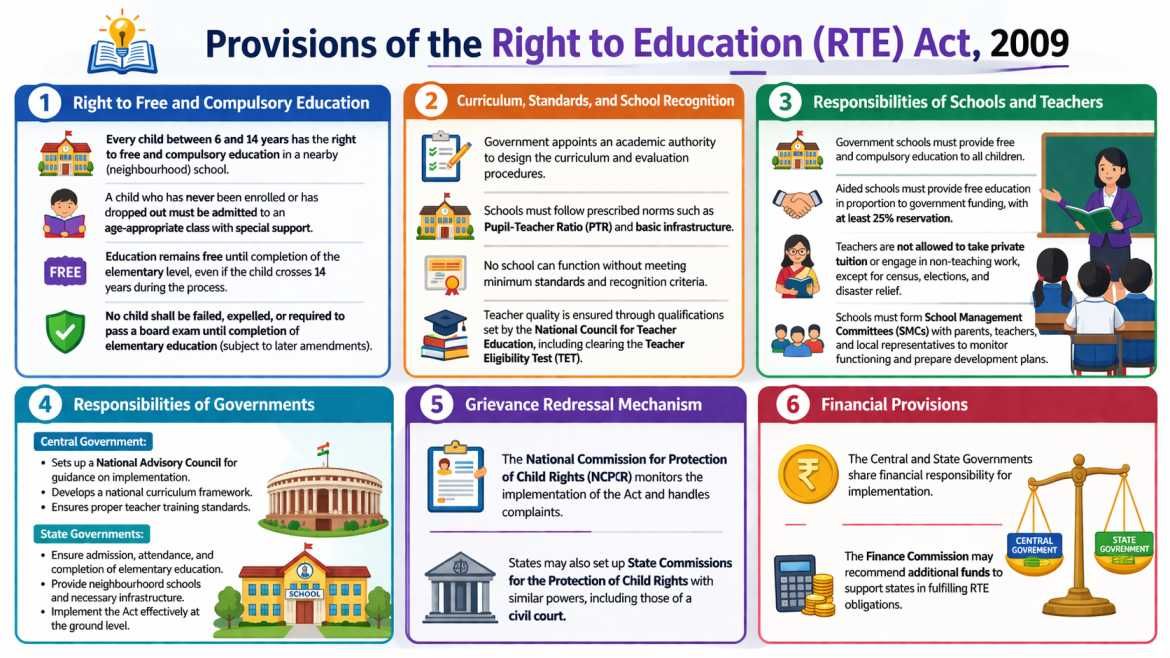
1. Right to Free and Compulsory Education
- Every child between 6 and 14 years has the right to free and compulsory education in a nearby (neighbourhood) school.
- A child who has never been enrolled or has dropped out must be admitted to an age-appropriate class with special support.
- Education remains free until completion of the elementary level, even if the child crosses 14 years during the process.
- No child shall be failed, expelled, or required to pass a board exam until completion of elementary education (subject to later amendments).
2. Curriculum, Standards, and School Recognition
- The government appoints an academic authority to design the curriculum and evaluation procedures.
- Schools must follow prescribed norms such as the Pupil-Teacher Ratio (PTR) and basic infrastructure.
- No school can function without meeting these minimum standards and recognition criteria.
- Teacher quality is ensured through qualifications set by the National Council for Teacher Education, including clearing the Teacher Eligibility Test (TET).
3. Responsibilities of Schools and Teachers
- Government schools must provide free and compulsory education to all children.
- Aided schools must provide free education in proportion to government funding, with at least 25% reservation.
- Teachers are not allowed to take private tuition or engage in non-teaching work, except for census, elections, and disaster relief.
- Schools must form School Management Committees (SMCs) with parents, teachers, and local representatives to monitor functioning and prepare development plans.
4. Responsibilities of Governments
Central Government:
- Sets up a National Advisory Council for guidance on implementation.
- Develops a national curriculum framework.
- Ensures proper teacher training standards.
State Governments:
- Ensure admission, attendance, and completion of elementary education.
- Provide neighbourhood schools and necessary infrastructure.
- Implement the Act effectively at the ground level.
5. Grievance Redressal Mechanism
- The National Commission for Protection of Child Rights monitors the implementation of the Act and handles complaints.
- States may also set up State Commissions for the Protection of Child Rights with similar powers, including those of a civil court.
6. Financial Provisions
- The Central and State Governments share financial responsibility for implementation.
- The Finance Commission may recommend additional funds to support states in fulfilling RTE obligations.
Amendments to the Right to Education (RTE) Act, 2009
Over time, the Right to Education (RTE) Act, 2009 has been amended to address gaps in implementation and improve inclusiveness and learning outcomes.
1. Amendment Act of 2012
This amendment focused on inclusion and clarity in the scope of the Act:
Inclusion of Children with Disabilities
- Children with disabilities were brought under the ambit of the RTE Act, aligning it with the Rights of Persons with Disabilities Act, 2016.
- Provision for home-based education for children with severe disabilities.
- Emphasis on inclusive education in regular schools, wherever possible.
Exemption to Minority Institutions
- Institutions protected under Article 30 (minority educational institutions) were exempted from certain provisions of the RTE Act, especially the 25% reservation clause.
2. Amendment Act of 2019
This amendment aimed at improving learning outcomes and accountability:
- Removal of “No Detention Policy”
- Earlier, students could not be failed or detained up to Class 8.
- The amendment allows detention after examination if a child fails to meet learning standards.
- Students are given an additional opportunity for re-examination before being held back.
State Flexibility:
- States are given the power to decide whether to continue or modify the no-detention policy based on their needs.
3. Developments After 2019
There has been no major formal amendment to the RTE Act after 2019, but important developments have influenced its implementation:
National Education Policy (NEP), 2020
The National Education Policy 2020 recommended:
- Expanding the scope of RTE to cover ages 3–18 years (early childhood to secondary level).
- Strengthening foundational literacy and numeracy (FLN).
- Improving learning outcomes and teacher training.
Focus on Learning Outcomes
- Greater emphasis on quality education, periodic assessments, and competency-based learning.
Also read: Inclusive Growth UPSC Notes: Definition, Objectives and Government Schemes
Key Challenges Associated with the Right to Education Act
While the Right to Education (RTE) Act, 2009 has improved access to schooling, its effective implementation still faces several challenges:
1. Quality of Education
- The Act focuses more on enrolment than learning outcomes.
- Many elementary school students struggle with basic reading and arithmetic skills.
- Lack of teacher training and modern teaching methods affects classroom learning.
2. Shortage of Teachers and Infrastructure
- Many schools face a shortage of qualified teachers, leading to a poor Pupil-Teacher Ratio (PTR).
- Issues like inadequate classrooms, toilets, drinking water, and digital facilities persist, especially in rural areas.
3. Implementation Gaps Across States
- Education is a concurrent subject, so implementation varies widely across states.
- Some states lack administrative capacity and monitoring mechanisms, leading to uneven outcomes.
4. Challenges in 25% Reservation Policy
- Private schools often show resistance in admitting disadvantaged students.
- Issues related to the delay in reimbursement by governments create financial strain on schools.
- Social integration of children from diverse backgrounds remains a concern.
5. Exclusion of Early Childhood Education
- The Act covers only 6–14-year-olds, leaving out children under 6.
- This gap affects foundational learning, which is critical for long-term educational outcomes.
6. Learning Outcomes vs No-Detention Policy Debate
- The earlier no-detention policy led to concerns about declining academic standards.
- Even after the Right of Children to Free and Compulsory Education (Amendment) Act, 2019, balancing learning outcomes and student retention remains a challenge.
7. Weak Monitoring and Accountability
- School Management Committees (SMCs) often lack awareness and capacity.
- Limited data tracking and evaluation systems reduce accountability in implementation.
8. Financial Constraints
- Proper implementation requires adequate and timely funding.
- Delays in fund allocation and sharing between the Centre and States affect infrastructure and teacher recruitment.
9. Impact of COVID-19 and Digital Divide
- The COVID-19 pandemic disrupted schooling and widened the digital divide.
- Many students, especially in rural and poor households, lacked access to online education.
Addressing these challenges is crucial for achieving inclusive and effective education in India.
UPSC Prelims PYQs on RTE Act 2009
QUESTION 1
Consider the following statements :
- As per the Right to Education (RTE) Act, to be eligible for appointment as a teacher in a State, a person would be required to possess the minimum qualifications laid down by the concerned State Council of Teacher Education.
- As per the RTE Act, for teaching primary classes, a candidate is required to pass a Teacher Eligibility Test conducted in accordance with the National Council of Teacher Education guidelines.
- In India, more than 90% of teacher education institutions are directly under the State Governments.
Which of the statements given above is/are correct?
QUESTION 2
India is home to lakhs of persons with disabilities. What are the benefits available to them under the law?
- Free schooling till the age of 18 years in government-run schools.
- Preferential allotment of land for setting up business.
- Ramps in public buildings.
Which of the statements given above is/are correct?
UPSC Mains Practice Question on RTE Act 2009
The Right to Education (RTE) Act, 2009 has ensured access to schooling but faces challenges in delivering quality education. Critically examine the limitations of this act. (150 words, 10 marks)
Evaluate your Answer in 60 secondsWay Forward
As Nelson Mandela rightly said, “Education is the most powerful weapon which you can use to change the world.” The Right to Education (RTE) Act, 2009 has laid a strong foundation, but its true success lies in improving quality, equity, and outcomes.
- Focus on Learning Outcomes: Shift from mere enrolment to foundational literacy and numeracy (FLN) and regular assessment of student learning.
- Strengthen Teacher Capacity: Improve teacher training, recruitment, and accountability, along with continuous professional development.
- Expand the Scope of RTE: Extend coverage to early childhood (3–6 years) and secondary education, in line with the National Education Policy 2020.
- Improve Infrastructure and Digital Access: Ensure basic facilities in all schools and bridge the digital divide through technology-enabled learning.
- Enhance Governance and Funding: Strengthen monitoring mechanisms, School Management Committees (SMCs), and ensure timely financial support to states and schools.
A balanced approach focusing on access, quality, and inclusivity is essential to make the RTE Act truly transformative for India’s education system.
Start your UPSC Preparation 2027 with SuperKalam
SuperKalam is your personal mentor for UPSC preparation, guiding you at every step of the exam journey. Practice, revise, and evaluate– all in one place.
Download Now