Mission Drishti: Private Satellites for Border Surveillance
As private deeptech enters military reconnaissance, Mission Drishti tests whether commercial constellations can fix India's Himalayan border surveillance gaps.
Nov, 2026
•11 min read

Overview
Mission Drishti is India's first attempt to bridge border reconnaissance gaps using privately built hybrid surveillance satellites. It tests whether commercial deeptech can deliver continuous tactical intelligence along contested frontiers like the Line of Actual Control.
The mission combines radar and optical sensors on a single low-Earth orbit bus to pierce Himalayan cloud cover. Relying on private constellations has become an operational necessity to remove blind spots. Realising that sovereign value, however, requires tackling space hardware vulnerabilities, critical data dependencies, and rigid procurement pathways.
Why in the News: The Launch of Mission Drishti and GalaxEye's Hybrid Sensor
Bengaluru-based startup GalaxEye Space launched Mission Drishti aboard a SpaceX Falcon 9 rocket from California. The launch took place on May 3, 2026, from Vandenberg Space Force Base, marking a milestone for India's commercial space sector.
Weighing roughly 190 kilograms, the craft is India's largest privately developed Earth observation satellite. As of July 2026, the mission has triggered an active defence policy review following an orbital space weather anomaly.
The initial flight profile encompassed several distinct operational phases:
- Launch and Early Orbit Insertion: NewSpace India Limited (NSIL) and ISRO's Telemetry, Tracking and Command Network (ISTRAC) managed the primary ground-station tracking and orbital commands during the Launch and Early Orbit Phase (LEOP).
- Subsystem Verification: The engineering team completed between 80% and 85% of early orbit operations, verifying core systems including telemetry and attitude control.
- Orbital Weather Anomaly: On July 7, 2026, GalaxEye Space reported a loss of communication with Mission Drishti after geomagnetic radiation damaged onboard electronics during LEOP.
The incident demonstrated the technical promise of India's private space industry alongside the severe operational risks of orbital military reconnaissance.
What Is OptoSAR Technology: Merging Optical Imagery with Radar Sensing
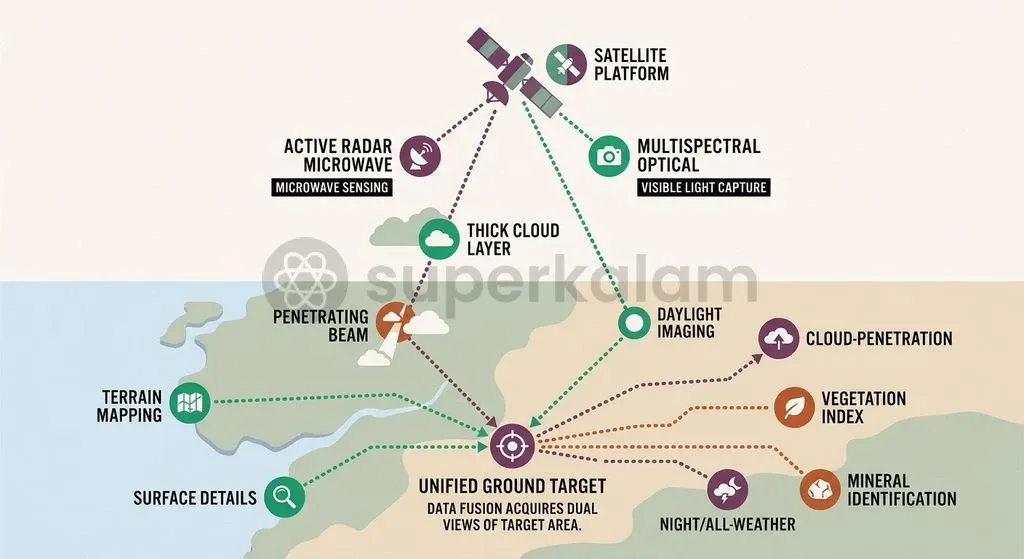
OptoSAR synchronises Synthetic Aperture Radar microwave signals with multispectral optical imagery on one low-Earth orbit platform. Historically, Earth observation forced planners into a compromise between visual clarity and all-weather capability.
Optical sensors capture intuitive, high-resolution imagery across spectral bands. However, they cannot pierce thick cloud decks, dense haze, or nocturnal shadows. Synthetic Aperture Radar (SAR) emits microwave pulses that cut through clouds, smoke, and darkness, but radar backscatter creates speckled noise that demands specialist interpretation.
Mission Drishti resolved this operational trade-off by mounting both sensors on a common satellite bus. The OptoSAR payload pairs an active X-band radar spectrum sensor with a 7-band multispectral optical payload covering Panchromatic, RGB, Near-Infrared, Red Edge, and Coastal Blue bands. This dual-mode setup pierces dense clouds, monsoonal cover, and night darkness by creating co-registered optical and radar datasets of the same footprint.
| Capability Dimension | Optical Sensors (Electro-Optical) | Synthetic Aperture Radar (SAR) | Hybrid OptoSAR (Mission Drishti) |
|---|---|---|---|
| All-Weather Capability | Ineffective under cloud cover, fog, and smoke | Full penetration through clouds, fog, and smoke | Full microwave penetration co-aligned with optical data |
| Day and Night Operation | Restricted to daylight hours | Operational across day and night | Continuous 24/7 sensing across day and night cycles |
| Spectral Detail | Rich multispectral colour and surface reflectivity | Single-band structural and dielectric data | 7-band multispectral context paired with structural radar |
| Data Interpretation | Intuitive visual interpretation for tactical commanders | Complex microwave backscatter requiring processing | Synchronised visual-radar overlay processed onboard |
| Orbital Platform Size | Dedicated single-sensor bus | Dedicated heavy-power radar bus | Integrated 190 kg bus hosting dual synchronized payloads |
Hardware synchronisation of these distinct data streams demands real-time edge processing in orbit. Mission Drishti integrated an edge artificial intelligence compute node powered by the Nvidia Jetson Orin platform to align incoming data. By registering radar and optical pixels onboard before transmission, the satellite removed downlinking delays to send actionable tactical data directly to field commanders.
Discuss with Superkalam
Recall the two sensor types integrated onto Mission Drishti's payload and the specific computing platform used for onboard edge processing.
Ask NowThe Strategic Void: Why India Needs Round-the-Clock Reconnaissance Across Contested Borders
India faces persistent surveillance deficits along contested frontiers, exposed during the 2017 Doklam standoff and 2020 Galwan Valley clashes. Mountain passes experience sudden weather shifts, dense overcast skies, and heavy snowfall that blinds conventional optical platforms.
Border reconnaissance bottlenecks stem from two interlocking operational constraints:
- Atmospheric Obscuration: Cloud decks and blizzards regularly block electro-optical observation during sensitive troop movements along high-altitude mountain passes.
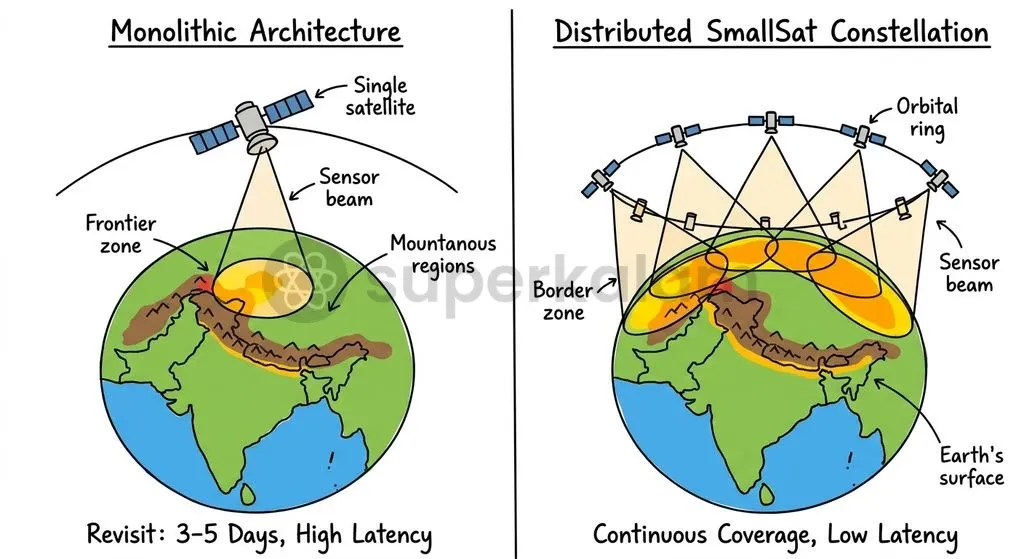
- Revisit Latency: ISRO's state-owned satellites—such as the Cartosat electro-optical series and the RISAT radar series—deliver high-grade sovereign intelligence. Yet these platforms follow orbits that impose multi-day satellite revisit intervals, leaving long gaps over critical border passes.
Adversaries exploit these surveillance lapses to build forward military outposts and shift combat formations unseen. Closing this gap demands high-density constellations capable of sub-hourly tactical revisit rates over critical choke points. Relying purely on intermittent state passes is no longer viable, making private SmallSat networks central to territorial defence.
Comparison: Traditional State-Built Satellites vs Private Deeptech Constellations
State-built remote sensing satellites offer deep strategic precision but lack the rapid revisit cycles of distributed private constellations. India's legacy space doctrine relied on monolithic platforms designed for civilian resource surveys and strategic surveillance simultaneously. Modern warfare requires distributed orbital meshes that provide continuous, resilient battlefield awareness.
| Strategic Parameter | Traditional State Satellites (ISRO Cartosat / RISAT) | Private Deeptech Constellations (e.g., GalaxEye) |
|---|---|---|
| Architecture | Heavy, monolithic spacecraft (typically >1,000 kg) | Distributed SmallSat constellations (typically 150–300 kg) |
| Revisit Frequency | Multi-day revisit schedules over specific tactical coordinates | Potential sub-hourly revisit through orbital plane proliferation |
| Manufacturing Horizon | Multi-year bespoke fabrication cycles | Rapid iterative manufacturing within 12–24 months |
| Anti-Satellite (ASAT) Vulnerability | High strategic impact if a single satellite is targeted | High constellation redundancy mitigating single-point loss |
| Development Funding | Direct sovereign budgetary allocations via Department of Space | Private venture capital backed by defence grants |
Monolithic assets remain exposed to anti-satellite weapons and orbital space anomalies. Losing one large platform blinds a sector for years while a bespoke replacement is constructed. In contrast, commercial SmallSat networks offer inherent architectural resilience, where losing a single node degrades system capacity slightly without blinding the intelligence network.
Discuss with Superkalam
Explain how combining microwave radar backscatter with multispectral optical bands addresses the specific surveillance constraints faced in the high Himalayas.
Ask NowThe Promise: Tactical Agility, Low Latency, and Cost-Effective Defence Readiness
Commercial constellations provide the Defence Space Agency with rapid data refresh cycles, fast manufacturing pipelines, and resilient battlefield awareness. Established in 2019 under the Integrated Defence Staff, the Defence Space Agency (DSA) is the tri-services command managing military space needs. Enlisting commercial constellations gives the command tactical Intelligence, Surveillance, and Reconnaissance (ISR) coverage without exhausting sovereign capital budgets.
Recent battlefields and international programmes illustrate the tactical utility of commercial architectures:
- Frontline Resilience Under Jamming: During the Russia-Ukraine war, commercial SAR networks like Capella Space and satellite internet systems like SpaceX Starlink maintained frontline links despite intense electronic warfare. These systems delivered uninterrupted tactical target tracking even as sovereign military assets were jammed.
- Integration via Dedicated Contracts: The United States National Reconnaissance Office uses its Electro-Optical Commercial Layer (EOCL) contract to pipe imagery from Planet Labs, BlackSky, and Capella Space directly into intelligence operations.
- Proliferated Warfighter Architecture: The US Space Development Agency is fielding the Proliferated Warfighter Space Architecture (PWSA) to deploy low-latency SmallSat tracking arrays.
For India, adopting a similar commercial partnership offers a viable route to persistent border vigilance.
The Strategic Dilemma: Can India Trust Private Constellations with Sovereign Security?
Integrating commercial satellites into frontline military operations exposes operational risks around ground-link interception, foreign cloud storage, and cosmic radiation. Commercial deeptech builds rapidly, but delegating border reconnaissance introduces distinct sovereign hazards. Military intelligence demands closed encryption chains, end-to-end mission security, and radiation-shielded hardware.
Frontline commercial adoption must address three acute security bottlenecks:
- Downlink and Routing Interception: Private firms run major sovereign risks whenever telemetry passes through foreign ground stations or offshore cloud servers, as assessed by the USI Strategic Journal and Centre for Land Warfare Studies (as reported in September 2024). Foreign server hosting leaves sensitive border data exposed to extraterritorial court orders or foreign intelligence interception during crises.
- Unshielded Semiconductor Supply Chains: Most Indian space startups depend on imported semiconductors that lack radiation hardening, leaving satellite buses vulnerable to orbital weather events unless domestically certified, according to tech policy analyses from the Observer Research Foundation (as reported in August 2026).
- Orbital Space Weather Shocks: The failure of Mission Drishti underlines this problem: intense solar storms can disable commercial components that lack full space-grade shielding.
To counter this vulnerability, GalaxEye Space announced plans to launch two replacement 300-kilogram OptoSAR satellites featuring radiation-hardened subsystems within a 24-month horizon, per industry disclosures in The Times of India (as reported in July 2026).
Discuss with Superkalam
Analyse the trade-offs between deploying a few heavily shielded, monolithic state satellites versus a proliferated commercial SmallSat constellation along contested borders.
Ask NowRegulatory and Structural Bottlenecks: Procurement Lock-ins and IN-SPACe Clearances
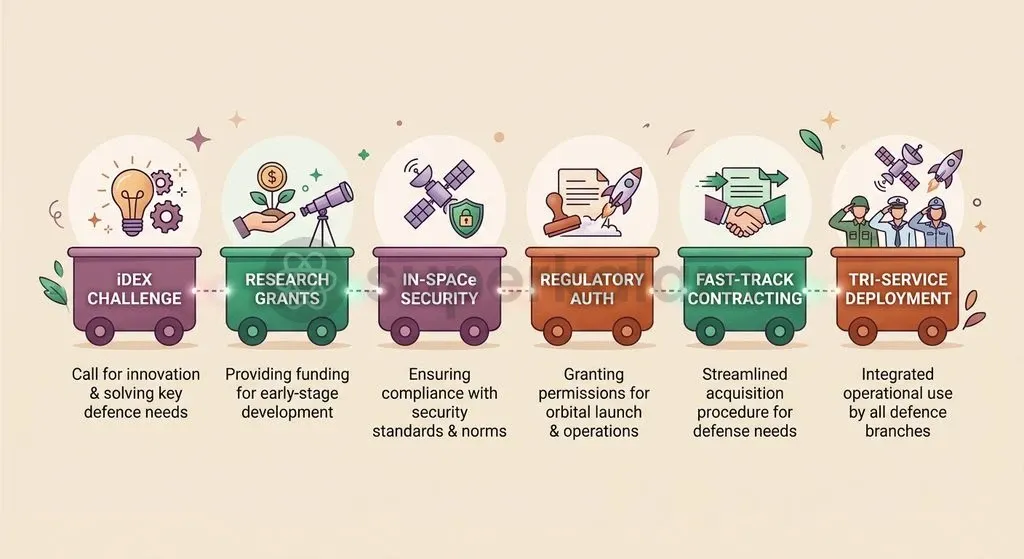
Friction between experimental iDEX grants and prolonged procurement cycles under the Defence Acquisition Procedure delays the military adoption of private space hardware. The Indian Space Policy 2023 shifted ISRO's operational mandate away from routine commercial manufacturing toward scientific research and deep-space missions. The policy created the Indian National Space Promotion and Authorisation Centre (IN-SPACe) as the autonomous single-window regulator to license private launches.
Private space firms encounter several distinct structural gates:
- Regulatory Clearance and Security Audits: In May 2024, IN-SPACe released its 'Norms, Guidelines and Procedures (NGPs)' to govern commercial Earth observation satellites. These rules enforce security vetting, downlink audits, and dissemination controls.
- Data Resolution Restrictions: Operating alongside NGPs, the National Geospatial Policy 2022 opened data access up to one-metre resolution while requiring sovereign security clearance for sub-metre imagery.
- Early Grant Ceilings: The Ministry of Defence launched 'Mission DefSpace' in October 2022, establishing 75 defence space challenges for private industry. Innovations for Defence Excellence (iDEX) provides early prototype funding up to ₹1.5 crore under DISC and up to ₹10 crore under iDEX Prime.
- Capital Acquisition Friction: Sustained friction remains between fast prototype development under iDEX and the multi-year capital acquisition cycles in Chapter III of the Defence Acquisition Procedure (DAP) 2020, as observed by the Manohar Parrikar Institute for Defence Studies and Analyses (as reported in June 2025).
Startups face protracted field trials that risk burning their venture capital long before securing sustained procurement contracts.
Discuss with Superkalam
Evaluate whether India's defence establishment should rely on privately built commercial satellites for strategic border reconnaissance despite severe space weather and electronic vulnerabilities.
Ask NowWay Forward: Building a Hybrid Military-Commercial Space Ecosystem for Tri-Services
The Defence Space Agency must introduce commercial contracting frameworks that match international practices to bring private space technology into service. Rather than treating private space enterprises merely as grant recipients, the Ministry of Defence should issue anchor customer contracts with guaranteed data procurement. Following the US NRO commercial imagery model would give domestic startups dependable revenue, encouraging private capital investment into resilient sovereign space systems.
India can strengthen its military space architecture through four direct reforms:
- Procurement Streamlining under DAP: Establish a fast-track procurement lane under the Defence Acquisition Procedure for space systems, bypassing multi-year Chapter III field trials for flight-tested iDEX prototypes.
- Sovereign Downlink and Cloud Mandate: Require private strategic constellations to route telemetry via domestic tracking stations—like ISRO's ISTRAC—and store raw data on domestic sovereign clouds to stop foreign interception.
- National Radiation Hardening Facility: Set up shared domestic testing infrastructure under the Department of Space to certify radiation-hardened components, protecting startups from foreign supply shocks and solar space weather events.
- Subscription-Based Surveillance Contracts: Shift defence procurement from purchasing satellite hardware to buying 'Surveillance-as-a-Service', paying commercial operators for verified data feeds along the Line of Actual Control and Indian Ocean Region.
Marrying private deeptech with sovereign military commands ensures India secures rapid situational awareness over its borders. Mission Drishti proved that domestic startups can manufacture dual-sensor payloads. Converting that capability into reliable operational dominance requires dismantling acquisition roadblocks and securing the orbital hardware chain.
Key Takeaways
- Hybrid Sensing Architecture: Mission Drishti demonstrated the world's first OptoSAR architecture, combining X-band radar and 7-band multispectral optical payloads on a single 190 kg bus.
- Overcoming Border Voids: Round-the-clock OptoSAR sensing overcomes Himalayan cloud obscuration, snow reflection, and multi-day revisit delays highlighted by the Doklam and Galwan standoffs.
- Institutional Space Shifts: The Indian Space Policy 2023 and IN-SPACe have opened military-grade satellite manufacturing to private deeptech startups, shifting ISRO's operational mandate to deep-space research.
- Hardware and Security Dilemmas: Private satellite constellations face severe space weather vulnerabilities and downlink security challenges, as evidenced by Mission Drishti's radiation-induced communication failure.
- Procurement Bottlenecks: Bridging the valley of death between iDEX development grants and DAP 2020 capital acquisitions is essential to build a resilient military-commercial space architecture.
Mains Question
'The integration of commercial deeptech constellations under the aegis of the Defence Space Agency (DSA) marks a critical transition from monolithic surveillance assets to distributed orbital resilience.' Examine the strategic rationale and operational advantages of this transition for border reconnaissance. (10 Marks)
Evaluate NowMains Question
'While hybrid OptoSAR payloads bridge critical all-weather surveillance deficits across contested frontiers like the Line of Actual Control, reliance on private space hardware introduces distinct operational vulnerabilities.' Critically analyse this statement in light of Mission Drishti's orbital experience. (15 Marks)
Evaluate NowPractice MCQs
QUESTION 1
With reference to the OptoSAR technology deployed in 'Mission Drishti', consider the following statements:
- It synchronises Synthetic Aperture Radar (SAR) microwave signals with multispectral optical imagery on a single satellite bus.
- The onboard sensor suite integrates an active X-band radar with a 7-band multispectral optical payload.
- It relies exclusively on post-downlink ground stations to co-register optical and radar pixels, avoiding orbital edge computing. Which of the statements given above are correct?
QUESTION 2
Consider the following statements regarding satellite surveillance and space architectures mentioned in the context of Indian border defence:
- The Defence Space Agency (DSA) was established in 2019 under the Integrated Defence Staff as a tri-services command.
- State-owned satellites like the Cartosat and RISAT series are distributed SmallSat constellations capable of sub-hourly tactical revisit rates.
- Private SmallSat constellations offer architectural redundancy that mitigates single-point failure compared to monolithic satellites. Which of the statements given above is/are correct?
QUESTION 3
Regarding Mission Drishti and its operational parameters, consider the following statements:
- It is India's largest privately developed Earth observation satellite, weighing roughly 190 kilograms.
- Primary ground-station tracking and orbital commands during the Launch and Early Orbit Phase (LEOP) were managed by NewSpace India Limited (NSIL) and ISTRAC.
- The satellite suffered an orbital anomaly leading to loss of communication caused by space debris impact. Which of the statements given above is/are correct?
QUESTION 4
In the context of modern military Earth observation, which of the following best describes the operational limitation of conventional Electro-Optical (EO) sensors when compared to Synthetic Aperture Radar (SAR)?
QUESTION 5
With reference to the global integration of commercial satellite constellations into defence frameworks mentioned in the context of tactical ISR, consider the following pairs:
- Electro-Optical Commercial Layer (EOCL) : United States National Reconnaissance Office
- Proliferated Warfighter Space Architecture (PWSA) : US Space Development Agency
- Capella Space : Frontline commercial SAR operations in the Russia-Ukraine conflict How many of the pairs given above are correctly matched?