Citizen's Charters in India: From Voluntary Pledges to Statutory Rights
Why voluntary administrative charters failed citizens, and how statutory guarantees, Sevottam standards, and digital audits make public delivery enforceable.
Nov, 2026
•12 min read
Overview
India's administrative Citizen's Charters failed to transform frontline public service delivery. Voluntary executive declarations lacked statutory backing, managerial penalties, and judicial enforceability. Progressive governance reforms subsequently pivoted toward binding State Public Service Guarantee Acts, Sevottam quality standards, and automated digital tracking systems.
The Department of Administrative Reforms and Public Grievances (DARPG) introduced these voluntary pledges in 1997 to adapt British administrative accountability to Indian governance. Bureaucratic departments routinely treated these documents as procedural formalities rather than binding operational standards.
Real administrative transformation requires replacing voluntary pledges with statutory timelines, compensatory penalties for bureaucratic delay, and independent social performance audits. Modern public governance demands that administrative discretion yields to enforceable citizen entitlements and verifiable procedural fairness across all public offices.
Why Public Service Delivery Pledges Broke Down Across India
The Department of Administrative Reforms and Public Grievances introduced Citizen's Charters across Indian public administration to establish transparent standards of bureaucratic performance and institutional accountability. The reform assumed that publishing service standards would build a culture of responsive, citizen-centric administration. As of June 2024, administrative evaluations demonstrate that voluntary declarations have largely given way to statutory delivery timelines and digital grievance tracking under comprehensive DARPG guidelines.
Voluntary administrative pledges failed to overcome institutional inertia. Frontline departments across the country issued charters that promised swift administrative action, yet citizens continued to encounter delays at municipal counters.
Public administration cannot operate on moral appeals alone. Traditional charters broke down due to three structural weaknesses:
- Zero judicial enforceability: Citizens had no legal recourse when departments breached published timelines.
- Frontline bureaucratic apathy: Officials faced no formal sanctions, salary deductions, or operational penalties for delays.
- Discretionary service delivery: Unregulated desk-level discretion sustained rent-seeking behaviour at sub-district offices.
What a Citizen's Charter Was Supposed to Do (and Where It Fell Short)
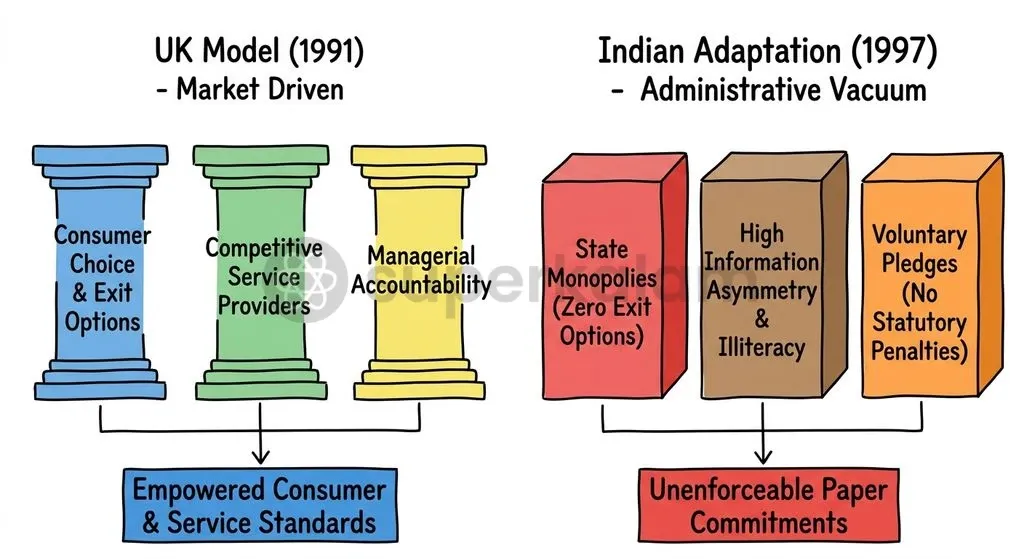
Prime Minister John Major initiated the Citizen's Charter programme in the United Kingdom in 1991 to inject commercial accountability and performance benchmarks into sovereign public administration. According to the UK Cabinet Office White Paper (The Citizen's Charter: Raising the Standard), this administrative framework rested on six core principles: published standards of service, transparent public information, user choice, courteous behaviour, effective grievance redressal, and tangible value for money.
India formally adopted this reform following the Conference of Chief Ministers on May 24, 1997. The conference endorsed an Action Plan for Effective and Responsive Government, which the Department of Administrative Reforms and Public Grievances (DARPG) coordinated across Central and State secretariats. The original intent was to convert paternalistic bureaucratic hierarchies into client-focused public service organisations.
The Indian administrative environment differed sharply from the British governance context. As the DARPG Handbook on Citizen's Charters documents, the UK model relied on moral suasion—appealing to administrative conscience without legal compulsion—which broke down when transplanted into India's public sector monopolies, steep socio-economic literacy divides, and complete absence of managerial penalties.
| Structural Dimension | United Kingdom Model (1991) | Original Indian Adoption (1997) |
|---|---|---|
| Institutional Driver | Market-like choice and consumer empowerment | Administrative action plan endorsed by Chief Ministers |
| Operating Environment | Competitive public utilities with alternative options | Monopolistic state delivery of basic essential services |
| Citizen Position | Empowered consumer with market leverage | Vulnerable applicant dependent on bureaucratic discretion |
| Accountability Levers | Charter Mark awards and independent inspectorates | Internal departmental reviews with no external audits |
| Legal Basis | Executive white paper with managerial oversight | Purely administrative declaration with zero legal standing |
Discuss with Superkalam
On what date did the Conference of Chief Ministers endorse the Action Plan for Effective and Responsive Government that introduced Citizen's Charters in India?
Ask NowThe Core Flaw: Why Voluntary Charters Failed to Change Bureaucratic Habits
The Indian Institute of Public Administration revealed that frontline administrative personnel operated without basic orientation or awareness regarding their own department's Citizen's Charter commitments. Field audits established that line staff viewed the documents as public-relations exercises crafted by remote secretariat officers rather than binding operational instructions.
Departmental evaluations commissioned by DARPG documented that central and state organisations formulated these charters without consulting end-users or civil society organisations. Secretariats published delivery commitments that frontline offices lacked the staff, equipment, and logistical resources to execute.
Audits by the Indian Institute of Public Administration (IIPA) and the Second Administrative Reforms Commission (2nd ARC) identified four fatal design flaws:
- Unmeasurable commitments: Charters relied on vague phrasing like prompt delivery and utmost courtesy rather than specifying precise, quantifiable turnaround days.
- Top-down formulation: Committees drafted pledges without user consultation or baseline workload assessments.
- Invisible standards: Departments failed to allocate distinct publicity budgets, leaving citizens unaware of grievance channels.
- Legal non-justiciability: The 2nd ARC highlighted in its 12th Report that charters possess purely administrative status, meaning citizens cannot enforce charter pledges through Article 32 or Article 226 writ petitions.
Traditional charters offer no remedy for administrative default. While consumer protection legislation empowers consumer commissions to grant enforceable monetary compensation for deficiency of service, sovereign administrative functions remain exempt from such commercial remedies.
Discuss with Superkalam
Why is prior internal process restructuring essential before an administrative department publishes a Citizen's Charter?
Ask NowWhat the Second Administrative Reforms Commission Recommended to Fix Them
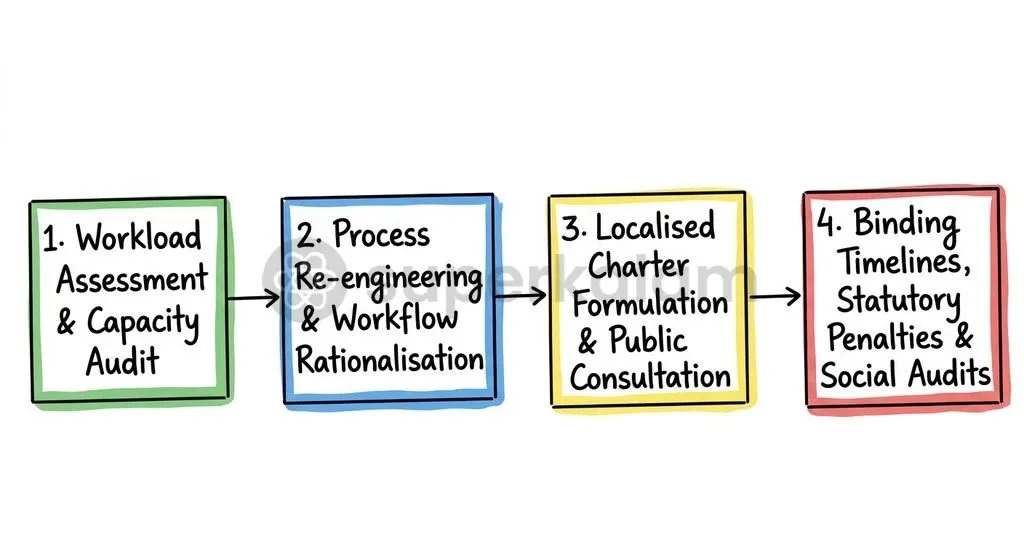
The Second Administrative Reforms Commission dedicated its 12th Report, titled Citizen-Centric Administration – The Heart of Governance, to dismantling the superficial compliance that crippled traditional administrative charters. The Commission recognised that issuing uniform, sweeping charters across nationwide ministries created unworkable, decorative declarations that ignored operational realities in district and taluk offices.
The Commission proposed a four-part operational overhaul to give Citizen's Charters functional relevance:
- Unit-Level Formulation: Abandon centralised, ministry-wide templates in favour of tailored charters drafted specifically at the sub-district, municipal, and local office level to reflect actual operational constraints.
- Prior Process Restructuring: Make internal process re-engineering and administrative capacity audits a mandatory prerequisite before drafting any charter, ensuring promised timelines match delivery capabilities.
- Penalties and Citizen Compensation: Embed explicit administrative sanctions against defaulting public servants, paired with direct financial compensation for affected applicants when service delivery timelines fail.
- Independent Civil Society Oversight: Require mandatory third-party performance audits by civil society organisations and establish permanent consumer evaluation panels to review compliance systematically.
Internal administrative restructuring must strictly precede the publication of commitments. When public departments streamline procedural files and eliminate redundant documentation, published delivery targets become operationally achievable targets rather than aspirational fiction.
Discuss with Superkalam
How would you apply Karnataka's Sakala tracking mechanism to streamline municipal certificate issuance in your local district?
Ask NowPaper Promises vs. Legal Rights: How State Service Delivery Acts Work in Practice
The Madhya Pradesh Lok Sewaon Ke Pradan Ki Guarantee Adhiniyam of 2010 created India's first legally enforceable statutory right to time-bound public service delivery. Recognising that voluntary charters could not overcome systemic administrative inertia, the state legislature replaced discretionary administrative pledges with mandatory legal obligations backed by individual financial liability.
State Public Service Guarantee Acts introduce a uniform structural architecture that transforms the citizen's relationship with frontline public administration. These statutes notify specific public services alongside strict statutory deadlines, designate formal delivery officers, and establish a two-tier appellate mechanism. When an officer fails to provide a notified certificate, land record, or licence within the statutory window without reasonable cause, the appellate authority levies a direct daily monetary penalty that is deducted straight from the official's monthly salary and disbursed directly to the citizen as compensatory relief.
Karnataka accelerated this statutory model by enacting the Karnataka Guarantee of Services to Citizens Act in 2012, operationalised under the Sakala Mission. The Sakala framework assigns a unique 15-digit GSC number to every incoming citizen application at citizen service centres. The integrated digital platform links document movement to an automated escalation protocol, preventing files from languishing undetected on administrative desks.
| Evaluation Metric | Traditional Citizen's Charter (1997) | State Public Service Guarantee Act (e.g. MP 2010, Karnataka 2012) |
|---|---|---|
| Legal Standing | Purely administrative, non-statutory executive guidelines | Enacted state legislation creating justiciable legal rights |
| Judicial Enforceability | Non-enforceable under writ jurisdiction (Articles 32/226) | Enforceable through statutory appellate authorities |
| Turnaround Time | Aspirational and vaguely phrased (e.g. "as soon as possible") | Strictly numbered statutory days for each notified service |
| Official Default | Zero personal or institutional liability for delays | Mandatory daily financial penalties deducted from monthly salary |
| Citizen Remedy | Internal departmental grievance box with no compensation | Legally mandated financial compensation disbursed to the applicant |
| Workflow Tracking | Manual paper registers vulnerable to tampering | End-to-end digital tracking via unique application numbers |
The Central Government attempted to establish a national statutory floor by introducing The Right of Citizens for Time Bound Delivery of Goods and Services and Redressal of their Grievances Bill, 2011 in the Lok Sabha on December 20, 2011. . Despite the lapse of the central legislation, individual State Public Service Guarantee Acts have demonstrated that legal penalties decisively outperform moral appeals in ensuring timely administrative delivery.
Discuss with Superkalam
Compare the core accountability mechanisms of the UK 1991 Citizen's Charter model with India's 1997 adoption to identify why moral suasion collapsed in the Indian context.
Ask NowSevottam Framework and Public Audits: Measuring Real Service Quality on the Ground
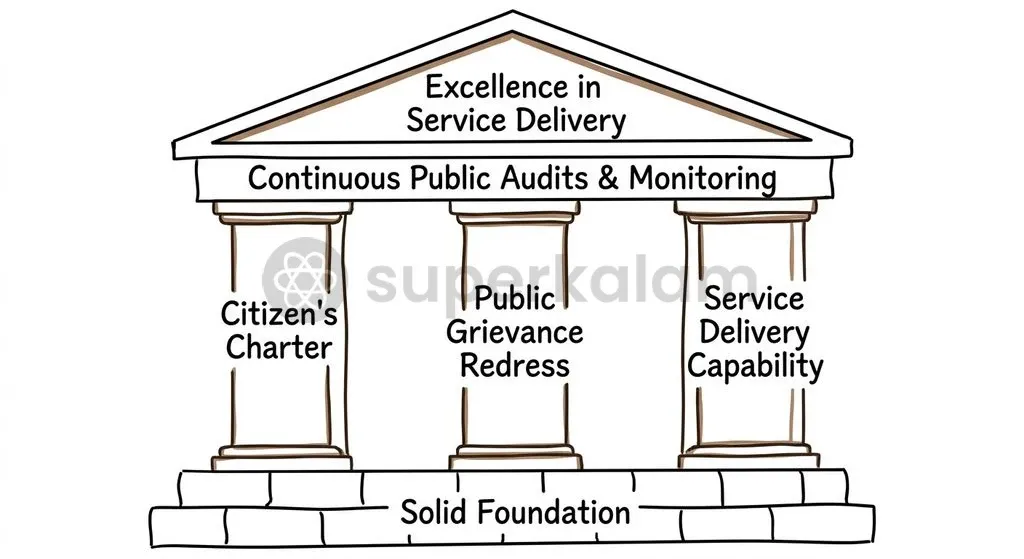
The Department of Administrative Reforms and Public Grievances formulated the Sevottam Model in 2006 to establish an objective, standardised framework for evaluating public service capability across government departments. The name combines the Hindi words Seva (Service) and Uttam (Excellence), moving the administrative conversation beyond simple procedural output toward holistic quality management.
The Sevottam architecture rests upon three distinct operational pillars that operate as an integrated quality loop:
- Pillar 1: Citizen's Charter Implementation: Assessing whether departments formulate, publicise, and operationalise unit-level charters with measurable performance standards and frontline consultation.
- Pillar 2: Public Grievance Redressal: Evaluating the accessibility, speed, and objective resolution of citizen complaints within defined institutional channels.
- Pillar 3: Service Delivery Capability: Measuring an organisation's internal infrastructure, employee competencies, and process management required to deliver services reliably.
The Bureau of Indian Standards (BIS) institutionalised this approach by publishing IS 15700:2005 (Quality Management Systems - Requirements for Service Quality by Public Service Organizations). This benchmark made India one of the first countries to establish a formal, auditable national standard for quality in public administration, allowing citizen-facing public bodies to pursue formal certification.
Digital platforms provide the operational machinery that makes Sevottam functional. Under DARPG's 2024 Comprehensive Guidelines for Public Grievance Redressal, the maximum resolution timeframe on the Centralised Public Grievance Redress and Monitoring System (CPGRAMS) was reduced from 30 days to 21 days across ministries. At the apex level, the Pro-Active Governance and Timely Implementation (PRAGATI) platform, operational since 2015, integrates video conferencing, CPGRAMS data, and GIS spatial mapping to allow the Prime Minister to review and resolve inter-departmental bottlenecks directly.
The Ethical Dimension: Turning Paternal Bureaucracy into Citizen Rights
The Second Administrative Reforms Commission framed public service delivery as an ethical imperative that dismantles colonial paternalism and restores citizen dignity. In traditional bureaucratic cultures inherited from colonial rule, public service delivery is frequently approached as discretionary patronage granted by the state to supplicant beneficiaries.
This administrative stance contradicts constitutional governance. Grounded in procedural justice and the constitutional promise of a dignified existence, the statutory transformation of Citizen's Charters reframes public administration: public services are not state favours, but sovereign citizen entitlements financed by public resources.
When a citizen endures weeks of deliberate bureaucratic delay to obtain a basic caste certificate, land record, or pension sanction, the failure represents an institutional breakdown. Subjecting citizens to unchecked bureaucratic discretion undermines procedural justice and forces vulnerable individuals into compromised interactions with administrative middlemen.
Enforceable service delivery acts embody constitutional morality in everyday administrative practice. By establishing designated delivery officers, rigid deadlines, and personal salary penalties for default, the statutory approach institutionalises three core ethical principles:
- Institutional Accountability: Ending administrative anonymity by fixing unambiguous personal responsibility on designated officials for each procedural step.
- Procedural Fairness: Eliminating arbitrary bureaucratic discretion so that every citizen receives identical, rule-bound administrative processing regardless of social status.
- Human Dignity: Recognising that an individual's time, economic security, and self-respect are inviolable rights that public authorities are sworn to protect.
Discuss with Superkalam
Weigh the benefits and potential administrative challenges of deducting direct monetary penalties from civil servants' monthly salaries for service delivery delays.
Ask NowThe Way Forward: Four Steps Toward Enforceable, Digitally Monitored Public Services
The Union Government and State Secretariats must align administrative charters with statutory penalties and automated digital platforms to secure dependable public governance. Decades of administrative experimentation prove that paper declarations alone cannot shift deeply ingrained bureaucratic habits.
Transforming public service delivery requires four concrete interventions:
- Enact a Central Public Service Guarantee Statute: Parliament should revive and enact a comprehensive federal statutory framework, drawing upon the principles of the 2011 Bill, to guarantee time-bound services across all central ministries and sovereign public entities.
- Mandate Pre-Charter Process Restructuring: DARPG guidelines must bar any department from notifying a charter until its administrative workflows are re-engineered, digitalised, and subjected to rigorous baseline workload assessments.
- Universalise IS 15700:2005 Certification: State and central departments should make Bureau of Indian Standards Sevottam compliance a mandatory performance metric for departmental leadership, tied directly to annual administrative performance appraisals.
- Deploy Automated Digital Escalation Protocols: Every state should integrate the Sakala model of unique tracking numbers with CPGRAMS, automatically escalating delayed files to appellate officers and deducting statutory penalties through digital treasury integration without requiring citizen litigation.
When legal rights replace administrative discretion, Citizen's Charters evolve from toothless public declarations into practical democratic instruments.
Key Takeaways
- Traditional Citizen's Charters, initiated in the UK in 1991 and adopted across India in 1997 under DARPG, failed because voluntary executive declarations lack statutory teeth, managerial penalties, and judicial enforceability.
- Empirical audits conducted by DARPG and the Indian Institute of Public Administration (IIPA) confirmed that traditional charters suffered from unmeasurable commitments, absent end-user consultation, and untrained frontline personnel.
- Citizen's Charters remain non-justiciable under Article 32 and Article 226, unlike the enforceable compensation mechanisms established under the Consumer Protection Act for commercial services.
- The 2nd ARC 12th Report recommended unit-level charters formulated at the sub-district level, mandatory internal process restructuring prior to drafting, and statutory sanctions with citizen compensation for default.
- State Public Service Guarantee Acts, pioneered by Madhya Pradesh in 2010 and expanded through Karnataka's Sakala framework in 2012, introduced mandatory time limits, designated appellate authorities, and direct daily salary deductions for errant officials.
- The Sevottam Model (IS 15700:2005) structures service quality around charter implementation, grievance redressal, and delivery capability, supported by digital tracking platforms like CPGRAMS and PRAGATI.
- .
Mains Question
"Voluntary executive declarations lacked statutory backing, managerial penalties, and judicial enforceability, reducing Citizen's Charters to mere procedural formalities." In this context, evaluate the transition from voluntary charters to State Public Service Guarantee Acts. (15 Marks)
Evaluate NowMains Question
The Second Administrative Reforms Commission in its 12th Report observed that administrative commitments without prior capacity restructuring remain aspirational fictions. Elucidate the key reforms recommended by the Commission to make Citizen's Charters functionally effective. (10 Marks)
Evaluate NowPractice MCQs
QUESTION 1
Regarding the evolution and adoption of Citizen's Charters in India, consider the following statements:
- The formal adoption of Citizen's Charters in India was initiated following the Conference of Chief Ministers held on May 24, 1997.
- The Department of Administrative Reforms and Public Grievances (DARPG) served as the coordinating nodal agency for implementing the Action Plan for Effective and Responsive Government.
- The original UK model relied primarily on statutory financial penalties deducted directly from bureaucrats' salaries to enforce service standards.
Which of the statements given above is/are correct?
QUESTION 2
With reference to the legal status and enforceability of traditional Citizen's Charters in India, consider the following statements:
- The Second Administrative Reforms Commission (2nd ARC) in its 12th Report noted that traditional Citizen's Charters hold purely administrative status.
- Breaches of commitments made under traditional Citizen's Charters can be directly enforced by citizens via writ petitions under Article 32 or Article 226.
- Sovereign administrative functions enjoy exemptions from the monetary compensation remedies typically granted under consumer protection legislation.
Which of the statements given above are correct?
QUESTION 3
The 12th Report of the Second Administrative Reforms Commission (2nd ARC), titled 'Citizen-Centric Administration – The Heart of Governance', recommended which of the following operational overhauls for Citizen's Charters?
- Formulating tailored charters at the sub-district, municipal, and local office levels rather than issuing sweeping ministry-wide templates.
- Undertaking prior internal process restructuring and administrative capacity audits before drafting commitments.
- Providing direct financial compensation to affected applicants when service timelines fail, backed by sanctions on defaulting officers.
Select the correct answer using the code given below:
QUESTION 4
Consider the following statements regarding State Public Service Guarantee Acts in India:
- The Madhya Pradesh Lok Sewaon Ke Pradan Ki Guarantee Adhiniyam of 2010 established India's first legally enforceable statutory right to time-bound public service delivery.
- Under State Public Service Guarantee Acts, appellate authorities can levy daily monetary penalties that are deducted from a defaulting official's salary and disbursed to the citizen.
- The Karnataka Guarantee of Services to Citizens Act (2012) operationalised the Sakala Mission, which assigns a unique 15-digit GSC number to track document movement.
Which of the statements given above is/are correct?
QUESTION 5
Which of the following bodies revealed through field audits that frontline administrative staff operated without orientation regarding their own department's Citizen's Charter commitments, treating them as public-relations exercises crafted by remote secretariats?