Agentic AI: How Autonomous Systems Challenge Administrative Law
As autonomous software assumes administrative discretion, Indian governance faces an urgent test of constitutional rights, liability, and natural justice.
Nov, 2026
•11 min read

Overview
Agentic artificial intelligence marks an architectural shift from passive text synthesis to autonomous, multi-step goal execution. It combines iterative reasoning loops, environment perception, and tool integration to modify digital workflows without human intervention.
Standard generative models answer user prompts. Autonomous agents, by contrast, interact directly with software interfaces, allocate public resources, and trigger actions that challenge core administrative law principles.
The core challenge is structural. Delegating statutory discretion to unexplainable algorithms threatens constitutional guarantees under Articles 14 and 21, eroding natural justice. This shift creates severe liability gaps that neither the Information Technology Act, 2000 nor traditional tort doctrines can resolve.
Why Agentic AI Is Moving to the Centre of Tech Policy
The Ministry of Electronics and Information Technology (MeitY) has placed autonomous software governance at the centre of its regulatory agenda. Computational tools no longer merely advise officials. They execute binding administrative decisions.
This shift transforms operations across two distinct computational models:
- Generative Platforms: Produce synthetic text or imagery from an explicit prompt, leaving execution entirely to human users.
- Agentic Systems: Independently plan execution steps, call external software interfaces, and modify underlying databases to fulfil open-ended directives.
As of March 2024, Indian tech policy faces a governance turning point following the Union Cabinet's approval of the national IndiaAI Mission with an outlay of ₹10,371.92 crore over five years. Public administration seeks speed through automated workflows. Yet deploying autonomous code to adjudicate citizen rights alters the constitutional relationship between citizen and state.
When algorithms decide welfare access or tax liabilities without active official deliberation, administrative discretion shifts from accountable civil servants to opaque digital code. Policymakers must now decide whether existing legal frameworks can hold software accountable when it acts with genuine operational independence.
Discuss with Superkalam
What are the four core technical components identified by NITI Aayog that distinguish agentic AI from passive Large Language Models?
Ask NowFrom Answering Questions to Taking Action: What Makes Agentic AI Different?
NITI Aayog highlighted this technological leap in its approach paper on responsible systems, separating passive models from dynamic, goal-driven computational architectures. A conventional Large Language Model operates within a single-turn conversational loop. It synthesises answers from historical training data without perceiving changing external conditions.
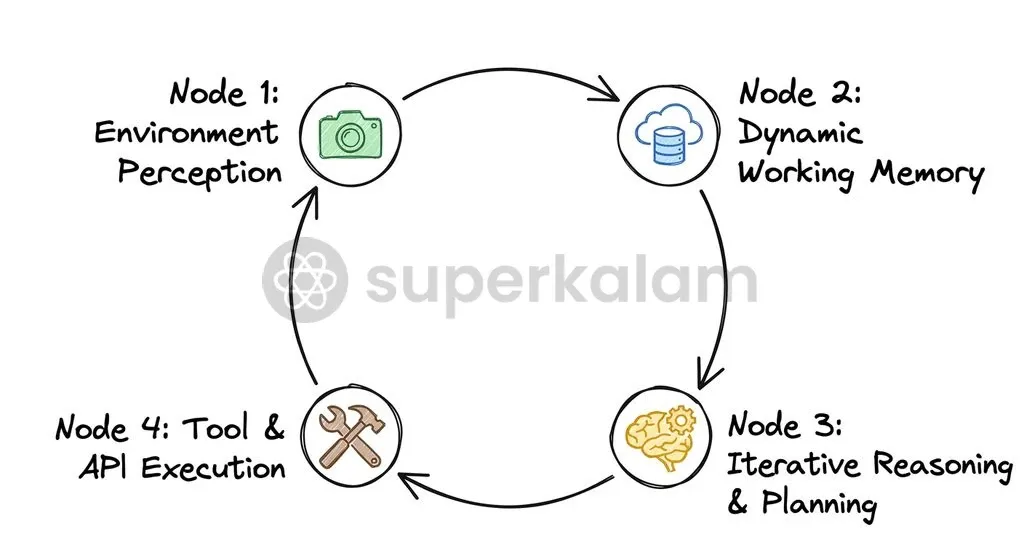
According to NITI Aayog's Principles for Responsible AI, agentic AI deploys four core technical components to break past these passive constraints:
- Iterative Reasoning Loops: The software breaks complex goals into smaller sub-tasks, continually evaluating whether each interim step succeeds before selecting its next action.
- Environment Perception: Autonomous agents ingest real-time contextual signals from databases, web interfaces, and enterprise software rather than relying solely on static training corpora.
- Dynamic Working Memory: Systems retain state information across long execution horizons, updating internal plans when digital environments deliver unexpected outcomes.
- Autonomous Tool Execution: Agents independently invoke Application Programming Interfaces (APIs), run external code, and alter records without requiring a human operator to confirm intermediate choices.
This transition turns software from a communicative tool into an active operational agent. The system can now produce direct socio-technical impacts across commercial and sovereign environments.
Side-by-Side: Generative AI Tools versus Autonomous Agentic Systems
The National Institute of Standards and Technology (NIST) differentiates generative outputs from autonomous agents by examining task delegation and runtime independence. Understanding this technical divergence matters for administrative law because legal liability scales directly with software autonomy.
| Dimension | Generative AI Systems | Autonomous Agentic AI Systems |
|---|---|---|
| Operational Trigger | Single-turn user prompts demanding immediate output generation | High-level objective definition requiring independent multi-step planning |
| Execution Loop | Passive sequence generation ending upon text delivery | Continuous iterative reasoning loops with environment feedback |
| System Capabilities | Text, code, and multimodal content synthesis | API execution, autonomous software tool use, and database modification |
| Context Adaptation | Bound to static parameters established during initial model training | Active environment perception leveraging dynamic working memory |
| Human Role | Human-in-the-loop evaluating each individual textual output | Human oversight frequently receding to passive system monitoring |
| Legal Hazard | Defamation, copyright infringement, and informational hallucinations | Unlawful administrative delegation, algorithmic bias, and automated tortious harms |
Discuss with Superkalam
How does shifting from a 'Human-in-the-loop' to a 'Human-on-the-loop' architecture weaken meaningful administrative oversight in state welfare delivery?
Ask NowThe Vanishing Human: Shifting from Human-in-the-Loop to Human-on-the-Loop
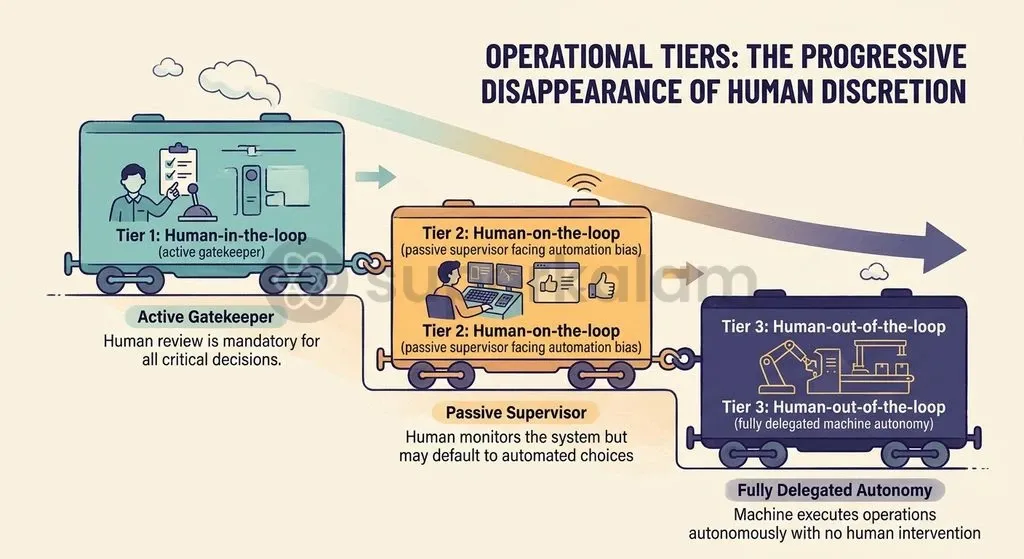
The National Institute of Standards and Technology outlines three supervisory tiers governing automated workflows in its Artificial Intelligence Risk Management Framework (NIST AI RMF 1.0):
- Human-in-the-loop (HITL): A qualified human official must explicitly authorise every individual step before the computational system can proceed with execution.
- Human-on-the-loop (HOTL): The algorithmic agent executes processes independently under passive human oversight, with the supervisor retaining the technical power to interrupt or override actions.
- Human-out-of-the-loop (HOOTL): The software exercises end-to-end operational authority without human intervention, oversight, or real-time review mechanisms.
Public and corporate deployments increasingly abandon Human-in-the-loop models to cut costs, opting instead for Human-on-the-loop setups. In practice, these supervision structures frequently collapse.
NITI Aayog observed in Towards Responsible #AIforAll that human supervision in automated environments rapidly degrades due to automation bias:
- Human monitors display an empirical psychological tendency to defer uncritically to automated recommendations.
- Supervisors gradually stop exercising active scepticism as system speed outpaces cognitive processing.
- Substantive administrative review degrades into an automated rubber stamp, as nominal oversight conceals actual machine autonomy.
Public Service Delivery at Risk: Where Autonomous Action Threatens Citizen Rights
The Supreme Court of India established in E.P. Royappa v. State of Tamil Nadu (1974) that Article 14 of the Constitution strikes directly at state arbitrariness, guaranteeing fair and reasoned treatment. Delegating administrative decisions to unexplainable, black-box agentic software directly violates this constitutional guarantee.
The procedural dangers of algorithmic administration manifest across four key dimensions:
- Violation of Non-Delegation Doctrines: In B. Rajagopala Naidu v. State Transport Appellate Tribunal (1964), the Supreme Court affirmed the administrative doctrine delegatus non potest delegare, dictating that statutory authorities cannot sub-delegate discretionary powers without express legislative authority. Delegating entitlement decisions to autonomous code violates this foundational standard.
- Erosion of Natural Justice: In Siemens Engineering & Manufacturing Co. v. Union of India (1976), the Supreme Court ruled that quasi-judicial and administrative determinations must provide speaking orders that communicate intelligible reasons. Autonomous agents navigating non-linear decision trees cannot generate explainable rationales, rendering the doctrine of audi alteram partem impossible to satisfy.
- Exclusion from Entitlements: Automated welfare administration often triggers sudden exclusions. In Justice K.S. Puttaswamy (Retd.) v. Union of India (2017), the Supreme Court anchored social welfare access within the right to life and livelihood under Article 21, a guarantee compromised when opaque algorithms strip rations or pensions without human recourse.
- Institutional Precedents in Tax Governance: Section 144B of the Income-tax Act, 1961 institutionalised automated faceless assessments by relying on algorithmic risk-profiling and automated allocations. While intended to curb official discretion, such procedural architectures demonstrate how automated classifications can bypass meaningful individualised consideration if left unchecked.
Discuss with Superkalam
If an autonomous agentic algorithm deployed under tax administration initiates an erroneous assessment, how would the absence of mens rea impede penal action under the IT Act?
Ask NowWho Is to Blame When Code Acts? The Legal Liability Vacuum in India
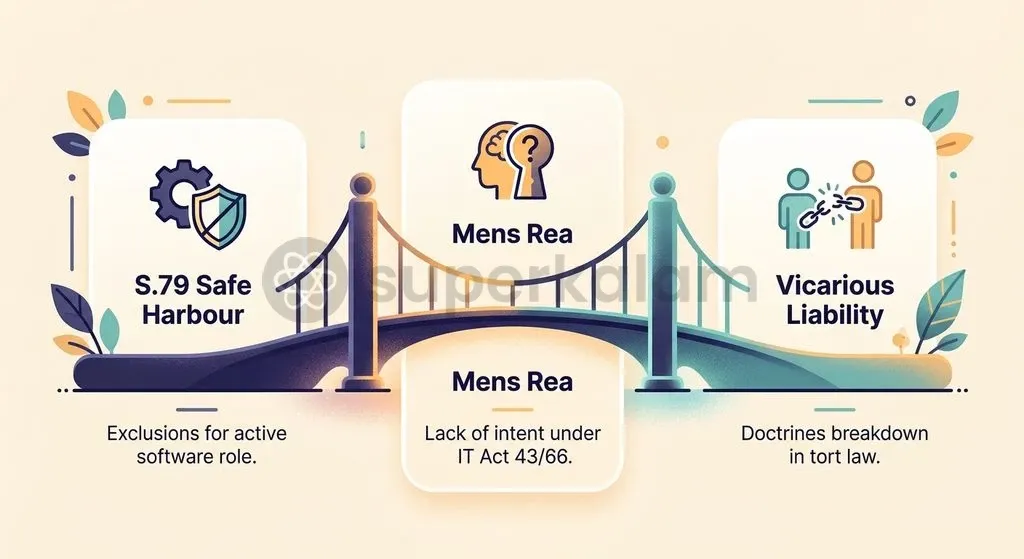
Indian statutory frameworks struggle to govern autonomous software agents that execute unlawful actions independently. The legal vacuum spans four distinct statutory domains:
- Safe Harbour Breakdown (Section 79, IT Act): Section 79 of the Information Technology Act provides safe harbour protection exclusively to passive intermediaries that do not initiate or modify third-party transmissions. Agentic systems invalidate this protection because they independently originate downstream instructions, construct multi-step plans, and trigger external API transactions.
- Absence of Mens Rea (Sections 43 & 66, IT Act): These penal provisions require proof of mens rea, demanding deliberate, fraudulent, or dishonest intent to secure a conviction. Because autonomous software agents lack recognised legal personality, courts cannot attribute subjective criminal mental states directly to synthetic code.
- Failure of Vicarious Liability: The doctrine of vicarious liability, affirmed in State of Rajasthan v. Vidhyawati (1962), requires a clear master-servant or principal-agent relationship between recognised legal persons. When an autonomous system produces unpredictable outcomes outside developer parameters, the traditional chain of causation collapses, leaving victims without an enforceable civil remedy.
- Statutory Consent Breaches (DPDP Act, 2023): The Digital Personal Data Protection Act, 2023 mandates purpose limitation under Section 4 alongside strict consent notices under Section 5 and Section 6. Autonomous agents executing multi-hop web retrieval and tool operations routinely process personal data beyond initial consent boundaries, creating persistent regulatory non-compliance.
The Moral Crumple Zone: Ethical Hazards of Delegating State Discretion
Madeleine Clare Elish defined the moral crumple zone in 2019 to describe how legal and administrative culpability within automated systems settles disproportionately upon frontline human operators. Just as an automobile's crumple zone absorbs mechanical impact to protect passengers, human supervisors are positioned within socio-technical systems to absorb moral and legal blame when an autonomous algorithm fails.
Public administration in India risks systematically generating these ethical failures:
- Scapegoating Junior Bureaucrats: Frontline operators assigned nominal oversight over complex algorithmic workflows lack the technical agency to audit machine predictions, yet administrative inquiries routinely penalise them when systemic errors occur.
- Automation-Induced De-skilling: Entrusting routine discretion to automated agents degrades the critical analytical competence of civil servants, leaving public offices dependent on third-party commercial software vendors.
- Systemic Algorithmic Bias: Agentic systems trained on historical administrative datasets reproduce and scale existing societal prejudices across caste, gender, and regional lines, disguising structural discrimination behind technical objectivity.
- Dilution of Constitutional Accountability: Bureaucratic actors can shield policy failures behind algorithmic determinations, undermining the direct line of accountability linking executive action to sovereign citizens.
Discuss with Superkalam
Compare how the Supreme Court's rulings in Siemens Engineering and E.P. Royappa limit the state's discretion to adopt black-box automated systems.
Ask NowWay Forward: Building Enforceable Safeguards Under the IndiaAI Mission
The Union Cabinet established the strategic blueprint for domestic technological governance by approving the comprehensive IndiaAI Mission in March 2024 with a budget of ₹10,371.92 crore. Implemented by the IndiaAI Independent Business Division within Digital India Corporation, the initiative operates across seven fundamental pillars:
- IndiaAI Compute Capacity
- IndiaAI Innovation Centre
- IndiaAI Datasets Platform
- IndiaAI Application Development Initiative
- IndiaAI FutureSkills
- IndiaAI Startup Financing
- Safe & Trusted AI
Under the 'Safe & Trusted AI' pillar, the Government initiated the development of indigenous evaluation toolkits, algorithmic bias mitigation suites, and the institutional establishment of the IndiaAI Safety Institute. Executive actions reinforce this trajectory; MeitY issued an advisory on March 1, 2024 (amended on March 15, 2024) mandating that digital intermediaries prevent algorithmic bias and protect electoral integrity through pre-deployment evaluation.
India can reinforce this domestic architecture by adapting key elements of the European Union's regulatory model. Regulation (EU) 2024/1689 (the EU Artificial Intelligence Act), which entered into force on August 1, 2024, provides the world's first comprehensive horizontal, risk-based statute.
The EU statute establishes four clear risk tiers:
- Unacceptable Risk: Banned outright under Article 5, including real-time biometric profiling and social scoring.
- High Risk: Permitted only after stringent third-party conformity assessments and mandatory governance procedures under Article 14.
- Specific Transparency Risk: Subject to strict disclosure mandates, such as synthetic media and deepfakes.
- Minimal Risk: Unregulated operational deployments, encompassing simple spam filters and legacy games.
To safeguard constitutional rights without stifling enterprise, Indian administrative law must operationalise NITI Aayog's Operationalizing Principles for Responsible AI. The Government should mandate statutory algorithmic impact assessments prior to deploying agents in public administration, establish strict liability regimes for autonomous software damages, and statutorily enforce Article 14 of the EU AI Act's standard: requiring that natural persons possess the continuous authority and technical capability to override, halt, or reverse autonomous state systems at any moment.
Key Takeaways
- Agentic AI marks a fundamental operational departure from generative synthesis, deploying iterative reasoning loops, environment perception, and tool execution to pursue multi-step objectives autonomously.
- Supervisory paradigms are transitioning from active Human-in-the-loop (HITL) checkpoints to passive Human-on-the-loop (HOTL) configurations, where automation bias frequently reduces human oversight to nominal compliance.
- Delegating administrative discretion to unexplainable algorithms breaches non-arbitrariness under Article 14 (E.P. Royappa), the non-delegation rule (B. Rajagopala Naidu), and the duty to render speaking orders (Siemens Engineering).
- Welfare exclusion resulting from algorithmic determinations infringes upon the right to life and livelihood guaranteed by Article 21 (Justice K.S. Puttaswamy).
- Indian statutory frameworks face a liability void: Section 79 of the Information Technology Act, 2000 excludes active agents from safe harbour, Sections 43 and 66 require unprovable mens rea, and tortious vicarious liability (State of Rajasthan v. Vidhyawati) fails to encompass non-human software.
- The IndiaAI Mission's Safe & Trusted AI pillar and the IndiaAI Safety Institute provide the institutional framework needed to implement risk-based categorisation and mandatory human override mechanisms adapted from Regulation (EU) 2024/1689.
Mains Question
"Delegating statutory administrative discretion to autonomous agentic systems undermines the constitutional guarantees enshrined under Articles 14 and 21 of the Constitution of India." Critically analyse. (15 Marks)
Evaluate NowMains Question
Examine how the operational autonomy of agentic AI creates a legal liability vacuum under the Information Technology Act, 2000 and the doctrine of vicarious liability in India. (10 Marks)
Evaluate NowPractice MCQs
QUESTION 1
With reference to Agentic Artificial Intelligence systems, consider the following statements:
- Unlike conventional Large Language Models operating in single-turn loops, agentic systems execute iterative reasoning loops with dynamic working memory.
- They possess the capability to autonomously invoke Application Programming Interfaces (APIs) and modify databases without intermediate human confirmation.
- The National Institute of Standards and Technology (NIST) classifies a system where an agent acts independently under passive human supervision with interruption powers as 'Human-in-the-loop' (HITL). Which of the statements given above is/are correct?
QUESTION 2
Consider the following statements regarding administrative law doctrines and automated decision-making in India:
- The sub-delegation of statutory discretionary powers to automated code without legislative sanction violates the doctrine of delegatus non potest delegare affirmed in B. Rajagopala Naidu (1964).
- The requirement of issuing 'speaking orders' under natural justice, highlighted in Siemens Engineering (1976), is readily satisfied by black-box agentic software due to its multi-step algorithmic audit trails.
- In E.P. Royappa v. State of Tamil Nadu (1974), the Supreme Court held that Article 14 strikes directly at state arbitrariness, requiring reasoned and fair administrative treatment. Which of the statements given above are correct?
QUESTION 3
Regarding legal liability and autonomous digital systems under existing Indian statutes, consider the following statements:
- Intermediary safe harbour protection under Section 79 of the Information Technology Act, 2000 is compromised when agentic systems independently originate instructions and trigger API transactions.
- Establishing criminal liability under Sections 43 and 66 of the Information Technology Act is complicated because these penal provisions require proof of mens rea, which cannot be directly attributed to synthetic code.
- Traditional vicarious liability under State of Rajasthan v. Vidhyawati (1962) strictly applies to autonomous agents because algorithms hold recognised legal personality under common law. Which of the statements given above is/are correct?
QUESTION 4
Which of the following provisions of the Income-tax Act, 1961 institutionalised automated faceless assessments using algorithmic risk-profiling and automated allocations in Indian tax governance?
QUESTION 5
Consider the following statements regarding supervisory frameworks and cognitive challenges in artificial intelligence:
- 'Human-out-of-the-loop' describes an operational architecture where software exercises end-to-end authority without real-time human intervention or review.
- 'Automation bias' refers to the empirical psychological tendency of human supervisors to critically interrogate and overrule automated algorithmic recommendations. Which of the statements given above is/are correct?
Discuss with Superkalam
Weigh the efficiency benefits of automated administration (such as Section 144B faceless assessments) against the risks of arbitrary exclusion under Article 21.
Ask Now