Digital Rupee vs UPI: Sovereign Money vs Payment Rails
While UPI routes commercial bank deposits across private balance sheets, the Digital Rupee creates risk-free sovereign cash with profound macroeconomic stakes.
Nov, 2026
•9 min read

Overview
The Reserve Bank of India introduced the Digital Rupee to offer a sovereign alternative to commercial bank deposits. It differs fundamentally from the Unified Payments Interface. The e-Rupee is risk-free central bank money (M0), whereas UPI is an account-based transfer mechanism.
Retail users often conflate both networks because interoperable QR codes link them together. Yet their balance-sheet mechanics diverge completely. UPI settles claims between commercial banks. By contrast, the e-Rupee is an unhedged sovereign liability of the central bank.
Adoption remains sluggish because commercial bank money already flows seamlessly through UPI. Overcoming this friction requires positioning sovereign tokens elsewhere. The digital currency must serve as specialised sovereign infrastructure for programmable disbursements and cross-border settlement, not as another retail payment competitor.
Why in the News: The Low Retail Uptake of India's Central Bank Digital Currency
Retail uptake of the sovereign token remains remarkably low. As of October 2026, the retail Digital Rupee (e₹-R) struggles to dislodge entrenched payment habits across domestic markets, despite full technical interoperability with merchant payment networks.
The central bank rolled out the pilot across phased institutional milestones:
- Wholesale pilot (e₹-W): Launched on 1 November 2022 to settle secondary market transactions in government securities.
- Retail pilot (e₹-R): Introduced on 1 December 2022 within a Closed User Group across select cities.
- QR interoperability mandate: Enforced through circular NPCI/UPI/OC No 170/2023-24 issued on 20 September 2023, requiring UPI QR codes to accept Digital Rupee tokens.
Despite this integration, retail transaction volumes have not taken off. Consumers see little reason to move from an established commercial banking application to a standalone sovereign wallet. This inertia exposes a central policy truth: sovereign digital tokens need clear institutional utility rather than identical consumer payment rails.
Money vs Payment Rails: Why an e-Rupee Is Not Simply Another UPI App
The Reserve Bank of India Act, 1934 establishes a strict statutory boundary between the Digital Rupee and commercial bank money routed via UPI.
Key legislative amendments define this legal status:
- Statutory classification: Under Section 2 of the Reserve Bank of India Act, 1934, amended by Section 139 of the Finance Act, 2022, clause (aiv) defines a bank note as a note issued by the central bank in physical or digital form.
- Exemption from physical mandates: Section 22A, inserted by the Finance Act, 2022, exempts digital notes from physical currency mandates governing form, denomination, and recovery under Sections 24, 25, 27, 28, and 39.
- Legal tender guarantee: Section 26 guarantees that the Digital Rupee holds legal tender status across India at a strict 1:1 par value with paper notes.
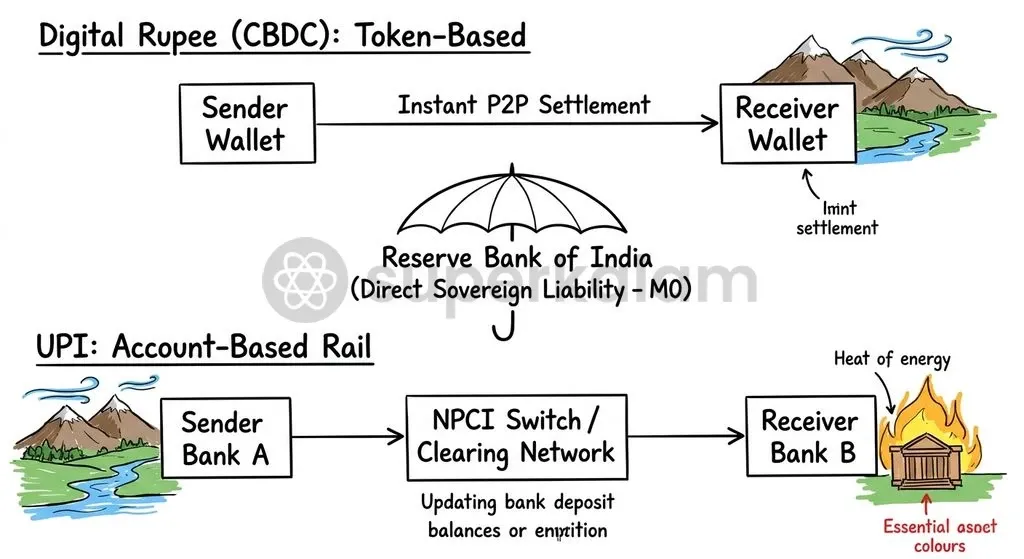
Macroeconomically, the Digital Rupee is central bank reserve money, classified as M0 monetary base and representing a direct sovereign liability. In contrast, the Unified Payments Interface is purely a messaging and routing network operated by the National Payments Corporation of India. A UPI transaction shifts commercial bank deposits—classified as M3 broad money—between commercial bank balance sheets.
Counterparty solvency underlines this divide. A bank deposit carries commercial credit risk because it is a private claim against a lending institution. Conversely, an e-Rupee token represents an unhedged sovereign liability backed by central bank assets under Section 33 of the RBI Act, 1934.
Discuss with Superkalam
Which statutory amendment to the Reserve Bank of India Act, 1934 formally recognized central bank digital tokens as legal bank notes?
Ask NowArchitectural Contrast: Token-Based Sovereign Cash vs Account-Based Bank Transfers
Settlement architecture marks the fundamental operational divide between both instruments, according to the RBI Concept Note on Central Bank Digital Currency. The National Payments Corporation of India routes account-based transactions across commercial lenders. The Digital Rupee, however, relies on tokenised issuance for direct peer-to-peer settlement.
UPI transactions use messaging protocols to instruct core banking systems to debit and credit commercial accounts. This design requires deferred net settlement across interbank clearing houses. Conversely, a CBDC transfer executes instantaneous, final settlement directly in central bank money without intermediating ledgers.
To preserve financial stability, the central bank implemented a two-tier distribution architecture. The Reserve Bank issues e₹ tokens directly. Commercial lenders then manage end-user onboarding, wallet hosting, and customer compliance checks.
| Dimension | Digital Rupee (e₹-Retail) | Unified Payments Interface (UPI) |
|---|---|---|
| Monetary Nature | Sovereign liability (M0 reserve money) | Private commercial bank claim (M3 broad money) |
| Governing Statute | Section 2(aiv) & 26, RBI Act, 1934 | Payment and Settlement Systems Act, 2007 |
| Settlement Mechanism | Instantaneous, final token transfer | Interbank clearing via NPCI core banking systems |
| Counterparty Credit Risk | Zero (backed by central bank assets) | Commercial bank default risk |
| Interest Accrual | Explicitly non-interest bearing | Accrues commercial savings interest |
| Operational Architecture | Two-tier token distribution | Multi-bank account-based messaging rail |
The Disintermediation Trap: Why Commercial Banks Fear e-Rupee Deposits
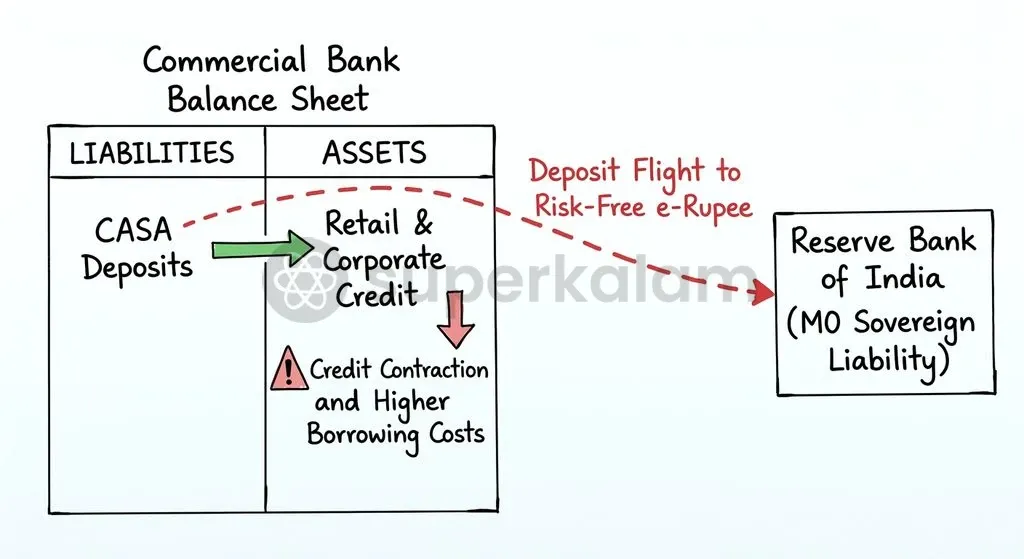
Commercial banks rely on low-cost deposits to fund credit creation. Retail Central Bank Digital Currency adoption directly threatens this balance. The primary economic paradox of sovereign digital cash is the risk of commercial bank disintermediation.
Deposit migration triggers two distinct systemic risks:
- Erosion of low-cost CASA capital: If households convert standard bank deposits into sovereign digital tokens, commercial institutions lose their primary source of Current Account Savings Account funding. According to the RBI Concept Note on Central Bank Digital Currency, this deposit flight forces banks toward costlier wholesale borrowing, pushing up systemic lending rates.
- Acceleration of digital bank runs: During institutional distress, depositors can instantly transfer funds from commercial accounts into sovereign digital cash via smartphones, bypassing physical branch queues and automated teller machine limits.
To prevent these imbalances, the central bank designed the Digital Rupee to be strictly non-interest bearing. Withholding interest on sovereign wallets removes the incentive for savers to drain commercial deposits. Savers retain their funds in interest-yielding commercial accounts instead.
Discuss with Superkalam
How does the balance-sheet liability of an e-Rupee token differ fundamentally from a commercial bank balance held in a UPI-linked account?
Ask NowThe Anonymity Dilemma: Can RBI Replicate Physical Cash Privacy in Code?
Physical currency offers complete transactional privacy because handoffs leave no digital trail. Digital code cannot easily duplicate that silence. The Information Technology Act, 2000 and data protection statutes force the central bank to weigh user privacy against anti-money laundering mandates.
To reconcile these competing demands, the Reserve Bank implements a managed anonymity framework for the retail e-Rupee. Under this approach, small-value transactions mirror cash-like confidentiality, while higher-value movements trigger standard reporting under the Prevention of Money Laundering Act, 2002.
Intermediary commercial banks must balance strict, competing legal mandates:
- Data protection compliance: Digital Rupee transaction ledgers hosted by intermediary banks fall within the regulatory purview of the Digital Personal Data Protection Act, 2023.
- Cybersecurity standards: Commercial wallet intermediaries must satisfy reasonable security safeguards under Section 43A of the Information Technology Act, 2000.
- Audit trail maintenance: Banks must retain auditable records for financial intelligence and crime-prevention agencies.
Consequently, the e-Rupee cannot offer unconditioned anonymity without violating global financial oversight standards. Sovereign tokens leave an electronic trail. For retail consumers accustomed to the complete anonymity of banknotes, that trace weakens the appeal of digital cash.
Discuss with Superkalam
How could a government department deploy programmable e-Rupee tokens to curb leakage in agricultural input subsidy schemes?
Ask NowWhere CBDC Actually Wins: Cross-Border Remittances and Offline Programmability
Physical currency is expensive to manage. According to the Reserve Bank of India Annual Report 2021-22, the printing, procurement of security paper, and logistics of physical banknotes cost ₹4,984.8 crore in FY 2021-22 alone.
Beyond reducing printing outlays, digital currency unlocks three major structural capabilities:
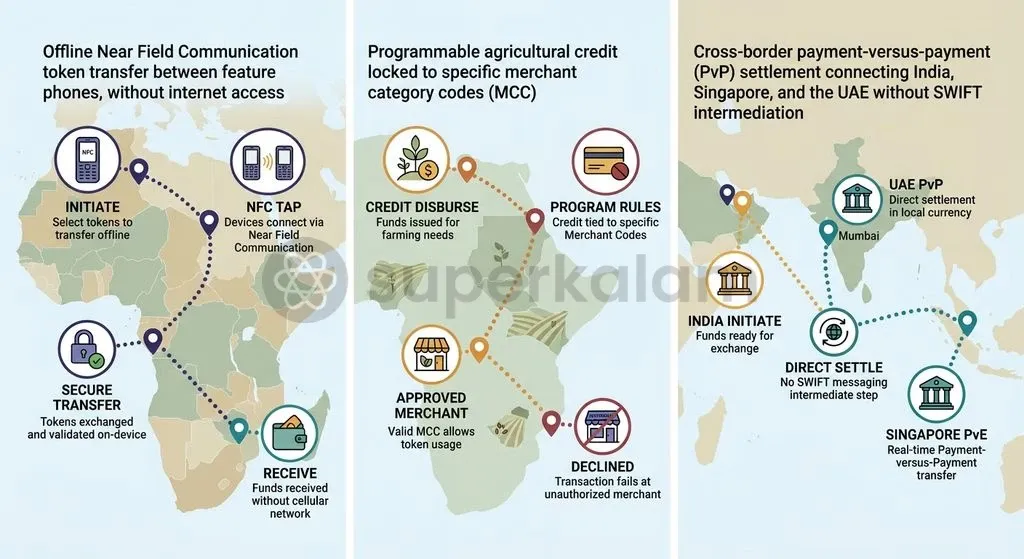
- Programmable fiscal transfers: On 8 February 2024, the central bank announced the formal rollout of programmability and offline functionality within the retail pilot. Programmable tokens allow agencies to restrict subsidy spend to specific merchant category codes, geographic regions, or expiry dates, preventing leakages in targeted agricultural credit.
- Offline connectivity in remote zones: Offline CBDC architectures use Near Field Communication and sound-wave protocols to execute peer-to-peer transfers in rural geographies lacking telecommunication coverage.
- Frictionless cross-border settlements: Digital sovereign tokens bypass legacy correspondent banking networks by enabling atomic payment-versus-payment settlement, cutting transaction delays and SWIFT fees.
To advance this cross-border push, the central bank formalised arrangements in its 2025-26 Annual Report to launch bilateral pilots with the Monetary Authority of Singapore and the Central Bank of the UAE.
Discuss with Superkalam
Examine the systemic trade-offs between absolute transaction anonymity and regulatory compliance under the Prevention of Money Laundering Act.
Ask NowWay Forward: Repositioning the Digital Rupee as Public Infrastructure
The Reserve Bank of India must reposition the Digital Rupee from a retail UPI competitor into foundational infrastructure for targeted governance and sovereign international settlement. The National Payments Corporation of India has already perfected low-cost domestic retail clearing. Consumers have little reason to switch to non-interest-bearing digital wallets for daily payments. Policy should focus instead on three structural frontiers:
- Targeted welfare delivery: Institutionalising programmable digital tokens across direct benefit transfers to eliminate leakages in targeted agricultural credit and welfare subsidies.
- Offline financial inclusion: Expanding sound-wave and Near Field Communication token standards to enable digital commerce in deep rural areas lacking mobile telecommunications.
- Cross-border corridors: Scaling atomic payment-versus-payment bilateral bridges with international trade partners, including Singapore and the UAE, to bypass SWIFT settlement costs.
By anchoring sovereign money to specialised programmatic and cross-border rails, the central bank can protect commercial deposit stability while modernising national monetary infrastructure.
Key Takeaways
- Sovereign Legal Nature: The Digital Rupee represents a direct liability of the Reserve Bank of India (M0 reserve money) under Section 2(aiv) and Section 26 of the RBI Act, 1934, unlike UPI which transfers commercial bank deposits (M3 broad money).
- Settlement Finality: Central Bank Digital Currency executes instantaneous, sovereign final settlement without intermediary counterparty risk, whereas UPI relies on multi-bank messaging, NPCI clearing, and deferred net settlement.
- Disintermediation Safeguards: To protect commercial bank CASA deposits and prevent rapid digital bank runs during crises, the e-Rupee is deliberately structured as non-interest bearing.
- Privacy and Regulatory Trade-offs: The RBI enforces a managed anonymity framework balancing small-value cash privacy with PMLA 2002 reporting, operating under DPDP Act, 2023 and Section 43A of the IT Act, 2000.
- Specialised Value Drivers: The e-Rupee delivers systemic value in programmable social welfare, offline rural transfers via Near Field Communication protocols, and atomic cross-border settlements bypassing legacy SWIFT networks.
Mains Question
"The Digital Rupee is risk-free sovereign money, whereas UPI is merely a payment routing rail." In light of this architectural distinction, critically analyse the macroeconomic risks of commercial bank disintermediation posed by Central Bank Digital Currencies. (15 Marks)
Evaluate NowMains Question
Highlighting the provisions introduced via the Finance Act, 2022 to the RBI Act, 1934, elucidate how programmability and offline features differentiate the Digital Rupee from conventional payment mechanisms. (10 Marks)
Evaluate NowPractice MCQs
QUESTION 1
With reference to the legal and statutory framework governing the Digital Rupee in India, consider the following statements:
- The Finance Act, 2022 amended Section 2 of the Reserve Bank of India Act, 1934 to define a bank note as one issued in physical or digital form.
- Section 22A of the RBI Act, 1934 exempts digital notes from physical currency mandates governing form, denomination, and recovery.
- The retail Digital Rupee earns interest equivalent to commercial bank savings accounts to promote adoption. Which of the statements given above is/are correct?
QUESTION 2
Regarding the macroeconomic and balance-sheet differences between the Digital Rupee and the Unified Payments Interface (UPI), consider the following statements:
- Digital Rupee tokens constitute M0 reserve money representing a direct sovereign liability of the Reserve Bank of India.
- UPI transactions involve the movement of M3 broad money representing commercial bank deposit liabilities.
- Unlike UPI transfers which involve interbank net clearing, CBDC settlement is instantaneous and final in central bank money. Which of the statements given above is/are correct?
QUESTION 3
Consider the following statements regarding the structural features and pilot rollouts of India's Central Bank Digital Currency (CBDC):
- The wholesale pilot (e₹-W) was launched to settle secondary market transactions in government securities.
- Commercial lenders are completely bypassed in the retail CBDC architecture, with the central bank directly hosting citizen wallets.
- Offline CBDC functionality leverages Near Field Communication (NFC) and sound-wave protocols. Which of the statements given above is/are correct?
QUESTION 4
Which among the following best explains the primary rationale behind designing the Digital Rupee as a non-interest-bearing instrument?
QUESTION 5
Consider the following statements regarding privacy and compliance standards of the Digital Rupee:
- Small-value transactions are governed by a managed anonymity framework to mirror cash-like confidentiality.
- High-value retail CBDC movements trigger reporting mandates under the Prevention of Money Laundering Act, 2002.
- Wallets hosted by intermediary commercial banks are exempt from the provisions of the Digital Personal Data Protection Act, 2023. Which of the statements given above is/are correct?
Discuss with Superkalam
Design a strategic policy roadmap for the Reserve Bank of India to position the Digital Rupee for cross-border wholesale remittances rather than domestic retail competition.
Ask Now