Narco-Terrorism in India: Inside the Asymmetric Proxy War
As cross-border networks weaponise drug pipelines to fund proxy conflict, understanding the crime-terror nexus becomes crucial for internal security analysis.
Nov, 2026
•13 min read
Overview
Narco-terrorism in India is a strategic convergence of transnational drug trafficking and state-sponsored proxy warfare. Hostile external actors weaponise illicit pipelines across the Golden Crescent to generate autonomous, untraceable revenue. At the same time, this influx erodes public health and internal stability in border regions like Punjab and Jammu and Kashmir.
This asymmetric doctrine allows militant groups to bypass international anti-money laundering checks. They rely instead on cash-heavy shadow economies, hawala networks, and encrypted digital tokens.
Interdictions by the Border Security Force and joint naval task forces show a clear shift toward low-observable unmanned aerial vehicles and deep-sea maritime corridors. Defeating this threat requires moving past isolated border seizures toward unified financial intelligence and multi-agency enforcement.
Why in the News? The Spike in Drone Drops and High-Seas Contraband
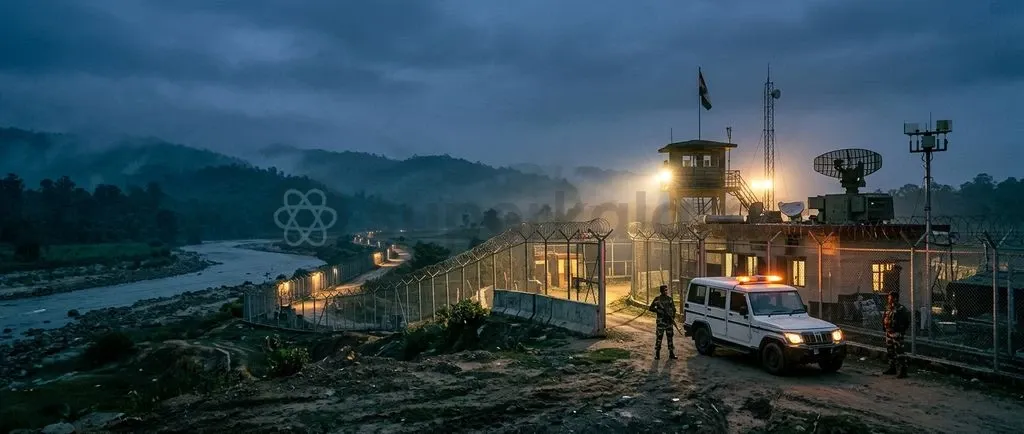
India's internal security agencies face a mounting influx of contraband along western land borders and territorial waters. According to the Border Security Force, security personnel recovered 107 rogue drones in Punjab in 2023 and 294 rogue drones in 2024. This spike reflects an intensified reliance on automated aerial logistics by cross-border handlers.
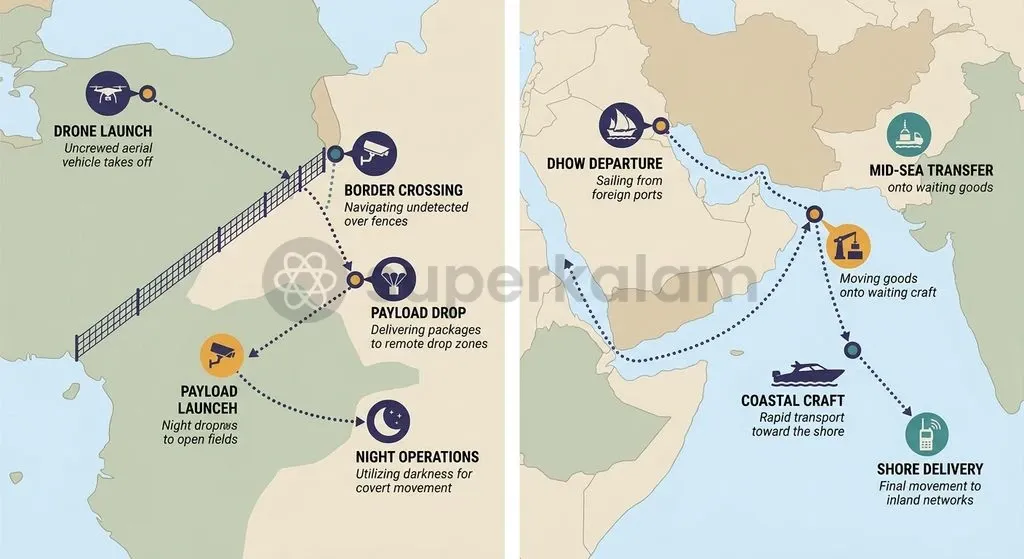
Unmanned aerial vehicles (UAVs) drop payloads directly into border agricultural fields. These cross-border consignments deliberately bypass physical fencing and typically combine multiple illicit items:
- Narcotics Base: High-grade heroin consignments alongside synthetic stimulants.
- Lethal Ordnance: Imported handguns, spare magazines, and compact ammunition caches.
- Sabotage Gear: Military-grade detonators and remote improvised explosive device triggers.
Maritime interdictions reveal an equally sophisticated deep-sea pipeline. Under Operation Samudragupta, launched in February 2022 to disrupt trafficking originating from the Makran Coast and Afghanistan, the Narcotics Control Bureau and the Indian Navy intercepted approximately 2,500 kg of methamphetamine off the Kerala coast in May 2023. This interdiction marks India's largest single maritime drug seizure.
As reported by the Narcotics Control Bureau in operational briefings in May 2023, cumulative seizures under Operation Samudragupta likely yielded approximately 3,200 kg of methamphetamine, 500 kg of heroin, and 529 kg of hashish from Pakistani and Afghan networks.
This surge proves that cross-border smuggling is not unorganised crime. Hostile intelligence networks deploy narcotics as a hybrid warfare instrument. They calibrate shipments to fund armed proxy conflict while systematically undermining frontier societies.
Beyond Crime: What is the Crime-Terror Continuum?
Organised crime and political insurgency are no longer separate operational worlds. Scholar Tamara Makarenko formulated the Crime-Terror Continuum framework to illustrate how ideological terror groups and profit-driven criminal cartels converge.
Traditionally, syndicates chase illicit profits, whereas insurgent organisations fight for political or religious power. Makarenko's model demonstrates that non-state groups travel along an operational spectrum ranging from short-term alliances to complete criminal-terror convergence.
| Analytical Dimension | Conventional Narcotics Trafficking | Narco-Terrorism Nexus |
|---|---|---|
| Primary Motivation | Commercial profit and market dominance | Political destabilisation, ideological warfare, and territorial control |
| Revenue Destination | Private enrichment, syndicate expansion, and asset accumulation | Arms procurement, cadre salaries, operational logistics, and terror staging |
| Operational Tradecraft | Bribery, commercial concealment, and evasion of law enforcement | Unmanned aerial systems, paramilitary tactics, subterranean tunnels, and armed ambushes |
| State Sponsorship | Operates outside or against state structures via corruption | Frequently directed, sheltered, or logistically assisted by hostile intelligence agencies |
| Statutory Treatment | Prosecuted under criminal statutes like the Narcotic Drugs and Psychotropic Substances Act, 1985 | Invokes anti-terror statutes such as the Unlawful Activities (Prevention) Act, 1967 |
At the convergence point, militant outfits adopt criminal commercial logistics to secure financial self-sufficiency, freeing them from unreliable state patrons. The United Nations Security Council codified this nexus in Resolution 2462 (2019), noting that terrorist groups increasingly fund operations through transnational organised crime, especially illicit narcotics.
In Jammu & Kashmir and Punjab, this continuum operates as a seamless reality. Criminal couriers, weapons smugglers, and insurgent commanders function inside a shared logistics apparatus.
Discuss with Superkalam
Recall the exact number of rogue drones intercepted by the Border Security Force in Punjab across 2023 and 2024.
Ask NowThe Asymmetric Doctrine: Why Adversaries Weaponise the Drug Pipeline
Hostile state sponsors use narcotics trafficking to inflict strategic damage on India while staying safely beneath the threshold of conventional military conflict. According to an analysis by the Observer Research Foundation, external intelligence agencies run drug corridors as an instrument of hybrid proxy warfare, extracting off-the-books revenue while hollowing out frontier demographics in Punjab and Jammu & Kashmir.
This doctrine achieves two operational outcomes simultaneously:
- Autonomous Operational Liquidity: Militant networks generate vast local financing without moving capital across formal, monitored banking channels.
- Societal Attrition: Flooding border districts with high-purity heroin and synthetic stimulants creates severe chemical dependency, depleting local economic productivity and straining state healthcare infrastructure.
Drug revenues also allow non-state groups to bypass international financial watchdogs. According to the Observer Research Foundation, terrorist outfits systematically substitute formal banking routes with drug capital to neutralise surveillance conducted under the anti-money laundering standards of the Financial Action Task Force. Because narcotics transactions rely on physical cash, direct barter, and informal couriers, this capital easily circumvents global wire tracking.
Discuss with Superkalam
How does the Makarenko Crime-Terror Continuum explain the shift of terrorist outfits toward autonomous illicit financing?
Ask NowMapping the Corridors: The Golden Crescent, the Makran Route, and Border States
India sits trapped between the world's two primary illicit opiate production hubs. According to the United Nations Office on Drugs and Crime, the country lies directly between the Golden Crescent (encompassing Iran, Afghanistan, and Pakistan) to the west and the Golden Triangle (encompassing Myanmar, Thailand, and Laos) to the east.
| Pipeline Route | Staging Geography | Primary Transit Methods | Target Infiltration Points |
|---|---|---|---|
| Overland Northern Axis | Afghanistan via Pakistani border staging hubs | Subterranean border tunnels, night drone drops, cross-LoC concealment | Punjab border districts, Jammu & Kashmir valleys |
| Southern Maritime Axis | Makran Coast (Balochistan / Iran) | Deep-sea dhows, mid-sea mechanised transfers | Gujarat, Maharashtra, and Kerala coastlines |
The western route begins in Afghan processing centres, moving refined heroin and synthetic methamphetamine into Pakistani launchpads. Consignments targeting Jammu & Kashmir and Punjab cross heavily guarded land perimeters. In Jammu & Kashmir, state-backed networks previously exploited confidence-building initiatives.
The Ministry of Home Affairs suspended cross-Line of Control barter trade on April 18, 2019, after National Investigation Agency investigations confirmed trade routes were being systematically abused to funnel weapons, narcotics, and hawala money.
Along the International Border in Punjab, syndicates deploy subterranean tunnels equipped with rudimentary ventilation systems alongside remote drone flights to cross perimeter fences.
The southern maritime pipeline runs out of the Makran Coast across Pakistan and Iran. Smugglers load cargo onto motorised dhows that cross international waters in the Arabian Sea. They transfer consignments mid-ocean to domestic fishing vessels bound for Gujarat, Maharashtra, and Kerala. Operation Samudragupta was launched specifically to break this multi-tonne maritime supply chain before ships make coastal landfall.
Discuss with Superkalam
If deployed as a district police chief in a border region seeing high drone drops, how would you coordinate with central security forces to counter composite payloads?
Ask NowThe New Tradecraft: Drones, Darknet Markets, and Crypto-Hawala Laundering
Modern trafficking syndicates use technical tradecraft to avoid physical checkpoints and defeat physical fencing. Commercial drones carrying custom payload releases and GPS waypoints fly fast night sorties. They drop contraband at mapped coordinates in frontier fields and return across the border before border patrols can intercept them.
Domestically, criminal syndicates rely on encrypted digital tools to shield their logistics and payments. According to the Ministry of Home Affairs, the Narcotics Control Bureau registered 92 cases involving darknet marketplaces and cryptocurrency payments between 2020 and April 2024, while national law enforcement bodies booked 1,025 parcel and courier trafficking cases across the country. Buyers order contraband on hidden web markets, pay through pseudonymous wallets, and receive narcotics via ordinary postal couriers.
Traffickers convert illicit street revenues into clean operational terror funding through a four-stage process:
- Border Infiltration: Low-flying aerial drones cross land boundaries while deep-sea dhows transfer multi-tonne shipments in international waters.
- Domestic Distribution: Wholesale syndicates break down bulk consignments, distributing them via darknet listings, encrypted chats, and commercial parcels.
- Capital Obfuscation: Syndicates split profits between trade mis-invoicing and digital mixing services alongside informal hawala operators.
- Operational Staging: Cleaned, off-the-books liquidity purchases weapons, procures safe houses, and sustains insurgent cadres.
Two laundering mechanisms drive this pipeline:
- Trade-Based Money Laundering: Syndicates use deliberate mis-invoicing and false customs declarations in commercial trade, shifting value across borders without raising regulatory flags.
- Informal Hawala and Crypto-Mixers: Cash from street sales feeds into domestic hawala brokers, who trigger matching overseas disbursements for arms shipments. Simultaneously, cryptocurrency tumblers obscure wallet trails, blinding forensic financial audits.
Discuss with Superkalam
Analyse why hostile state actors prefer weaponising narcotics pipelines over conventional military skirmishes in border states.
Ask NowStrategic Toll: Border Destabilisation, Youth Vulnerability, and Internal Security
Narco-trafficking along frontier belts is deliberate societal destabilisation, running far deeper than commercial crime. Flooding border communities with cheap opiates and synthetic stimulants sparks severe chemical dependency. This directly hits the demographic backbone of agricultural and industrial labour forces.
This multi-vector offensive strains state resilience across four fronts:
- Demographic Degradation: Household savings bleed into local illicit drug markets, generating petty street crime and eroding regional human capital.
- Healthcare Distress: Border district public health infrastructure faces severe overload from untreated addictions and blood-borne transmissions.
- Enforcement Distraction: Police bandwidth shifts toward managing local street-level consumption rather than hunting organised cartel leadership.
- Logistics Convergence: Contraband transit corridors double as weapon routes, turning addicted couriers into easily compromised operational assets.
According to the National Crime Records Bureau, over 70% of total cases registered across India under the Narcotic Drugs and Psychotropic Substances Act in 2022 were filed for possession for personal consumption rather than commercial trafficking or financing. This caseload clogs lower courts and district lockups with consumers, leaving syndicate distribution hubs largely untouched.
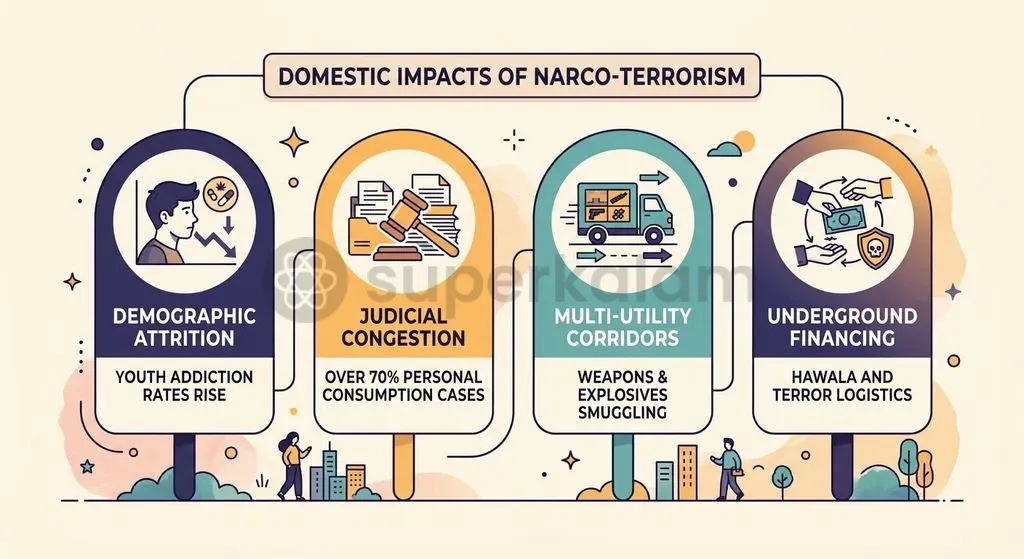
Trafficking conduits also operate as multi-purpose logistics routes for hostile planners. A pipeline built to smuggle narcotics can transport assault rifles, ammunition, detonators, and counterfeit currency. Local distribution couriers, compromised by substance dependency or quick cash, become easy recruiting targets for cross-border handlers seeking operational scouts and logistics safehouses.
India's Enforcement Architecture: NCB, NIA, and the NCORD Framework
India's counter-narcotics enforcement architecture combines multi-agency administrative bodies, specialised investigative agencies, and statutory penal frameworks to confront organised trafficking networks. At the strategic coordination apex sits the Narco-Coordination Centre, institutionalised by the central government as a four-tier mechanism operating across Apex, Executive, State, and District levels to break down administrative silos between central ministries and local police forces.
To implement decisions on the ground, state governments and union territory administrations established dedicated Anti-Narcotics Task Forces headed by Additional Director General or Inspector General rank officers. The Narcotics Control Bureau also established a Joint Coordination Committee, chaired by its Director General, to drive complex investigations exhibiting cross-border and narco-terrorism ramifications.
Digitised surveillance platforms support these institutional mechanisms:
- NIDAAN Database: The Ministry of Home Affairs launched the National Integrated Database on Arrested Narco-offenders, which is an interoperable platform linked with the Crime and Criminal Tracking Network & Systems to track the biometrics and criminal linkages of drug offenders.
- MANAS Portal: The central government operationalised the MANAS portal and the national toll-free helpline 1933 to aggregate citizen intelligence and route actionable inputs directly to enforcement bodies.
| NCORD Operational Tier | Administrative Leadership | Core Responsibilities |
|---|---|---|
| Apex Level | Union Home Secretary | Strategic oversight, national policy direction, inter-ministerial coordination |
| Executive Level | Special Secretary / NCB Director General | Joint Coordination Committee operations, complex cross-border case direction |
| State Level | State Chief Secretary / Head of ANTF (ADG/IG) | Multi-agency state operations, state anti-narcotics policy execution |
| District Level | District Magistrate / Superintendent of Police | Local interdiction, police station coordination, grassroots intelligence |
The statutory framework rests on the Narcotic Drugs and Psychotropic Substances Act, 1985. Section 27A mandates 10 to 20 years of rigorous imprisonment and a minimum fine of ₹1 lakh for financing illicit drug traffic or harbouring offenders. Section 37 imposes strict dual bail conditions for commercial quantities, disallowing bail unless the court is convinced the accused is innocent and unlikely to reoffend.
When cross-border smuggling attacks sovereign integrity, prosecutors invoke the Unlawful Activities (Prevention) Act, 1967. Section 15(1)(a)(iiia), inserted through a 2012 amendment, broadens the definition of a terrorist act to penalise actions threatening India's economic security and monetary stability through the production, smuggling, or circulation of high-quality counterfeit currency, coin, or any other material.
Despite this statutory toolkit, institutional friction persists. Under the Seventh Schedule of the Constitution of India, 'Police' and 'Public Order' are State subjects under Entries 1 and 2 of List II. This constitutional division occasionally slows coordination between state police forces and central bodies like the Narcotics Control Bureau, the National Investigation Agency, and the Border Security Force.
A statutory evidentiary divide also complicates enforcement. The Narcotic Drugs and Psychotropic Substances Act treats contraband seizures primarily as drug supply offences. Linking confiscated shipments to wider terror financing plots requires invoking the Unlawful Activities (Prevention) Act or formally transferring cases to the National Investigation Agency.
Discuss with Superkalam
Design an inter-agency operational protocol linking maritime surveillance, customs courier checks, and cyber-financial tracing to dismantle the crypto-hawala supply chain.
Ask NowWay Forward: Shifting from Seizures to Dismantling the Financial Nexus
Border seizures alone cannot halt narco-terrorism. Criminal cartels treat seized narcotics as routine operational overhead. To break these syndicates, enforcement agencies must cut off the illicit capital sustaining syndicate leaders.
Executing an effective Counter-Threat Finance doctrine requires real-time forensic collaboration across intelligence and policing agencies. The Financial Action Task Force emphasised that effective counter-threat finance requires real-time forensic alignment between the Enforcement Directorate, the Financial Intelligence Unit (FIU-IND), and national anti-terror agencies to track hidden assets. Interrogating suspicious transaction reports, unmasking shell entities, and tracking trade mis-invoicing will strike at the capital funding weapons procurement.
Key operational priorities include:
- Upgrading Technical Interdiction: Deploying automated anti-drone systems featuring radio-frequency jamming and directional spoofing along vulnerable stretches of the International Border in Punjab and Jammu & Kashmir.
- Rationalising Enforcement Bandwidth: Shifting local police resources away from low-level personal possession cases toward investigating commercial-quantity distributors, money couriers, and logistics coordinators.
- Broadening International Cooperation: Leveraging India's 37 bilateral agreements and Memoranda of Understanding on narcotics matters to exchange actionable maritime intelligence and execute reciprocal asset forfeiture against overseas kingpins.
- Strengthening Coastal Radar Networks: Enhancing coordination between the Indian Navy, the Indian Coast Guard, and state Marine Police units to seal maritime entry points across the Arabian Sea.
Dismantling narco-terrorism requires treating narcotics trafficking as a direct attack on sovereign security. By uniting hard border defences with forensic accounting and integrated intelligence, India can shut down this proxy pipeline for good.
Key Takeaways
- Hybrid Warfare Instrument: Cross-border narco-trafficking functions as an asymmetric proxy warfare mechanism that generates untraceable funding for militant operations while inflicting demographic damage on border states.
- The Crime-Terror Continuum: Tamara Makarenko's model explains how terrorist outfits adopt the logistics and revenue strategies of organised crime, shifting from ideological purists to self-funding criminal-terror enterprises.
- Bypassing FATF Surveillance: Illicit drug proceeds provide militant networks with an off-the-books revenue pipeline that circumvents formal banking channels and international anti-money laundering monitoring.
- Emerging Delivery Tradecraft: Cross-border syndicates have escalated low-observable drone drops along the land border—recovering 294 rogue UAVs in Punjab in 2024 alone—while deploying maritime dhows along the Makran Coast.
- Statutory and Institutional Convergence: Enforcement relies on the Narcotic Drugs and Psychotropic Substances Act, 1985 (Sections 27A and 37) and the Unlawful Activities (Prevention) Act, 1967 (Section 15(1)(a)(iiia)), coordinated through the four-tier NCORD mechanism and state Anti-Narcotics Task Forces.
Mains Question
'Hostile external actors weaponise illicit drug corridors as an instrument of asymmetric proxy warfare to secure autonomous operational liquidity while bypassing Financial Action Task Force surveillance.' Elucidate. (10 Marks)
Evaluate NowMains Question
Evaluate the efficacy of India's border enforcement and interdiction architecture in countering the evolving tradecraft of low-observable drones and high-seas narco-trafficking corridors. (15 Marks)
Evaluate NowPractice MCQs
QUESTION 1
With reference to 'Operation Samudragupta', consider the following statements:
- It was launched jointly by the Narcotics Control Bureau and the Indian Navy in February 2022.
- Its primary mandate is to disrupt maritime drug trafficking originating from the Makran Coast and Afghanistan.
- Under this operation, an interception off the Kerala coast in May 2023 yielded India's largest single maritime drug seizure.
Which of the statements given above are correct?
QUESTION 2
Regarding the 'Crime-Terror Continuum' and international frameworks on terror financing, consider the following statements:
- Scholar Tamara Makarenko formulated the framework illustrating how ideological terror groups and commercial cartels converge along an operational spectrum.
- United Nations Security Council Resolution 2462 (2019) explicitly recognized that terrorist groups increasingly fund operations through transnational organised crime and illicit narcotics.
- The narco-terrorism nexus in India is prosecuted exclusively under the Narcotic Drugs and Psychotropic Substances Act, 1985, completely precluding the invocation of anti-terror legislation.
Which of the statements given above is/are correct?
QUESTION 3
Consider the following statements regarding the geographical transit corridors of narcotics affecting India:
- The Golden Crescent encompasses Iran, Afghanistan, and Pakistan, while the Golden Triangle covers Myanmar, Thailand, and Laos.
- The Southern Maritime Axis originates from the Makran Coast and targets coastal states such as Gujarat, Maharashtra, and Kerala through mid-sea transfers.
- Cross-Line of Control barter trade in Jammu & Kashmir was officially suspended in April 2019 following investigations that confirmed its misuse for funneling narcotics, arms, and hawala money.
Which of the statements given above is/are correct?
QUESTION 4
Consider the following statements regarding cross-border smuggling tradecraft along the western border:
- Border Security Force data reported a decrease in rogue drone recoveries in Punjab between 2023 and 2024.
- Unmanned aerial vehicle consignments frequently drop composite payloads combining narcotics base, lethal firearms, and military-grade detonators.
- Syndicates operating across the International Border in Punjab have deployed subterranean tunnels equipped with rudimentary ventilation systems.
Which of the statements given above is/are correct?
QUESTION 5
According to data from the Ministry of Home Affairs cited in the article, how many cases involving darknet marketplaces and cryptocurrency payments were registered by the Narcotics Control Bureau between 2020 and April 2024?