I.R. Coelho Case Explained: Ending Blanket Immunity in the Ninth Schedule
How a nine-judge bench dismantled Parliament's unreviewable statutory vault to place fundamental rights above legislative supremacy.
Nov, 2026
•13 min read
Overview
In I.R. Coelho v. State of Tamil Nadu (2007), a unanimous nine-judge Supreme Court bench held that all constitutional amendments inserting enactments into the Ninth Schedule on or after 24 April 1973 remain subject to judicial review against the basic structure. The ruling dismantled the long-standing presumption that Article 31B created an impregnable legal sanctuary capable of shielding statutes from fundamental rights violations.
By establishing the direct impact and effect test, the Supreme Court ruled that Parliament cannot deploy its constituent amending power under Article 368 to immunise ordinary laws that erode the Golden Triangle of Articles 14, 19, and 21. This decision reconciles legislative policy objectives with constitutional supremacy, ensuring that no statutory vault can override judicial scrutiny or extinguish foundational constitutional principles.
The Nilgiris Land Dispute: How a Local Forest Law Sparked a Constitutional Crisis
The Gudalur Janmam Estates Act, 1969 triggered one of India's most significant constitutional confrontations when private estate holders resisted the statutory acquisition of their ancestral forest holdings in the Nilgiris district.
The legal clash originated within the distinctive land-tenure framework of the Gudalur taluk in Tamil Nadu. Under this historical system, Janmis held absolute proprietary rights over expansive tracts of forest and agricultural territory. The Tamil Nadu legislature sought to dismantle this feudal hierarchy by enacting the Gudalur Janmam Estates (Abolition and Conversion into Ryotwari) Act, 1969.
While the statute aimed to confer ryotwari tenure onto cultivating tenants, Section 3 of the Act vested vast swathes of privately held forest lands directly into the custody of the State government. Plantation owners contested this expropriation, carrying their challenge to the highest judicial forum.
In Balmadies Plantations Ltd. v. State of Tamil Nadu (1972), the Supreme Court struck down Section 3 of the 1969 Act insofar as it transferred private forests to the State, as held by the Supreme Court of India. The Court determined that transferring uncultivated private forests did not qualify as an agrarian reform measure under Article 31A. Consequently, the expropriation lost constitutional protection and stood invalidated for violating the fundamental right to acquire and hold property under Article 19(1)(f).
Parliament moved swiftly to override this judicial invalidation through constituent means:
- Constitutional insertion: Rather than curing defects through state legislative amendments, Parliament passed the Constitution (Thirty-fourth Amendment) Act, 1974, inserting the entire statute into the Ninth Schedule as Item 80.
- Statutory immunity claimed: The insertion invoked Article 31B to shield the invalidated forest acquisitions from further judicial scrutiny.
- Direct constitutional challenge: I.R. Coelho, representing the estate owners, challenged this enactment alongside the Constitution (Sixty-sixth Amendment) Act, 1990, questioning whether Parliament could validate unconstitutional laws by statutory deposit alone.
Discuss with Superkalam
Which landmark 1973 Supreme Court verdict established the basic structure doctrine and served as the temporal cut-off for Ninth Schedule review?
Ask NowThe Origin of the Ninth Schedule: Why Parliament Created a Legal Vault in 1951
The First Constitutional Amendment Act, 1951 introduced Article 31B and the Ninth Schedule to insulate urgent post-independence socio-economic land reforms from protracted property-rights litigation.
Following independence, provincial governments enacted sweeping land reform measures to dismantle the exploitative zamindari, jagirdari, and inamdari systems. These progressive enactments faced immediate legal roadblocks. High Courts across India invalidated statutory land acquisition schemes on the ground that statutory compensation formulas violated the fundamental right to property then guaranteed under Articles 14, 19(1)(f), and 31.
The resulting judicial freeze threatened state-led social welfare initiatives and redistribution policies. Prime Minister Jawaharlal Nehru's provisional Parliament responded by enacting the Constitution (First Amendment) Act, 1951, which created a protective constitutional apparatus. This amendment added two key articles alongside an initial repository of 13 state agrarian statutes:
- Article 31A: Created targeted protection for specific categories of legislation, primarily the state acquisition of estates and agrarian modifications, shielding them from Articles 14 and 19.
- Article 31B: Constructed an expansive, non-obstante protective umbrella, declaring that none of the Acts or Regulations specified in the Ninth Schedule could be deemed void for inconsistency with any fundamental right in Part III.
- The Ninth Schedule: Provided the literal constitutional vault, establishing an indexed statutory catalogue whose contents enjoyed absolute judicial immunity.
Constitutional framers designed this mechanism as an extraordinary, transitional remedy to protect vulnerable land redistribution policies. The explicit intent was to prevent wealthy feudal intermediaries from exploiting constitutional guarantees to perpetuate agrarian inequality.
From Land Reform to Political Shield: How the Schedule Grew Beyond Its Purpose
Article 31B transformed over four decades from an agrarian reform shield into an expansive political bunker protecting controversial economic, electoral, and administrative statutes.
While the Ninth Schedule commenced in 1951 with just 13 land-tenure enactments, successive central governments progressively expanded its contents. By the enactment of the Constitution (Seventy-eighth Amendment) Act, 1995, the Schedule had ballooned to accommodate 284 protective entries, documenting an extensive expansion beyond agrarian reform. The statutory catalogue ceased to reflect its original socio-economic welfare mandate.
Governments began deploying Article 31B to protect non-agrarian measures from judicial review under Part III:
- Electoral and political immunisation: Under the Constitution (Thirty-ninth Amendment) Act, 1975, Parliament placed the Representation of the People Act, 1951 into the Schedule to shield Prime Minister Indira Gandhi's election from invalidation.
- Preventive detention override: The same 1975 amendment added the Maintenance of Internal Security Act (MISA) to insulate detentions from habeas corpus challenges under Article 21.
- Economic and industrial controls: The Schedule absorbed statutes regulating monopolies, foreign exchange administration, essential commodities distribution, and textile mill nationalisations.
By the 1990s, the Schedule served routinely as a bypass whenever ordinary statutes clashed with judicial doctrine.
Discuss with Superkalam
How does Article 31B operate in conjunction with the Ninth Schedule to protect enactments from challenges under Part III of the Constitution?
Ask NowThe Road to the Nine-Judge Bench: Conflicting Rulings from Kesavananda to Waman Rao
The Supreme Court experienced three decades of doctrinal friction regarding whether parliamentary additions to the Ninth Schedule remained bounded by the basic structure doctrine.
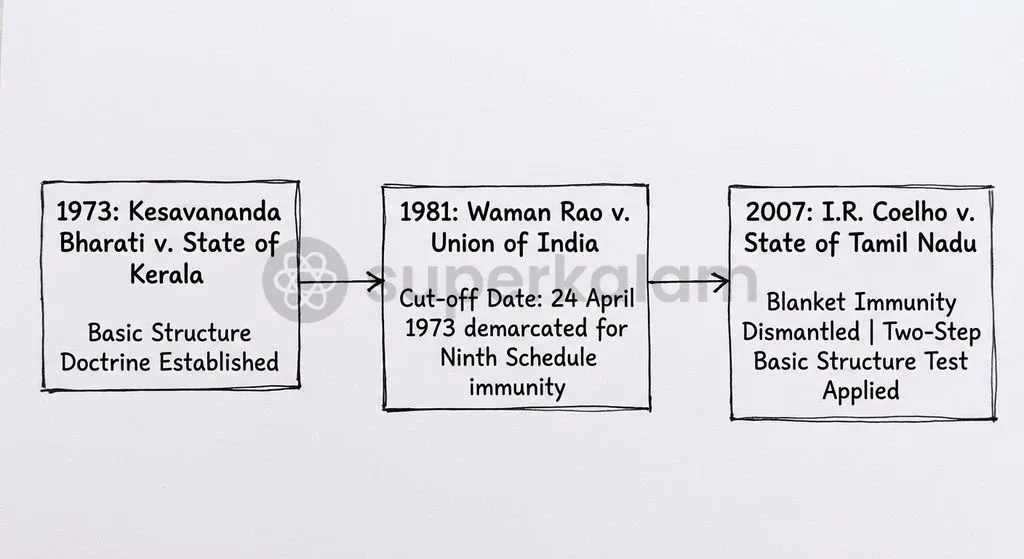
The constitutional balance shifted permanently on 24 April 1973 with the landmark decision in Kesavananda Bharati v. State of Kerala. A historic seven-to-six majority ruled that while Parliament possesses broad constituent powers under Article 368, it cannot alter or damage the basic structure of the Constitution. The Kesavananda bench upheld the validity of Article 31B as an institutional provision, but left unresolved whether individual statutes added to the Schedule by subsequent amendments could be evaluated against basic structure standards.
The Court attempted to reconcile this doctrinal ambiguity in Waman Rao v. Union of India (1981). The bench drew a prospective constitutional dividing line anchored to the Kesavananda verdict:
- Pre-Kesavananda Amendments: Constitutional amendments enacted prior to 24 April 1973 that inserted laws into the Ninth Schedule received absolute protection and remained immune from judicial challenge.
- Post-Kesavananda Amendments: Amendments passed on or after 24 April 1973 remained open to judicial challenge if the inserted statutes violated the basic structure of the Constitution.
Doctrinal inconsistency soon emerged between the reasoning in Waman Rao and the principles articulated in Minerva Mills v. Union of India (1980). In Minerva Mills, the Court held that the unamendable core of the Constitution relies on a delicate harmony between fundamental rights in Part III and directive principles in Part IV.
Legal scholars and judges identified an unresolved tension: did Waman Rao permit statutes to bypass fundamental rights completely so long as they did not destroy an abstract basic structure concept, or did fundamental rights themselves constitute the basic structure?
This unresolved friction culminated on 14 September 1999, when a five-judge Constitution Bench hearing the I.R. Coelho appeal referred the matter to a larger bench, as documented in the Supreme Court referral order. The referral bench concluded that the apparent contradictions between Waman Rao and Minerva Mills required authoritative resolution by a nine-judge Constitution Bench.
The 2007 Verdict: How Chief Justice Sabharwal Dismantled Blanket Immunity
On 11 January 2007, a unanimous nine-judge Constitution Bench delivered a landmark ruling, declaring that no statutory amendment can entirely extinguish judicial review under the Ninth Schedule.
The nine-judge bench in I.R. Coelho (Dead) by LRs v. State of Tamil Nadu & Ors. (2007) definitively rejected the executive assertion of unchecked constituent authority. The Court established several core constitutional principles:
- Limited constituent power: Parliament's authority under Article 368 remains a limited constituent power, preventing any created authority from subverting constitutional supremacy.
- Temporal line confirmed: The cutoff date of 24 April 1973 remains an immutable boundary, subjecting all subsequent additions to judicial review.
- Golden Triangle protection: Fundamental protections under the Golden Triangle of Articles 14, 19, and 21 constitute foundational values whose core essence cannot be abrogated.
- Judicial review inviolable: Judicial oversight under Articles 32 and 226 forms an essential basic feature that Article 31B cannot bypass.
Discuss with Superkalam
Suppose Parliament enacts a statute curbing press freedom and places it in the Ninth Schedule. How would the 'direct impact and effect test' from I.R. Coelho be applied?
Ask NowThe Two-Step Test: How Courts Now Examine Laws in the Ninth Schedule
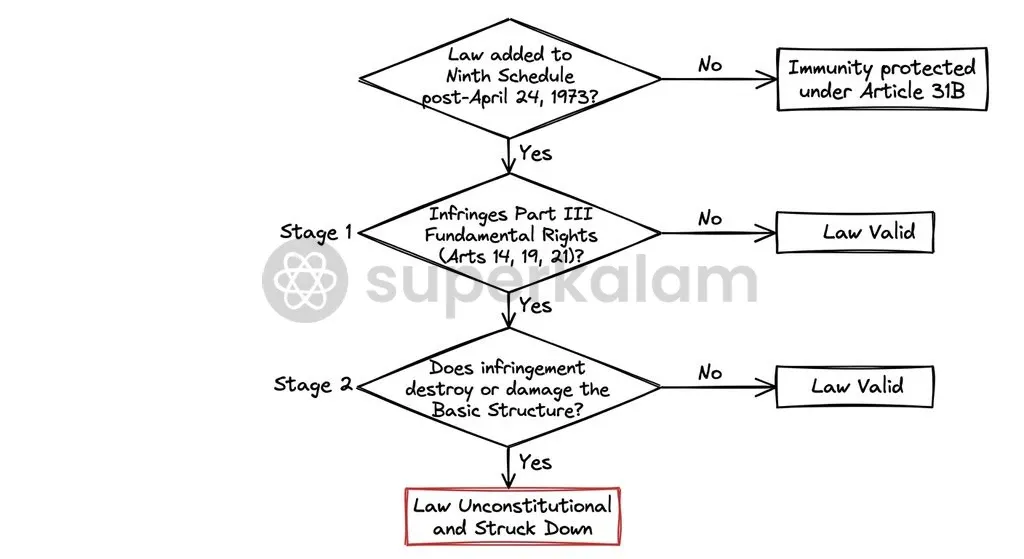
The Supreme Court formulated an objective two-stage constitutional standard in I.R. Coelho to review enactments placed into the Ninth Schedule.
Rather than accepting the formal legislative wrapper of a constitutional amendment, the Court instituted the direct impact and effect test. Under this doctrine, judges examine the substantive consequences of the impugned statute upon fundamental rights, rather than merely evaluating parliamentary legislative intent or constitutional form.
| Stage | Core Question | Negative Finding | Affirmative Finding |
|---|---|---|---|
| Stage 1: Rights Infringement | Does the inserted statute violate or abridge any fundamental right under Part III? | Statute is constitutionally valid; judicial inquiry concludes. | Proceed directly to Stage 2 for constitutional impact assessment. |
| Stage 2: Basic Structure Impact | Does the identified rights infringement destroy or abrogate the basic structure? | Statute is protected under Article 31B and remains valid. | Ninth Schedule immunity is denied; amending insertion is invalidated. |
The operation of this constitutional standard follows a sequential examination:
- Stage One (Rights Infringement Assessment): The reviewing court examines the provisions of the statute included in the Ninth Schedule to ascertain whether it infringes any fundamental right guaranteed under Part III, particularly Articles 14, 19, and 21. If the court finds no fundamental rights violation, the statute remains entirely valid, and the constitutional inquiry ends.
- Stage Two (Basic Structure Impact Assessment): If the statute infringes fundamental rights, the court investigates whether the violation damages or destroys the basic structure of the Constitution. If the impact undermines essential features—such as secularism, democracy, the rule of law, or the essence of equality—the amendment inserting that statute into the Ninth Schedule is struck down as ultra vires Article 368.
This standard prevents Parliament from validating a void statute through secondary constitutional amendments. If a statute was previously struck down by a competent court for violating fundamental rights, inserting it into the Ninth Schedule post-1973 does not cure the defect automatically. The state must demonstrate that the law does not subvert basic constitutional principles.
Discuss with Superkalam
Contrast the doctrinal approaches of Waman Rao (1981) and Minerva Mills (1980) that ultimately necessitated a nine-judge bench referral in I.R. Coelho.
Ask NowBefore and After Coelho: A Side-by-Side Look at Judicial Power Over Article 31B
The constitutional architecture governing Article 31B experienced a fundamental restructuring following the 2007 verdict.
The shift established clear parameters for constitutional review, replacing executive and legislative discretion with transparent judicial oversight. The comparative framework highlights this doctrinal transformation:
| Constitutional Dimension | Pre-Coelho Position (Waman Rao Era) | Post-Coelho Position (2007 Onward) |
|---|---|---|
| Status of Article 31B | Regarded as creating a complete blanket immunity for all listed enactments. | Article 31B operates subject to the overarching basic structure doctrine. |
| Temporal Scope | Absolute protection for pre-1973 laws; ambiguity regarding post-1973 statutes. | Absolute protection for pre-1973 laws; post-1973 additions face rigorous judicial review. |
| Applicability of Part III | Laws in the Ninth Schedule were entirely exempt from Part III challenges. | Violations of Part III are scrutinised to determine if they damage basic constitutional values. |
| Standard of Review | Formalistic approach assessing parliamentary legislative competence under Article 368. | Substantive direct impact and effect test examining real-world consequences on citizen rights. |
| Role of Golden Triangle | Articles 14, 19, and 21 could be overridden through scheduled insertions. | Articles 14, 19, and 21 form the essential core of the basic structure and cannot be abrogated. |
| Power of Judicial Review | Substantially curtailed once an enactment entered the Ninth Schedule. | Affirmed as an unalterable basic feature operating via Articles 32 and 226. |
The Federal Ripple Effect: What the Ruling Means for State Reservation Laws
The principles articulated in I.R. Coelho exposed non-agrarian socio-economic legislation across Indian states to direct constitutional challenge.
The primary testing ground involves state affirmative action measures that breach judicially established ceilings:
- The 69 percent quota law: The Tamil Nadu Backward Classes, Scheduled Castes and Scheduled Tribes Act, 1993 guarantees 69 percent reservation, exceeding the 50 percent limit set in Indra Sawhney (1992).
- Parliamentary shelter via Entry 257A: To prevent judicial invalidation, the Constitution (Seventy-sixth Amendment) Act, 1994 inserted this statute into the Ninth Schedule as Entry 257A.
- Loss of blanket immunity: Because this amendment occurred after 24 April 1973, Entry 257A remains open to judicial review under the Coelho doctrine.
- Equality test under Article 14: Litigants argue that exceeding the 50 percent quota without proven exceptional grounds destroys the essential equality guarantee under Article 14, violating the basic structure.
The Coelho precedent confirmed that placing quota enactments in the Ninth Schedule cannot prevent constitutional courts from reviewing their compliance with fundamental rights.
Discuss with Superkalam
To what extent was the judiciary justified in dismantling the statutory vault of Article 31B given Parliament's original intent to protect socio-economic reforms?
Ask NowThe Coelho Legacy: Securing Judicial Review as an Unshakeable Pillar of Governance
The enduring constitutional significance of the I.R. Coelho decision lies in its defence of constitutional supremacy over legislative sovereignty.
The ruling demonstrated that subjecting Ninth Schedule enactments to judicial review does not destroy progressive social welfare legislation. A notable application occurred in September 2010 when the Supreme Court resolved the long-standing Gudalur Janmam dispute itself. In Glanrock Estate (P) Ltd. v. State of Tamil Nadu (2010), a three-judge bench applied the Coelho two-step test to the 34th Amendment. The Court upheld the insertion of the Gudalur Janmam Estates Act into the Ninth Schedule, finding that the statutory preservation of private forest areas did not damage the basic structure or destroy the core principles of Article 14 or Article 21.
This outcome established that judicial review does not automatically invalidate socio-economic legislation. Instead, the Coelho doctrine establishes a calibrated constitutional filter:
- Checks Legislative Overreach: Prevents governments from creating unreviewable legislative enclaves to protect politically expedient enactments.
- Preserves Valid Social Reforms: Protects genuine agrarian and developmental statutes that align with constitutional values from being struck down arbitrarily.
- Safeguards Citizen Liberties: Guarantees that no individual can be stripped of essential procedural and substantive fundamental rights through statutory insertion.
By subordinating Article 31B to the basic structure doctrine, the Supreme Court confirmed that the Indian Constitution does not tolerate legislative absolutism. The decision firmly consolidated the institutional authority of the judiciary to defend democratic governance, fundamental liberties, and the rule of law.
Key Takeaways
- Judicial Review Over Article 31B: The Supreme Court in I.R. Coelho (2007) unanimously ended blanket immunity for Ninth Schedule enactments, holding that all additions made on or after 24 April 1973 are subject to judicial review.
- The Temporal Cutoff Date: The Court anchored the cutoff date to 24 April 1973—the date of the Kesavananda Bharati verdict—placing Parliament on notice that constituent amending powers under Article 368 are bounded by the basic structure doctrine.
- The Two-Step Rights Test: Courts apply the 'direct impact and effect' test by first determining if a scheduled statute violates a fundamental right in Part III, and second, assessing whether that violation damages the basic structure.
- Sanctity of the Golden Triangle: Fundamental rights under Articles 14, 19, and 21 embody essential constitutional values; any scheduled statute abrogating their core essence is unconstitutional.
- Vulnerability of State Quota Laws: Statutes inserted after 1973, such as Tamil Nadu's 69 percent reservation law under Entry 257A (76th Amendment, 1994), enjoy no blanket constitutional protection and remain open to judicial scrutiny.
Mains Question
"The Ninth Schedule was conceived as an extraordinary shield for agrarian reforms, but gradually evolved into a political bunker against judicial scrutiny." Elucidate the circumstances leading to the nine-judge bench verdict in I.R. Coelho (2007). (10 Marks)
Evaluate NowMains Question
"Parliament's power under Article 368 is a limited constituent power and cannot be deployed to immunise ordinary laws that erode constitutional supremacy." In the light of the I.R. Coelho judgment, critically analyse how the Supreme Court reconciled legislative policy with the doctrine of judicial review. (15 Marks)
Evaluate NowPractice MCQs
QUESTION 1
With reference to the Ninth Schedule and Article 31B of the Indian Constitution, consider the following statements:
- The Ninth Schedule was introduced into the Constitution by the Constitution (First Amendment) Act, 1951, initially containing 13 state agrarian statutes.
- Article 31B provides a protective umbrella declaring that enactments included in the Ninth Schedule cannot be deemed void for inconsistency with any fundamental right in Part III.
- The Constitution (Thirty-ninth Amendment) Act, 1975 added the Representation of the People Act, 1951 and the Maintenance of Internal Security Act (MISA) to the Ninth Schedule. Which of the statements given above are correct?
QUESTION 2
Consider the following statements regarding the Supreme Court's ruling in Waman Rao v. Union of India (1981):
- It held that constitutional amendments enacted prior to 24 April 1973 that inserted laws into the Ninth Schedule were open to judicial challenge on grounds of basic structure.
- It held that amendments passed on or after 24 April 1973 remained open to judicial challenge if the inserted statutes violated the basic structure of the Constitution. Which of the statements given above is/are correct?
QUESTION 3
Regarding the judicial history of the Gudalur Janmam Estates (Abolition and Conversion into Ryotwari) Act, 1969, consider the following statements:
- In Balmadies Plantations Ltd. v. State of Tamil Nadu (1972), the Supreme Court held that transferring uncultivated private forests qualified as an agrarian reform measure under Article 31A.
- Parliament placed the 1969 statute into the Ninth Schedule as Item 80 via the Constitution (Thirty-fourth Amendment) Act, 1974 to shield it from judicial invalidation. Which of the statements given above is/are correct?
QUESTION 4
According to the Supreme Court's judgment in I.R. Coelho v. State of Tamil Nadu (2007), what standard applies to laws inserted into the Ninth Schedule on or after 24 April 1973?
QUESTION 5
By the enactment of the Constitution (Seventy-eighth Amendment) Act, 1995, how many protective entries had the Ninth Schedule accumulated?