Macaulay's Minute of 1835: Downward Filtration Theory and Education Policy
Designed to build a loyal administrative buffer class, Macaulay's language policy starved mass schooling and inadvertently forged India's national resistance.
Nov, 2026
•11 min read
Context
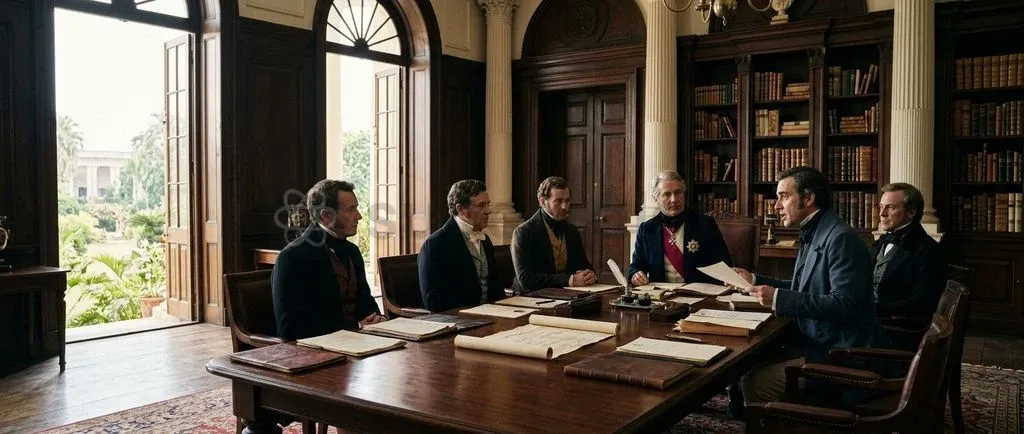
Thomas Babington Macaulay's Minute on Indian Education, presented on 2 February 1835, instituted an imperial policy to engineer a loyal administrative buffer class through English-medium instruction. It deliberately abandoned mass vernacular learning across British India. This administrative manoeuvre resolved a protracted fiscal deadlock within the East India Company by concentrating limited state subsidies on an English-speaking elite.
The resulting framework established the Downward Filtration Theory. This doctrine assumed modern European knowledge would permeate organically through society from the upper classes. Instead of educating the public, the policy entrenched severe social stratification, neglected traditional indigenous schools, and reinforced deep rural-urban divides.
Language policy was an instrument of imperial control. Inadvertently, it also forged the pan-Indian intelligentsia that ultimately challenged colonial rule.
Why Macaulay's 1835 Education Debate Still Matters in Modern India
The colonial education debate initiated by Macaulay continues to shape contemporary Indian schooling. It defines persistent structural tensions between English linguistic capital and mother-tongue instruction. As of March 2026, educational policymakers continue to grapple with the structural hierarchy that prioritises English-medium schooling over regional languages in professional markets.
Macaulay's intervention forged an enduring link between English proficiency and socioeconomic mobility. By turning an administrative language into an exclusive gatekeeper for formal employment, the policy altered Indian civil society for generations. Today, that legacy manifests across several key areas:
- Labour Market Premium: English proficiency remains heavily tied to formal white-collar employment.
- Linguistic Stratification: Regional languages face persistent systemic devaluation in tertiary and professional education.
- Cognitive Divides: Early English immersion often overrides foundational vernacular comprehension in early childhood.
Modern educational reforms reflect the scale of this challenge. While early colonial administrators viewed education through the lens of imperial utility, contemporary governance frameworks recognise that equitable primary education requires vernacular grounding to ensure genuine cognitive development.
Discuss with Superkalam
Can you recall the exact annual financial allocation mandated by Section 43 of the East India Company Charter Act of 1813 for Indian education?
Ask NowThe 1813 Charter Deadlock: Why the East India Company Was Forced to Choose
Section 43 of the East India Company Charter Act of 1813 compelled colonial administrators to fund public instruction by mandating an annual allocation of one lakh rupees. This statutory requirement, formally enacted under 53 Geo. 3. c. 155, represented the first time the British Parliament acknowledged state financial responsibility for Indian education.
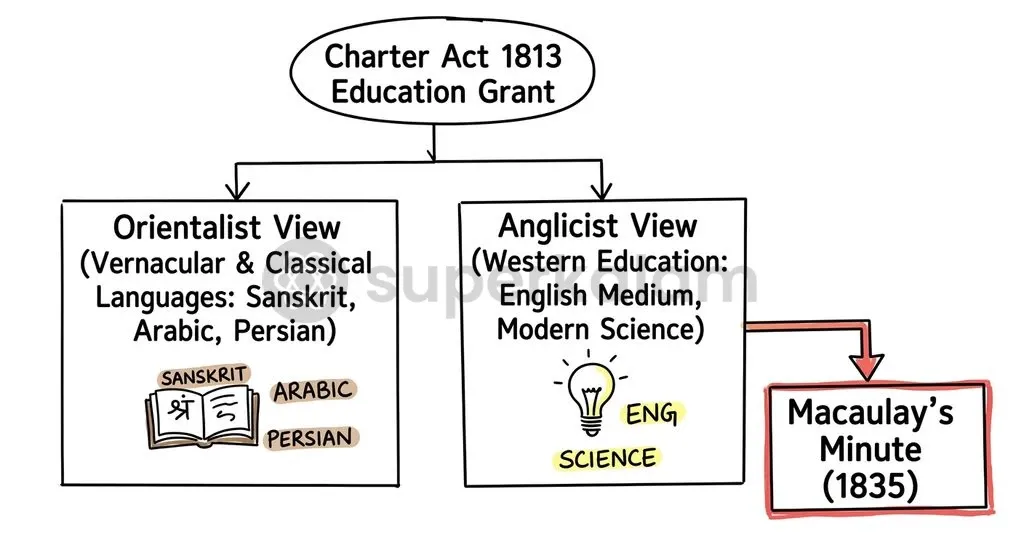
The parliamentary mandate directed these territorial revenues toward two distinct objectives: reviving native literature and introducing scientific knowledge. British administrators, however, failed to specify the medium of instruction or the precise curriculum to be financed. To administer this statutory grant, the colonial government established the General Committee of Public Instruction in Calcutta on 17 July 1823.
The General Committee immediately fractured into two opposing factions, producing an intractable five-versus-five deadlock. The Orientalist faction, led by scholar-bureaucrat H.T. Prinsep, advocated for preserving classical learning through Sanskrit, Arabic, and Persian institutions. The Anglicist faction insisted on directing all public funds exclusively toward English-medium instruction in Western science and literature.
Internal disagreements extended beyond British officials. Indian reformers also intervened in the debate. Raja Ram Mohan Roy addressed a formal letter to Lord Amherst on 11 December 1823, arguing against funding a new Sanskrit college in Calcutta. Roy urged the colonial state to deploy European instructors to teach mathematics, chemistry, and anatomy, viewing Western empirical sciences as indispensable for national regeneration.
| Dimension | The Orientalist Position | The Anglicist Position |
|---|---|---|
| Primary Champions | H.T. Prinsep and traditionalist Company civil servants | Thomas Babington Macaulay and reforming colonial officials |
| Target Languages | Sanskrit, Arabic, and Persian | English exclusively |
| Curricular Focus | Classical literary traditions and indigenous scientific systems | Modern Western science and European liberal arts |
| Administrative Philosophy | Cultural non-interference to preserve political stability | Cultural transformation to cultivate imperial loyalty |
| Institutional Strategy | Funding traditional madrasas and Sanskrit colleges | Constructing urban English colleges and high schools |
Inside the 1835 Minute: Downward Filtration and the Creation of a Buffer Class
Thomas Babington Macaulay presented his Minute on Indian Education in February 1835 to establish an elite English-educated class that would serve British administrative and ideological interests. Macaulay arrived in India in 1834, joining the Governor-General's Council before assuming the presidency of the deadlocked General Committee of Public Instruction.
Macaulay framed the policy problem as an absolute choice between modern rationalism and obsolete traditional lore. In paragraph 10 of his Minute, Macaulay made his infamous declaration that a single shelf of a good European library was worth the whole native literature of India and Arabia. He advanced this sweeping claim while explicitly acknowledging in the text that he possessed no personal knowledge of either Sanskrit or Arabic.
The central mechanism of Macaulay's strategy was social engineering rather than universal public instruction. On 2 February 1835, Macaulay laid out the core components of his design:
- Creating Cultural Intermediaries: Establishing a class of interpreters between the British rulers and the millions they governed.
- Engineering Identity: Cultivating a group Indian in blood and colour, but English in taste, opinions, morals, and intellect.
- Directing State Funds: Restricting state resources to European literature and science via the English language, formally enacted by Bentinck's English Education Act on 7 March 1835.
Lord Auckland, who succeeded Bentinck, formalised this doctrine into the Downward Filtration Theory in his official Minute of 24 November 1839. The colonial administration operated on the flawed hypothesis that educating a wealthy, upper-caste urban minority would cause European knowledge and ethical values to trickle modern ideas downward naturally into vernacular tongues.
Discuss with Superkalam
How did the administrative philosophy of the Orientalists differ from the Anglicists during the General Committee of Public Instruction debates?
Ask NowThe Economic Lever: How Hardinge Turned English into the Exclusive Currency of Public Jobs
Lord Hardinge issued an Educational Resolution on 10 October 1844 that established exclusive recruitment preference in public service for candidates educated in English-medium institutions. This executive order, issued by the Home Department, transformed what had been an ideological curricular preference into a compulsory economic imperative.
Hardinge's decree solved a pressing administrative dilemma for the East India Company by supplying cheap subordinate manpower. The policy fulfilled two primary economic functions:
- Fiscal Cost Reduction: Employing European civil servants across the subcontinent was fiscally prohibitive for the Company's revenue margins.
- Clerical Bureaucracy: An Indian clerical workforce proficient in English accounting and correspondence managed revenue collection, subordinate courts, and municipal departments at minimal cost.
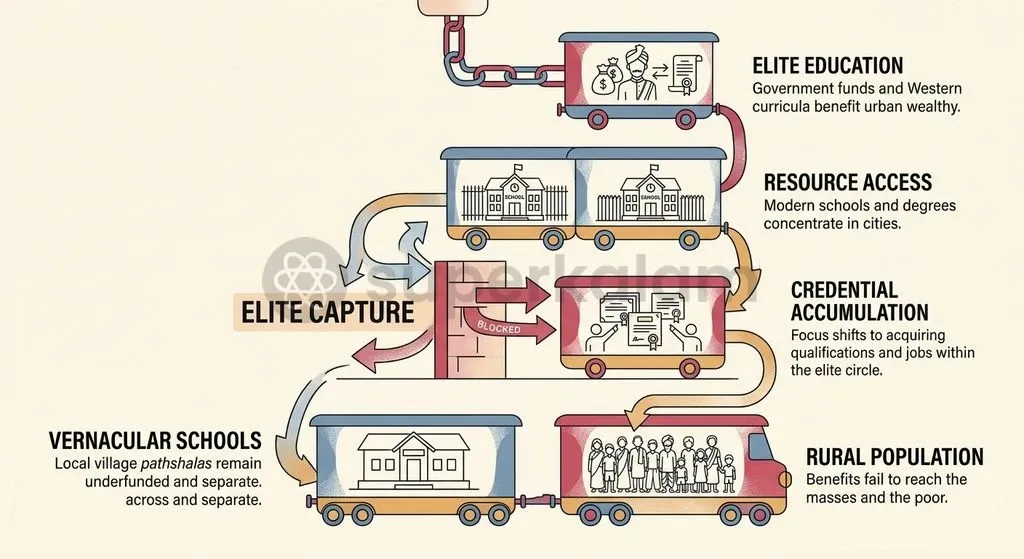
This economic mandate fundamentally altered the social calculus for Indian households. Families with sufficient social capital realigned their educational investments toward English schools to secure stable administrative postings. Fluency in English became an indispensable form of exclusive cultural capital required to access judicial clerkships, revenue offices, and administrative positions.
The Hunter Commission of 1882 later documented the inevitable collapse of the Downward Filtration model. Rather than disseminating Western scientific insights to rural communities, the newly minted English-educated intelligentsia practised elite capture, consolidating public office and legal practice within select urban castes. Linguistic competence was an extraction mechanism rather than a public conduit for mass enlightenment.
Discuss with Superkalam
If you examine modern recruitment patterns, how does Hardinge's 1844 linkage between English and public jobs continue to operate in contemporary professional markets?
Ask NowThe Structural Fallout: Mass Neglect, Vernacular Decay, and the Rural-Urban Divide
William Adam submitted three official reports between 1835 and 1838 documenting that Bengal and Bihar sustained over 100,000 indigenous village pathshalas. Appointed by Lord William Bentinck to conduct an exhaustive survey of local schooling, Adam warned that starving traditional village schools of state resources would devastate basic community literacy.
Colonial administrators dismissed Adam's warnings, choosing to concentrate their narrow budgets on urban colleges in Presidency capitals. Consequently, the indigenous village school system degraded rapidly over the subsequent two decades. The withdrawal of state recognition and patronage crippled pathshalas and madrasas, deepening the rural-urban educational divide across the subcontinent.
Sir Charles Wood's Despatch of 19 July 1854 acknowledged this systemic catastrophe by formally repudiating the Downward Filtration Theory. Wood's Despatch directed the East India Company to assume direct responsibility for mass elementary education through regional vernacular languages. However, the institutional damage was already embedded; the social hierarchy separating English-medium elites from vernacular speakers remained deeply entrenched.
From an ethical and governance perspective, Macaulay's policy institutionalised profound epistemic injustice, as articulated in modern philosophical scholarship. The colonial framework enacted systematic testimonial and hermeneutical injustice:
- Testimonial Injustice: Colonial administrators systematically deflated the credibility of native scholars, treating non-European scientific, medical, and mathematical traditions as inherently superstitious.
- Hermeneutical Injustice: Indigenous communities were stripped of the institutional resources needed to understand and articulate their social realities in their own conceptual idioms, forcing all public discourse into Western cognitive categories.
- Instrumental Subordination: Public instruction was severed from genuine human development, reduced entirely to producing subordinate human capital for imperial administrative extraction.
Discuss with Superkalam
Why did the Downward Filtration Theory result in elite capture rather than the intended organic dissemination of European knowledge to the rural public?
Ask NowThe Imperial Irony: How the English-Educated Intelligentsia Organised National Resistance
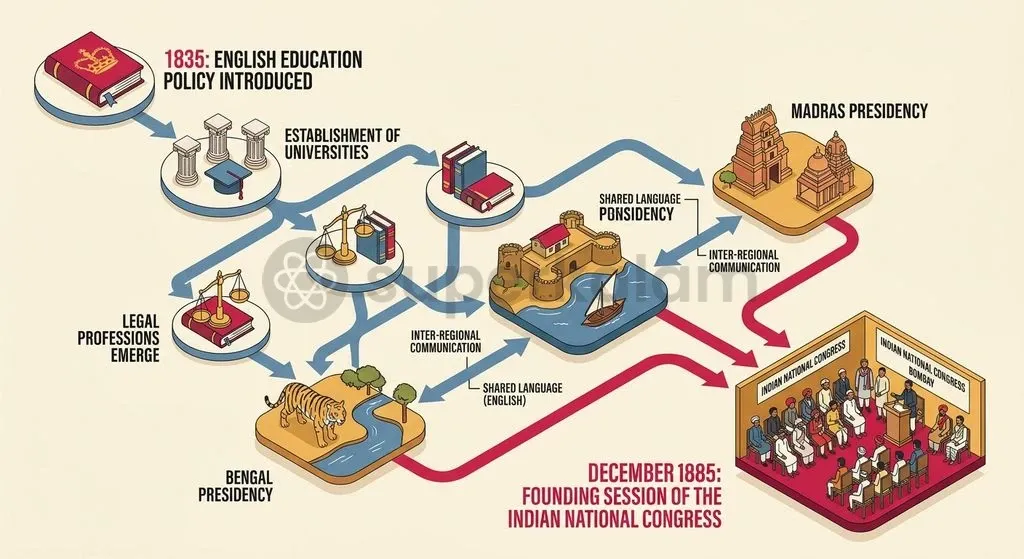
Colonial education inadvertently equipped Indian leaders with a common secular language, enabling diverse provincial representatives to assemble at Bombay in December 1885. The founding delegates of the Indian National Congress represented geographically distant Presidencies—Bengal, Bombay, and Madras—that possessed distinct regional tongues.
English became an accidental lingua franca across regional boundaries. Macaulay had designed English instruction to mould loyal subjects aligned with British imperial interests. Instead, Indian intellectuals deployed English to assimilate European political philosophy, drawing directly on concepts of constitutional liberty, parliamentary democracy, and civic rights.
Early nationalist leaders systematically redirected Western analytical frameworks against the colonial state:
- Economic Critique: Dadabhai Naoroji and Romesh Chunder Dutt formulated empirical critiques that exposed the systemic economic drain draining Indian wealth.
- Discursive Challenge: Nationalists communicated in the political language of Westminster, discrediting imperial governance on its own philosophical terms.
- Pan-Indian Mobilisation: English enabled cross-provincial coordination, unifying regional leaderships that otherwise shared no common vernacular.
The colonial class engineering project produced the exact inverse of its intended outcome. Macaulay sought to cultivate an administrative buffer class loyal to the Crown. Instead, he generated an articulate counter-elite capable of mobilising institutional resistance across provincial borders.
Discuss with Superkalam
Weighing Macaulay's imperial objective against the eventual rise of an English-educated national intelligentsia, to what extent did colonial language policy produce an unintended outcome?
Ask NowBeyond Macaulay: Decolonising Indian Pedagogy and the Language Dilemma in NEP 2020
The National Education Policy 2020 addresses colonial-era linguistic disparities by mandating mother-tongue instruction through primary schooling across all Indian classrooms. Paragraph 4.11 of the policy stipulates that, wherever feasible, the medium of instruction until at least Grade 5, and preferably until Grade 8 and beyond, shall be the home language, mother tongue, local language, or regional language.
| Year | Statutory / Policy Benchmark | Primary Language Policy Mandate |
|---|---|---|
| 1835 | English Education Act | State funds restricted exclusively to English-medium learning |
| 1854 | Wood's Despatch | Repudiation of Downward Filtration; vernacular primary schools |
| 1956 | Article 350A, Constitution of India | Constitutional endeavour for linguistic minority mother-tongue |
| 2009 | Section 29(2)(f), RTE Act | Elementary instruction in mother tongue as far as practicable |
| 2020 | Paragraph 4.11, National Education Policy | Mother tongue medium mandated through Grade 5 (preferably Grade 8) |
The constitutional architecture of independent India provides explicit support for vernacular instruction. Article 350A of the Constitution of India, inserted through the Constitution (Seventh Amendment) Act of 1956, directs every State and local authority to provide adequate facilities for mother-tongue instruction at the primary stage to children belonging to linguistic minority groups. Similarly, Section 29(2)(f) of the Right of Children to Free and Compulsory Education (RTE) Act, 2009 requires that the medium of instruction in elementary schooling shall, as far as practicable, be in the child's mother tongue.
Implementing these progressive mandates continues to encounter structural friction. The economic valuation of English in the national and global services marketplace creates strong parental demand for early English-medium private schooling, regardless of pedagogical outcomes. Reversing colonial linguistic stratification requires substantive policy interventions:
- Developing Pedagogical Resources: Publishing rigorous science, mathematics, and technical textbooks in regional languages to ensure conceptual depth.
- Bilingual Transitional Frameworks: Implementing dual-medium instructional models that scaffold mother-tongue conceptual foundations with functional English acquisition.
- Decoupling Economic Utility from Medium: Expanding regional language testing for technical, professional, and civil service examinations to lower socioeconomic barriers.
The enduring lesson of Macaulay's 1835 policy failure is that language planning cannot be separated from political economy. When an educational medium is weaponised as a mechanism of social exclusion, it undermines mass human potential; true educational decolonisation requires institutionalising linguistic equity across public administration and economic markets.
Key Takeaways
- Charter Act of 1813 Section 43: Mandated the first state allocation of one lakh (100,000) rupees annually for literature and sciences, sparking the decade-long Orientalist-Anglicist deadlock inside the General Committee of Public Instruction.
- Macaulay's Minute of 1835: Advanced the explicit objective of creating an intermediary buffer class "Indian in blood and colour, but English in taste, in opinions, in morals, and in intellect", while asserting cultural superiority despite admitting zero knowledge of Sanskrit or Arabic.
- Bentinck's 1835 Resolution: Endorsed Macaulay's Minute via the Council Resolution of 7 March 1835, redirecting all educational funds exclusively to English-medium Western education.
- Hardinge's 1844 Decree: Linked government recruitment exclusively to English proficiency, turning an ideological policy into a mandatory economic incentive that entrenched elite capture and bypassed the rural masses.
- Downward Filtration Failure: Formalised by Lord Auckland in 1839 and repudiated by Wood's Despatch in 1854, the trickle-down assumption collapsed as the urban elite monopolised administrative jobs rather than enriching regional vernaculars.
- Constitutional and NEP 2020 Reforms: Current frameworks actively counter colonial linguistic hierarchies through Article 350A, Section 29(2)(f) of the RTE Act 2009, and Paragraph 4.11 of NEP 2020, which mandates mother-tongue instruction through at least Grade 5.
Mains Question
"The introduction of English-medium instruction under Macaulay's Minute of 1835 and Hardinge's Resolution of 1844 was driven by imperial administrative utility rather than a genuine commitment to mass enlightenment." Critically examine. (15 Marks)
Evaluate NowMains Question
"Lord Auckland's formalisation of the Downward Filtration Theory in 1839 assumed an organic diffusion of modern knowledge that historical reality failed to deliver." Elucidate. (10 Marks)
Evaluate NowPractice MCQs
QUESTION 1
Consider the following statements regarding the 1813 Charter Act and educational governance in colonial India:
- Section 43 of the Charter Act of 1813 mandated an annual state expenditure of one lakh rupees to revive native literature and introduce scientific knowledge.
- The General Committee of Public Instruction was instituted in Calcutta in 1823 to administer the statutory education grant.
- Indian reformer Raja Ram Mohan Roy supported the Orientalist faction by petitioning Lord Amherst to fund traditional Sanskrit institutions in Calcutta. Which of the statements given above is/are correct?
QUESTION 2
With reference to the Anglicist-Orientalist controversy and Macaulay's Minute of 1835, consider the following statements:
- The Orientalist faction was led by scholar-bureaucrat H.T. Prinsep, who advocated preserving classical learning in Sanskrit, Arabic, and Persian.
- Macaulay explicitly acknowledged in his Minute that he possessed extensive proficiency in both Sanskrit and Arabic literature.
- Bentinck's English Education Act of 7 March 1835 formally restricted state resources to European literature and science through English. Which of the statements given above are correct?
QUESTION 3
Consider the following statements regarding the Downward Filtration Theory and colonial education policy:
- Lord Auckland formalised the Downward Filtration Theory in his official Minute of 24 November 1839.
- The theory operated on the assumption that educating a wealthy, upper-caste urban minority would cause European ideas to permeate naturally into vernacular tongues.
- The Hunter Commission of 1882 affirmed the success of the Downward Filtration model in transmitting Western scientific insights to rural masses. Which of the statements given above is/are correct?
QUESTION 4
Consider the following statements regarding administrative and curricular developments following Macaulay's Minute:
- Lord Hardinge's Educational Resolution of 10 October 1844 established recruitment preference in public service for candidates educated in English-medium institutions.
- The recruitment preference aimed to reduce the East India Company's fiscal costs by substituting expensive European civil servants with cheap subordinate clerical labour.
- Sir Charles Wood's Despatch of 19 July 1854 formally repudiated the Downward Filtration Theory. Which of the statements given above are correct?
QUESTION 5
Which of the following colonial-era reports documented that Bengal and Bihar sustained over 100,000 indigenous village pathshalas, warning that starving them of state resources would devastate community literacy?