Integrated Farming System (IFS): Meaning, Components, Models & Benefits
Integrated Farming System (IFS) combines crop cultivation with dairy, poultry, fisheries and horticulture on the same farm, so that residues from one enterprise become low-cost inputs for another. This explainer covers the meaning and components of IFS, the ICAR-IIFSR one-hectare model, income and employment benefits, adoption barriers for small farmers, and the policy way forward for UPSC GS-3.
Nov, 2026
•13 min read
Context
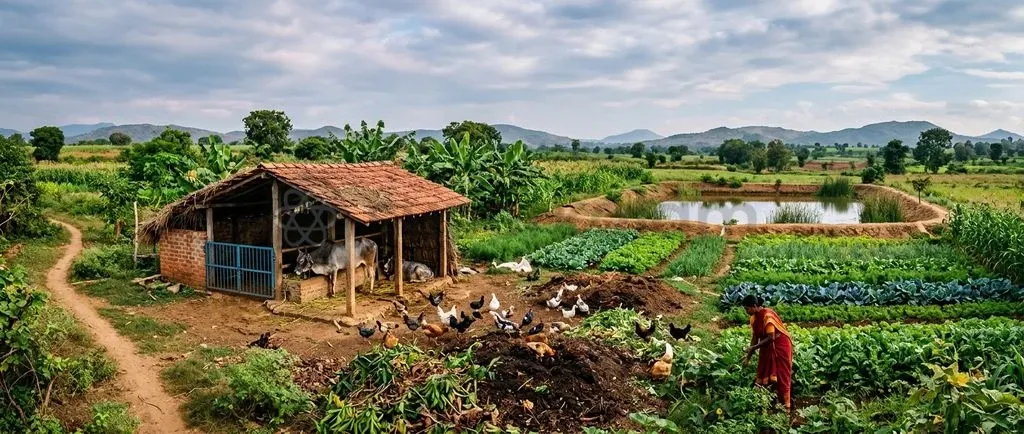
An Integrated Farming System (IFS) is a whole-farm approach that deliberately combines crop cultivation with allied enterprises such as dairy, poultry, fisheries, and horticulture, so that residues from one enterprise serve as low-cost inputs for another. By recycling biological waste internally instead of depending on purchased inputs, IFS offers a proven pathway to raise smallholder incomes and build climate resilience.
According to the ICAR-Indian Institute of Farming Systems Research (IIFSR) Research Framework on Integrated Farming Systems, combining crops with livestock, horticulture, and aquaculture transforms by-products into low-cost internal inputs. Agronomic trials confirm substantial yield stability and cash-flow gains over monoculture regimes.
Yet adoption among smallholders remains limited by rigid single-crop agricultural credit, fragmented landholdings, and high upfront capital costs. Bridging this structural gap requires transitioning from disjointed crop loans to composite enterprise financing and village-level producer collectives.
Why in the News: The Policy Push for Climate-Resilient Agriculture
State-sponsored initiatives for sustainable agriculture have elevated multi-enterprise farming into a central strategic priority for addressing recurring climate shocks and rural distress. Public policy now treats whole-farm integration as an operational shield for rainfed zones.
Key policy milestones and fiscal commitments driving this transition include:
- Rainfed Area Development (RAD) Funding: As of May 2026, data from a Press Information Bureau Release on Sustainable Agriculture and NMSA shows that the RAD component released ₹2,119.84 crore between 2014–15 and 2025–26, assisting 14.35 lakh farmers across 8.50 lakh hectares.
- Input Cost Assistance under PM-RKVY: Now integrated under PM-RKVY, the scheme provides financial support covering up to 50% of input costs, capped between ₹10,000 and ₹25,000 per hectare for establishing integrated cropping, horticulture, and livestock systems.
- Doubling Farmers' Income Targets: The Ashok Dalwai Committee on Doubling Farmers' Income recommended scaling up integrated farming models as a vital lever to lift livestock's share of agricultural gross value added from 30% to 40%.
The economic logic is clear: single-crop farming is structurally fragile under erratic monsoon patterns. In contrast, multi-enterprise bio-recycling secures durable farm solvency across dry tracts absorbing the brunt of weather anomalies.
Beyond Monocropping: How Enterprise Integration Changes Farm Economics
Integrated Farming Systems counter the input-heavy economics of Green Revolution grain monocultures by converting biological waste into active economic capital. The ICAR-IIFSR defines an Integrated Farming System as a comprehensive whole-farm approach that deliberately combines crop cultivation with allied activities such as dairy husbandry, poultry, and aquaculture. Because residues from one enterprise serve directly as baseline inputs for another, the model sharply curtails reliance on expensive synthetic fertilisers, commercial feeds, and external agrochemicals.
Empirical trials show that multi-enterprise architecture fundamentally alters farm-level income, risk, and labour parameters:
- Substantial Income Multipliers: Empirical evaluations by ICAR-IIFSR at Modipuram show that diversified IFS regimes increase net farm income by two to three times compared to conventional single-crop systems.
- Even Cash-Flow Distribution: Enterprise diversification smooths out the sharp income volatility inherent in seasonal harvest cycles. By generating complementary revenue streams through daily milk sales, seasonal vegetable pluckings, and periodic fish harvests, composite holdings maintain liquid operating cash flow throughout the year.
- Superior Climate and Yield Resilience: Long-term field trials across regional farming centres record a Sustainability Yield Index between 0.80 and 0.85 for integrated systems, proving far superior yield stability under moisture stress than monoculture plots.
- Continuous Rural Employment: ICAR Indian Farming publications observe that integrated crop-dairy-horticulture-fishery systems lift farm labour absorption from 100–150 man-days per hectare annually under field crops to 250–350 man-days per hectare. This continuous absorption curbs seasonal rural underemployment.
Discuss with Superkalam
What percentage of operational landholdings in India are classified as small and marginal according to the Agriculture Census 2015–16?
Ask NowThe 1-Hectare Model: Internal Waste-to-Input Cycling Explained
The functional core of an integrated holding lies in closed-loop nutrient flows across distinct biological boundaries. A standard one-hectare ICAR-IIFSR model operates through coordinated internal resource transfers:
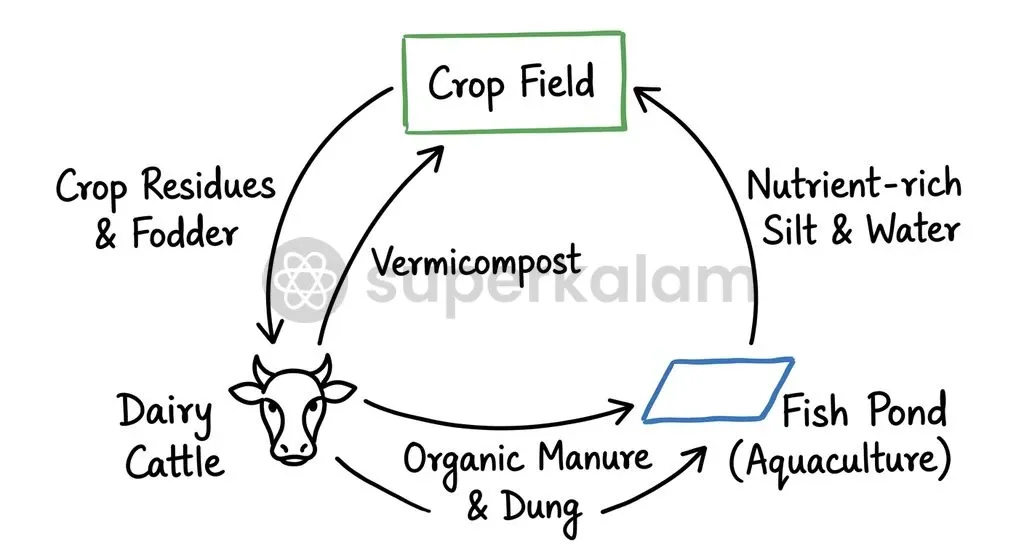
- Biomass Generation and Soil Manuring: The farm generates approximately 22,000 to 25,000 kg of recyclable farm biomass annually. From this internal reservoir, around 9,000 kg is recycled back into the soil matrix as prepared organic manure, avoiding soil organic carbon depletion without requiring costly synthetic conditioners.
- Animal-Fish-Crop Nutrient Transfers: Cattle dung and poultry droppings are directed into aquaculture ponds as organic fertilisers and channelled into vermicomposting pits. This biological cycling supplies between 25% to 50% of crop NPK requirements internally.
- Pond Silt Topsoil Enrichment: Nutrient-rich pond silt excavated during routine desilting is deposited directly onto crop bunds and field plots as natural topsoil nourishment, completing a self-sustaining cycle across crops, livestock, and water bodies.
To deliver practical solutions suited to regional ecologies, the ICAR-IIFSR has developed and validated 51 agro-climatic zone-specific IFS models across 25 States and Union Territories tailored for small and marginal landholders. These models map out precise crop-livestock configurations aligned with local soil chemistry, water availability, and regional fodder access.
Discuss with Superkalam
How does the closed-loop transfer of cattle dung and pond silt reduce a farmer's operational expenditure on synthetic fertilisers?
Ask NowComparison: Single-Crop Farming vs Integrated Multi-Enterprise Systems
To understand why national agricultural policy is pivoting toward integrated holdings, one must evaluate how diversified multi-enterprise models compare against traditional single-crop monocultures across operational parameters.
| Operational Dimension | Conventional Single-Crop Monoculture | Integrated Multi-Enterprise System (IFS) |
|---|---|---|
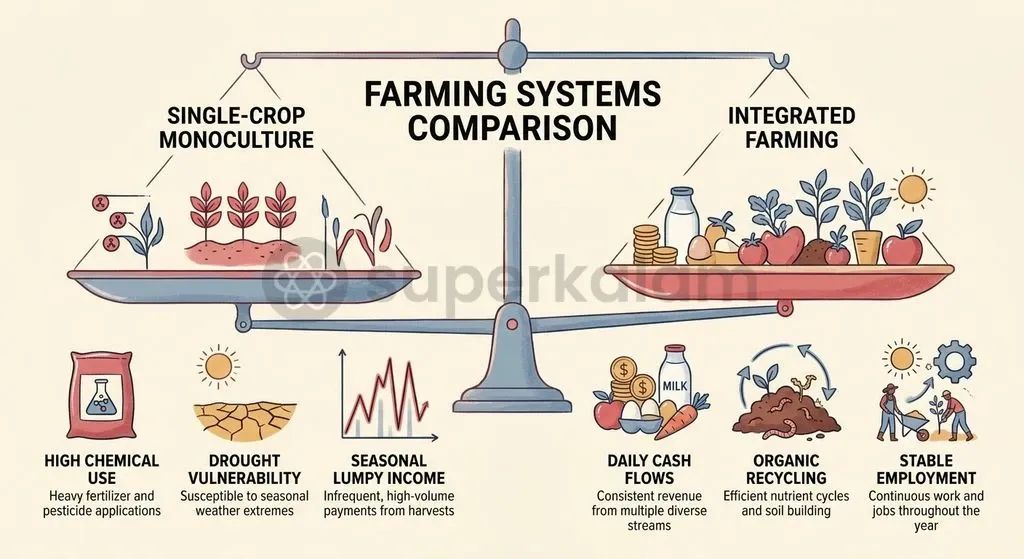
| Input Dependency | High external dependence on chemical fertilisers and pesticides | High internal input generation; recycles 9,000 kg biomass as manure per hectare |
| Cash Flow Timing | Lumpy, seasonal returns restricted to 1–2 harvest windows per year | Continuous, year-round revenue through daily dairy, weekly vegetables, and seasonal fish |
| Climate Shock Resilience | Vulnerable; weather shocks or pest outbreaks risk total seasonal crop loss | High resilience; records a Sustainability Yield Index of 0.80–0.85 |
| Soil Nutrient Balance | Chronic soil depletion; continuous chemical mining of topsoil macro and micro-nutrients | Closed-loop cycling; cattle and poultry manure supply 25% to 50% of crop NPK |
| Labour Utilisation | Low and seasonal; accounts for 100–150 man-days per hectare annually | High and continuous; generates 250–350 man-days per hectare annually |
| Economic Performance | Baseline returns constrained by rising commercial input expenses | Multi-enterprise models generate 2 to 3 times higher net farm income |
The Adoption Paradox: Why High Payoffs Fail to Convince Marginal Holders
Despite compelling agronomic evidence, smallholder uptake of integrated farming remains exceptionally low across India. This divergence stems from structural constraints in agrarian land ownership and household cash flows.
According to the Agriculture Census 2015–16, small and marginal operational holdings below two hectares represent 86.2% of all operational landholdings but control only 47.3% of operated agricultural land. The average operational holding has steadily fragmented, declining from 2.28 hectares in 1970–71 to just 1.08 hectares in 2015–16.
The NSO 77th Round Situation Assessment Survey (Report No. 587) highlights that marginal cultivators operating less than one hectare make up 70.4% of total agricultural households in rural India. For these vulnerable households, average monthly income stood at just ₹10,218 during the 2018–19 agricultural cycle.
NSO Report No. 587 revealed that wages constitute the largest share of household earnings at 40%, followed by crop cultivation at 37%, livestock farming at 15%, and non-farm enterprises at 6%.
| Household Income Stream | Share of Monthly Earnings (NSO 77th Round: ₹10,218) | | :--- | | Wages | 40% | | Crop Cultivation | 37% | | Livestock Farming | 15% | | Non-Farm Business | 6% |
These baseline figures reveal three major structural bottlenecks preventing sub-hectare farmers from adopting multi-enterprise practices:
- Prohibitive Capital Investment: Establishing a fully integrated one-hectare unit requires ₹2.5 lakh to ₹4.5 lakh in initial capital expenditure for cattle sheds, farm pond excavation, and vermicomposting beds. This requirement represents multiple years of total household income for a marginal farmer.
- Physical Parcel Fragmentation: Operational land is typically split into non-contiguous plots scattered across village boundaries. As noted in the Report of the Committee on Doubling Farmers' Income (Volume VI), this spatial dispersal prevents farmers from moving liquid manure, animal fodder, and pond water across parcels.
- Exhaustive Daily Labour Demands: Operating diverse enterprises requires unbroken daily chores including livestock feeding, twice-daily milking, shed sanitation, and intensive crop weeding. Agrarian field surveys indicate that this continuous workload imposes a heavy burden of unpaid family labour that falls disproportionately upon rural women, as reported in the Journal of Community Mobilization and Sustainable Development.
Discuss with Superkalam
If a marginal farmer operating 0.8 hectares receives a 50% input subsidy under PM-RKVY, what additional financing mechanisms are needed to bridge the remaining capital expenditure?
Ask NowCredit and Extension Bottlenecks: How Current Lending and KVKs Fail Composite Farms
Rural institutional architecture remains stubbornly aligned with single-commodity field crop cycles, penalising multi-enterprise farms. The Kisan Credit Card (KCC) scheme establishes credit ceilings primarily around seasonal crop cycles governed by the Scale of Finance, which is determined annually by District Level Technical Committees. This framework is designed for short-term input purchases like seeds and synthetic fertilisers, disbursed before sowing and repaid post-harvest.
In 2019, the Government of India expanded the KCC facility to cover Animal Husbandry and Fisheries up to a working capital limit of ₹2 lakh within the overall ₹3 lakh concessional ceiling. However, this extension explicitly excludes medium- and long-term capital investments. An integrated operator seeking funds to excavate an aquaculture pond, erect perimeter fencing, or build a modern cattle shed cannot access concessional KCC credit for those works.
This short-term focus reflects wider distortions in agricultural lending. Priority Sector Lending rules mandate that domestic commercial banks allocate 18% of Adjusted Net Bank Credit to agriculture. Yet the RBI Internal Working Group on Agricultural Credit found that disbursements remain heavily skewed toward short-term production credit rather than long-term capital assets.
| Lending Category | Institutional Alignment & Flow |
|---|---|
| Short-Term Production Credit | Dominates Priority Sector Lending via seasonal crop loans governed by the Scale of Finance |
| Long-Term Capital Credit | Substantially neglected, restricting multi-enterprise asset creation and structural pond or shed construction |
Agricultural extension systems reflect similar departmental fragmentation. Extension delivery through Krishi Vigyan Kendras (KVKs) operates within rigid administrative silos where Subject Matter Specialists are divided by technical discipline rather than trained in whole-farm enterprise management.
A parallel coordination failure hampers the Agricultural Technology Management Agency (ATMA). Field evaluations by NITI Aayog reveal that line departments for agriculture, horticulture, animal husbandry, and fisheries operate independently, distributing inputs and subsidies without cross-departmental alignment. A smallholder attempting to establish an integrated unit must navigate separate departmental bureaucracies to secure dairy subsidies, fish fingerlings, and certified crop seed.
Discuss with Superkalam
Why do the findings of NSO Report No. 587 on household income composition explain the reluctance of smallholders to undertake multi-enterprise investments?
Ask Now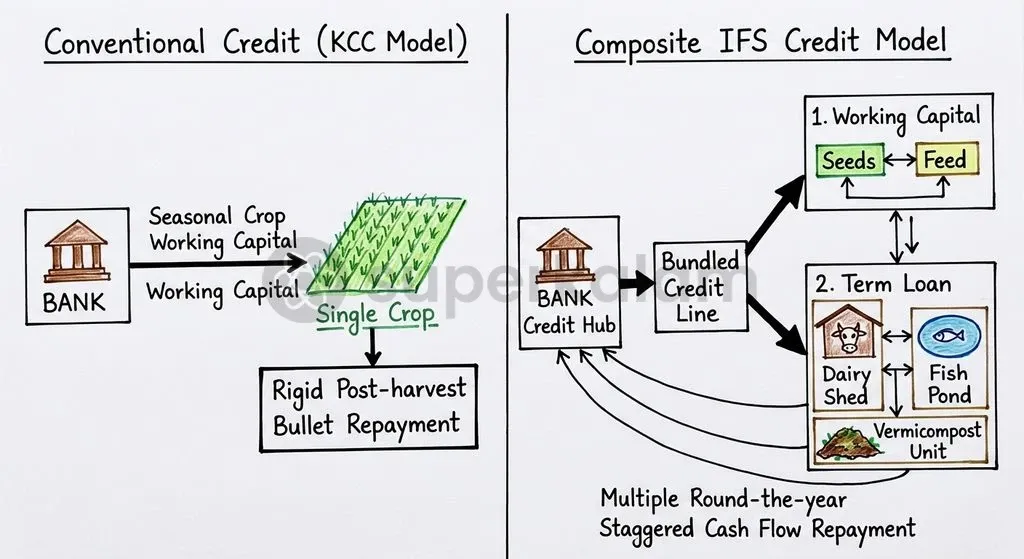
Cluster and Community Solutions: Overcoming Land Fragmentation through FPOs
Because individual marginal holdings cannot independently support the land area or capital equipment needed for an integrated system, community aggregation offers a viable structural workaround. The Ashok Dalwai Committee on Doubling Farmers' Income (Volume VIII) recommended aggregating small and marginal IFS cultivators into Farmer Producer Organisations (FPOs) to overcome scale deficits in processing, input procurement, and marketing.
Under a cluster-based collective model, participating smallholders do not need to operate every enterprise on their own individual parcels:
- Village-Scale Enterprise Specialisation: One cluster member manages a communal nursery and vermicomposting facility, a second operates a community dairy collection unit, and a third maintains a collective water-harvesting pond for aquaculture.
- Shared Input Logistics: The FPO bulk-purchases veterinary medicines, organic supplements, and fingerlings, while collecting raw cow dung and poultry litter across member plots to manufacture enriched organic compost.
- Pooled Cold Chains and Marketing: Rather than attempting to sell small quantities of milk, vegetables, and fish independently, member households pool their daily output through the FPO, bypassing village intermediaries and securing stable urban retail contracts.
This cluster strategy addresses the land fragmentation challenge identified in agricultural census data. Aggregating production across contiguous village blocks unlocks the ecological and financial benefits of enterprise integration without forcing marginal farmers to finance unmanageable capital investments on sub-hectare holdings.
Discuss with Superkalam
How would you redesign agricultural lending guidelines to shift from crop-specific loan disbursement to composite enterprise credit for integrated farms?
Ask NowWay Forward: Reforming Crop Credit and Subsidy Delivery for Integrated Holdings
Scaling up Integrated Farming Systems across rainfed and vulnerable agricultural zones requires restructuring rural financial products, extension systems, and subsidy programmes. The policy roadmap builds on several concrete institutional reforms:
- Composite Credit Assessments: Commercial banks, regional rural banks, and primary agricultural credit societies should replace segmented single-crop evaluations with comprehensive whole-farm appraisals. Following the recommendations of the RBI Internal Working Group on Agricultural Credit, lenders must introduce composite credit assessment tools that evaluate unified farm cash flows across crops, dairy, and fisheries. This approach allows daily dairy and poultry earnings to support credit lines for seasonal crop and capital needs.
- Unified Single-Window Subsidies: State agricultural departments should merge disjointed financial subsidies from the National Mission for Sustainable Agriculture, Paramparagat Krishi Vikas Yojana, and animal husbandry schemes into a unified composite grant. Smallholders establishing verified IFS units should receive consolidated financial assistance through a single digital clearance window.
- Reorganising KVK Extension Curricula: Krishi Vigyan Kendras must restructure training from discipline-specific modules to integrated systems management. Subject Matter Specialists should be evaluated on whole-farm productivity, composite input cost reductions, and farm-level nutrient cycling metrics rather than single-crop demonstration yields.
- Targeted Capital Subsidies for Shared Infrastructure: Public capital outlays under PM-RKVY and the Agriculture Infrastructure Fund should focus on shared physical assets for IFS clusters, including custom hiring centres for fodder harvesting, mini-dairies, solar-powered cold rooms, and communal bio-digesters.
| Reform Pillar | Core Strategic Intervention |
|---|---|
| Credit Modernisation | Adopt composite credit assessments of unified whole-farm cash flows |
| Extension Restructuring | Transition from narrow disciplinary silos to whole-farm agro-ecological advisory |
| Collective Infrastructure | Deploy capital subsidies to establish FPO-managed shared ponds, digesters, and cold rooms |
Transitioning from input-intensive monocultures to integrated enterprise farming is essential for securing smallholder livelihoods. Converting single-crop production credit into composite enterprise financing will provide marginal cultivators with the capital access needed to run viable, climate-resilient farms.
Key Takeaways
- An Integrated Farming System links crop cultivation with allied enterprises like dairy, poultry, and fisheries so that organic wastes from one activity serve as direct inputs for another.
- ICAR-IIFSR field assessments confirm that diversified IFS models boost net farm income by 2 to 3 times and generate 250 to 350 man-days of annual employment per hectare.
- Internal nutrient cycling across a one-hectare model supplies 25% to 50% of crop NPK requirements, generating roughly 22,000 to 25,000 kg of recyclable biomass annually.
- High capital requirements of ₹2.5 lakh to ₹4.5 lakh per hectare, coupled with extreme land fragmentation, severely hinder adoption among marginal landholders who make up 70.4% of farm households.
- Institutional lending remains skewed toward single-crop seasonal production credit through the Scale of Finance, failing to offer the composite multi-enterprise financing required for integrated farming.
Mains Question
"Despite agronomic trials confirming that Integrated Farming Systems (IFS) can multiply net farm income and build climate resilience, widespread adoption remains blocked for marginal holders." In the light of the NSO 77th Round survey and Agriculture Census data, critically examine the structural bottlenecks that impede smallholders from adopting integrated multi-enterprise systems. (15 Marks)
Evaluate NowMains Question
The Ashok Dalwai Committee on Doubling Farmers' Income recommended scaling up integrated farming models to enhance livestock's share in agricultural gross value added. Elucidate how internal waste-to-input bio-recycling transforms the economics of smallholder farming. (10 Marks)
Evaluate NowPractice MCQs
QUESTION 1
With reference to Integrated Farming Systems (IFS), consider the following statements:
- Diversified IFS models can increase net farm income by two to three times compared to conventional single-crop regimes.
- In a standard one-hectare integrated model, biological nutrient recycling supplies 100% of the crop's NPK requirements.
- Integrated farming systems lift annual farm labour absorption to 250–350 man-days per hectare compared to field crops. Which of the statements given above are correct?
QUESTION 2
According to the NSO 77th Round Situation Assessment Survey (Report No. 587) cited in agrarian studies, which source contributes the largest share to the monthly earnings of rural agricultural households?
QUESTION 3
Consider the following statements regarding the policy and institutional support for Integrated Farming Systems in India:
- The Rainfed Area Development (RAD) component under PM-RKVY provides financial support covering up to 50% of input costs for establishing integrated cropping, horticulture, and livestock systems.
- The Ashok Dalwai Committee on Doubling Farmers' Income recommended scaling up integrated farming models to lift livestock's share of agricultural gross value added to 40%.
- ICAR-IIFSR has developed and validated 51 agro-climatic zone-specific IFS models across 25 States and Union Territories. Which of the statements given above are correct?
QUESTION 4
With reference to the structural constraints of Indian agriculture highlighted in the Agriculture Census 2015–16, consider the following statements:
- Small and marginal operational holdings below two hectares represent over 85% of all operational landholdings in India.
- Small and marginal farmers operate more than 70% of the total operated agricultural land.
- The average operational holding size declined from 2.28 hectares in 1970–71 to 1.08 hectares in 2015–16. Which of the statements given above is/are correct?
QUESTION 5
In the context of multi-enterprise integrated farming systems, what does a Sustainability Yield Index (SYI) of 0.80 to 0.85 signify?




