Mantle Plumes and Plate Tectonics: How Deep Earth Heat Rifts Continents
While horizontal plate boundaries drive seafloor spreading, vertical thermal plumes explain intraplate volcanism and the dramatic breakup of supercontinents.
Nov, 2026
•9 min read
Context
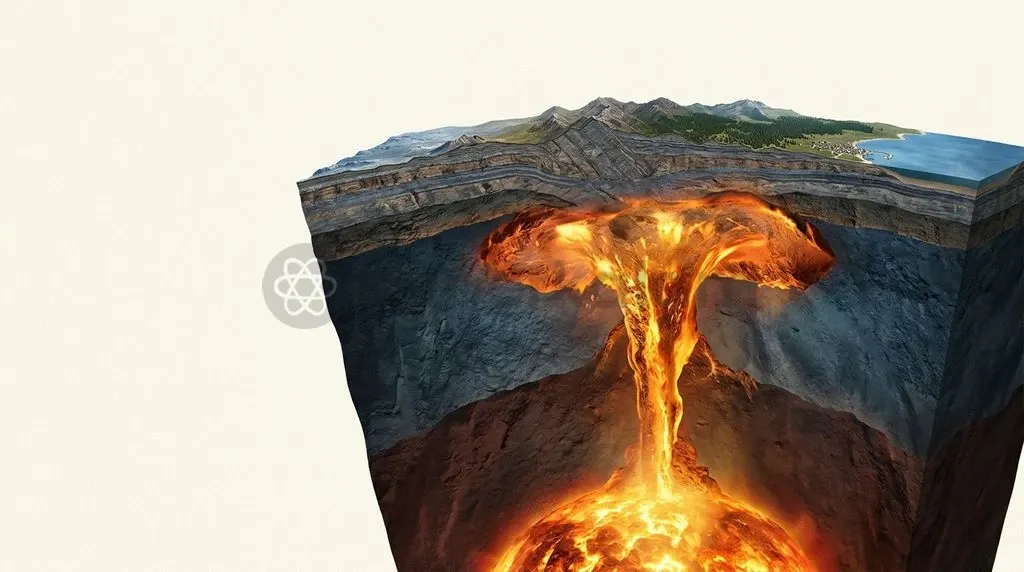
Mantle plumes are narrow, thermally buoyant upwellings of superheated rock originating near Earth's core-mantle boundary. They ascend through the mantle to induce continental rifting, massive volcanic outpourings, and rapid plate reorganisations.
Classical plate tectonics views planetary dynamics as a horizontal, lithosphere-driven system governed by subduction and seafloor spreading. Deep thermal plumes introduce an essential vertical thermodynamic engine. By puncturing stable plates from beneath, these upwellings build oceanic island chains and discharge volatile emissions that alter planetary climate.
Why Plate Boundaries Alone Cannot Explain Earth's Surface Dynamic
Classical plate tectonics cannot account for intraplate volcanism occurring thousands of kilometres away from plate margins. According to the USGS, conventional plate boundary interactions account for mid-ocean ridge basaltic creation and subduction-zone explosive volcanism. Yet these boundary mechanisms fail to explain volcanic edifices erupting within thick, rigid plate interiors.
Interior continental and oceanic domains frequently exhibit persistent magmatism independent of plate edges:
- Oceanic intraplate tracks: The Hawaiian-Emperor seamount chain forms far from any active margin, fed by an isolated sub-lithospheric melting anomaly.
- Continental volcanic fields: Volcanic provinces across the interior of Africa show sustained activity without nearby tectonic boundaries.
- Vertical thermodynamic drive: Horizontal forces like slab-pull and ridge-push require a complementary vertical heat engine to balance global mantle circulation.
What Are Mantle Plumes and Hotspots?
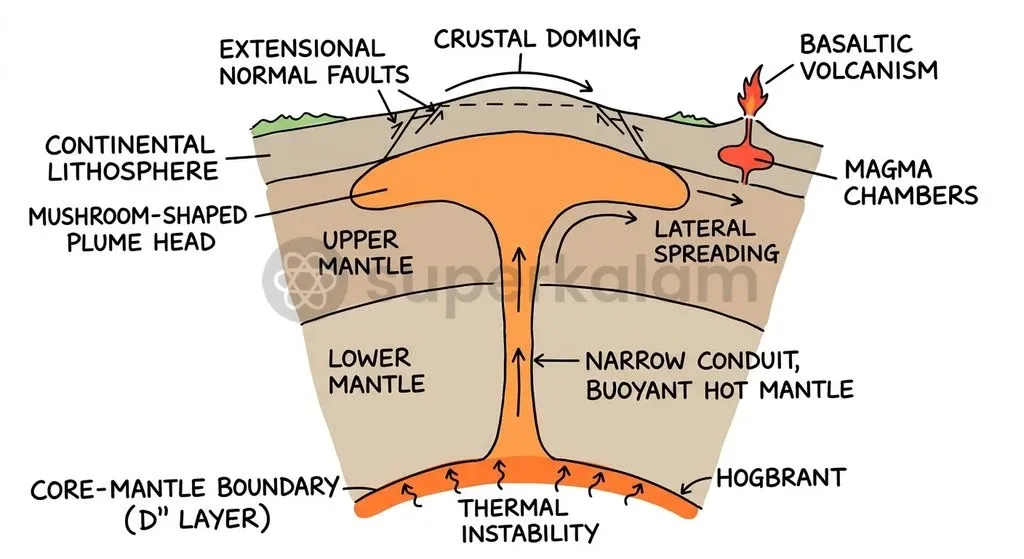
Mantle plumes are buoyant columns of hot solid rock rising from the deep Earth. In contrast, hotspots are surface volcanic expressions caused by these upwellings. Geophysicist W. Jason Morgan first proposed this mantle plume hypothesis, showing that ascending plumes supply molten material to persistent surface hotspots. Progressive volcanic tracks emerge across the crust as tectonic plates drift over these thermal conduits.
Fluid dynamical modelling by Campbell and Griffiths establishes that an ascending mantle plume develops a distinct, two-stage geometric structure during its lifetime:
- The Plume Head: A massive, bulbous thermal swelling measuring 500 to 2,000 kilometres across that forms during ascent and drives dramatic continental uplift upon reaching the lithosphere.
- The Plume Tail: A narrow conduit measuring 100 to 200 kilometres wide that sustains a long-term supply of buoyant magma long after the initial head flattens and dissipates.
| Geodynamic Characteristic | Plume Head Phase | Plume Tail Phase |
|---|---|---|
| Geometry | Giant bulbous sphere (500–2,000 km across) | Slender vertical conduit (100–200 km wide) |
| Surface Duration | Rapid pulses lasting 1 to 5 million years | Persistent lifespan over tens of millions of years |
| Tectonic Manifestation | Massive Large Igneous Provinces (LIPs) and flood basalts | Linear, age-progressive volcanic island and seamount chains |
| Topographic Impact | Broad dynamic crustal uplift (1,000–2,000 m doming) | Localised volcanic construction over overriding plate |
| Primary Example | Deccan Traps continental flood basalt province | Hawaiian-Emperor Chain; Réunion-Chagos volcanic track |
Geologist J. Tuzo Wilson observed that an overriding lithospheric plate traversing a stationary conduit creates linear, age-progressive volcanic chains. The Hawaiian-Emperor Seamount Chain represents the clearest oceanic record of this process. Rocks grow systematically older as plate transport carries earlier volcanic edifices away from the modern, active hotspot locus.
The Deep Engine: How Heat Escapes the Core-Mantle Boundary
Deep thermal plumes originate primarily from dynamic thermo-chemical boundary layer instabilities at the Core-Mantle Boundary, known geophysically as the D'' layer. Garnero and colleagues show that this structural boundary lies at a depth of approximately 2,890 kilometres beneath the surface. Metallic heat escaping from the liquid iron outer core warms the silicate base of the lower mantle, triggering buoyant instabilities.
Seismic tomography reveals two primary lower-mantle anchors governing plume ascent:
- Large Low Shear Velocity Provinces (LLSVPs): Named Tuzo (beneath Africa) and Jason (beneath the Pacific Ocean basin) by Torsvik and colleagues, these dense thermochemical piles focus rising plumes along their margins.
- Primordial chemical reservoirs: Basalts at Hawaii and Réunion show high helium-3 to helium-4 isotopic ratios (3He/4He), indicating upward transport of undegassed mantle preserved since early accretion.
Such ancient noble gas signatures confirm that these plumes tap deep, unmixed reservoirs rather than shallow, recycled asthenosphere.
Discuss with Superkalam
Recall the approximate depth of the D'' layer at the core-mantle boundary where deep thermal plumes originate.
Ask NowTearing Landmasses Apart: How Plume Heads Initiate Continental Rifting
The arrival of an ascending plume head imposes intense mechanical and thermal strain upon the overlying continent. Campbell documents that an arriving head generates 1,000 to 2,000 metres of dynamic crustal doming as buoyant material spreads beneath the lithosphere. Decompression melting then produces colossal basalt volumes, constructing continental Large Igneous Provinces in just 1 to 5 million years.
Plume-induced continental rupture typically unfolds along systematic structural stages:
- Triple junction fracturing: Uplift organises crustal fractures into three-arm rift systems meeting at 120-degree triple junctions, as demonstrated by Burke and Dewey.
- Oceanic opening: Two rift arms widen under sustained extension to form juvenile ocean basins with active seafloor spreading.
- Aulacogen preservation: The failed third arm ceases spreading and preserves an aborted, sediment-filled rift graben.
Storey showed that thermal erosion and mechanical weakening from underlying plume heads facilitated the breakup of supercontinents Pangea and Gondwana. Plume heads weaken cratonic keels from below, transforming stable continental interiors into mobile, drifting plates.
Discuss with Superkalam
Explain in your own words how the movement of an overriding tectonic plate over a stationary plume tail generates an age-progressive volcanic island track.
Ask NowFlood Basalts and Mass Extinctions: When Deep Earth Shakes the Biosphere
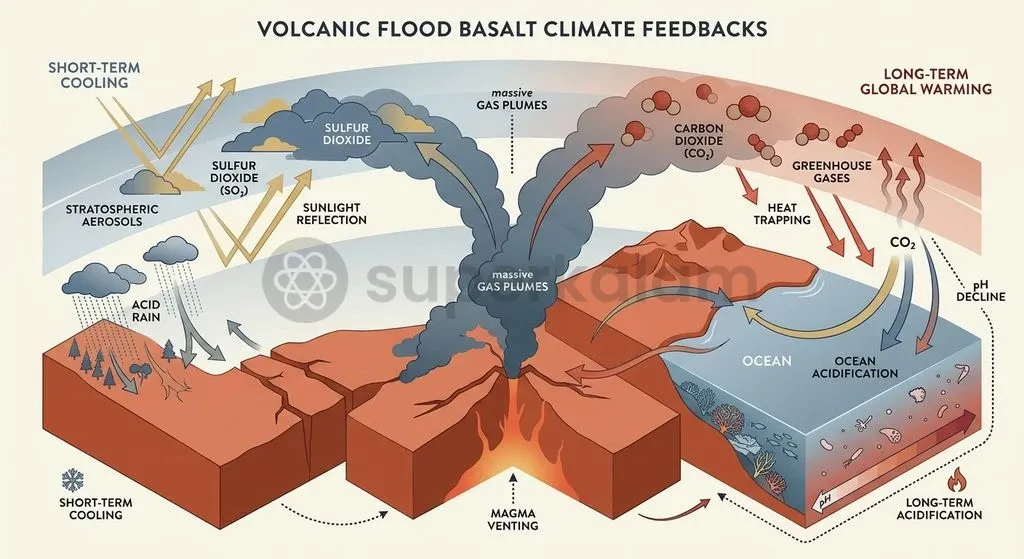
Rapid continental flood basalt eruptions trigger severe environmental disruptions across Earth history. Burgess and co-authors established that the end-Permian mass extinction approximately 252 million years ago coincided directly with the eruption of the Siberian Traps. These flood basalts vented massive volumes of greenhouse gases into the ocean-atmosphere system, driving the most severe biotic crisis on record.
A comparable volcanic surge marked the Cretaceous-Paleogene boundary 66 million years ago. The Deccan Traps erupted alongside the Chicxulub bolide impact. Schoene and colleagues showed through high-precision geochronology that Deccan magmatic pulses occurred in rapid, multi-stage outbursts across this boundary, stressing ecosystems already vulnerable to collapse.
Plume-fed flood basalts destabilise planetary climate through paired atmospheric shocks:
- Short-term volcanic winter: Massive sulphur dioxide emissions induce rapid cooling and severe acid rain.
- Long-term climate disruption: Vast releases of carbon dioxide and methane provoke sustained greenhouse warming and ocean acidification.
- Thermogenic gas escalation: When basaltic sills bake organic-rich sedimentary basins, runaway volatile degassing ravages both marine and terrestrial food webs.
The Great Tectonic Debate: Deep Thermal Upwelling vs Shallow Plate Stress
Geoscientists debate whether intraplate magmatism originates from deep thermal upwellings or shallow lithospheric cracking. Morgan's bottom-up model treats autonomous thermal upwellings as the primary drivers of intraplate volcanism. Conversely, Don L. Anderson proposed a top-down paradigm, arguing that shallow lithospheric extension, non-rigid plate cracking, and upper-mantle chemical fertility govern intraplate melting.
Gillian Foulger and other top-down proponents note that lithospheric tensile stress dictates where magma breaches the surface, arguing deep plumes are unnecessary. Tomographic imaging reveals an intermediate reality. Some primary plumes possess continuous conduits reaching the D'' layer at 2,890 kilometres, while other melting anomalies remain confined to the upper mantle.
| Paradigm | Primary Driving Mechanism | Source Depth | Controlling Factor for Volcanism |
|---|---|---|---|
| Bottom-Up (Plume Model) | Thermal buoyancy from core-mantle boundary | Core-Mantle Boundary (D'' layer, ~2,890 km) | Autonomous deep-mantle upwelling and thermal flux |
| Top-Down (Plate Model) | Lithospheric extension and intraplate stress | Lithosphere and upper asthenosphere | Structural weakness, non-rigid cracking, and mantle fertility |
Deep thermal upwellings provide the most compelling explanation for the extreme thermal and isotopic anomalies observed in Large Igneous Provinces. Meanwhile, lithospheric stress patterns dictate exactly where ascending magma penetrates the surface. Both processes operate as coupled components of Earth's heat engine.
Discuss with Superkalam
If a newly discovered continental flood basalt exhibits high helium-3 to helium-4 isotopic ratios, what does this indicate about its mantle source reservoir?
Ask NowThe Indian Subcontinent Story: How the Reunion Hotspot Forged the Deccan Traps
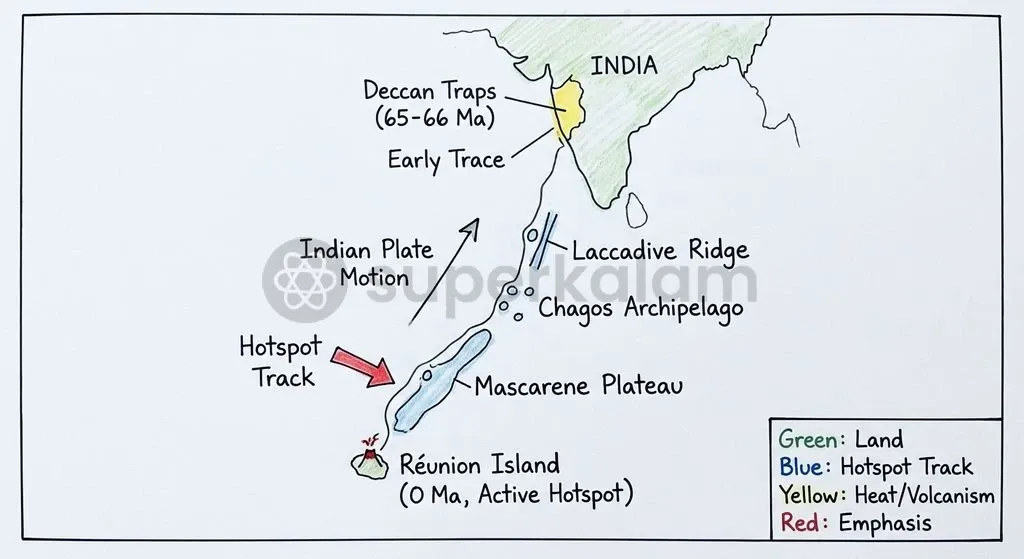
The tectonic evolution of the Indian plate illustrates how mantle plumes reshape continents. Thermal rifting driven by the Marion plume detached Madagascar from Greater India at approximately 88 million years ago, as documented by Storey and colleagues. This breakup opened the oceanic corridor that freed the Indian landmass for its rapid northward journey.
Courtillot and colleagues confirmed that the vast Deccan Traps formed around 65 to 66 million years ago when India traversed the Réunion plume head. The Geological Survey of India reports that Deccan basalts cover over 500,000 square kilometres, reaching stratigraphic thicknesses exceeding 2,000 metres in the Western Ghats.
The passage over the Réunion plume left clear geodynamic signatures:
- Plate acceleration: India accelerated across the Neo-Tethys to extraordinary rates of 15 to 20 centimetres per year, as shown by Kumar and colleagues.
- Lithospheric erosion: Paul and Ghosh demonstrated that the plume thermally eroded up to 130 kilometres of India's basal continental root, slashing mantle drag.
- Linear volcanic tracks: Duncan traced the trailing plume tail across the Chagos-Laccadive Ridge and Mascarene Plateau, terminating at active Réunion Island.
Revising the Wilson Cycle: What Plumes Mean for Earth's Geologic Future
The classical Wilson Cycle explains the opening and closure of ocean basins primarily through horizontal forces. Deep-mantle plumes revise this model by showing that horizontal slab-pull alone rarely initiates continental breakup. Impinging plume heads supply the dynamic uplift and thermal softening necessary to rupture rigid continental lithosphere.
Plume action updates our understanding of continental lifecycles through two distinct stages:
- Thermal conditioning: Plume heads heat and weaken thick cratonic roots, preconditioning stable lithosphere for extensional failure.
- Active modern rifting: The East African Rift System captures this process today, where mantle upwellings are thinning continental crust and opening young extensional basins that will eventually split the Horn of Africa from the mainland.
Discuss with Superkalam
Evaluate the strengths and limitations of Morgan's bottom-up plume hypothesis versus Anderson's top-down plate stress model in explaining intraplate volcanism.
Ask NowKey Takeaways
- Classical plate tectonics fails to explain intraplate volcanism located far from active plate boundaries, necessitating the deep-mantle plume hypothesis.
- Mantle plumes originate via thermo-chemical instabilities at the Core-Mantle Boundary (D'' layer) at an approximate depth of 2,890 kilometres, rooted along Large Low Shear Velocity Provinces (LLSVPs).
- Ascending plumes consist of a bulbous head (500–2,000 km across) causing dynamic uplift and flood basalts, followed by a narrow conduit tail generating age-progressive hotspot tracks.
- Plume-driven continental doming generates three-arm rift systems (triple junctions), facilitating the fragmentation of supercontinents like Pangea and Gondwana into dispersing plates.
- The Deccan Traps erupted 65 to 66 million years ago over the Réunion hotspot, thinning India's lithospheric root by up to 130 km and accelerating its drift to 15–20 cm/year.
- Massive volatile degassing from plume-generated flood basalts (such as the Siberian and Deccan Traps) produced catastrophic climate disruptions coinciding with global mass extinctions.
Mains Question
"Classical plate tectonics views planetary dynamics as a horizontal, lithosphere-driven system; however, deep thermal plumes introduce an essential vertical thermodynamic engine." Examine how mantle plumes initiate continental rifting and reshape supercontinents. (10 Marks)
Evaluate NowMains Question
The geodynamic transit of the Indian tectonic plate over mantle plumes profoundly altered its lithospheric architecture, velocity, and surface environment. Elucidate with specific reference to the Marion and Réunion hotspots. (15 Marks)
Evaluate NowPractice MCQs
QUESTION 1
With reference to the dynamics of mantle plumes and hotspots, consider the following statements:
- The plume head is a bulbous thermal swelling that lasts for tens of millions of years at the surface.
- The plume tail constitutes a narrow conduit that can create age-progressive volcanic chains as a tectonic plate drifts over it.
- Basalts derived from plumes such as Hawaii and Réunion exhibit high helium-3 to helium-4 isotopic ratios, indicating an origin in primordial chemical reservoirs. Which of the statements given above are correct?
QUESTION 2
Consider the following statements regarding the Core-Mantle Boundary and mantle plume dynamics:
- The D'' layer, situated at a depth of approximately 2,890 kilometres, acts as a primary thermo-chemical boundary layer triggering buoyant plume instabilities.
- Large Low Shear Velocity Provinces (LLSVPs) known as Tuzo and Jason focus rising mantle plumes along their margins.
- Ascending plume heads cause lithospheric subsidence of 1,000 to 2,000 metres prior to volcanic eruption. Which of the statements given above is/are correct?
QUESTION 3
Regarding the geodynamic evolution of the Indian Subcontinent, consider the following statements:
- The breakup of Madagascar from Greater India around 88 million years ago was driven by thermal rifting associated with the Marion plume.
- Deccan flood basalts erupted when the Indian plate traversed the Réunion plume head approximately 65 to 66 million years ago.
- Passage over the Réunion plume thermally eroded up to 130 kilometres of India's basal continental root, contributing to plate acceleration. Which of the statements given above is/are correct?
QUESTION 4
In the context of plume-induced continental rifting, what is the term used to describe the failed third arm of a 120-degree triple junction that ceases spreading and preserves an aborted rift graben?
QUESTION 5
Consider the following pairs of tectonic theories and their primary characteristics:
- Bottom-Up Plume Model: Driven by thermal buoyancy from the D'' layer at the core-mantle boundary.
- Top-Down Plate Model: Governed by lithospheric extension, tensile stress, and upper-mantle chemical fertility.
- Wilson Cycle Revision: Classical horizontal plate mechanics are fully capable of explaining continental interior intraplate volcanism without deep plumes. Which of the pairs given above is/are correctly matched?
Discuss with Superkalam
Imagine you are developing a geodynamic model of continental breakup: formulate the sequence of structural stages from dynamic crustal doming to failed rift aulacogens.
Ask Now