Zero FIR Under BNSS: Section 173 and Crime Burking Explained
While Section 173 makes Zero FIR a statutory right, ending crime burking requires overcoming missing transfer deadlines and police resistance at the station gate.
Nov, 2026
•10 min read

Overview
Section 173(1) of the Bharatiya Nagarik Suraksha Sanhita, 2023 transforms the Zero FIR from an administrative convention into an explicit statutory right. Police officers must now record information regarding cognizable offences regardless of territorial jurisdiction.
This mandate directly targets the institutional inertia that stalls investigations during the initial hours of a crime. Yet statutory words alone cannot eliminate crime burking. Without legally binding transfer deadlines and rigorous systemic oversight, station-level resistance will persist.
Why Zero FIR Is Under Scrutiny with the Rollout of BNSS
Section 173 of the Bharatiya Nagarik Suraksha Sanhita, 2023 took effect as part of a sweeping overhaul of Indian criminal procedure. As of July 2024, the operational shift from the Code of Criminal Procedure, 1973 has placed station-level intake under intense public and judicial scrutiny. For decades, victims faced rejection when reporting crimes at stations outside their territorial limits.
Station-level gatekeeping historically crippled the justice system. The Second Administrative Reforms Commission highlighted this breakdown in its Fifth Report. Jurisdictional disputes between adjacent stations routinely degenerate into jurisdictional ping-pong, with officers bouncing victims back and forth.
This bureaucratic deflection causes severe operational damage:
- Investigation delays: Disputes over police boundaries stall inquiries during the golden hours.
- Forensic compromise: Physical evidence degrades while officers argue over jurisdiction.
- Complainant trauma: Bouncing victims across stations causes evidence degradation and complainant attrition.
Section 173 of the Sanhita establishes an unambiguous statutory right to register. Even so, codification alone cannot end crime burking. Meaningful change requires strict transfer deadlines and automated digital monitoring across all police ranks.
Discuss with Superkalam
Which specific statutory provision in the Bharatiya Nagarik Suraksha Sanhita, 2023 mandates the registration of an FIR irrespective of territorial jurisdiction?
Ask NowWhat Is a Zero FIR and How Does It Work?
The Bharatiya Nagarik Suraksha Sanhita formalises the Zero FIR to register cognizable crimes reported to out-of-jurisdiction stations. A First Information Report (FIR) triggers criminal proceedings under Indian procedural law. Under Section 173(1) of the Sanhita, the officer in charge cannot refuse registration simply because the crime occurred elsewhere.
Guidelines from the Bureau of Police Research & Development require the station to register this initial complaint under serial number '0'. This zero placeholder documents the cognizable disclosure without consuming an annual serial number from the station's local crime register. Consequently, it prevents artificial inflation of the registering station's local crime statistics.
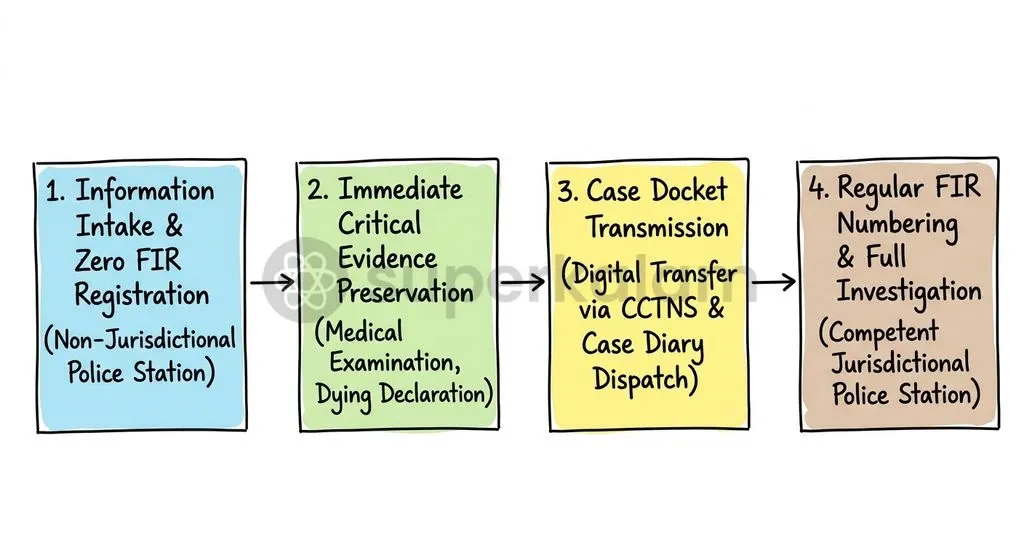
The standard operational workflow follows four sequential stages:
- Information Intake: The complainant gives information orally or in writing to an officer in charge at any station, irrespective of where the crime occurred.
- Immediate Evidentiary Measures: The registering station takes urgent procedural steps. These include securing endangered crime scenes and sending injured persons or sexual assault survivors for prompt medical examinations.
- Docket Transmission: Officers compile the statement, medical reports, and contemporaneous seizure memos into a physical and digital file for transit.
- Regular Re-registration: The jurisdictional police station receives the case file and enters it into its regular crime register under a fresh, local annual number.
According to Crime Branch Circular No. 02/2024, the registering station must complete essential evidentiary tasks before dispatching the case file. These duties include arranging medical examinations for victims of sexual offences under Section 164 of the Sanhita. Officers must also record dying declarations when a victim faces imminent danger of death. Immediate action protects fragile forensic traces that delay would permanently destroy.
From Judicial Mandate to Statute: Lalita Kumari to Section 173 BNSS
The Code of Criminal Procedure, 1973 contained no explicit rule requiring registration outside territorial boundaries, omitting the term "Zero FIR" entirely. Section 154 of the 1973 Code merely directed officers to record disclosures of cognizable crime. This silence gave station staff an easy excuse to turn complainants away and tell them to visit the local station holding geographical jurisdiction.
Decades of judicial intervention sought to bridge this administrative void:
- Satvinder Kaur v. State (Govt of NCT of Delhi) (1999): The Supreme Court ruled that a police officer cannot refuse investigation at the threshold stage on grounds of lacking territorial jurisdiction.
- Justice J.S. Verma Committee (January 2013): Following the December 2012 gang-rape incident in Delhi, the committee recommended that police stations must record information on cognizable crimes without turning complainants away on territorial grounds.
- Ministry of Home Affairs Advisory (10 May 2013): The Ministry directed all States and Union Territories to mandate that police register an FIR or a Zero FIR immediately upon receipt of cognizable information.
- Lalita Kumari v. Government of Uttar Pradesh (2013): A five-judge Constitution Bench declared that registration of an FIR is mandatory under statutory law if information reveals a cognizable offence, leaving no discretion to the police officer.
Police adherence remained inconsistent because executive advisories and judicial rulings lacked direct statutory backing within the 1973 Code. Section 173(1) of the Bharatiya Nagarik Suraksha Sanhita, 2023 fixes this historic omission. It embeds the phrase "irrespective of the area where the offence is committed" directly into the opening statutory mandate of criminal procedure.
Discuss with Superkalam
How does the procedural life cycle and numbering of a Zero FIR differ from that of a regular FIR?
Ask NowRegular FIR vs Zero FIR: Key Differences in Procedure and Evidence Handling
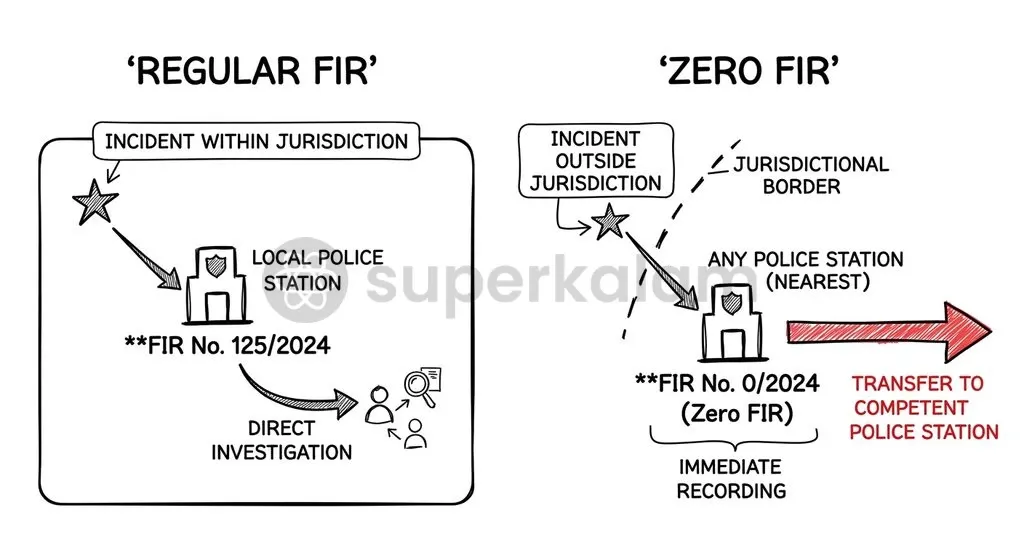
A regular FIR and a Zero FIR diverge in jurisdiction, numbering, and investigative scope. A regular FIR triggers a full investigation within the registering station's territorial limits. In contrast, a Zero FIR operates as an emergency procedural placeholder. It secures contemporaneous statements and forensic evidence before transferring the case to the competent station.
The operational differences between both filings appear in the comparative structure below:
| Procedural Parameter | Regular FIR | Zero FIR |
|---|---|---|
| Primary Statutory Basis | Section 173(1) of the BNSS, 2023 (corresponding to Section 154 CrPC, 1973) | Section 173(1) of the BNSS, 2023 (explicit phrase: "irrespective of the area") |
| Territorial Jurisdiction | Exclusively registered by the police station holding local territorial competence | Registered by any police station regardless of crime location |
| Crime Register Numbering | Allocated a permanent, sequential local annual serial number (e.g. Crime No. 45/2024) | Allocated serial number '0' to avoid consuming local station diary numbers |
| Investigative Scope | Comprehensive investigation, witness examination, search, seizure, and final charge-sheet filing | Restricted to immediate time-sensitive measures: medical exams, dying declarations, scene preservation |
| Post-Registration Trajectory | Investigated locally and culminated in a final report to the local jurisdictional Magistrate | Physical and electronic transmission to the competent territorial police station |
| Final Case Numbering | Retains its original registration serial number throughout judicial proceedings | Re-registered at the receiving station under a fresh, local annual serial number |
The BPR&D Training Manual on the Sanhita notes that the receiving station cannot treat the Zero FIR as an administrative footnote. That station assigns a fresh, regular annual serial number from its own register. This entry becomes the permanent identifier for subsequent investigation and charge-sheet filing before the jurisdictional Magistrate.
Why Police Stations Still Evade Zero FIRs: The Problem of Crime Burking
In its 154th Report, the Law Commission of India identified the institutional practice of crime burking. Burking refers to the deliberate suppression, minimisation, or non-registration of cognizable offences to fabricate an artificial drop in local crime statistics. Station officers face intense scrutiny based on reported crime figures within their beats. As a result, many treat territorial questions as a convenient pretext to turn victims away.
Bureaucratic incentives in station administration actively encourage this non-registration:
- Statistical minimisation: Station house officers suppress crime entries to present an impression of low crime during monthly supervisory reviews.
- Investigation workload deflection: Registering out-of-district cases requires inter-station coordination and forensic dispatch. Overburdened station staff routinely avoid these tasks.
- Informal mediation and settlements: Officers frequently downgrade serious cognizable complaints to non-cognizable disputes, pushing parties toward informal compromises at the station gate.
- Fear of disciplinary scrutiny: Officers worry that recording high numbers of violent crimes will signal poor vigilance, punishing transparency while rewarding concealment.
This institutional posture harms victims through compounded delays. As the Second Administrative Reforms Commission noted in its Fifth Report on Public Order, jurisdictional squabbles cause evidence degradation and complainant attrition. Victims of severe violence often abandon the legal process entirely out of sheer exhaustion.
Discuss with Superkalam
Analyse how administrative performance metrics tied to reported crime figures inadvertently incentivize police officers to commit crime burking.
Ask NowGaps in BNSS: The Missing Penalties for Inter-Station Transfer Delays
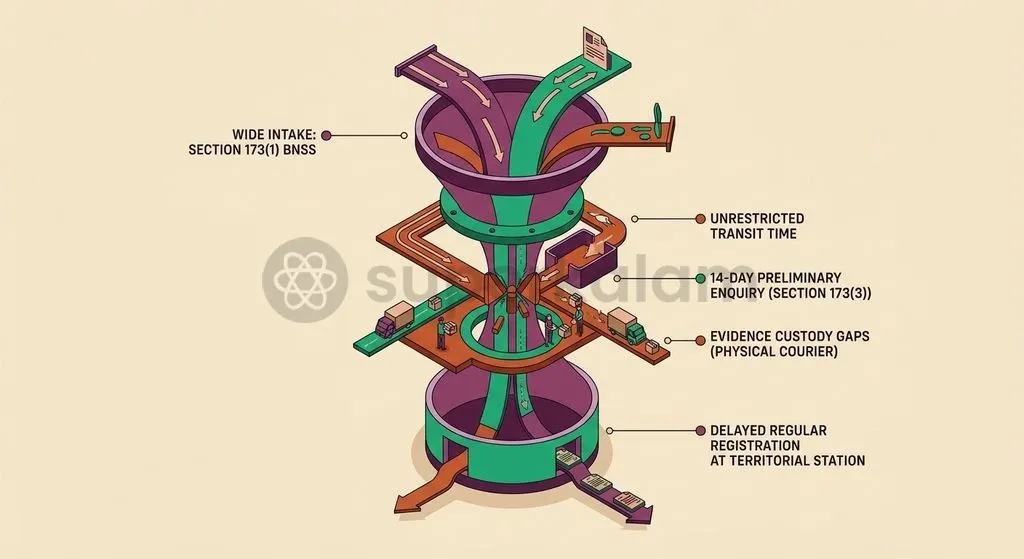
Section 173 of the Bharatiya Nagarik Suraksha Sanhita creates a statutory mandate to register a Zero FIR. However, it omits the practical safeguards needed to enforce that right. Most glaringly, Section 173 sets no mandatory statutory timeline for transferring the completed docket to the jurisdictional police station. This silence allows case files to sit in transit without triggering automatic statutory default.
Four major statutory and operational gaps persist across the procedure:
- Unspecified transfer deadlines: The absence of statutory transfer limits leaves inter-station file transit entirely to unmonitored administrative discretion.
- Preliminary enquiry delays: Section 173(3) introduces a preliminary enquiry window of up to 14 days, conducted with prior permission of a Deputy Superintendent of Police, for offences punishable with three to seven years imprisonment. This provision creates an administrative avenue to delay registration under the guise of threshold assessment.
- Chain-of-custody ambiguity: Per a BPR&D research study (as reported, 2 September 2024), ambiguity in chain-of-custody protocols during the physical transit of a Zero FIR docket between non-contiguous districts creates operational vulnerabilities. These gaps heighten the risk of evidence tampering and systemic accountability deficits.
- Strict e-FIR signature windows: Section 173(1)(ii) allows electronic reporting but mandates that the informant sign the communication within three days for it to be formally registered. Missing this seventy-two-hour cutoff risks procedural nullification, penalising victims facing displacement or hospitalisation.
Fixing Police Reluctance: Administrative Reforms and Digital Accountability
The statutory framework provides specific penal sanctions against public servants who subvert registration mandates. Institutional accountability operates across three primary levels:
- Penal sanctions under BNS: Under Section 199(c) of the Nyaya Sanhita, any public servant who fails to record information under Section 173(1) of the Sanhita for specified offences against women and children faces mandatory rigorous imprisonment between six months and two years, alongside a fine. Section 198 of the Nyaya Sanhita also penalises public servants who knowingly disobey directions of law with simple imprisonment up to one year, a fine, or both.
- Independent grievance redressal: In Prakash Singh v. Union of India, the Supreme Court directed the establishment of District Police Complaints Authorities, headed by a retired district judge, to investigate complaints of serious misconduct, including non-registration of FIRs, against officers up to the rank of Deputy Superintendent of Police. Informants facing refusal also retain the statutory remedy under Section 173(4) of the Sanhita to submit the substance of their complaint by post directly to the Superintendent of Police.
- Automated digital tracking: According to National Crime Records Bureau guidelines, the Crime and Criminal Tracking Network & Systems (CCTNS) enables inter-station electronic generation and real-time tracking of Zero FIR transfers across police stations nationwide. Automating docket transmission via CCTNS bypasses physical courier delays and logs immutable digital audit trails. The platform also alerts senior supervisory officers whenever a transferred case exceeds operational transfer deadlines.
Discuss with Superkalam
What institutional accountability mechanism would you design to prevent inter-station delays when transferring a Zero FIR docket?
Ask NowKey Takeaways
- Explicit statutory recognition: Section 173(1) of the Bharatiya Nagarik Suraksha Sanhita, 2023 codifies Zero FIR into parliamentary statute, removing jurisdictional barriers present under Section 154 of the 1973 Code.
- Mandated evidentiary duties: Registering stations must complete non-deferrable evidentiary actions, including medical examinations under Section 164 of the Sanhita and dying declarations, before transferring the case file.
- Administrative impediment of burking: Crime burking, driven by statistical manipulation and workload avoidance, remains the primary operational obstacle to genuine Zero FIR enforcement at station level.
- Statutory gap in BNSS: Section 173 of the Sanhita establishes the right to register a Zero FIR but fails to impose mandatory statutory timelines for transferring dockets to jurisdictional stations.
- Penal deterrence under BNS: Section 199(c) of the Bharatiya Nyaya Sanhita prescribes rigorous imprisonment between six months and two years for officers who refuse to record cognizable offences concerning women and children.
Mains Question
"Statutory codification under Section 173(1) of the Bharatiya Nagarik Suraksha Sanhita, 2023 transforms the Zero FIR from an administrative convention into an enforceable right, yet procedural gaps continue to hinder its intended objective." Critically analyse. (15 Marks)
Evaluate NowMains Question
Highlighting the observations of the Second Administrative Reforms Commission regarding 'jurisdictional ping-pong', examine the systemic drivers of crime burking at the police station level. (10 Marks)
Evaluate NowPractice MCQs
QUESTION 1
Regarding the registration and processing of a 'Zero FIR' under Indian criminal procedure, consider the following statements:
- Section 173(1) of the Bharatiya Nagarik Suraksha Sanhita, 2023 explicitly mandates the recording of cognizable crime information irrespective of where the offence was committed.
- A Zero FIR is registered under serial number '0' to prevent the artificial inflation of the registering police station's annual crime figures.
- Upon receiving a transferred Zero FIR, the jurisdictional police station conducts the trial using the original serial number assigned at the initial station. Which of the statements given above is/are correct?
QUESTION 2
Consider the following statements regarding procedural law and judicial developments on FIR registration in India:
- The Code of Criminal Procedure, 1973 contained an express statutory provision codifying the procedure for 'Zero FIR'.
- In Lalita Kumari v. Government of Uttar Pradesh (2013), the Supreme Court held that the registration of an FIR is mandatory if the information discloses a cognizable offence.
- The Justice J.S. Verma Committee recommended that police stations must record information on cognizable crimes without deflecting complainants on territorial grounds. Which of the statements given above are correct?
QUESTION 3
Which of the following actions is a registering police station mandated to complete before dispatching a Zero FIR docket to the competent territorial station under Crime Branch Circular No. 02/2024?
- Arranging medical examination for victims of sexual offences under Section 164 of the Sanhita
- Recording dying declarations of victims facing imminent danger of death
- Filing a final charge-sheet before the jurisdictional Magistrate Select the correct answer using the code given below:
QUESTION 4
In Indian police administration, the term 'crime burking' primarily refers to:
QUESTION 5
With reference to the institutional challenges identified in police handling of complaints, consider the following statements:
- The Second Administrative Reforms Commission pointed out that jurisdictional squabbles between police stations lead to evidence degradation and complainant attrition.
- Section 173 of the Bharatiya Nagarik Suraksha Sanhita, 2023 lays down strict penal consequences and automatic default penalties for inter-station transmission delays. Which of the statements given above is/are correct?