India's Potential GDP: Why Misreading the Output Gap Traps Policy
Misreading India's productive capacity risks runaway inflation from excess stimulus or choked economic growth from premature rate hikes by the central bank.
Nov, 2026
•10 min read

Context
Potential GDP is the non-inflationary speed limit of an economy. It measures the maximum volume of real goods and services a country can sustainably produce when labour and capital operate at normal utilisation rates.
Calculating the output gap—the mathematical difference between actual national production and this theoretical ceiling—determines whether the Reserve Bank of India should alter benchmark interest rates or whether the Ministry of Finance should adjust fiscal deficits.
Mismeasuring this unseen capacity creates grave policy errors. Treating structural deceleration as a cyclical downturn leads to inflationary over-stimulus. Conversely, underestimating productive potential triggers premature monetary tightening that unnecessarily chokes economic expansion.
Why Potential GDP and the Output Gap Matter for Policy Today
The Reserve Bank of India relies on potential GDP estimates to calibrate monetary policy without destabilising domestic price levels. Potential output is the operational speed limit for national growth. Accelerating past this threshold strains domestic supply chains, inflates wages, and fuels demand-pull price pressures across the broader economy.
Policymakers in New Delhi face a recurring diagnostic challenge when actual economic growth deviates from targets:
- Cyclical slowdown: A temporary shortfall in aggregate demand that requires counter-cyclical monetary and fiscal easing.
- Structural deceleration: An enduring decline in productive capacity where demand stimulus triggers price spirals instead of growth.
As noted in research from the Brookings Institution, treating a structural drop in productive capacity as a temporary demand shock prompts governments to deploy debt-financed stimulus, triggering inflation rather than sustainable production gains.
Accurate measurement of the output gap secures institutional credibility under India's macroeconomic framework. The Monetary Policy Committee balances price stability with growth objectives under Section 45ZB of the Reserve Bank of India Act, 1934. Mismeasuring this unseen benchmark directly skews statutory rate decisions, tax collection projections, and sovereign debt targets.
Discuss with Superkalam
Recall the exact percentage threshold cited in the article as the optimal inflation target where the output gap closes without price distortions.
Ask NowWhat Are Potential GDP and the Output Gap?
Potential GDP measures the maximum output an economy sustains over the medium term under full resource utilisation without stoking price pressures. According to an analytical study published in the RBI Working Paper Series, this conceptual benchmark reflects complete, sustainable employment of domestic capital equipment and available labour supply without generating inflationary friction.
The output gap expresses the percentage deviation between real gross domestic product and this unobserved productive frontier. The Reserve Bank of India calculates this operational metric using the standard arithmetic formulation:
$$\text{Output Gap} = \left(\frac{\text{Actual GDP} - \text{Potential GDP}}{\text{Potential GDP}}\right) \times 100$$
(Expressed as actual output minus potential output, divided by potential output, multiplied by one hundred).
| Economic Metric | Positive Output Gap | Negative Output Gap |
|---|---|---|
| Operational Definition | Actual gross output exceeds sustainable potential capacity | Actual output falls below productive economic capacity |
| Capacity Utilisation | Factories run above normal capacity; labour shortages emerge | Capital equipment sits idle; structural underemployment rises |
| Price Transmission | Aggregate demand outstrips aggregate supply, causing inflation | Slack demand generates persistent disinflationary headwinds |
| Monetary Response | Tightening policy stance; raising policy repo rates | Accommodative policy stance; lowering repo rates to spur demand |
| Empirical Source | RBI Mint Street Memos No. 14 | RBI Bulletin: Estimation of Potential Output |
A positive output gap emerges when aggregate spending outpaces domestic productive limits, forcing enterprises to pay overtime wages and bid up input materials. A negative output gap reflects persistent economic slack, where unused factory capacity and surplus workers induce disinflationary pressures across wholesale and consumer markets.

How the Output Gap Governs Inflation: The Phillips Curve Link
The Phillips Curve links output gap movements directly to consumer price inflation across developing and advanced economies. When actual output runs above potential, competition for scarce productive inputs bids up production costs and drives consumer price inflation upward.
Central bank research confirms the presence of an asymmetric, convex Phillips Curve within the Indian economy:
- Flat during downturns: An empirical study published in the RBI Bulletin demonstrated that this curve remains relatively flat during periods of negative output gaps, meaning disinflation takes time to manifest when industrial slack exists.
- Steep during expansions: The slope steepens rapidly once the output gap shifts into positive territory, causing headline inflation to accelerate sharply as capacity bottlenecks emerge.
Structural bottlenecks in domestic agriculture and distribution networks compound these demand pressures. When aggregate domestic demand approaches potential output, supply rigidities transform incremental spending into higher consumer prices rather than real physical production. Empirical evaluations published in an RBI Discussion Paper indicate that an inflation target of 4.0 percent marks the optimal threshold where the output gap closes without generating price distortions.
Discuss with Superkalam
Explain how an asymmetric, convex Phillips Curve alters the speed at which inflation accelerates compared to how disinflation sets in.
Ask NowJobs and Growth: Why Okun's Law Breaks Down in India
Okun's Law fails to hold reliably in the Indian economy. Vast structural informality across rural and urban labour markets severs the link between headline growth and open joblessness. Traditional macroeconomic models assume that every two to three percentage point drop in actual gross output relative to potential raises open unemployment by approximately one percentage point.
Cross-country empirical evidence from the International Monetary Fund demonstrates that this negative trade-off breaks down across developing economies with large agrarian workforces.
In India, this relationship fractures along two structural realities:
- Disguised underemployment absorbs shocks: Economic slowdowns rarely translate into formal, open job terminations. Displaced workers instead migrate back to subsistence agriculture, casual wage labour, or informal self-employment, masking macroeconomic slack as disguised underemployment rather than visible open unemployment.
- Low employment elasticity of growth: Structural research indicates that the employment elasticity of growth in India has remained structurally low, reported as falling below 0.20 across key growth sectors.
Because output growth generates minimal formal payroll positions, tracking open unemployment surveys yields little actionable insight into whether the output gap is positive or negative. The Reserve Bank of India cannot rely on standard unemployment statistics to determine macroeconomic slack.
How the RBI Tracks the Unseen: Urjit Patel Committee Mandate and Policy Reports
The Urjit Patel Committee established the output gap as a primary operational anchor for Indian monetary policy formulation. Submitted in 2014, the Report of the Expert Committee to Revise and Strengthen the Monetary Policy Framework recommended adopting Flexible Inflation Targeting, prioritising consumer price index inflation while responding to domestic output gaps.
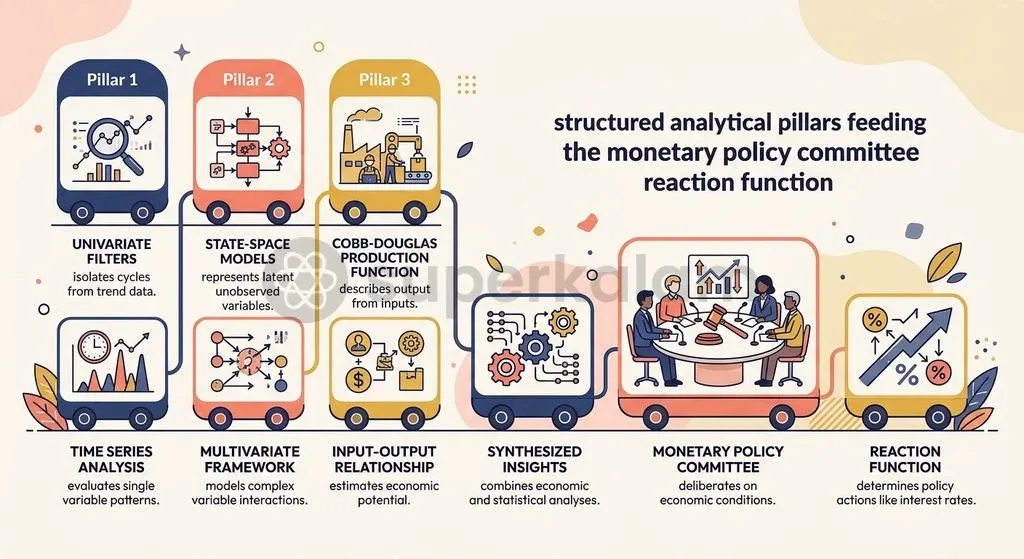
Because potential output is an unobservable latent variable, the central bank must infer its value using econometric methodologies. In its bi-annual Monetary Policy Report, the Reserve Bank of India deploys three complementary analytical approaches to track trend production:
- Univariate Statistical Filters: Techniques such as the Hodrick-Prescott (HP) filter decompose historical GDP time series into cyclical movements and permanent secular trends.
- Multivariate Kalman Filters: Dynamic state-space models integrate macroeconomic relationships, cross-referencing inflation readings and capacity utilisation data to estimate unobserved supply potential.
- Cobb-Douglas Production Function: A structural framework that models output based on capital stock accumulation, labour inputs, and Total Factor Productivity (TFP), which captures underlying technological efficiency.
Financial sector variables provide an additional lens for central bankers. Research on the Finance-Neutral Output Gap (FNOG) reveals that traditional measures miss dangerous vulnerabilities when asset markets, bank credit, and property prices expand rapidly during intervals of subdued price inflation. Incorporating leverage ratios prevents the monetary authority from mistaking debt-driven credit booms for sustainable structural expansion.
Discuss with Superkalam
If a government mistakes a structural slowdown for a cyclical demand shortfall, what fiscal and monetary outcomes would you anticipate?
Ask NowThe Structural Slowdown Debate: Did India's Potential Fall from 8% to 6.5%?
India's potential GDP growth rate underwent a measurable deceleration following the 2008 global financial crisis. According to central bank econometric assessments, India's potential growth surged to around 8.0 percent annually during the 2003–2008 boom period, driven by surging corporate investment and strong total factor productivity gains.
Growth subsequently decelerated across distinct macroeconomic phases:
- Post-Crisis Tapering (2009–2015): Capital accumulation tapered, reducing trend expansion toward 7.0 percent. Protracted corporate debt distress—termed the Twin Balance Sheet challenge—paralysed private capital expenditures as commercial banks struggled with non-performing loans.
- Credit Friction (2018): The 2018 non-banking financial company liquidity crunch further constrained domestic credit distribution across capital-intensive industries.
- Pandemic Scarring (2020 onward): The Reserve Bank of India observed in its Report on Currency and Finance that pandemic disruptions inflicted lingering capital scarring and labour market reallocation, temporarily pushing trend potential growth below 6.0 percent.
Headline output rebounded post-pandemic, but rebuilding long-term potential requires repairing degraded capital assets. It also requires addressing educational learning losses among entering workers.
The Policy Trap: How Faulty Output Gap Estimates Misguide Rates and Budgets
Mismeasuring potential output creates severe macroeconomic distortions by leading fiscal and monetary authorities into opposite policy traps. When a central bank or finance ministry misdiagnoses structural impediments as a cyclical slowdown, it deploys demand-side remedies to fix what are fundamentally supply-side deficiencies.
India experienced the costly overestimation trap firsthand between 2009 and 2013. The Ministry of Finance noted in the Economic Survey 2015-16 that policymakers sustained post-crisis fiscal and monetary stimulus under the mistaken assumption that India's potential growth remained at 8 to 9 percent. Real domestic capacity had already downshifted. As a result, surplus liquidity could not generate physical goods, igniting double-digit consumer inflation and pushing the Current Account Deficit to unsustainable highs during the 2013 Taper Tantrum.
| Policy Miscalculation | Overestimation Mistake | Underestimation Mistake |
|---|---|---|
| Core Assumption | Potential growth is high (e.g., 8 to 9 percent) | Potential growth is low (e.g., 6.0%) |
| Economic Reality | Potential capacity has fallen (e.g., to 7.0%) | Productive frontier is actually higher (e.g., 7.5%) |
| Prescribed Policy Action | Extended fiscal and monetary stimulus | Pre-emptive monetary rate tightening |
| Macroeconomic Result | Double-digit inflation, twin deficits (e.g., 2009–2013) | Choked credit, sacrificed employment and growth |
The reverse hazard occurs when authorities underestimate potential output. An analytical study by the National Institute of Public Finance and Policy observed that underestimating potential GDP causes central banks to view healthy, non-inflationary expansions as overheating, leading to premature rate hikes that choke off credit.
Monetary policy cannot correct supply contractions. Lowering rates during a supply disruption fuels headline inflation without expanding physical capacity.
Discuss with Superkalam
Compare the effectiveness of using open unemployment rates versus capacity utilisation surveys when determining macroeconomic slack in India.
Ask NowRaising the Ceiling: Supply-Side Reforms to Expand India's Productive Capacity
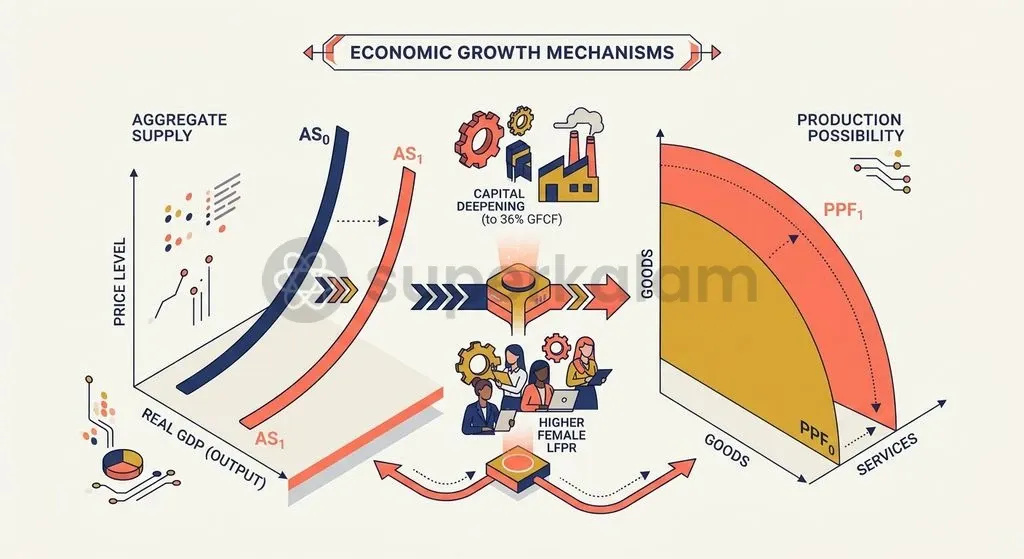
Supply-side interventions are the only viable path to shifting India's potential growth frontier outward on a permanent basis. Macroeconomic research demonstrates that physical capital formation is the single largest quantitative contributor to India's potential output, surpassing raw labour expansion and efficiency gains.
Two critical levers govern this capacity expansion:
- Gross Fixed Capital Formation (GFCF): The Ministry of Finance highlighted in the Economic Survey 2023-24 that lifting India's sustainable growth rate to 8.0 percent requires increasing the GFCF rate from recent levels of 31 to 33 percent toward 35 percent of GDP. Sustained public infrastructure capital expenditure lowers logistics costs and crowds in private corporate investments.
- Female Workforce Mobilisation: As reported by the Ministry of Statistics and Programme Implementation in the Periodic Labour Force Survey Annual Report 2023-24, India's Female Labour Force Participation Rate reached 41.7 percent under usual status. Removing gender barriers through safe public transit, affordable urban childcare, and equal industrial skilling can structurally shift the aggregate production function outward, raising the non-inflationary ceiling for the next decade.
Key Takeaways
- Potential GDP is the medium-term non-inflationary speed limit of an economy, defined by full, sustainable utilisation of capital equipment and domestic labour.
- The output gap measures the percentage deviation of actual GDP from potential GDP, guiding rate decisions for the RBI Monetary Policy Committee.
- Okun's Law displays weak empirical transmission across India due to high informal employment, disguised rural labour, and low sectoral employment elasticity.
- The 2014 Urjit Patel Committee anchored Flexible Inflation Targeting around closing the domestic output gap while targeting 4.0 percent consumer price index inflation.
- Overestimating potential output risks fuelling double-digit inflation through unwarranted demand stimulus, while underestimation induces premature rate hikes that sacrifice real growth.
- Raising potential GDP toward 8.0 percent requires increasing the investment rate to 35 percent of GDP and raising female labour force participation.
Mains Question
"Mismeasuring potential output creates grave policy errors, turning cyclical prescriptions into structural traps." In the light of the Urjit Patel Committee framework, critically examine the challenges faced by the Reserve Bank of India in estimating the output gap for monetary policy formulation. (15 Marks)
Evaluate NowMains Question
'The breakdown of Okun's Law in developing economies highlights why open unemployment figures are an inadequate indicator of macroeconomic slack.' Elucidate with reference to the Indian labour market. (10 Marks)
Evaluate NowPractice MCQs
QUESTION 1
With reference to the Phillips Curve dynamics in the Indian economy, consider the following statements:
- The Phillips Curve in India is found to be symmetric, exhibiting identical slopes during economic expansions and downturns.
- During periods of negative output gaps, disinflation takes time to manifest because the curve remains relatively flat.
- An inflation target of 4.0 percent represents the optimal threshold where the output gap closes without creating price distortions. Which of the statements given above is/are correct?
QUESTION 2
Consider the following statements regarding Okun's Law and its applicability in India:
- Okun's Law posits that an excess of actual gross output relative to potential reduces open unemployment.
- In India, macroeconomic shocks during slowdowns are primarily masked as disguised underemployment rather than open job terminations.
- The employment elasticity of growth across key sectors in India has remained structurally low, falling below 0.20. Which of the statements given above are correct?
QUESTION 3
Which of the following analytical methodologies are deployed by the Reserve Bank of India in its bi-annual Monetary Policy Report to estimate potential output?
- Univariate statistical filters such as the Hodrick-Prescott (HP) filter
- Multivariate Kalman filters integrating dynamic state-space models
- Cobb-Douglas Production Function incorporating Total Factor Productivity Select the correct answer using the code given below:
QUESTION 4
The concept of 'Finance-Neutral Output Gap' (FNOG), examined in Reserve Bank of India research, primarily seeks to address which of the following limitations in traditional output gap measurement?
QUESTION 5
Consider the following statements regarding the institutional and operational framework of potential output in India:
- The Urjit Patel Committee recommended Flexible Inflation Targeting, prioritising CPI inflation while responding to output gaps.
- Under Section 45ZB of the Reserve Bank of India Act, 1934, the Monetary Policy Committee is mandated to balance price stability with growth objectives.
- A positive output gap implies that actual output falls below productive capacity, generating disinflationary headwinds. Which of the statements given above is/are correct?
Discuss with Superkalam
Weigh the benefits and risks of integrating financial variables into traditional output gap models for setting benchmark interest rates.
Ask Now