Environmental Ethics in India: Judicial Mandates vs Executive Development
As courts ground climate resilience in Article 21, executive industrial clearances expose an unresolved constitutional clash over India's ecological future.
Nov, 2026
•10 min read

Overview
Friction between judicial rulings and executive policies in India stems from an unresolved constitutional divide. Utilitarian developmental goals continually clash with rights-based biocentric jurisprudence.
This confrontation surfaced sharply in M.K. Ranjitsinh & Ors. v. Union of India, where green energy infrastructure collided directly with species preservation.
Executive bodies prioritise industrialisation and energy security under non-justiciable state directives. Superior courts, by contrast, expand enforceable fundamental rights to protect ecological integrity and climate resilience.
Resolving this institutional impasse requires moving past reactionary litigation towards pre-clearance cumulative appraisals, binding statutory duties, and institutionalised ecological economics.
Why in the News? The Court's Push for Climate Rights Meets State Development Goals
The Supreme Court of India broadened domestic environmental rights by establishing that citizens possess a fundamental right under Articles 14 and 21 to be free from the adverse effects of climate change. The Court affirmed that life and equality cannot endure without stable ecological systems.
This landmark ruling was delivered in M.K. Ranjitsinh & Ors. v. Union of India (2024).
Executive agencies, conversely, continue pushing large-scale industrial clearances to ensure energy independence, sovereign border infrastructure, and national mineral output. This divide reflects competing institutional philosophies:
- Judicial posture: Considers ecological integrity a non-negotiable prerequisite for human dignity and constitutional survival.
- Executive posture: Treats natural resources as tradeable instruments for sovereign growth and capital accumulation.
As of March 2026, this friction has reached a critical stage across high-stakes infrastructure corridors where environmental safeguards and executive targets directly intersect.
Discuss with Superkalam
Which specific constitutional articles did the Supreme Court link together in M.K. Ranjitsinh (2024) to establish the right against adverse climate change effects?
Ask NowTwo Opposing Worldviews: Human-First Growth vs Nature-First Rights
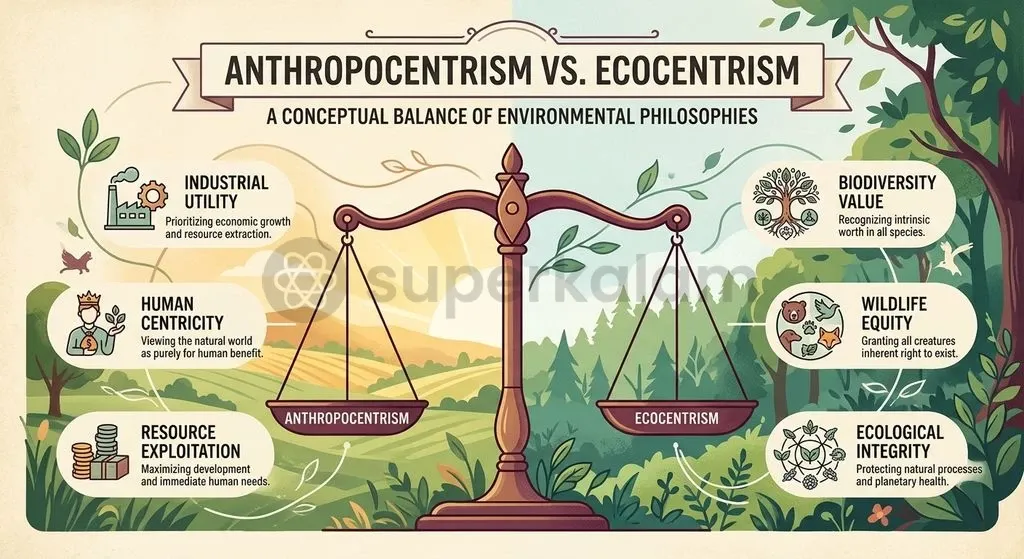
Environmental governance in India reflects two divergent philosophical models that dictate how institutions value nature. Utilitarian anthropocentrism places human welfare at the moral centre, asserting that ecosystems carry only instrumental value for economic sustenance and national security.
Under this approach, clearing ancient forests or altering river courses is considered justifiable whenever aggregate economic gains outweigh localised ecological damage.
Ecocentrism and biocentrism reject this purely commercial calculus. Non-human species possess intrinsic moral standing and an inherent right to exist regardless of human utility.
In T.N. Godavarman Thirumulpad v. Union of India (2012), the Supreme Court affirmed that environmental justice requires shifting from anthropocentric models to an ecocentric framework.
The Court reinforced this stance by applying the species-best-interest standard in Centre for Environmental Law, WWF-India v. Union of India (2013) to mandate the reintroduction of the Asiatic lion.
| Dimension | Utilitarian Anthropocentrism | Ecocentrism / Biocentrism |
|---|---|---|
| Primary Beneficiary | Human populations and sovereign economic welfare | The entire ecological community, including non-human life |
| Value of Nature | Purely instrumental (resources, commodities, capital inputs) | Intrinsic moral standing, irrespective of human utility |
| Philosophical Base | Utilitarian cost-benefit analysis and resource exploitation | Deep Ecology, animal rights, and ecological interconnectedness |
| Judicial Articulation | Early industrial development policies and sovereign resource allocation | T.N. Godavarman (2012), WWF-India (2013), and A. Nagaraja (2014) |
| Trade-Off Resolution | Environmental degradation mitigated by monetary compensation | Strict limits on diversion where survival of critical species is at stake |
Constitutional Anchors: How Articles 21, 48A, and the Public Trust Doctrine Collide
The Constitution of India creates institutional tension by dividing environmental governance between justiciable fundamental rights and non-justiciable state objectives. Article 21 guarantees an enforceable right to life and personal liberty, which the judiciary interprets to encompass unpolluted air, clean water, and ecological stability.
By contrast, Article 48A directs the State to protect and improve the environment, yet sits within Part IV as a non-justiciable directive principle that executive planners balance against immediate developmental demands.
| Constitutional Dimension | Part III (Justiciable Rights) | Part IV (Non-Justiciable Directives) |
|---|---|---|
| Governing Article | Article 21 (Right to Life) | Article 48A (Protection of Environment) |
| Substantive Scope | Right to clean environment and climate resilience | State duty to safeguard forests and wildlife |
| Enforcement Mechanism | Judicial interdictions and Public Interest Litigation | Executive discretion guided by economic and energy priorities |
Judicial intervention relies heavily on the Public Trust Doctrine, introduced into domestic jurisprudence through M.C. Mehta v. Kamal Nath (1997). The Supreme Court held that natural resources like rivers, forests, and air are held by the state in sovereign stewardship for the public, preventing the executive from converting them into private commercial ownership.
Statutory interpretations under Article 51A(g) also guide judicial scrutiny. In Animal Welfare Board of India v. A. Nagaraja (2014), the Court held that Article 51A(g) and Article 51A(h) read with the Prevention of Cruelty to Animals Act, 1960 confer intrinsic rights on animals to live free from unnecessary pain.
This dynamic places executive approvals under strict evaluation against benchmarks from Vellore Citizens' Welfare Forum v. Union of India (1996), including the Precautionary Principle and Intergenerational Equity.
Discuss with Superkalam
Explain how the Public Trust Doctrine limits the executive's discretion in granting commercial clearances over natural resources.
Ask NowOn-the-Ground Flashpoints: Great Nicobar, Hasdeo Arand, and Renewable Energy Corridors
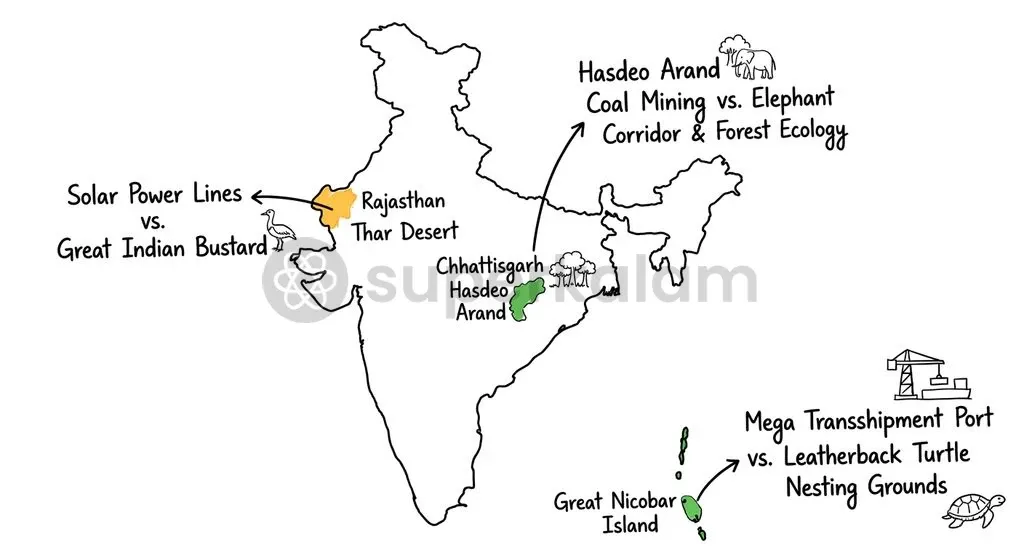
Administrative clearances frequently trigger legal battles when infrastructure corridors encroach upon ecologically sensitive landscapes. The project threatens the critical nesting habitats of the Giant Leatherback Turtle and the Nicobar Megapode.
The ₹72,000-crore Great Nicobar Island project represents one such flashpoint, requiring the diversion of 130.75 square kilometres of primary tropical rainforest.
Legal petitions before the Calcutta High Court (Circuit Bench at Port Blair) asserted that revoking tribal reserve status compromised protections guaranteed to the indigenous Shompen and Nicobarese tribes under the Forest Rights Act, 2006.
The National Green Tribunal upheld the environmental clearance on strategic grounds, remitting procedural monitoring to a High-Powered Committee.
| Project Corridor | Core Ecological Stakes | Judicial & Administrative Status |
|---|---|---|
| Great Nicobar Island (₹72,000-crore project) | Diversion of 130.75 sq km rainforest; habitats of Giant Leatherback Turtle and Nicobar Megapode | Cleared on strategic security grounds; compliance overseen by High-Powered Committee |
| Hasdeo Arand Coalfield (PEKB Coal Block) | Fragmentation of 170,000 hectares of sal forest and vital elephant corridors | Supreme Court stayed NGT suspension of mining to safeguard active power supplies |
| Thar & Deccan Green Corridors | Overhead transmission lines causing fatal Great Indian Bustard collisions | Supreme Court recalled blanket undergrounding mandate to protect national solar targets |
A parallel dispute persists in Chhattisgarh's Hasdeo Arand coalfield, an expanse covering over 170,000 hectares of dense sal forest and vital elephant migration corridors. Forest clearances for the Parsa East and Kanta Basan (PEKB) coal block ignited intense disputes over gram sabha consent under the Forest Rights Act, 2006.
In Civil Appeal No. 4395 of 2014, the Supreme Court stayed an NGT suspension of mining, demonstrating judicial reluctance to disrupt operational thermal energy networks.
Discuss with Superkalam
How can administrative planners design infrastructure corridors to respect the 'species-best-interest standard' when laying transmission lines in wildlife zones?
Ask NowThe Great Indian Bustard Dilemma: When Saving Climate Clashes with Saving Wildlife
In the Great Indian Bustard habitat litigation, the Supreme Court faced an acute dilemma between decarbonisation infrastructure and wildlife survival. High-voltage overhead cables across arid grasslands caused fatal collisions, driving this critically endangered bird toward extinction.
In 2021, the Court prioritised species preservation by ordering that overhead lines across 99,000 square kilometres in Rajasthan and Gujarat be routed underground.
Executive departments and solar developers challenged the ruling, arguing that undergrounding high-voltage transmission lines was technically unfeasible and economically prohibitive. In M.K. Ranjitsinh (2024), the Supreme Court recalled its blanket undergrounding order, determining that an inflexible mandate endangered India's broader renewable energy transition.
To balance these competing imperatives, the Court adopted an intermediate pathway:
- Technical review: An expert committee was tasked with assessing specific transmission lines on a case-by-case basis.
- Priority zoning: Underground cabling was restricted to core conservation zones, while bird diverters were deployed across non-critical tracts.
Discuss with Superkalam
Analyze the systemic conflict between fulfilling national decarbonisation targets via green corridors and preserving local endangered fauna like the Great Indian Bustard.
Ask NowWhy Judicial Green Rulings Often Fail on the Ground
Judicial remedies in environmental litigation struggle with implementation deficits because courts lack independent administrative enforcement machinery. Extended judicial oversight repeatedly exposes bureaucratic inertia without securing permanent structural compliance.
Using the tool of continuing mandamus, the Supreme Court has monitored environmental disputes for decades, as seen in ongoing hearings under M.C. Mehta v. Union of India regarding Delhi air pollution.
Executive actions also undermine preventive frameworks through post-facto regularisations. Granting retrospective approvals circumvents statutory impact assessments and dilutes environmental safeguards.
In Alembic Pharmaceuticals Ltd. v. Rohit Prajapati (2020) and Vanashakti v. Union of India (2026), the Supreme Court held that ex-post facto environmental clearances cannot rest on executive office memoranda and require a valid statutory notification under the Environment (Protection) Act, 1986, with prior clearance remaining the rule.
Official audits demonstrate that institutional deficits run deep:
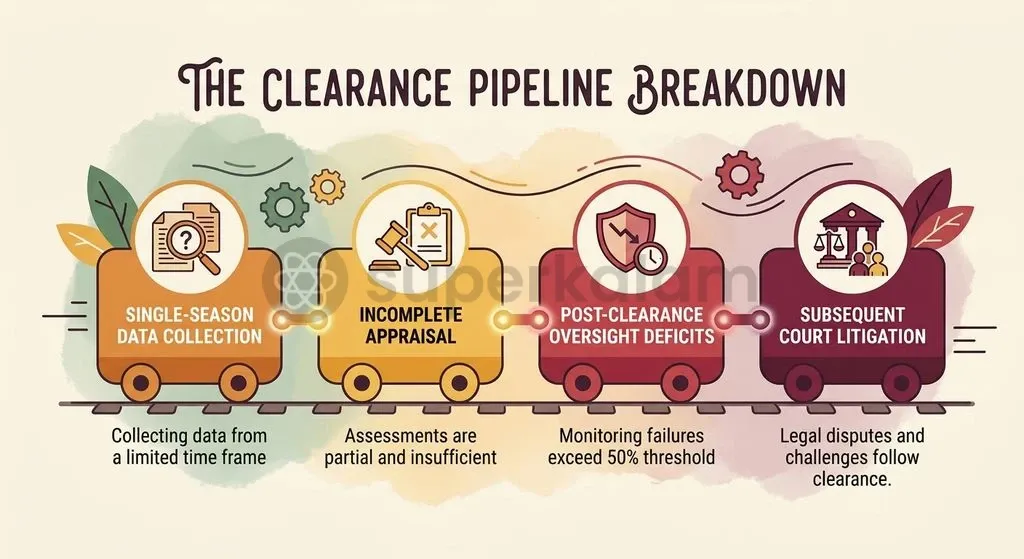
- Deficient impact data: Performance audits by the Comptroller and Auditor General (CAG) revealed systemic reliance on single-season baseline data and an absence of cumulative regional assessments.
- Oversight deficits: The same CAG audit documented monitoring deficits exceeding 50% across evaluated projects.
- Jurisdictional limitations: Although Section 16 of the National Green Tribunal Act, 2010 provides an appellate mechanism, the Tribunal cannot decide constitutional challenges under Articles 32 and 226, driving recurring disputes back to higher courts.
An Ethical Way Forward: Reconciling Immediate Needs with Long-Term Survival
Reconciling economic expansion with environmental ethics requires moving past reactive litigation toward structured administrative appraisals. The executive branch must replace isolated project appraisals with cumulative regional impact assessments, preventing the piecemeal fragmentation of continuous forest biomes.
Statutory regulators must treat environmental clearances as strict statutory boundaries rather than procedural clearances, as emphasised in Common Cause v. Union of India (2017) under Section 21(5) of the Mines and Minerals (Development and Regulation) Act, 1957.
| Strategic Pillar | Core Policy Shift | Operational Mechanism |
|---|---|---|
| Cumulative Appraisals | Transition from isolated, single-season clearances | Model aggregate carrying capacity across entire ecological zones |
| Non-Fungible Ecosystems | Preserve irreplaceable biological hotspots | Impose strict bans on mineral extraction in high-biodiversity corridors |
| Institutionalised NPV | Recognise full non-market value of natural systems | Factor carbon storage, hydrology, and biodiversity into project costs |
Economic valuations must integrate non-market ecosystem services into early policy planning. Institutionalising ecological economics alongside the Precautionary Principle ensures infrastructure growth respects constitutional commitments to intergenerational equity and non-human survival.
The Net Present Value (NPV) framework mandated in T.N. Godavarman Thirumulpad (2006) offers an established formula by monetising carbon sequestration, watershed protection, and biodiversity retention for diverted forest areas.
Discuss with Superkalam
Evaluate whether the Supreme Court's decision to stay the NGT suspension of mining in Hasdeo Arand undermined the Precautionary Principle.
Ask NowKey Takeaways
- The Core Conflict: The friction between executive policy and judicial rulings stems from an unresolved divide between utilitarian anthropocentrism (human economic primacy) and ecocentrism (the intrinsic moral standing of non-human species).
- Expanded Fundamental Rights: In M.K. Ranjitsinh (2024), the Supreme Court affirmed that citizens possess a fundamental right under Articles 14 and 21 to be protected from adverse climate change impacts.
- Constitutional Friction: The division between enforceable fundamental rights under Article 21 and non-justiciable directive principles under Article 48A drives recurring litigation between judicial orders and state infrastructure goals.
- The Public Trust Doctrine: Formulated domestically in M.C. Mehta v. Kamal Nath (1997), this doctrine binds the state to preserve natural resources as a sovereign trustee rather than transferring them for private commercial exploitation.
- The GIB Precedent: The recall of the blanket undergrounding order in M.K. Ranjitsinh demonstrated how climate mitigation targets can directly clash with localized biodiversity preservation, necessitating technical compromises.
- Regulatory Gaps: CAG Performance Audit findings showed that inadequate cumulative appraisals, single-season baseline data, and over 50% deficits in post-clearance monitoring undermine environmental enforcement on the ground.
Mains Question
"The transition from utilitarian anthropocentrism to an ecocentric framework in Indian environmental jurisprudence remains continually constrained by executive imperatives of energy security and economic growth." Critically analyse with reference to recent judicial interventions. (15 Marks)
Evaluate NowMains Question
'The constitutional divide between justiciable fundamental rights under Article 21 and non-justiciable directive principles under Article 48A creates an enduring institutional friction in environmental governance.' Elucidate. (10 Marks)
Evaluate NowPractice MCQs
QUESTION 1
With reference to environmental jurisprudence in India, consider the following statements:
- The Supreme Court in M.K. Ranjitsinh & Ors. v. Union of India recognized a fundamental right under Articles 14 and 21 to be free from the adverse effects of climate change.
- The Public Trust Doctrine was introduced into Indian environmental law in the Vellore Citizens' Welfare Forum case.
- In Animal Welfare Board of India v. A. Nagaraja, the Supreme Court linked Article 51A(g) and Article 51A(h) with statutory protections against unnecessary pain for animals.
Which of the statements given above are correct?
QUESTION 2
Consider the following statements regarding the legal and ecological dynamics surrounding the Great Indian Bustard habitat litigation:
- In 2021, the Supreme Court originally ordered the undergrounding of overhead transmission lines across 99,000 square kilometres in Rajasthan and Gujarat.
- In M.K. Ranjitsinh (2024), the Supreme Court recalled its blanket undergrounding mandate, observing that an inflexible order endangered India's broader renewable energy transition.
- The Court resolved the conflict by completely exempting solar developers from wildlife appraisal mechanisms.
Which of the statements given above is/are correct?
QUESTION 3
Consider the following pairs of legal cases and their associated environmental principles/outcomes mentioned in the text:
- T.N. Godavarman Thirumulpad (2012) : Shift from anthropocentric models to an ecocentric framework
- Centre for Environmental Law, WWF-India (2013) : Application of the species-best-interest standard for the Asiatic lion
- M.C. Mehta v. Kamal Nath (1997) : Formulation of the Precautionary Principle
Which of the pairs given above is/are correctly matched?
QUESTION 4
Which of the following infrastructural projects or resource extraction activities witnessed a stay by the Supreme Court on a National Green Tribunal suspension to safeguard active thermal power supplies?
QUESTION 5
Regarding the constitutional provisions governing environmental policy in India, consider the following statements:
- Article 21 is a justiciable fundamental right interpreted to encompass ecological stability and climate resilience.
- Article 48A is a non-justiciable directive principle placing a duty on the State to protect and improve the environment.
- The Constitution explicitly grants non-human species fundamental rights under Part III.
Which of the statements given above is/are correct?