Emotional Intelligence - UPSC GS IV (Ethics Notes)
Emotional Intelligence (EI) is the ability to recognise, manage, & use emotions effectively. Learn EI components, EQ vs IQ, and the role in UPSC (GS IV Ethics). Also, practice Mains PYQs on EI with quick answer evaluation!
Feb, 2026
•8 min read
“You have power over your mind, not outside events. Realise this, and you will find strength.” — Marcus Aurelius
This is the essence of Emotional Intelligence. It means understanding your emotions, controlling them under pressure, and responding with empathy and maturity.
UPSC tests attitude, integrity, and emotional balance with knowledge. These notes will help you understand Emotional Intelligence with concepts and applications relevant for GS IV (Ethics) answers.
What is Emotional Intelligence?
The term Emotional Intelligence was coined in 1990 by psychologists Peter Salovey and John D. Mayer. However, it gained global recognition after Daniel Goleman published his bestselling book Emotional Intelligence: "Why It Can Matter More Than IQ", which highlighted its importance in success and leadership.
Definitions of Emotional Intelligence
1. Daniel Goleman
“The ability to motivate oneself and persist in the face of frustrations, to control impulse and delay gratification, to regulate one’s moods and keep distress from swamping the ability to think, to empathise, and to hope.”
2. Peter Salovey and John Mayer
“The ability to monitor one’s own and others’ feelings and emotions, to discriminate among them and use this information to guide one’s thinking and actions.”
3. Oxford Dictionary
“The capacity to be aware of, control and express one’s emotions, and to handle interpersonal relationships judiciously and empathetically.”
In simple words, Emotional Intelligence (EI) means:
- Being aware of your emotions
- Managing them effectively
- Understanding others’ feelings
- Responding wisely in challenging situations
Components of Emotional Intelligence
According to the model popularised by Daniel Goleman, Emotional Intelligence consists of five core components. These elements explain how individuals manage themselves and handle relationships effectively.
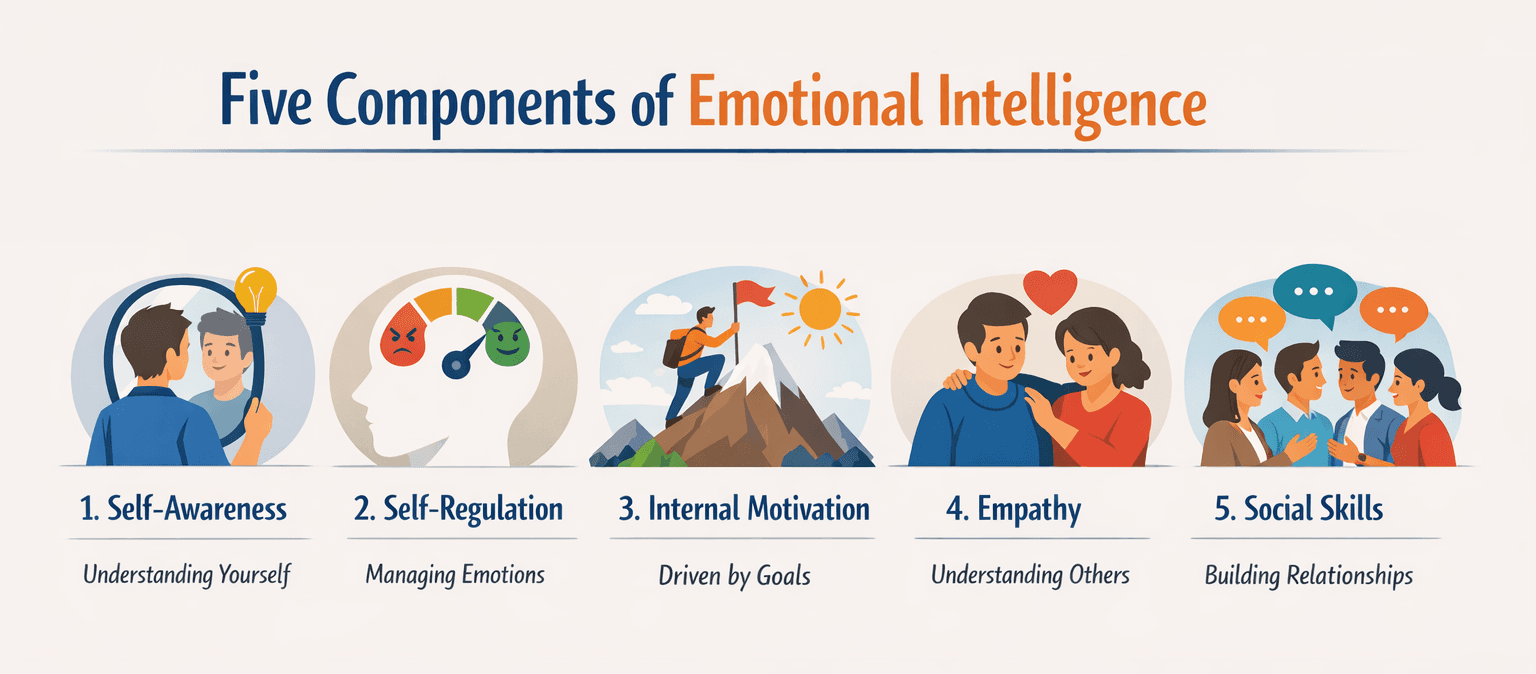
1. Self-Awareness
Self-awareness is the foundation of Emotional Intelligence. It means recognising and understanding your own emotions, strengths, weaknesses, values, and triggers in real time.
2. Self-Regulation
Self-regulation is the ability to control impulses and manage emotional reactions. Instead of reacting impulsively, a person pauses, thinks, and responds in a balanced and ethical manner.
3. Internal Motivation
Internal motivation refers to a strong inner drive to achieve goals with commitment, optimism, and resilience. It is not driven by external rewards like money or status, but by dedication to purpose and excellence. It is a key trait of ethical leadership.
4. Empathy
Empathy is the ability to understand and share the feelings of others. It allows a person to see issues from different perspectives and respond with compassion and fairness.
For civil servants, empathy ensures people-centric governance.
5. Social Skills
Social skills involve effective communication, conflict resolution, teamwork, and relationship-building. Strong social skills help in maintaining harmony, negotiating solutions, and leading diverse groups efficiently.
These five components together shape a civil servant who is emotionally balanced, ethically grounded, and socially sensitive.
UPSC Mains PYQ on Emotional Intelligence (GS Paper IV)
What are the main components of emotional intelligence (EI)? Can they be learned? Discuss. (2020) (150 words, 10 marks)
Evaluate your Answer in 60 SecondsEmotional Quotient (EQ) vs Intelligence Quotient (IQ)
Understanding the difference between EQ and IQ is important for the UPSC GS Paper IV syllabus and also for leadership ethics in civil services.
What is the Intelligence Quotient (IQ)?
Intelligence Quotient (IQ) measures a person’s cognitive abilities, such as logical reasoning, analytical thinking, memory, and problem-solving skills. It reflects how well a person can learn, understand concepts, and solve academic or technical problems.
What is Emotional Quotient (EQ)?
Emotional Quotient (EQ) measures a person’s ability to understand, manage, and use emotions effectively, both their own and others’. It reflects emotional awareness, empathy, self-control, and relationship management.
Key Differences Between EQ and IQ
| Basis | Intelligence Quotient (IQ) | Emotional Quotient (EQ) |
|---|---|---|
| Meaning | Ability to think logically and solve problems | Ability to understand and manage emotions |
| Focus | Cognitive intelligence | Emotional and social intelligence |
| Measured Through | Standardized IQ tests | Behavioral assessment and observation |
| Role in Success | Helps in academic and technical performance | Helps in leadership, teamwork, and conflict resolution |
| Stability | Largely stable over time | Can be improved with practice and awareness |
Example
Imagine a District Magistrate handling a protest situation:
- A high IQ helps in analysing the legal provisions and drafting orders correctly.
- A high EQ helps in calming the crowd, understanding public grievances, and resolving conflict peacefully.
Start Writing Ethics Case Studies for UPSC Mains GS Paper 4 with our guide.
Role of Emotional Intelligence in Civil Services
Emotional Intelligence (EI) enables a civil servant to serve with empathy, integrity, and balance. especially in challenging situations. Here's why Emotional Intelligence matters in the Civil Services
- Better Decision-Making Under Pressure: Civil servants often work in crises such as disasters, protests, cand ommunal tensions. Emotional balance prevents impulsive decisions and ensures rational, ethical action.
- Empathy Towards Vulnerable Sections: Policies impact diverse groups — women, children, minorities, and the poor. Empathy helps administrators design and implement people-centric governance.
- Conflict Resolution and Negotiation: Many administrative challenges involve managing competing interests. High EI helps in dialogue, persuasion, and peaceful resolution.
- Stress Management: The job involves long hours, public scrutiny, and political pressure. Emotional regulation prevents burnout and maintains professionalism.
- Ethical Leadership: EI strengthens integrity, accountability, and fairness.
Real-Life Case Study: Armstrong Pame (IAS)
Armstrong Pame, an IAS officer of the Manipur cadre, is widely known as the “People’s IAS Officer.” In 2012, he mobilised public donations and community participation to construct a 100-km road in a remote area of Manipur where government funds were insufficient.
Instead of blaming administrative constraints, he connected emotionally with the local community, understood their struggles, and inspired collective action.

Emotional Intelligence Displayed:
- Empathy towards neglected tribal communities
- Strong social skills and community engagement
- Internal motivation driven by service, not recognition
- Ethical leadership and transparency
This case shows how emotional intelligence can transform governance from rule-based administration to people-centred development.
How to Develop and Strengthen Your Emotional Intelligence (EI)?
Emotional Intelligence can be improved with conscious effort and regular practice. For a UPSC aspirant and future civil servant, developing EQ is as important as gaining knowledge.
- Practice Self-Awareness: Regularly reflect on your emotions. Ask yourself: Why am I feeling this? How is it affecting my response? Maintaining a journal can help track emotional patterns.
- Learn to Pause Before Reacting: Control impulsive reactions. Take a few seconds to think before speaking or acting, especially in stressful situations.
- Develop Empathy: Try to see situations from others’ perspectives. Listen actively without interrupting or judging.
- Improve Communication Skills: Express your thoughts clearly and respectfully. Good communication reduces misunderstandings and conflicts.
- Manage Stress Effectively: Practice meditation, exercise, or mindfulness. A calm mind improves emotional regulation.
- Seek Constructive Feedback: Ask mentors, peers, or colleagues about your behaviour and interpersonal skills. Use feedback for improvement.
UPSC Mains PYQ on Emotional Intelligence (GS Paper IV)
What is ‘emotional intelligence’ and how can it be developed in people? How does it help an individual in taking ethical decisions?
Evaluate your Answer in 60 SecondsConclusion
“Knowing yourself is the beginning of all wisdom.” — Aristotle
Emotional Intelligence is a core administrative competency. For UPSC aspirants, mastering emotions, practising empathy, and maintaining ethical balance are as important as academic preparation.
A civil servant with high emotional intelligence ensures people-centric governance, effective leadership, and ethical decision-making. In today’s complex administrative environment, EQ truly complements IQ and defines responsible public service.
Must see: UPSC Mains General Studies 4 Ethics Syllabus Analysis
Start your UPSC Preparation 2026/2027 with SuperKalam
SuperKalam is your personal mentor for UPSC preparation, guiding you at every step of the exam journey. Practice, revise, and evaluate– all in one place.
Download Now