Central Pollution Control Board (CPCB) | UPSC Notes
The Central Pollution Control Board (CPCB) is India’s apex statutory body for pollution control. Study its composition, key functions and initiatives for UPSC.
Feb, 2026
•4 min read
The Central Pollution Control Board (CPCB) is India’s apex body for pollution control and environmental protection. CPCB is an important topic for both Prelims and Mains, especially under GS Paper II (Governance) and GS Paper III (Environment & Ecology).
Let's study this topic in detail!
About the Central Pollution Control Board (CPCB)
The Central Pollution Control Board (CPCB) is a statutory body under the Ministry of Environment, Forest and Climate Change (MoEFCC).
CPCB serves as the apex authority in India for preventing and controlling pollution and for improving the quality of the environment. It plays a central role in implementing key environmental laws and coordinating with State Pollution Control Boards (SPCBs).
- The Central Pollution Control Board (CPCB) was established in 1974.
- It was constituted under the Water (Prevention and Control of Pollution) Act, 1974.
- It was later empowered to function under the Air (Prevention and Control of Pollution) Act, 1981.
- It also derives authority under the Environment (Protection) Act, 1986.
- Its headquarters is located in New Delhi.
- It is a statutory body, not a constitutional body.
Composition of the Central Pollution Control Board
The composition of the Central Pollution Control Board (CPCB) is defined under the Water (Prevention and Control of Pollution) Act, 1974.
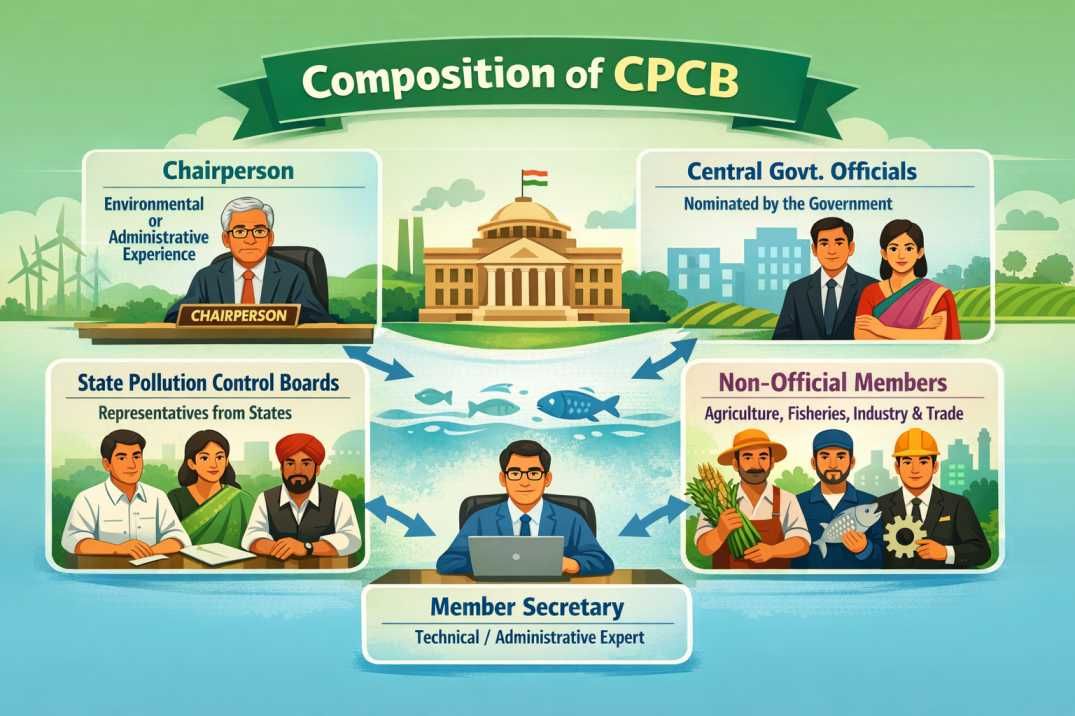
- Chairperson: The Board is headed by a Chairperson, who possesses special knowledge or practical experience in environmental protection or has administrative experience related to environmental management.
- Officials of GOI: It includes officials nominated by the Central Government, representing different ministries and departments.
- SPCB Representatives: They are included to ensure coordination between the Centre and States.
- Non-official Members: The Board also has non-official members representing sectors such as agriculture, fisheries, industry, or trade, reflecting stakeholder participation.
- Secretary: A Member Secretary, who is a full-time technical or administrative expert, manages the day-to-day functioning of the Board.
Principal Functions of the CPCB
The Central Pollution Control Board (CPCB) performs a wide range of functions aimed at preventing, controlling, and reducing pollution in India. Its functions are primarily defined under the Water Act, 1974 and the Air Act, 1981. Key functions:
- To promote the cleanliness of streams and wells and work to prevent and control water pollution across the country.
- To improve air quality and implement measures to control and abate air pollution.
- To advise the Central Government on matters related to the prevention and control of water and air pollution.
- To coordinate the activities of State Pollution Control Boards (SPCBs) and provide them with technical guidance and support.
- To plan and execute nationwide pollution control programmes and environmental monitoring initiatives.
- To lay down standards for air quality, water quality, and emission or discharge of pollutants from industries and vehicles.
- To collect, compile, and publish technical and statistical data related to pollution and environmental quality.
- To conduct and sponsor research related to pollution problems and control technologies.
- To provide training and capacity-building programmes for personnel engaged in pollution control activities.
- To establish and recognise laboratories for the analysis of air and water samples.
Moreover, CPCB exercises powers and performs functions in Union Territories, where it has delegated its authority under the Water Act, 1974; the Water (Prevention and Control of Pollution) Cess Act, 1977; and the Air Act, 1981 to the respective regional administrations.
Must read: Climate Change UPSC Notes: Meaning, Types, Causes & Key Initiatives
Key Programmes & Portals of CPCB
The Central Pollution Control Board (CPCB) implements several programmes and digital platforms to monitor pollution and strengthen environmental governance.
1. SAMEER App (System of Air Quality and Weather Forecasting and Research):
- A mobile application that provides real-time Air Quality Index (AQI) data across Indian cities.
- It also allows citizens to lodge complaints related to air pollution violations, improving public participation in environmental monitoring.
2. PRANA Portal (Portal for Regulation of Air Pollution in Non-Attainment Cities):
- An online platform to track the implementation of the National Clean Air Programme (NCAP) in around 130+ non-attainment cities.
- It monitors both physical progress and financial utilisation of funds allocated for air pollution control measures.
3. National Air Monitoring Programme (NAMP):
- A nationwide programme that monitors ambient air quality across hundreds of stations in India.
- It tracks major pollutants such as SO₂, NO₂, PM10, PM2.5, and others to assess trends and policy effectiveness.
4. National Water Monitoring Programme (NWMP):
- A programme aimed at monitoring the quality of surface and groundwater bodies across India.
- It helps in assessing pollution levels in rivers, lakes, and other water bodies.
5. Air Quality Index (AQI) Framework:
- CPCB developed the national AQI system to provide a simplified, colour-coded classification of air quality levels (Good to Severe) based on multiple pollutants.
6. Continuous Ambient Air Quality Monitoring Stations (CAAQMS):
- CPCB operates and supervises real-time monitoring stations that provide continuous air quality data.
- It supports policymaking and public awareness.
7. Environmental Data & Compliance Monitoring Systems:
- CPCB uses online platforms for emission monitoring, industry compliance tracking, and environmental reporting.
UPSC Prelims PYQ on CPCB
QUESTION 1
How is the National Green Tribunal (NGT) different from the Central Pollution Control Board (CPCB)?
- The NGT has been established by an Act whereas the CPCB has been created by executive order of the Government.
- The NGT provides environmental justice and helps reduce the burden of litigation in the higher courts whereas the CPCB promotes cleanliness of streams and wells, and aims to improve the quality of air in the country.
Which of the statements given above is/are correct
Way Forward
- Strengthen CPCB’s enforcement and compliance monitoring mechanisms.
- Expand real-time air and water quality monitoring networks.
- Improve coordination with State Pollution Control Boards (SPCBs).
- Increase transparency through public data portals and citizen participation.
- Integrate pollution control with climate action and sustainable development goals.
A stronger and technology-driven CPCB is essential for effective environmental governance in India.
Must cover: National Pollution Control Day 2025: History, Significance, Theme & Relevance for UPSC
Start your UPSC Preparation 2026/2027 with SuperKalam
SuperKalam is your personal mentor for UPSC preparation, guiding you at every step of the exam journey. Practice, revise, and evaluate– all in one place.
Download Now