Constitutional Morality in India: Judicial Compass and UPSC Guide
Unpacking how India's judiciary uses constitutional morality to balance transformative social justice with democratic separation of powers.
Aug, 2026
•10 min read
Context
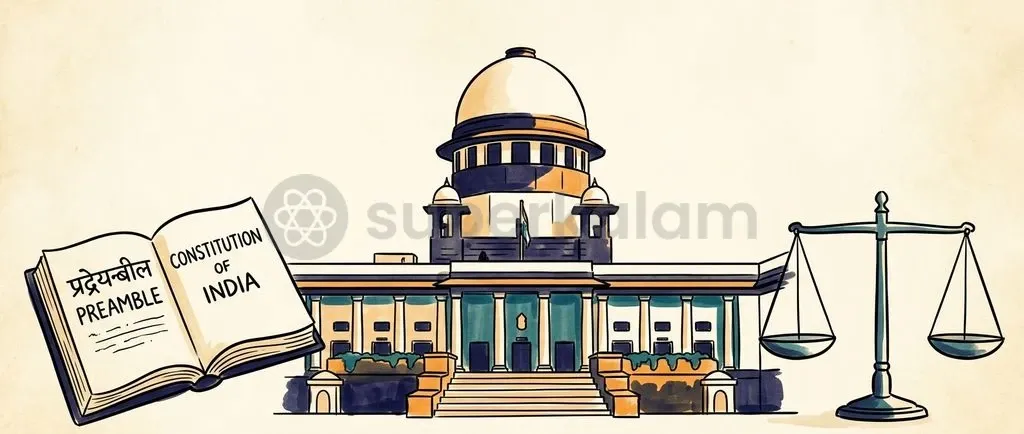
Fig: Constitutional morality acts as a judicial guide, balancing individual fundamental rights with institutional governance.
The doctrine of constitutional morality is a judicial compass in Indian constitutional law. It prioritises core ethics like individual liberty and equality over majoritarian public morality. This approach supports transformative governance while requiring strict judicial self-restraint to preserve the separation of powers.
The principle originated in British historiography and was championed by Dr. B.R. Ambedkar during the 1948 Constituent Assembly Debates. Modern jurisprudence uses it to test statutory provisions against core constitutional values. While the Supreme Court of India invokes the doctrine to invalidate discriminatory statutes, critics caution against subjective interpretations that risk encroaching upon the legislative domain.
Why Constitutional Morality is Dominating Legal Debates Today
As of May 2024, the Supreme Court of India frequently invokes constitutional morality to test state action against substantive democratic values rather than statutory text alone. The debate has intensified as the judiciary applies the principle to balance state authority and individual rights.
While the phrase 'constitutional morality' is not explicitly written in the Constitution of India, the word 'morality' is explicitly listed as a ground for reasonable restriction under Part III:
- Article 19(2) and 19(4): Restricting freedoms of speech, assembly, and association.
- Articles 25(1) and 26: Limiting freedom of conscience and religious management rights.
In November 2019, a 5-judge Supreme Court bench in Kantaru Rajeevaru v. Indian Young Lawyers Association referred the interpretation of 'morality' under Articles 25 and 26, alongside the boundaries of constitutional morality in religious matters, to a 9-judge Constitution Bench. This reference highlights the evolving friction between traditional religious practices and judicial constitutionalism.
Where the Concept Comes From: From Grote to Dr. B.R. Ambedkar
British historian George Grote first defined constitutional morality in his nineteenth-century work A History of Greece (1846–1856). Grote emphasised two core tenets:
- Absolute reverence: Commitment to constitutional forms and public self-restraint.
- Balanced civic action: Combining active critique of public officials with unreserved obedience to legal procedures.
Dr. B.R. Ambedkar introduced the concept to Indian constitutional discourse in his Constituent Assembly speech on 4 November 1948 while presenting the Draft Constitution. Dr. B.R. Ambedkar observed:
- Constitutional morality is not a natural sentiment; it must be cultivated.
- Democracy in India was only a top-dressing on soil that remained essentially undemocratic.
The Constituent Assembly recognised that administrative fidelity and institutional checks were required to sustain representative governance. Rather than relying solely on majoritarian mandates, the constitutional framework binds all state organs to democratic processes and ethical restraint.
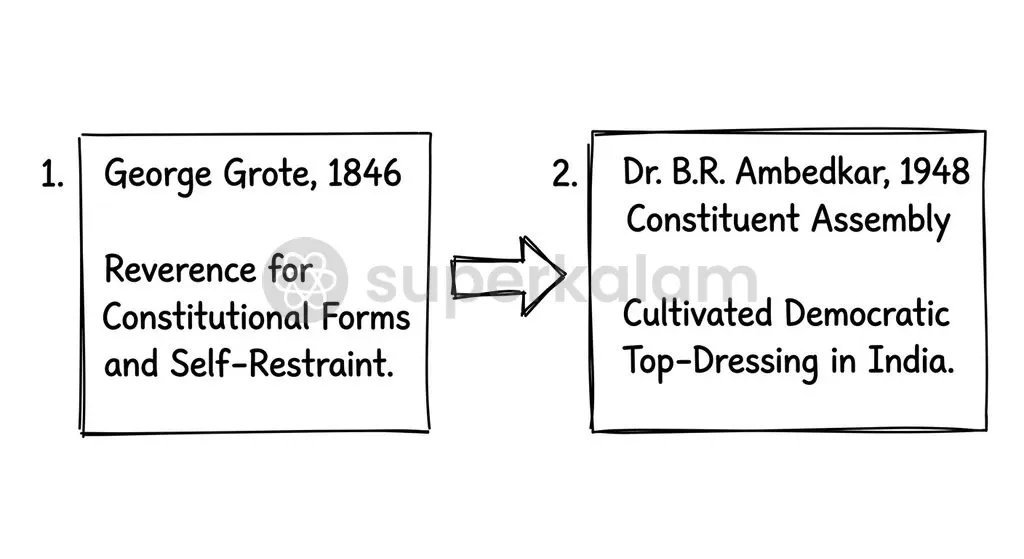
Fig: The evolution of constitutional morality from nineteenth-century British historiography to the Constituent Assembly Debates.
Discuss with Superkalam
Recall the two core tenets of constitutional morality defined by British historian George Grote in 'A History of Greece'.
Ask NowHow Courts Use Constitutional Morality as a Living Instrument
The Supreme Court of India applies constitutional morality as a living instrument to enforce transformative constitutionalism and protect fundamental rights against majoritarian erosion. In Navtej Singh Johar v. Union of India (2018), the Supreme Court defined constitutional morality as adherence to core ethical values—such as liberty, equality, fraternity, individual dignity, and the rule of law—rather than mere literal adherence to statutory text.
The judiciary explicitly distinguishes constitutional morality from popular or public morality. Majoritarian opinions, traditional customs, and societal prejudices cannot override fundamental rights guaranteed under Part III.
| Dimension | Constitutional Morality | Popular / Public Morality |
Core Source | Core constitutional principles, rule of law, and dignity enshrined in Part III. | Traditional customs, societal prejudices, and majoritarian sentiments. |
Primary Objective | Protects individual liberty, minority rights, and transformative social change. | Preserves prevailing social hierarchies and traditional norms. |
Judicial Application | Applied by courts to invalidate discriminatory legislation and executive acts. | Invocable by majorities to enforce social conformity. |
Institutional Role | Serves as a counter-majoritarian safeguard in democratic governance. | Reflects popular political will and prevailing cultural consensus. |
Landmark Judgments That Shaped the Doctrine
The Delhi High Court and the Supreme Court of India have systematically applied constitutional morality across seminal decisions regarding civil liberties, executive appointments, and gender equality.
- Naz Foundation v. Government of NCT of Delhi (2009): The Delhi High Court made the first landmark explicit application of constitutional morality, holding that constitutional values must outweigh popular public morality when reading down Section 377 of the Indian Penal Code.
- Manoj Narula v. Union of India (2014): A Constitution Bench of the Supreme Court held that constitutional morality and constitutional trust guide executive governance, requiring Prime Ministerial advice under Article 75(1) to align with democratic values during ministerial appointments.
- Government of NCT of Delhi v. Union of India (2018): The Supreme Court invoked the doctrine to uphold representative democracy, cooperative federalism, and institutional checks between the elected Delhi government and the Lieutenant Governor.
- Navtej Singh Johar v. Union of India (2018): The Supreme Court unanimously decriminalised consensual same-sex relations by striking down part of Section 377 IPC, affirming that majoritarian public morality must yield to constitutional morality.
- Joseph Shine v. Union of India (2018): The Supreme Court invalidated Section 497 of the Indian Penal Code on adultery, ruling that patriarchal social norms cannot supersede female autonomy and constitutional morality.
- Indian Young Lawyers Association v. State of Kerala (2018): A 4:1 majority held that barring women aged 10 to 50 from entering the Sabarimala temple violated constitutional morality and Article 25 equality rights.

Fig: Key judicial landmarks where Indian courts invoked constitutional morality to protect fundamental freedoms.
The Thin Line Between Safeguarding Rights and Judicial Overreach
Former Attorney General K.K. Venugopal warned that an unguided application of constitutional morality risks judicial overreach, potentially altering the constitutional balance of powers.
Key arguments and warnings regarding judicial overreach include:
- Risk of judicial subjectivism: AG K.K. Venugopal warned in December 2018 that an improperly defined doctrine could become a dangerous weapon turning the Supreme Court into a third chamber of Parliament.
- Erosion of separation of powers: Critics argue that without strict objective standards, unelected judges gain unchecked discretion to substitute personal moral preferences for legislative enactments.
- Disruption of religious traditions: In her dissenting opinion in Sabarimala (2018), Justice Indu Malhotra cautioned against applying constitutional morality to strike down essential religious practices in a pluralistic polity.
Discuss with Superkalam
What criteria could the Kantaru Rajeevaru Bench use to reconcile constitutional morality with essential religious practices?
Ask NowA Comparative View: How Other Democracies Balance Judicial Power
Democratic constitutions handle judicial review and unwritten conventions differently. Key distinctions include:
- British tradition: Rooted in parliamentary supremacy and unwritten conventions, as situated by George Grote in Athenian democracy and 19th-century systems where governance relied heavily on political self-restraint.
- Indian jurisprudence: Operates under a written constitution where core ethical values are directly enforced against statutory laws through judicial review.
While Indian jurisprudence treats constitutional morality as an enforceable judicial test, other constitutional democracies maintain distinct boundaries between legislative supremacy and judicial intervention.
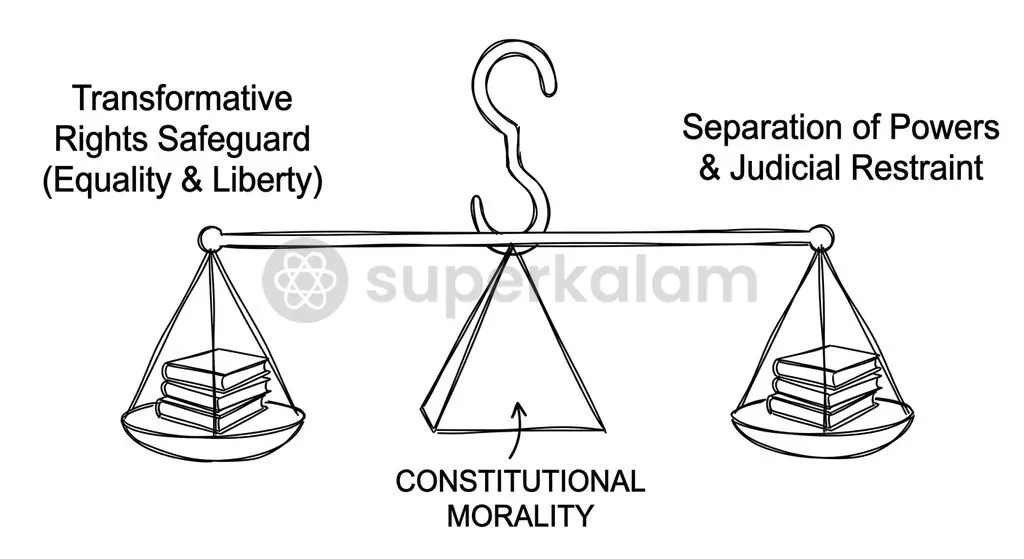
Fig: Balancing transformative constitutionalism against the separation of powers.
Restoring Institutional Trust Through Judicial Restraint
The Supreme Court of India can maintain public trust by grounding constitutional morality in objective constitutional text and establishing clear standards for judicial review. To address concerns regarding judicial subjectivism, courts must anchor the doctrine directly to explicit constitutional guarantees, such as fundamental rights in Part III.
The pending 9-judge Constitution Bench reference in Kantaru Rajeevaru provides an opportunity to establish precise boundaries for reviewing religious and cultural practices. By balancing transformative social justice with self-restraint, the judiciary can safeguard individual freedoms while maintaining institutional balance.
Key Takeaways
- Historical Origin: Coined by British historian George Grote in A History of Greece, the term was introduced to Indian polity by Dr. B.R. Ambedkar on 4 November 1948 to emphasize cultivated adherence to constitutional procedures.
- Constitutional vs Public Morality: The Supreme Court holds that constitutional morality (liberty, equality, and dignity) overrides popular public morality and majoritarian prejudice.
- Textual Presence: The exact phrase 'constitutional morality' is absent from the text of the Constitution of India, though 'morality' appears as a restriction in Articles 19(2), 19(4), 25(1), and 26.
- Judicial Overreach Concerns: Former AG K.K. Venugopal warned against subjective use turning the Supreme Court into a "third chamber of Parliament", while Justice Indu Malhotra dissented against overriding essential religious practices.
- 9-Judge Bench Reference: In Kantaru Rajeevaru (2019), the Supreme Court referred the interpretation of 'morality' under Articles 25 and 26 to a 9-judge bench.
Mains Question
"Constitutional morality is not a natural sentiment. It has to be cultivated." In light of Dr. B.R. Ambedkar's observation during the 1948 Constituent Assembly Debates, discuss how the judiciary has used constitutional morality as a living instrument to advance transformative constitutionalism. (15 marks)
Evaluate Now