India's SIOFA Accession: High-Seas Strategy and Maritime Surveillance
While New Delhi gains legal teeth to inspect foreign vessels on the southern high seas, domestic fleets still lack the deep-sea trawlers to harvest quota stocks.
Oct, 2026
•9 min read
Context
India completed its formal accession to the Southern Indian Ocean Fisheries Agreement in October 2026. The move secures decisive voting rights across treaty bodies and extends India's maritime monitoring footprint deep into international waters.
This accession is primarily a geopolitical step to expand maritime domain awareness and counter Chinese distant-water fishing fleets. Immediate commercial harvesting remains secondary, as domestic capacity is limited by an artisanal fleet structure.
The agreement unlocks governance over lucrative demersal resources, including Patagonian toothfish and orange roughy, across high-seas areas beyond national exclusive economic zones. Yet New Delhi's immediate dividend lies in treaty-backed inspection rights. Acquiring legal authority to inspect foreign vessels turns fisheries diplomacy into a sovereign instrument of southern oceanic surveillance.
Why in the News: India Signs On as a Full Contracting Party to SIOFA
The Central Government approved India's accession to the Southern Indian Ocean Fisheries Agreement (SIOFA) on 14 October 2026 under the Ministry of Fisheries, Animal Husbandry and Dairying, as announced in a PIB Delhi Press Release. This accession transitions India from an observer to an active rulemaking authority in the southern high seas. As of October 2026, the diplomatic upgrade resolves a four-year governance limitation:
- Transition from Observer Status: India held the status of a Cooperating Non-Contracting Party (CNCP) since 2022. That status allowed attendance but barred India from voting on substantive resolutions, catch limits, and compliance frameworks.
- Acquisition of Full Voting Rights: Full accession grants New Delhi definitive voting rights within the Meeting of the Parties, the Scientific Committee, and the Compliance Committee, enabling India to actively shape conservation and management measures (CMMs).
- Extension of Strategic Reach: The decision operationalises India's broader maritime doctrine. It links high-seas fisheries governance to national security architecture south of the equator, extending Indian influence beyond the northern Indian Ocean.
Discuss with Superkalam
Which specific species are covered under SIOFA's mandate, and which major fish stocks are explicitly excluded?
Ask NowWhat Is SIOFA and How Does It Govern the High Seas?
The Southern Indian Ocean Fisheries Agreement is an autonomous multilateral treaty concluded in Rome on 7 July 2006 under the auspices of the Food and Agriculture Organization (FAO), entering into force in June 2012. SIOFA is an independent Regional Fisheries Management Organisation (RFMO) headquartered in Saint-Denis, Réunion Island.
Under international maritime law, the high seas encompass roughly 65 percent of the global ocean surface, where living marine resources beyond national jurisdictions are governed through regional conventions. SIOFA exercises jurisdictional oversight over non-tuna fishery resources in the international waters bounded by the maritime boundaries of eastern Africa, Australia, and the southern polar convergence.
The treaty enforces maritime stewardship through four institutional pillars:
- Target Species Governance: SIOFA manages deep-sea demersal and pelagic species, specifically regulating commercial stocks of Patagonian toothfish, alfonsino, orange roughy, and oceanic squid.
- Statutory Exclusion of Highly Migratory Stocks: The agreement explicitly excludes oceanic tunas and billfishes listed in Annex I of the United Nations Convention on the Law of the Sea (UNCLOS), leaving their oversight to dedicated commissions.
- Mandatory Vessel Monitoring: Contracting Parties must enforce satellite-linked Vessel Monitoring Systems (VMS) on flagged vessels, ensuring real-time positional data transmission to flag-state and secretariat regulators.
- Supply Chain Traceability: For sensitive species like Patagonian toothfish, the organisation mandates Catch Documentation Schemes (CDS) and strict transshipment rules, banning mid-ocean cargo transfers unless supervised by certified observers.
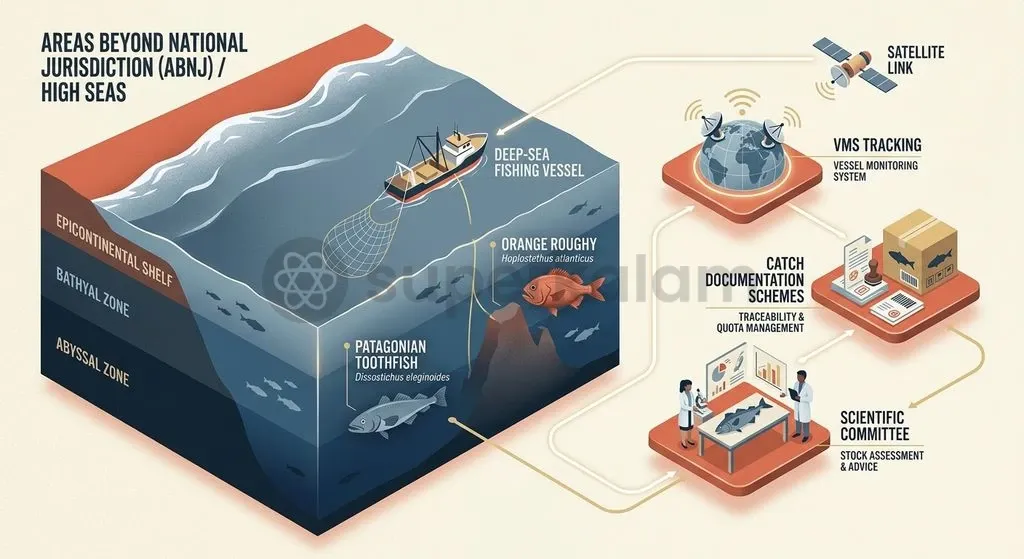
SIOFA operationalises the duties established under UNCLOS Articles 116 to 119, which grant all states the right to fish on the high seas subject to their treaty obligations and the universal duty to cooperate in conserving marine living resources.
SIOFA vs IOTC: Decoding the Division of High-Seas Mandates
The Indian Ocean Tuna Commission (IOTC) and SIOFA operate as complementary but legally distinct regional regimes dividing living resources by species biology and geographic boundaries. Understanding their institutional differences is essential for evaluating Indian ocean governance:
| Governance Dimension | Southern Indian Ocean Fisheries Agreement (SIOFA) | Indian Ocean Tuna Commission (IOTC) |
|---|---|---|
| Legal Foundation | Autonomous regional agreement concluded in 2006; entered into force in 2012 | Article XIV statutory body established under the FAO Constitution in 1993; entered into force in 1996 |
| Headquarters | Saint-Denis, Réunion Island | Victoria, Seychelles |
| Species Coverage | Non-tuna fishery resources: demersal finfish, alfonsino, Patagonian toothfish, and squid | Highly migratory tuna and tuna-like species listed in Annex I of UNCLOS |
| Spatial Jurisdiction | High seas strictly beyond national jurisdictions (outside coastal EEZs) | Both coastal Exclusive Economic Zones (EEZs) and the international high seas of the Indian Ocean |
| India's Membership | Cooperating Non-Contracting Party in 2022; Full Contracting Party in October 2026 | Full Contracting Party since 1996 |
| Institutional Relationship to FAO | Legally independent from FAO's internal administrative structure | Operationally embedded inside the administrative framework of the FAO |
The spatial and biological bifurcation creates a dual-track regime. India has shaped tuna management across its domestic EEZ and the wider ocean through the IOTC since 1996. Now, SIOFA provides the missing legal handle to govern sedentary and non-migratory deep-sea stocks in southern international waters.
Discuss with Superkalam
How does SIOFA's High Seas Boarding and Inspection (HSBI) Scheme transform regional fisheries governance into an instrument of maritime domain awareness?
Ask NowThe Strategic Imperative: Maritime Surveillance and Chinese Fleets
The primary driver behind India's full accession to SIOFA is maritime security and domain awareness, eclipsing immediate commercial fishing yields. Chinese Distant-Water Fishing (DWF) operations have expanded rapidly across the southern high seas, deploying massive industrial fleets targeting oceanic squid and demersal stocks. China formally acceded to SIOFA as a Contracting Party in 2019, cementing its institutional voting footprint and fishing allocations across the southern basin.
This distant-water expansion presents several operational and security challenges:
- Proliferation of Dark Vessels: Distant-water fleets in international waters frequently deactivate their satellite Automatic Identification Systems (AIS)—operating as dark vessels to conceal unauthorised extraction and undocumented transshipment.
- Civilian Dual-Use Platforms: Industrial fishing vessels operating on multi-month voyages collect oceanographic and bathymetric data. This generates baseline hydrographic profiles that assist submarine navigation and blue-water naval deployments.
- Enforcement Rights Under SIOFA: Full accession unlocks India's participation in the High Seas Boarding and Inspection (HSBI) Scheme established under SIOFA Conservation and Management Measure CMM 2021/14.
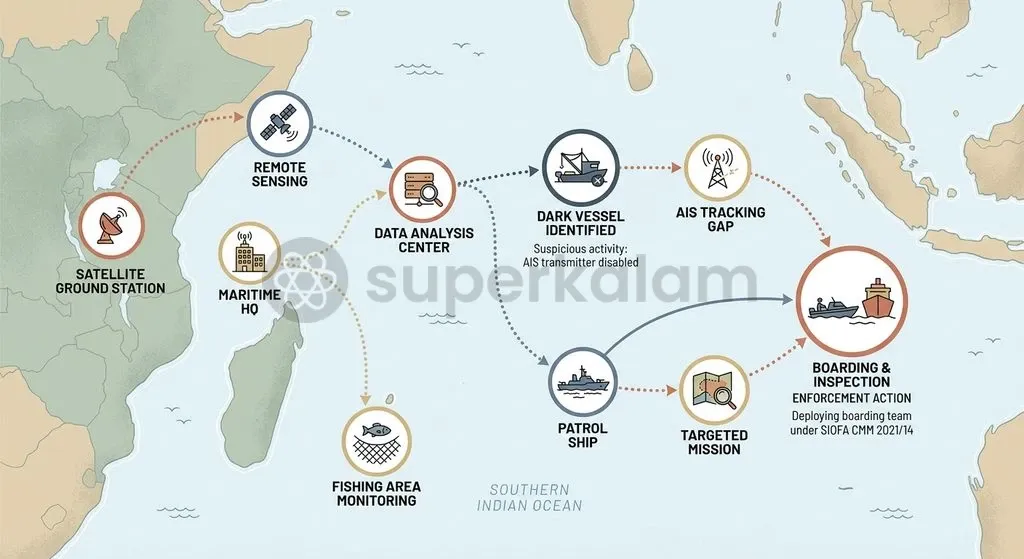
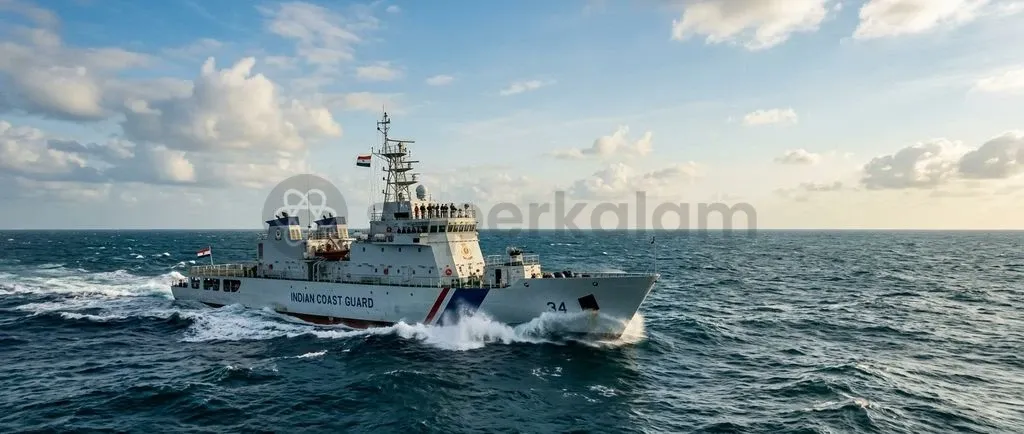
SIOFA's HSBI mechanism legally empowers Indian enforcement agencies, such as the Indian Coast Guard, to board, inspect, and verify logs on foreign-flagged fishing vessels suspected of unauthorised fishing in the southern high seas.
This high-seas mandate expands India's Maritime Domain Awareness (MDA) beyond the traditional security choke points of the Arabian Sea and Bay of Bengal. It projects Indian regulatory oversight southward toward sub-Antarctic waters. The treaty integration complements regional security doctrines like MAHASAGAR (Mutual and Active Harnessing of All Security and Growth in the Region), led by the Indian Navy. It converts multilateral fisheries law into a permanent mechanism for international maritime stability.
Discuss with Superkalam
Compare the geopolitical and operational impacts of distant-water fishing fleets acting as dual-use civilian platforms in international waters.
Ask NowThe Fleet Reality Check: Bridging India's Deep-Sea Harvesting Gap
India's maritime posturing under SIOFA faces an acute operational bottleneck: domestic commercial fishers cannot currently exploit the resource quotas secured in Saint-Denis. Data from the Department of Fisheries Annual Report indicates that over 90 percent of the domestic marine fishing fleet consists of artisanal, non-motorised, or motorised craft restricted to coastal waters within 60 to 80 nautical miles from shore.
The structural impediments hampering high-seas commercial viability include:
- Absence of Industrial Vessels: The domestic fleet currently lacks commercial deep-sea mother vessels and factory freezer trawlers required to withstand rough southern sea conditions and process catches during multi-month journeys.
- Cold Chain Deficits: Long-range operations targeting species like toothfish or squid require specialised on-board blast freezers capable of preserving catch quality at minus 40 degrees Celsius, an asset entirely absent from coastal craft.
- Slow Scheme Adoption: While the Pradhan Mantri Matsya Sampada Yojana (PMMSY) earmarked capital under its ₹20,050 crore envelope for fishers to procure modern deep-sea vessels, uptake has been reported as sluggish by parliamentary evaluations due to high capital requirements and vessels unsuited for high-seas operations.
| Fleet Segment | Geographic Range | Vessel Profile | Operational Constraint |
|---|---|---|---|
| Domestic Inshore Vessels | 60 to 80 nautical miles | Motorised and artisanal craft (>90 percent) | Daily coastal turnaround |
| Fleet Transition Gap | Intermediate waters | Transitioning commercial fleet | High capital requirements and lack of cold chains |
| SIOFA High-Seas Zone | International waters (>200 nautical miles) | Factory freezer mother vessels | Multi-month operational endurance required |
To establish regulatory discipline over prospective operators, the Government of India promulgated the 'Guidelines for High Sea Fisheries' in December 2025. These guidelines institute a mandatory Letter of Authorisation (LoA) for any Indian-flagged vessel traversing international waters, alongside strict compliance with satellite VMS tracking and catch reporting rules.
Without commercial-scale vessels to harvest these resources, India's SIOFA quotas risk remaining underutilised on paper. Strategic oceanic presence currently outpaces commercial extraction.
Discuss with Superkalam
Given that over 90% of India's fleet is artisanal, propose structural policy measures necessary to build an industrial deep-sea harvesting capacity.
Ask NowWay Forward: Building Industrial Fishing Power While Guarding Ocean Commons
Bridging the divide between India's international treaty commitments and its domestic maritime capability requires a targeted, two-track strategy balancing industrial capacity with multilateral conservation.
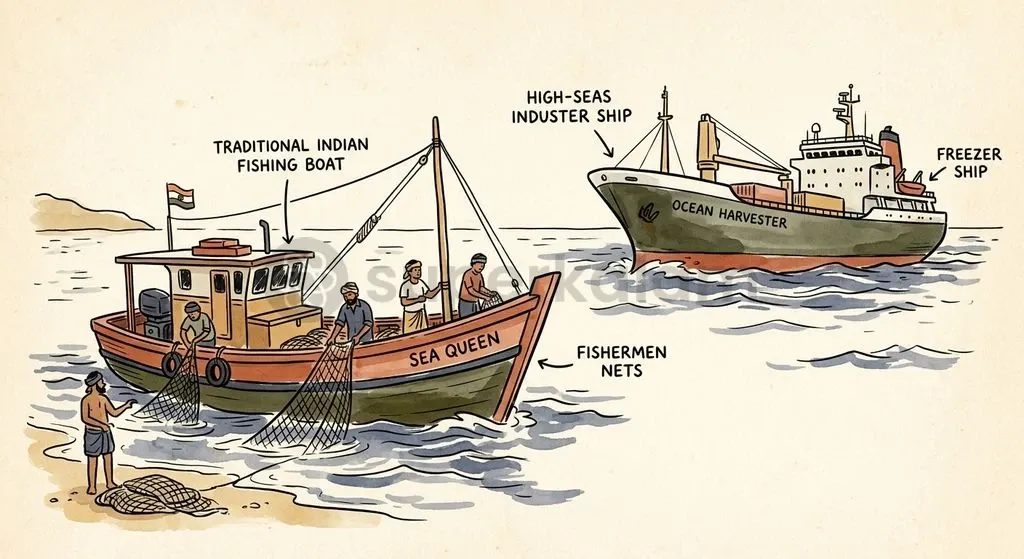
To turn SIOFA rights into durable maritime strength, India can pursue four practical steps:
- State-Backed Fleet Modernisation: The Department of Fisheries must restructure the deep-sea vessel financing model under PMMSY, facilitating joint ventures or public-private consortia to co-finance factory freezer trawlers capable of sustained high-seas voyages.
- Scientific Research Alignment: Full membership obliges India to submit rigorous biological sampling and catch-effort data to the SIOFA Scientific Committee. India should commission dedicated cruises by oceanic research vessels to study deep-sea stocks, establishing sovereign baseline data.
- Coordinated High-Seas Interdiction: The Indian Coast Guard and Indian Navy should integrate SIOFA's High Seas Boarding and Inspection protocols into standard patrol routines, combining satellite tracking with physical maritime boardings to deter illegal, unreported, and unregulated (IUU) fishing.
- Coalition Diplomacy within RFMOs: India must collaborate with like-minded Indian Ocean coastal states to standardise catch documentation, close regional ports to dark vessels, and ensure equitable access rights that protect the ocean commons against monopolisation by distant-water states.
Key Takeaways
- India acceded to the Southern Indian Ocean Fisheries Agreement (SIOFA) as a full Contracting Party on 14 October 2026, gaining definitive voting rights in its decision-making bodies.
- SIOFA is an independent Regional Fisheries Management Organisation (RFMO) established in 2006 under FAO auspices to govern non-tuna deep-sea resources in international waters, excluding UNCLOS Annex I tunas.
- The IOTC regulates highly migratory tuna across both EEZs and high seas, whereas SIOFA governs non-tuna demersal species strictly on the high seas beyond national EEZs.
- The strategic rationale behind accession centres on countering Chinese distant-water fleets, tracking dark vessels, and participating in the treaty's High Seas Boarding and Inspection (HSBI) Scheme.
- India's domestic harvesting capacity faces structural limits, with over 90 percent of the fleet composed of artisanal or motorised inshore craft and a complete lack of deep-sea freezer mother vessels.
Mains Question
"Acquiring legal authority to inspect foreign vessels turns fisheries diplomacy into a sovereign instrument of southern oceanic surveillance." In light of India's accession to the Southern Indian Ocean Fisheries Agreement (SIOFA), elucidate. (10 Marks)
Evaluate NowMains Question
Despite gaining decisive voting rights under SIOFA, India faces a stark divergence between its high-seas strategic ambitions and domestic harvesting capabilities. Critically analyse the structural impediments that constrain India's deep-sea commercial fishing power. (15 Marks)
Evaluate NowPractice MCQs
QUESTION 1
With reference to the Southern Indian Ocean Fisheries Agreement (SIOFA), consider the following statements:
- It is an independent Regional Fisheries Management Organisation headquartered in Victoria, Seychelles.
- Highly migratory tuna and billfish species listed in Annex I of UNCLOS are explicitly excluded from its mandate.
- Its regulatory jurisdiction applies strictly to the high seas beyond national exclusive economic zones.
Which of the statements given above are correct?
QUESTION 2
Consider the following statements regarding the institutional framework governing fisheries in the Indian Ocean:
- While the Indian Ocean Tuna Commission (IOTC) is an Article XIV statutory body under the FAO Constitution, SIOFA is an autonomous regional agreement.
- SIOFA requires Contracting Parties to implement Catch Documentation Schemes and satellite-linked Vessel Monitoring Systems.
- The High Seas Boarding and Inspection (HSBI) Scheme under SIOFA permits enforcement agencies to inspect foreign vessels suspected of unauthorised fishing.
Which of the statements given above is/are correct?
QUESTION 3
Consider the following statements regarding India's participation in Indian Ocean fisheries governance:
- India held the status of a Cooperating Non-Contracting Party (CNCP) in SIOFA before becoming a full Contracting Party in October 2026.
- As a full Contracting Party, India secures definitive voting rights in SIOFA's Meeting of the Parties, Scientific Committee, and Compliance Committee.
- India has been a full Contracting Party to the Indian Ocean Tuna Commission (IOTC) since 1996.
Which of the statements given above are correct?
QUESTION 4
Under the Southern Indian Ocean Fisheries Agreement (SIOFA), which of the following commercial marine species are regulated?
- Patagonian toothfish
- Oceanic squid
- Orange roughy
- Oceanic skipjack tuna
Select the correct answer using the code given below:
QUESTION 5
Which of the following international legal provisions establishes the universal right of states to fish on the high seas subject to their treaty obligations and the duty to cooperate in conserving marine living resources?