India-China Trade Deficit Crosses $100B: Structural Roots and Strategic Dilemmas
As manufacturing drives reliance on Chinese inputs past the $100 billion deficit mark, India faces an acute trade-off between industrial speed and security.
Oct, 2026
•12 min read
Overview
India’s goods trade deficit with China crossed the 100-billion-dollar mark to reach 105.93 billion dollars between January and September 2026. This expansion was driven by a domestic manufacturing sector that absorbs Chinese inputs faster than local supply chains can scale up.
Indian outbound shipments expanded rapidly from a low base. Inbound shipments surged in absolute volume to feed factories under national industrialisation drives. According to trade statistics from China's General Administration of Customs, two-way merchandise commerce reached 144.45 billion dollars over the same nine-month period. India's widening trade gap remains a structural feature of an expanding economy whose export competitiveness relies on imported intermediate inputs.
Why in the News? The $105 Billion Milestone
Official customs data from Beijing reveals that the India-China merchandise trade deficit expanded to an unprecedented 105.93 billion dollars across the first nine months of 2026. As of October 2026, the bilateral trade deficit widened by 20.7 percent year-on-year, according to the General Administration of Customs of the People's Republic of China (GAC). That breached the 100-billion-dollar threshold within three quarters. Total bilateral trade reached 144.45 billion dollars between January and September 2026, marking a 25.4 percent expansion over the corresponding period of the previous year.
| Trade Metric (Jan–Sep 2026) | Value & Growth |
|---|---|
| Total Bilateral Trade | $144.45 Billion (+25.4% YoY) |
| Chinese Exports to India | $125.19 Billion (+23.3% YoY) |
| Indian Exports to China | $19.26 Billion (+40.7% YoY) |
| Trade Imbalance | $105.93 Billion deficit for India |
Data released by the Ministry of Commerce and Industry in New Delhi shows that the bilateral gap had already touched an all-time fiscal high of 112.16 billion dollars in FY 2025–26, up from 99.21 billion dollars in FY 2024–25. China remains India’s largest source of merchandise imports. It accounts for over 35 to 40 percent of India’s overall merchandise trade deficit, according to the Ministry's Annual Trade Report. Inward remittances reached approximately 135 billion dollars in FY 2024–25 per Reserve Bank of India data, providing a vital balance-of-payments cushion against this gap.
What India Sells vs What India Buys: Unpacking the Trade Basket
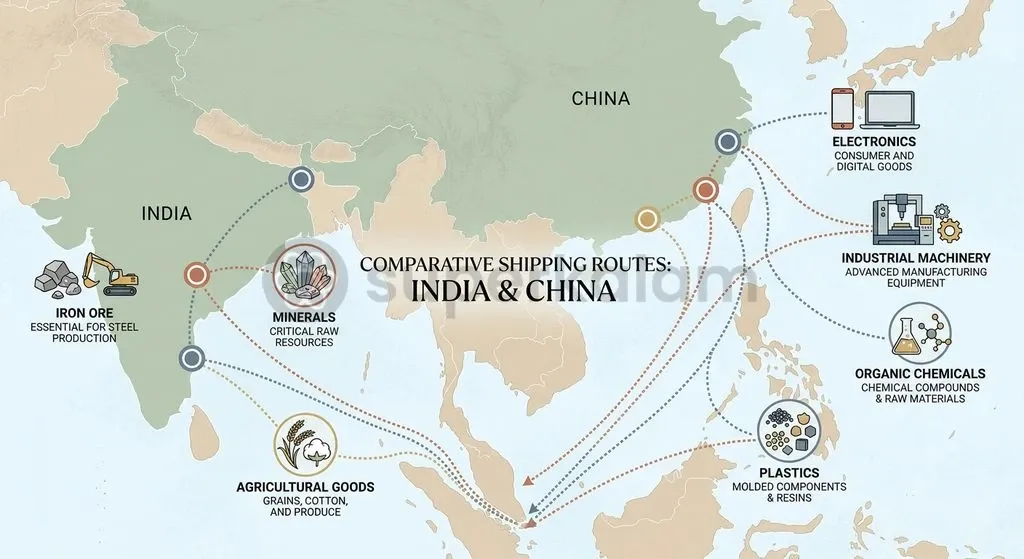
Trade data from the Directorate General of Commercial Intelligence and Statistics shows that bilateral commerce between India and China remains marked by an acute structural asymmetry. India's export profile consists overwhelmingly of low-value primary commodities. In contrast, inbound shipments are heavily concentrated in technologically advanced manufactured goods.
Key structural characteristics of the trade basket include:
- Primary commodities and raw materials dominate India's outbound shipments.
- Industrial goods represent 98.5 percent of inbound shipments from China.
- Intermediate production inputs (70 percent) and capital machinery (22 percent) make up the bulk of inbound volumes.
According to a report by the Global Trade Research Initiative (GTRI), industrial products account for 98.5 percent of India’s imports from China. Agricultural commodities, fuels, and gems and jewellery together make up less than 1.5 percent of the inbound basket. A parliamentary submission by the Ministry of Commerce and Industry highlighted that approximately 70 percent of India's imports from China consist of intermediate production inputs, while capital goods constitute another 22 percent. Over 90 percent of Chinese shipments to India are utilised directly as factory inputs and machinery rather than consumer retail products.
| Dimension | Indian Exports to China | Indian Imports from China |
|---|---|---|
| Primary Composition | Iron ore, refined petroleum naphtha, seafood, and agricultural items | Electronics, industrial machinery, organic chemicals, and plastics |
| Value Addition | Low-value raw materials and semi-processed resource goods | High-value capital equipment and specialized intermediate components |
| Sectoral Concentration | Resource-based commodities recorded by the DGCIS | Four groups make up nearly 80% of inbound shipments per GTRI |
| End-Use Profile | Inputs for Chinese smelting, refining, and industrial processing | Over 90% serves as inputs and machinery for Indian manufacturing |
The Directorate General of Commercial Intelligence and Statistics notes that India’s outbound basket remains tethered to resource extraction. When Chinese industrial activity accelerates, Indian raw materials find a market. However, these shipments generate limited domestic value addition. Conversely, India's factories cannot operate without the steady arrival of Chinese chemicals, components, and heavy equipment.
Discuss with Superkalam
Which four commodity groups make up nearly 80 percent of India's merchandise imports from China?
Ask NowWhy Did Exports Surge While the Trade Deficit Still Widened?
The Ministry of Commerce and Industry observed that India's merchandise exports to China surged by 40.7 percent during the first nine months of 2026. Shipments reached 19.26 billion dollars, matching the country's full-year export total for 2025 in just nine months, according to GAC trade statistics.
| Metric | Absolute Value | Year-on-Year Growth |
|---|---|---|
| Indian Exports | +$5.57 Billion absolute gain | 40.7% growth (from ~$13.69B base) |
| Chinese Exports | +$23.67 Billion absolute gain | 23.3% growth (from $101.52B base) |
| Net Trade Impact | Deficit widened by $18.1 Billion | Skewed by structural base effect |
A severe base-effect asymmetry explains why this rapid export growth failed to narrow the deficit. Indian exports grew 40.7 percent on a small base of roughly 13.69 billion dollars, adding approximately 5.57 billion dollars in absolute terms. Meanwhile, Chinese exports to India grew by 23.3 percent on an enormous base of 101.52 billion dollars, adding 23.67 billion dollars in shipments over the same period.
India's expanding manufacturing assembly sector also creates a compounding demand cycle. The Economic Survey 2023–24 noted that expanding domestic electronics and smartphone manufacturing under the Production-Linked Incentive (PLI) scheme has dramatically increased imports of sub-assemblies and components from China. Domestic assembly units require printed circuit boards, display modules, and lithium-ion cells. As a result, higher Indian final output mechanically inflates intermediate imports from Chinese suppliers.
Discuss with Superkalam
How does the base-effect asymmetry explain why a 40.7% surge in Indian exports failed to narrow the trade deficit with China?
Ask NowCritical Import Dependencies: Pharmaceuticals, Electronics, and Green Energy
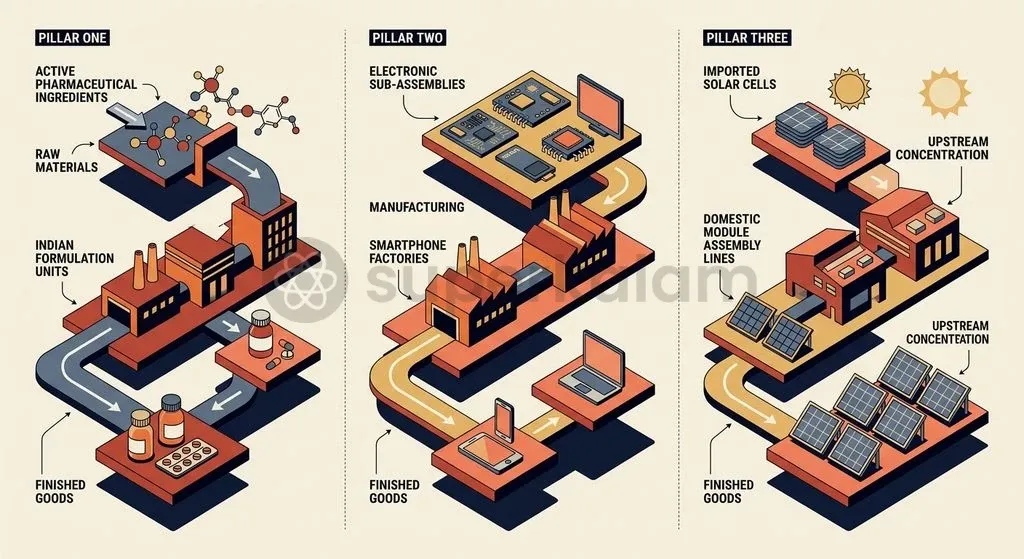
Data from the Department of Pharmaceuticals shows that Indian drug formulators rely on China for roughly 70 percent of their active pharmaceutical ingredients. For foundational antibiotics such as Penicillin G and 6-APA (6-aminopenicillanic acid), import reliance ranges between 75 to 90 percent, according to the Ministry of Chemicals and Fertilizers. Any disruption in Chinese logistics directly threatens India's generic formulation exports, which supply affordable medicines across the globe.
Core supply-chain vulnerabilities include:
- Active Pharmaceutical Ingredients (APIs): Sourced from China for ~70 percent of overall formulation needs.
- Critical Antibiotics: Import concentration between 75 percent and 90 percent for Penicillin G and 6-APA.
- Solar Energy Components: Persistent reliance on cell imports despite domestic module mandates.
- Strategic Minerals: Direct exposure to Chinese export quotas on graphite and gallium.
The renewable energy sector exhibits a parallel vulnerability in its upstream supply chains. The Ministry of New and Renewable Energy enforces the Approved List of Models and Manufacturers (ALMM) mandate to ensure domestic projects use certified solar modules. However, domestic solar module manufacturers remain heavily reliant on imported Chinese solar cells, as local cell manufacturing capacity lags behind domestic installation targets.
National security planners also monitor dependencies in advanced technology and energy storage. According to the Ministry of Mines, China's export licensing controls on critical minerals—including gallium, germanium, and graphite—pose significant risks for India's domestic semiconductor and electric vehicle battery programmes. Four commodity groups—electronics, machinery, organic chemicals, and plastics—account for nearly 80 percent of India's total imports from China, illustrating how broad-based this industrial reliance remains.
The Strategic Dilemma: Trade Ties Amid Border Tensions
The Ministry of External Affairs confirmed that Prime Minister Narendra Modi and President Xi Jinping held formal talks on trade friction during the recent BRICS Summit. The discussions focused on structural trade imbalances, non-tariff barriers facing Indian products, and disruptions across regional supply chains. This diplomatic dialogue illustrates the friction between India's national security imperatives and its industrial growth requirements.
New Delhi has maintained strict oversight of northern capital flows since the 2020 border confrontations. Under Press Note 3 (2020 Series) issued by the Department for Promotion of Industry and Internal Trade (DPIIT), all foreign direct investment from nations sharing a land border with India requires prior government approval. While this policy prevented opportunistic acquisitions of Indian assets, it also curtailed joint ventures that could have transferred critical manufacturing technologies to domestic firms.
Key policy positions shaping this strategic dilemma include:
- Security View: Strict regulatory screening under Press Note 3 to protect sovereign assets and critical infrastructure.
- Economic View: The Economic Survey recommendation to selectively absorb Chinese FDI and operational expertise.
- Pragmatic Compromise: Fast-tracking vetted joint ventures in designated high-technology industrial sectors.
Policy institutions have debated the long-term utility of comprehensive commercial disengagement. Chapter 3 of the Economic Survey 2023–24 advocated integrating into Chinese supply chains and selectively attracting Chinese direct investment to bolster Indian manufacturing and export competitiveness. In March 2026, the central government made a pragmatic exception by allowing state-run Bharat Heavy Electricals Limited (BHEL) to import 21 critical components directly from Chinese vendors to prevent execution delays across national thermal power projects.
Discuss with Superkalam
Assess the operational trade-offs of using Press Note 3 to restrict Chinese foreign direct investment while running a record merchandise trade deficit.
Ask NowEvaluating India's Response: Tariffs, Quality Controls, and Production Subsidies
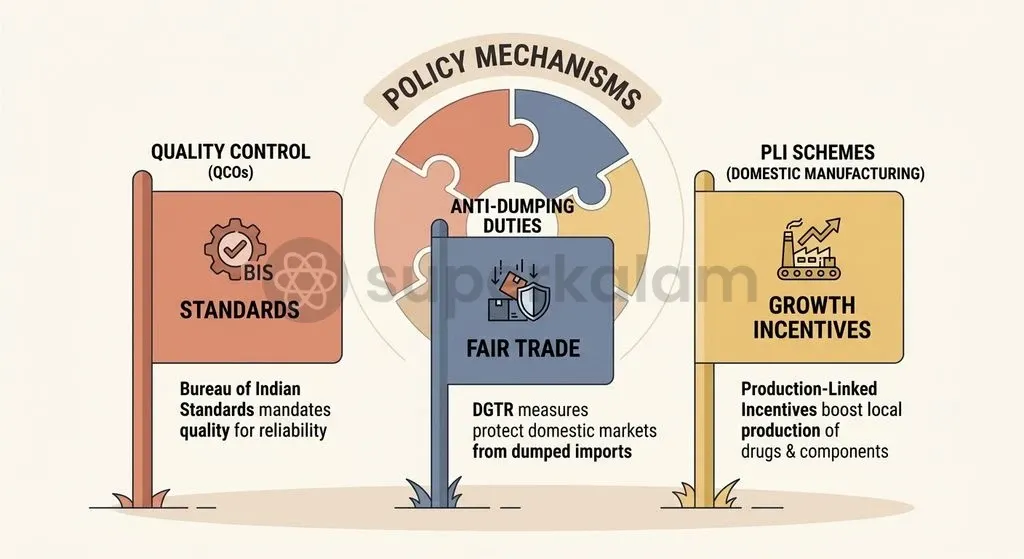
The Department for Promotion of Industry and Internal Trade has deployed targeted regulatory interventions, including mandatory quality orders and investment screening, to curb low-quality Chinese imports. The Bureau of Indian Standards (BIS), working alongside the DPIIT, has enforced over 150 Quality Control Orders (QCOs) covering sectors such as structural steel, industrial chemicals, toys, and electrical machinery. These non-tariff measures enforce stringent technical standards on inbound shipments without violating national treatment rules under the World Trade Organization (WTO).
Trade defence mechanisms have been deployed against predatory pricing practices. Following trade injury investigations, the Directorate General of Trade Remedies (DGTR) recommended definitive anti-dumping duties of up to 30 percent on CIF (Cost, Insurance, and Freight) value for three years on Chinese solar cells and modules. These remedial tariffs shield domestic manufacturers from subsidised production surpluses originating in Chinese industrial clusters.
India's current industrial policy toolkit incorporates several distinct instruments:
- Quality Standards: Over 150 Quality Control Orders (QCOs) enforced through BIS and DPIIT across manufacturing inputs.
- Trade Remedies: Targeted anti-dumping duties of up to 30 percent recommended by DGTR on solar components.
- Production Subsidies: Targeted PLI incentives supporting domestic bulk drugs, electronics, and solar modules.
- Investment Screening: Expedited approvals for minority foreign stakes up to 10 percent in key sectors.
The central government has simultaneously expanded domestic capacity through the Production-Linked Incentive (PLI) framework. In the pharmaceutical sector, the Department of Pharmaceuticals confirmed that 38 greenfield projects covering 28 critical bulk drugs were operational by December 2025, establishing 56,800 metric tonnes of domestic production capacity. Recognising that strict investment bans can slow domestic capital formation, the DPIIT clarified in August 2026 that an expedited approval mechanism would process minority foreign investments up to 10 percent and fast-track majority Indian-owned joint ventures in five designated high-technology sectors.
Discuss with Superkalam
Propose policy interventions that could build domestic intermediate component capacity without causing execution delays in national manufacturing projects.
Ask NowThe Way Forward: Building Domestic Capacity Without Stalling Growth
The Ministry of Commerce and Industry is implementing a dual-track strategy to build domestic industrial capabilities while diversifying import reliance across trusted global partners. Completely severing commercial links with China in the short term would starve Indian factories of essential components, inflate manufacturing costs, and undercut export competitiveness. Policymakers must instead pursue strategic supply-chain resilience through calibrated domestic capacity building and international trade partnerships.
Key policy priorities for structural reduction of the trade deficit include:
- Increase national research and development spending well beyond the current 0.64 percent of GDP.
- Deepen domestic component ecosystems beneath simple assembly operations.
- Accelerate bilateral trade pacts under the 'China Plus One' diversification model.
- Secure direct sovereign equity stakes in overseas critical mineral assets.
Deepening domestic value addition requires moving beyond simple assembly operations. In electronics and clean energy, production subsidies must prioritize basic components—such as semiconductor wafers, active pharmaceutical raw materials, and solar ingots—over end-product packaging. India's research and development spending stands at 0.64 percent of GDP, according to the Economic Survey. Expanding public and private research funding is essential to develop indigenous technological alternatives and reduce prolonged reliance on foreign capital machinery.
External trade diversification must complement domestic industrial programmes. The Department of Commerce has actively pursued the 'China Plus One' strategy by implementing Comprehensive Economic Partnership Agreements with the United Arab Emirates and Australia, while negotiating comprehensive trade compacts with the European Union and the United Kingdom. Deepening trade ties with alternative manufacturing hubs across Southeast Asia, Europe, and the Middle East will provide Indian industry with redundant component pipelines, reducing vulnerability to single-country supply shocks while domestic capacity scales up.
Key Takeaways
India's expanding trade deficit with China reflects an industrial structure reliant on imported inputs, demanding targeted supply-chain deepening alongside pragmatic external diversification.
- Deficit Crossing: Bilateral merchandise trade reached 144.45 billion dollars in the first nine months of 2026, with India's trade deficit expanding 20.7 percent year-on-year to hit an unprecedented 105.93 billion dollars, as documented by China's GAC statistics.
- The Base-Effect Reality: Despite Indian exports surging 40.7 percent to 19.26 billion dollars between January and September 2026, the trade gap widened because Chinese inbound shipments grew 23.3 percent on an import base more than six times larger.
- Input-Heavy Import Basket: Industrial production inputs drive the trade deficit, with intermediate goods accounting for roughly 70 percent and capital goods making up 22 percent of all Chinese shipments to India.
- Sectoral Exposure: Vulnerabilities remain acute in critical sectors, with India sourcing 70 percent of its active pharmaceutical ingredients and the majority of its solar cells and electronic sub-assemblies from Chinese suppliers.
- Calibrated Policy Response: New Delhi is balancing national security and economic growth through over 150 Quality Control Orders, targeted anti-dumping duties, PLI capacity additions, and expedited screening for minority joint ventures in strategic sectors.
Mains Question
"India's widening trade gap with China remains a structural feature of an expanding economy whose export competitiveness relies on imported intermediate inputs." Elucidate. (10 Marks)
Evaluate NowMains Question
Under Press Note 3 (2020 Series), India tightened scrutiny on capital inflows while continuing to witness record bilateral trade deficits with China. In this context, critically examine the policy conflict between national security imperatives and industrial growth requirements. (15 Marks)
Evaluate NowPractice MCQs
QUESTION 1
With reference to the composition of bilateral trade between India and China, consider the following statements:
- Industrial products account for over 95 percent of India's merchandise imports from China.
- Over 90 percent of Chinese shipments entering India are utilized directly as factory inputs and machinery rather than consumer retail products.
- Primary commodities and raw materials constitute the majority of India's outbound shipments to China. Which of the statements given above are correct?
QUESTION 2
Consider the following statements regarding the dynamics of India's trade deficit with China between January and September 2026:
- Despite Indian exports growing at a higher percentage rate than Chinese exports, the bilateral trade deficit widened.
- A significant base-effect asymmetry caused the absolute gain in Chinese exports to exceed the absolute gain in Indian exports.
- The expansion of domestic electronics assembly under the Production-Linked Incentive (PLI) scheme led to a decline in intermediate sub-assembly imports from China. Which of the statements given above is/are correct?
QUESTION 3
Regarding India's critical industrial and supply chain dependencies on China, consider the following statements:
- Indian pharmaceutical formulators depend on China for approximately 70 percent of their active pharmaceutical ingredients (APIs).
- Import reliance on China for foundational antibiotics such as Penicillin G and 6-APA ranges between 75 to 90 percent.
- Under the Approved List of Models and Manufacturers (ALMM) mandate, Indian solar module manufacturers have achieved near-complete self-sufficiency in domestic solar cell production. Which of the statements given above is/are correct?
QUESTION 4
With reference to regulatory and policy measures governing economic engagement with China, consider the following statements:
- Press Note 3 (2020 Series) mandates prior government approval for foreign direct investment originating from countries that share a land border with India.
- Chapter 3 of the Economic Survey 2023–24 advocated for the complete prohibition of Chinese FDI to shield domestic enterprises from external competition. Which of the statements given above is/are correct?
QUESTION 5
According to trade data cited in the article, which four commodity groups account for nearly 80 percent of India's total imports from China?