PM Samajik Sahayata Yojana: Evaluating NSAP Reforms and Welfare Architecture
While PM Samajik Sahayata Yojana widens disability aid, frozen ₹200 pensions highlight the growing fiscal burden shifting from the Centre to state governments.
Oct, 2026
•9 min read
Overview
The Union Cabinet restructured India's non-contributory welfare net in October 2026 by approving the Pradhan Mantri Samajik Sahayata Yojana with an outlay of ₹53,428 crore over five years. Yet the reform leaves the central old-age pension frozen at ₹200 per month for individuals aged 60 to 79.
The initiative is primarily a nomenclature rationalisation rather than a structural expansion. While disability criteria are relaxed, static demographic quotas dating back to 2001 still exclude millions of destitute senior citizens. Consequently, the financial burden of fulfilling constitutional welfare mandates falls almost entirely on state exchequers.
Why in the News: The Shift to PM Samajik Sahayata
The Union Cabinet approved the continuation of the National Social Assistance Programme as the Pradhan Mantri Samajik Sahayata Yojana on 14 October 2026. This administrative overhaul commits an outlay of ₹53,428 crore covering the five-year period from FY 2026–27 to FY 2030–31.
The scheme unifies several longstanding centrally sponsored schemes under revised titles:
- Pradhan Mantri Vridhavastha Pension Yojana: Replaces the Indira Gandhi National Old Age Pension Scheme.
- Pradhan Mantri Vidhawa Pension Yojana: Succeeds the Indira Gandhi National Widow Pension Scheme.
- Pradhan Mantri Divyangjan Pension Yojana: Restructures the disability pension component.
- Pradhan Mantri Parivar Labh Yojana: Renames the National Family Benefit Scheme, retaining the one-time lump-sum grant of ₹20,000 for bereaved below-poverty-line families.
Beyond nomenclature, the operational framework modifies parameters for persons with disabilities. It lowers the benchmark disability threshold and removes entry-age barriers. However, baseline cash transfers for the elderly remain unchanged, leading policy analysts to question whether the package delivers genuine welfare reform or cosmetic rebranding.
Discuss with Superkalam
What are the renamed components of the National Social Assistance Programme under the Pradhan Mantri Samajik Sahayata Yojana?
Ask NowThe 200-Rupee Trap: Why the Legacy NSAP Architecture Froze in Time
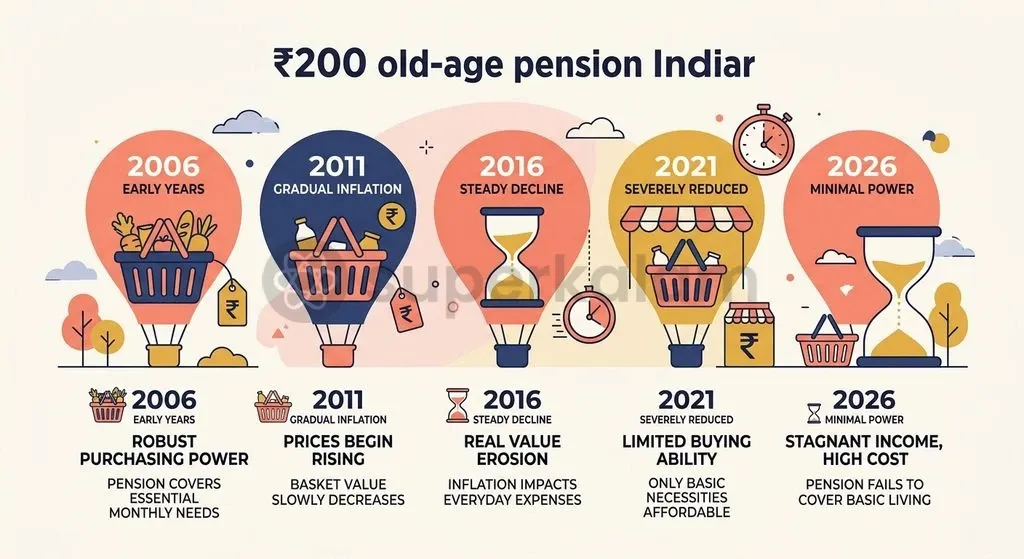
India's baseline old-age pension has remained stagnant for two decades. The Ministry of Rural Development continues to peg central assistance at ₹200 per month for beneficiaries aged 60 to 79 years.
This amount has remained completely unchanged since the 2006–07 fiscal revision. Beneficiaries aged 80 and above receive ₹500 per month, an allocation frozen since 2011.
Key figures illustrate the erosion of this safety net:
- ₹6.66 per day: The real daily value of a ₹200 monthly transfer, delivering less than 5% of national minimum wage benchmarks.
- Unadjusted for inflation: Two decades of price increases have hollowed out the real purchasing power of the stipend, failing to meet nutritional or medical needs.
- ₹9,671 crore allocation: The NSAP allocation in Union Budget 2026–27 accounts for roughly 4% of the budget of the Department of Rural Development.
Parliamentary committees have repeatedly criticised this stagnation. In its 5th Report for the 18th Lok Sabha, the Standing Committee on Rural Development and Panchayati Raj called the transfer exceptionally meagre assistance. The panel recommended an immediate upward revision linked to the cost-of-living index, warning that nominal cash transfers without periodic indexation fail to provide social protection.
Side-by-Side: What Changes Under PM Samajik Sahayata
The Pradhan Mantri Samajik Sahayata Yojana alters administrative nomenclature and specific disability parameters while leaving old-age transfers static. The central monthly assistance under the newly renamed Pradhan Mantri Divyangjan Pension Yojana increases by 25% from ₹300 to ₹375 for beneficiaries aged 0 to 79 years, and from ₹500 to ₹625 for citizens aged 80 and above.
Eligibility for disability pensions undergoes meaningful reform. The Ministry of Rural Development lowered the qualifying disability threshold from 80% to 40% and eliminated the previous minimum age requirement of 18 years, enabling financial support from birth. In contrast, the old-age pension framework retains its legacy rate structure.
| Structural Dimension | Legacy NSAP Framework | PM Samajik Sahayata Yojana (2026–2031) | Analytical Assessment |
|---|---|---|---|
| Old-Age Central Base (Ages 60–79) | ₹200 per month per beneficiary | ₹200 per month per beneficiary | Unchanged since 2006; real value degraded by inflation |
| Old-Age Central Base (Ages 80+) | ₹500 per month per beneficiary | ₹500 per month per beneficiary | Unchanged since 2011; provides no cost-of-living buffer |
| Disability Assistance (Ages 0–79) | ₹300 per month per beneficiary | ₹375 per month per beneficiary | 25% nominal increase; first rate adjustment in over a decade |
| Disability Qualification Criteria | Severe disability (≥80%), minimum 18 years | Benchmark disability (≥40%), support from birth | Significant structural improvement; expands coverage base |
| Widow Assistance (Ages 40–79) | ₹300 per month per beneficiary | ₹300 per month per beneficiary | Nominal stagnation; zero real income enhancement |
| National Target Ceiling | 3.09 crore total beneficiaries | 3.20 crore total beneficiaries | Marginal expansion of 11 lakh slots nationwide |
| Family Death Benefit (NFBS) | ₹20,000 lump sum for BPL breadwinner death | ₹20,000 lump sum under PM Parivar Labh Yojana | Zero adjustment to breadwinner replacement value |
Discuss with Superkalam
How does pegging social security quotas to Census 2001 figures lead to systemic administrative exclusion today?
Ask NowTargeting vs Universal Coverage: Will Dynamic Registries End Exclusion?
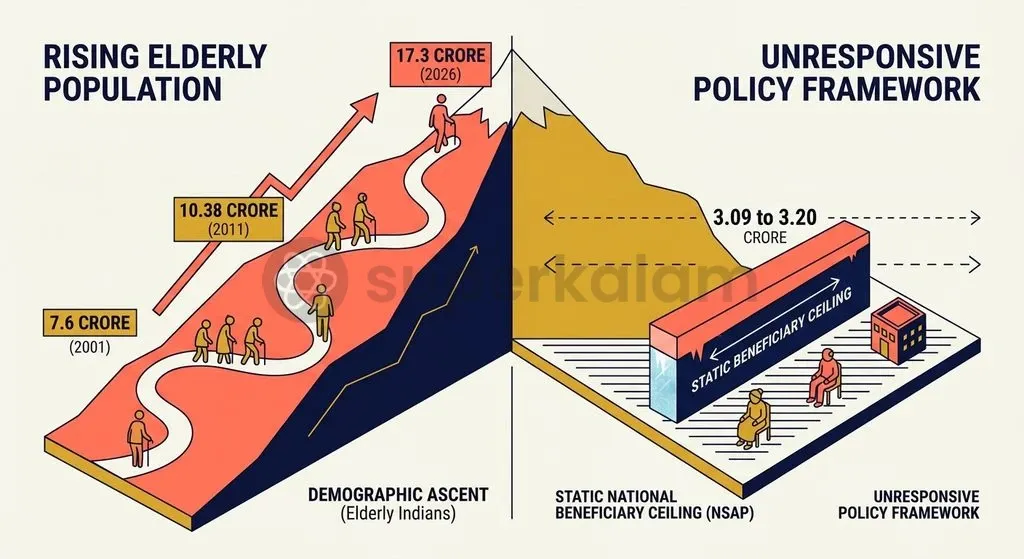
Outdated demographic baselines create severe administrative exclusion in the NSAP framework. The Comptroller and Auditor General of India, in Report No. 25 of 2023, pointed out that state quotas remain bound to Census 2001 population figures and 2004–05 poverty estimates. These archaic markers ignore a quarter-century of population aging.
Key structural constraints and leakages include:
- Widening demographic gap: India's elderly demographic expanded from 7.6 crore in Census 2001 to 10.38 crore in Census 2011, and is projected to reach 17.3 crore individuals by 2026.
- Static national caps: Lifting the national ceiling from 3.09 crore to 3.20 crore beneficiaries adds only 11 lakh slots across all schemes combined, leaving millions outside formal coverage.
- High economic vulnerability: Data indicates that over 40% of Indian seniors occupy the poorest wealth quintile, forcing nearly half of all elderly men and 22% of elderly women to continue manual labour into advanced age.
- Audit leakages: CAG Report No. 25 of 2023 uncovered ₹2.0 crore in irregular disbursements to 2,103 deceased beneficiaries across 26 States and UTs.
Direct Benefit Transfer systems deployed on the NSAP-PPS portal and Public Financial Management System have curtailed ghost beneficiaries since December 2014. Nevertheless, procedural bottlenecks like biometric mismatches continue to lock out genuine, infirm claimants.
Discuss with Superkalam
If you were the District Magistrate reviewing biometric DBT dropouts in rural pension rolls, how would you address physical infirmity and fingerprint fading among senior claimants?
Ask NowThe Fiscal Federalism Divide: State Top-Ups and Central Stagnation
The Seventh Schedule places social security, invalid pensions, and old-age relief under Entries 23 and 24 of the Concurrent List. While legislative jurisdiction is joint, financial obligations have shifted heavily to state governments.
The resulting fiscal distortions manifest in several ways:
- Disproportionate state financing: Regional governments now finance between 70% to more than 90% of total monthly disbursements, contributing top-ups ranging from ₹800 to ₹3,800 per month over the ₹200 central baseline.
- Geographic inequity: Because relief levels depend on state fiscal capacity, citizens with identical physical vulnerabilities receive vastly different support depending on their address.
- Tighter release conditions: Starting FY 2024–25, central allocations arrive in four quarterly instalments that are withheld if states fail to upload prompt utilisation certificates and digitised rolls, per the Standing Committee on Rural Development and Panchayati Raj.
- Inter-scheme fund diversions: CAG Report No. 25 of 2023 uncovered that ₹57.45 crore of NSAP funds were diverted across six States and UTs (Bihar, Goa, Odisha, Rajasthan, Chhattisgarh, and Jammu & Kashmir) for unapproved operational costs.
Diversion also occurred at the central level. The Ministry of Rural Development diverted ₹2.83 crore of NSAP funds intended for administration and publicity to finance campaigns for unrelated schemes like PMAY-G and DDU-GKY. This trend strains cooperative federalism, compelling cash-strapped states to shoulder the social floor alone.
Discuss with Superkalam
Contrast the structural changes made to disability assistance against the stagnant old-age pension under the 2026 reform: why might the state treat these vulnerable cohorts differently?
Ask NowConstitutional Mandate: Moving from Discretionary Relief to Article 41 Rights
India's non-contributory welfare architecture is grounded in distinct constitutional directives and judicial interpretations:
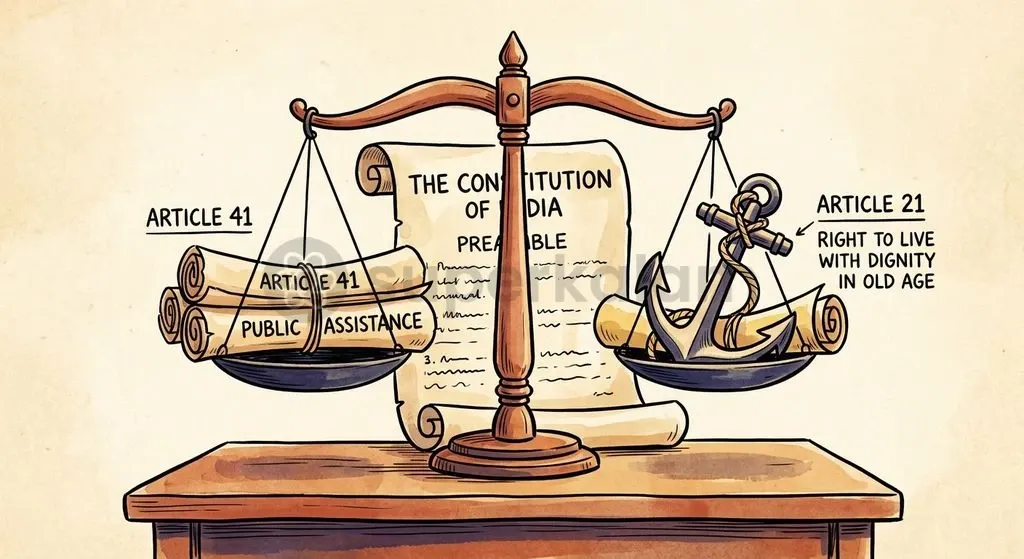
- Article 41 of the Constitution: Establishes a Directive Principle requiring the State to secure public assistance in cases of old age, sickness, and disablement, qualified only by economic capacity.
- Article 21 guarantees: In Ashwani Kumar v. Union of India (2019), the Supreme Court ruled that senior citizens possess a fundamental right to live with dignity under Article 21, ordering governments to reassess pension amounts and elder-care infrastructure.
Treating public pensions as discretionary executive charity conflicts with this rights-based mandate. A frozen transfer of ₹200 a month reduces social protection to a symbolic gesture. To realise the vision of Articles 21 and 41, India must transition from discretionary handouts to an enforceable statutory safety net.
Discuss with Superkalam
Design a statutory mechanism that automatically indexes non-contributory welfare transfers to inflation without compromising fiscal discipline between the Centre and States.
Ask NowKey Takeaways
- The Union Cabinet approved the Pradhan Mantri Samajik Sahayata Yojana on 14 October 2026 with a five-year outlay of ₹53,428 crore, extending the legacy NSAP architecture through FY 2030–31.
- Central monthly assistance for elderly beneficiaries aged 60 to 79 remains frozen at ₹200 per month, an amount that has seen zero upward revision since 2006–07.
- Disability pensions under the Pradhan Mantri Divyangjan Pension Yojana were raised by 25% to ₹375 per month, with eligibility widened by reducing the benchmark threshold from 80% to 40% and removing the 18-year age minimum.
- Beneficiary caps remain tethered to archaic Census 2001 parameters, expanding only marginally to 3.20 crore despite India's elderly demographic swelling to a projected 17.3 crore by 2026.
- States bear disproportionate fiscal pressure by financing 70% to more than 90% of total pension values, contributing top-ups ranging between ₹800 and ₹3,800 per month.
- The Supreme Court in Ashwani Kumar v. Union of India (2019) anchored the right of elderly individuals to live with dignity under Article 21, reinforcing the non-justiciable directive of Article 41.
Mains Question
"Non-contributory welfare pensions in India suffer from frozen nominal values, static demographic baselines, and fiscal federal imbalances." In this context, critically examine the architecture of the newly approved Pradhan Mantri Samajik Sahayata Yojana. (15 Marks)
Evaluate NowMains Question
'Treating non-contributory social security as discretionary executive charity rather than an enforceable constitutional right conflicts with Article 41 and the dignity guarantees under Article 21.' Elucidate with reference to the Ashwani Kumar v. Union of India (2019) judgment and recent welfare scheme audits. (10 Marks)
Evaluate NowPractice MCQs
QUESTION 1
With reference to the Pradhan Mantri Samajik Sahayata Yojana (restructured from the National Social Assistance Programme), consider the following statements:
- The qualifying benchmark disability threshold for disability assistance has been lowered from 80% to 40%.
- The minimum entry-age barrier of 18 years for disability pension assistance has been eliminated, providing coverage from birth.
- The central assistance for old-age pensioners aged 60 to 79 years has been raised from ₹200 to ₹375 per month. Which of the statements given above are correct?
QUESTION 2
Regarding the constitutional and jurisdictional architecture of non-contributory welfare pensions in India, consider the following statements:
- Social security, invalid pensions, and old-age relief fall under the Concurrent List of the Seventh Schedule.
- In Ashwani Kumar v. Union of India (2019), the Supreme Court linked the adequacy of pensions and elder-care infrastructure to the fundamental right to live with dignity under Article 21.
- Article 41 directs the State to secure public assistance in cases of old age, sickness, and disablement, within the limits of its economic capacity. Which of the statements given above is/are correct?
QUESTION 3
With reference to the National Social Assistance Programme (NSAP) coverage and audit findings, consider the following statements:
- The state allocation ceilings and beneficiary quotas continue to be anchored to Census 2001 population figures.
- The national target ceiling under the PM Samajik Sahayata Yojana was expanded from 3.09 crore to 4.50 crore beneficiaries.
- Findings from the Comptroller and Auditor General (CAG) Report No. 25 of 2023 highlighted irregular disbursements to deceased beneficiaries across several States and UTs. Which of the statements given above is/are correct?
QUESTION 4
Consider the following pairs of welfare components under the restructured PM Samajik Sahayata Yojana and their corresponding predecessor schemes:
- Pradhan Mantri Vridhavastha Pension Yojana — Indira Gandhi National Old Age Pension Scheme
- Pradhan Mantri Vidhawa Pension Yojana — Indira Gandhi National Widow Pension Scheme
- Pradhan Mantri Parivar Labh Yojana — National Family Benefit Scheme How many of the pairs given above are correctly matched?
QUESTION 5
Which of the following bodies recommended that the central assistance under the National Social Assistance Programme (NSAP) should be immediately revised upwards and linked to the cost-of-living index, characterizing the current transfers as 'exceptionally meagre assistance'?