Forest Rights Act 2006: Why Forest Tenure Remains Contested
As bureaucratic hurdles and high rejections stall forest tenure, understanding the FRA's contested decentralisation is critical for UPSC governance analysis.
Oct, 2026
•10 min read

Overview
The Scheduled Tribes and Other Traditional Forest Dwellers (Recognition of Forest Rights) Act, 2006 sought to undo historical injustice by restoring tenurial and governance autonomy to forest-dwelling communities across India. Rather than realising democratic decentralisation, the statute remains contested as bureaucratic resistance, high claim rejections, and administrative dilution of Gram Sabha authority reduce collective community empowerment to discretionary, small-scale individual land allocations. As cumulative national data submitted to Parliament reveals persistent implementation deficits, the unresolved friction between forest conservation laws and tribal rights exposes how tenure security continues to elude millions of traditional dwellers.
Why Forest Rights Remain in the Headlines
The Ministry of Tribal Affairs confirmed persistent disputes over forest tenure in data presented to the Rajya Sabha in August 2026. As of June 2026, cumulative records across 20 States and one Union Territory show that out of 54.01 lakh claims lodged under the Forest Rights Act, 2006, authorities have distributed 25.42 lakh titles while rejecting 18.13 lakh claims. Recent filings demonstrate ongoing friction: between financial years 2023–24 and 2025–26, citizens submitted 8,56,159 fresh claims, resulting in 2,34,352 approvals and 14,462 formal rejections.
Tenure insecurity has deepened alongside welfare transitions. Under the previous operational framework notified in January 2014 for the Mahatma Gandhi National Rural Employment Guarantee Act, title holders under the Forest Rights Act received an additional 50 days of wage work beyond the standard 100-day entitlement. Effective 1 July 2026, the Viksit Bharat – Guarantee for Rozgar and Ajeevika Mission (Gramin) Act, 2025 replaced that framework with a baseline guarantee of 125 days. However, per Ministry of Rural Development disclosures reported in October 2026, no notification has been issued under Section 5(4) of the 2025 statute to extend supplementary days to forest title holders.
Discuss with Superkalam
What is the statutory definition of 'three generations' required for Other Traditional Forest Dwellers under the Forest Rights Act, 2006?
Ask NowThe Historic Injustice the Law Aimed to Repair
Colonial forest policy systematically transformed customary community homelands into state-owned commercial estates through the Indian Forest Act, 1927. Imperial administrations classified inhabited ancestral territories as reserved forests and protected forests, treating traditional residents as illegal encroachers without recording pre-existing customary access or stewardship.
Post-independence administrative mechanisms perpetuated this institutional exclusion. State forest departments consolidated territorial authority under conservation statutes without conducting comprehensive ground settlements, leaving millions of forest dwellers vulnerable to summary evictions and administrative harassment.
The Scheduled Tribes and Other Traditional Forest Dwellers (Recognition of Forest Rights) Act, 2006, enacted as Act No. 2 of 2007, sought to reverse this prolonged marginalisation. The statute establishes statutory mechanisms to recognise pre-existing customary rights rather than conferring state charity. Under Section 11 of the Act, Parliament designated the Ministry of Tribal Affairs as the nodal agency, seeking to break the monopoly of traditional forest bureaucracy over forest-land administration.
The Three-Tier Recognition Process: How Claims Move From Gram Sabha to District
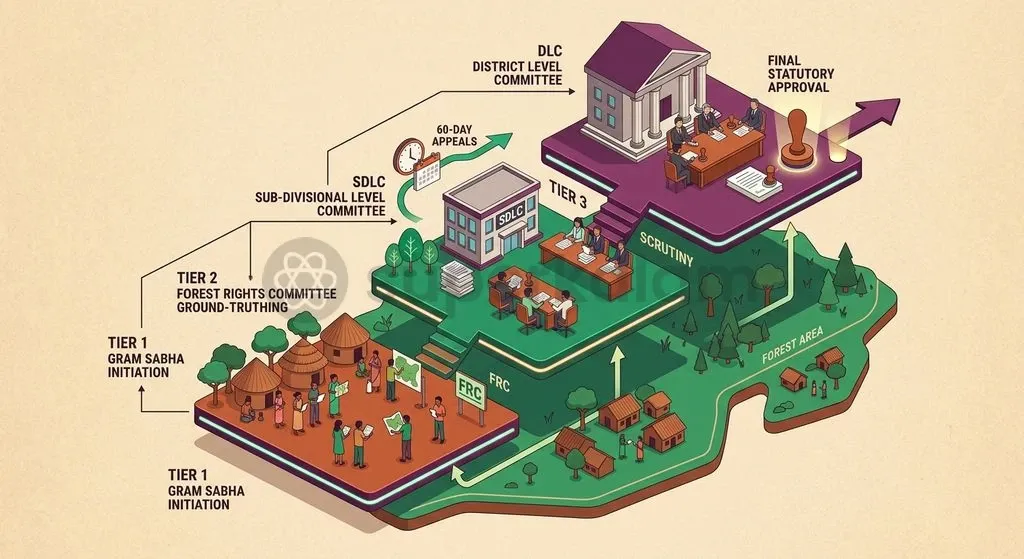
The Forest Rights Act, 2006 establishes an explicit bottom-up administrative hierarchy to prevent unilateral executive dispossessions. The statutory claim pathway operates across three sequential institutional tiers:
- Gram Sabha Initiation: Under Section 6(1) of the Act, the Gram Sabha serves as the sole competent authority to initiate the process of determining the nature and extent of individual or community rights. A village-level Forest Rights Committee receives claims, conducts participatory field verifications, and submits recommendations to the assembly for a formal resolution.
- Sub-Divisional Level Scrutiny: Under Sections 6(2) and 6(3) of the Act, the Sub-Divisional Level Committee examines Gram Sabha resolutions and collates the draft record of rights. Aggrieved claimants may petition this committee within 60 days of a village resolution.
- District Level Final Approval: Under Section 6(4) read with Section 6(6) of the Act, the District Level Committee functions as the final appellate and approving authority. Its formal approvals establish the final, conclusive record of rights.
Rigid eligibility criteria bifurcate applicants into two statutory categories under the law:
- Forest Dwelling Scheduled Tribes (FDST): Under Section 2(c), claimants must belong to Scheduled Tribes who primarily reside in and depend on forests for bona fide livelihood needs prior to 13 December 2005.
- Other Traditional Forest Dwellers (OTFD): Under Section 2(o) read with Section 2(a), non-tribal claimants must prove continuous residence and dependence on forest land for at least three generations—defined statutorily as 75 years at 25 years per generation—prior to 13 December 2005.
Statutory safeguards govern all recognised lands. Under Section 4(6) of the Act, titling is restricted to actual occupation and capped at four hectares per household. Section 4(4) mandates that all recognised tenures remain hereditary but non-alienable and non-transferable, prohibiting commercial land sales.
Discuss with Superkalam
Why does the recognition of Community Forest Resource (CFR) rights pose a greater challenge to state forest departments than Individual Forest Rights (IFR)?
Ask NowIndividual Titles vs Community Ownership: Why States Prefer the Smaller Stake
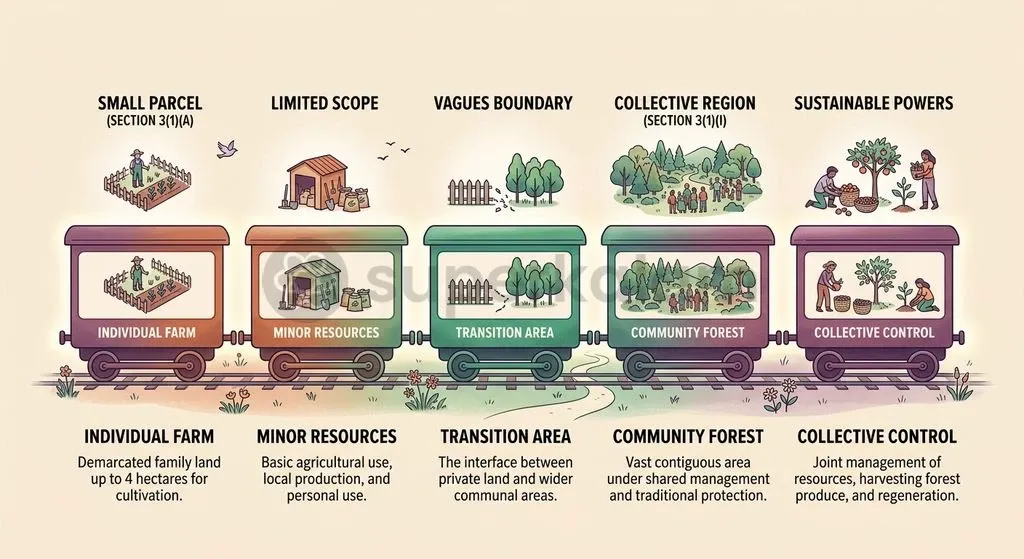
State administrations have overwhelmingly prioritised individual cultivation plots over collective tenure. Individual Forest Rights (IFR) under Section 3(1)(a) recognise personal agricultural and residential occupations. In contrast, Community Forest Resource (CFR) rights under Section 3(1)(i) vest the Gram Sabha with statutory power to protect, regenerate, and manage traditional forest boundaries.
Administrative bodies prefer individual titles because small land grants mirror conventional revenue welfare programmes without threatening state ownership over timber and commercial forest management. Conversely, Section 3(1)(c) grants community ownership over minor forest produce, stripping forest development corporations of lucrative harvest controls.
| Statutory Dimension | Individual Forest Rights (IFR) | Community Forest Resource Rights (CFR) |
|---|---|---|
| Statutory Core | Section 3(1)(a) | Section 3(1)(i) |
| Nature of Tenure | Household occupation for habitation and self-cultivation | Collective governance, conservation, and regeneration |
| Acreage Limit | Capped at actual occupation up to 4 hectares | Demarcated traditional customary village boundary |
| Administrative Friction | Moderate; treated by line departments as welfare distribution | High; challenges departmental monopoly over timber and transit |
| Commercial Impact | Confined to domestic household sustenance | Gram Sabha gains authority to harvest and trade minor forest produce |
Discuss with Superkalam
If a Gram Sabha's resolution approving a land claim is summarily dismissed without recorded reasons by a District Level Committee, how can the claimant utilize Rule 12A(3) to contest it?
Ask NowWhy Claim Rejections Peak: Evidence Gaps, Forest Department Resistance, and Committee Findings
High rejection rates reflect systemic procedural exclusions embedded within district-level operations. Under Rule 12A(3) of the Forest Rights Amendment Rules, 2012, both the Sub-Divisional Level Committee and District Level Committee must formulate written reasons for rejecting or altering claims and formally serve these orders to applicants to enable a 60-day appeal. In practice, state bodies dismiss claims summarily through unreasoned rejections, leaving forest dwellers without legal recourse.
Independent national reviews have repeatedly exposed these administrative failures:
- NC Saxena Joint Committee (2010): The committee documented widespread bureaucratic capture by state forest departments, which routinely superseded elected village committees. It found that Other Traditional Forest Dweller applications were dismissed because revenue officials unlawfully insisted on 75-year-old tax receipts, ignoring secondary oral and physical evidence permitted under the statutory rules.
- Virginius Xaxa High-Level Committee (2014): The committee reported that state administrations maintained an adversarial posture toward forest dwellers, treating rights claims as security or conservation threats. The committee highlighted that executive agencies frequently bypassed village consent to facilitate industrial resource extraction.
The Rules Dilution Debate: How the 2022 Conservation Rules Changed Gram Sabha Consent
The Ministry of Environment, Forest and Climate Change altered statutory forest clearance procedures through the Forest (Conservation) Rules, 2022. The 2022 framework dismantled long-standing safeguards established under earlier forest diversion guidelines.
Under previous executive instructions, private or public project proponents were required to present settled forest rights and prior informed consent from affected village assemblies before the central government granted Stage-I in-principle clearance. The 2022 rules shifted this settlement burden entirely to state governments after the central government grants final forest clearance.
This regulatory restructuring creates structural conflicts with statutory protections:
- Weakened Local Veto: Village assemblies lose bargaining leverage once central clearance is granted, reducing consent procedures to post-facto bureaucratic approvals.
- Jurisdictional Conflict: The Ministry of Tribal Affairs, as the statutory nodal body under Section 11, has repeatedly opposed rules that bypass local self-governance provisions guaranteed under the Forest Rights Act and the Panchayats (Extension to Scheduled Areas) Act, 1996.
Discuss with Superkalam
Analyze how designating the Ministry of Tribal Affairs rather than the Ministry of Environment, Forest and Climate Change as the nodal agency reflects the statutory intent of the Forest Rights Act.
Ask NowConservation vs Dwellers: What the 2019 Supreme Court Eviction Order Revealed
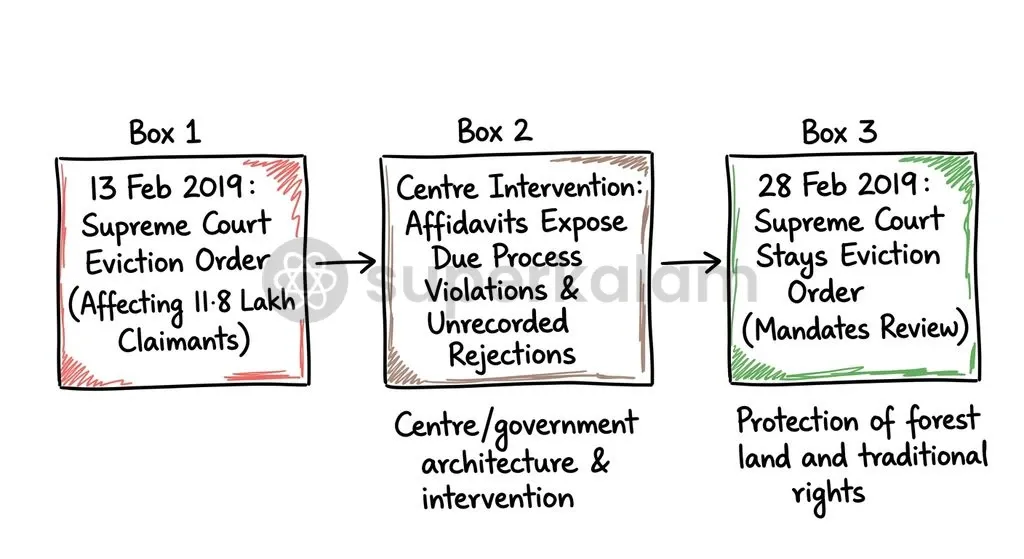
The Supreme Court brought systemic administrative flaws into sharp focus during hearings in Wildlife First & Ors. v. Ministry of Environment, Forest and Climate Change & Ors. On 13 February 2019, the apex court ordered 21 state governments to evict approximately 11.8 lakh forest dwellers whose claims had been recorded as rejected. The litigation, filed by conservation organisations, contended that rejected claimants occupied forest tracts as illegal encroachers who threatened wildlife protection.
The directive prompted emergency legal interventions. On 28 February 2019, the Supreme Court stayed its eviction directive after the Ministry of Tribal Affairs conceded that rejection procedures across states were marred by grave procedural irregularities, an absence of recorded reasons, and the denial of statutory appeal opportunities under Rule 12A(3).
Judicial precedent establishes that conservation and tribal survival are not mutually exclusive. In the landmark Niyamgiri judgment (Orissa Mining Corporation v. MoEF, 2013), the Supreme Court affirmed that the Gram Sabha possesses statutory authority under the Forest Rights Act to determine whether commercial diversions infringe upon religious, cultural, and livelihood entitlements. Furthermore, Section 5 of the statute explicitly charges the Gram Sabha with statutory responsibility to protect wildlife, biodiversity, and ecologically sensitive zones.
Reconciling Conservation and Livelihoods: The Path to Real Tenure Security
Democratic forest governance requires aligning executive procedure with the statutory guarantees of the 2006 Act. Converting legislative intent into secure ground tenure requires four institutional corrections:
- Statewide Re-examination of Rejections: State administrations must review all 18.13 lakh rejected claims, enforcing mandatory compliance with Rule 12A(3) by providing reasoned written notices and formal appeal windows.
- Prioritising Community Resource Titles: Sub-divisional and district authorities must proactively map collective boundaries under Section 3(1)(i) instead of restricting tenure recognition to individual household plots.
- Harmonising Environmental Rules: Central clearance procedures under the Forest (Conservation) Rules, 2022 must be reconciled with Section 6(1) to ensure that prior informed Gram Sabha consent remains a non-negotiable prerequisite prior to Stage-I diversion.
- Institutional Welfare Convergence: The Ministry of Rural Development must issue statutory guidelines under Section 5(4) of the Viksit Bharat – Guarantee for Rozgar and Ajeevika Mission (Gramin) Act, 2025 to formally restore additional livelihood entitlements for verified forest title holders.
Discuss with Superkalam
In light of the transition from MGNREGA to the Viksit Bharat Mission Act of 2025, evaluate the policy implications of omitting supplementary wage entitlements for forest title holders.
Ask NowKey Takeaways
- Statutory Framework: The Forest Rights Act, 2006 recognises individual cultivation rights up to 4 hectares under Section 3(1)(a) alongside collective Community Forest Resource management powers under Section 3(1)(i).
- Tiered Machinery: The Gram Sabha initiates all claims under Section 6(1), while the Sub-Divisional Level Committee scrutinises claims and the District Level Committee provides final, binding determinations under Section 6(6).
- Implementation Gap: As of June 2026, cumulative official data reveals 25.42 lakh titles distributed against 18.13 lakh claims rejected out of 54.01 lakh total applications across states.
- Procedural Violations: The 2010 NC Saxena and 2014 Virginius Xaxa committees highlighted widespread bureaucratic capture, arbitrary rejections of Other Traditional Forest Dwellers without written reasons, and systematic marginalisation of community rights.
- Regulatory Tensions: The Forest (Conservation) Rules, 2022 bypassed the requirement of obtaining prior Gram Sabha consent before central Stage-I forest clearance, moving compliance to a post-clearance state process.
- Judicial Safeguards: The Supreme Court stayed its 2019 eviction order in the Wildlife First case due to admitted procedural flaws, reaffirming the Gram Sabha's governance authority established in the 2013 Niyamgiri judgment.
Mains Question
"Rather than realising democratic decentralisation, the implementation of the Forest Rights Act, 2006 has reduced collective community empowerment to discretionary, small-scale individual land allocations." Critically examine. (15 Marks)
Evaluate NowMains Question
Examine the institutional architecture established under the Forest Rights Act, 2006 for the recognition of forest tenure, highlighting the statutory safeguards against arbitrary dispossession. (10 Marks)
Evaluate NowPractice MCQs
QUESTION 1
With reference to the Scheduled Tribes and Other Traditional Forest Dwellers (Recognition of Forest Rights) Act, 2006, consider the following statements:
- The Ministry of Environment, Forest and Climate Change serves as the statutory nodal agency for its implementation under Section 11.
- Under Section 6(1), the Gram Sabha is the sole competent authority to initiate the process of determining forest rights.
- The District Level Committee functions as the final appellate and approving authority for the record of rights. Which of the statements given above are correct?
QUESTION 2
Regarding the eligibility and conditions of tenure under the Forest Rights Act, 2006, consider the following statements:
- Other Traditional Forest Dwellers (OTFD) must prove continuous residence and dependence on forest land for at least 75 years prior to 13 December 2005.
- Land titling under the Act is capped at a maximum ceiling of four hectares per household.
- Recognized rights are hereditary, transferable, and can be commercially alienated by the title holder. Which of the statements given above is/are correct?
QUESTION 3
Consider the following statements regarding the rights recognized under the Forest Rights Act, 2006:
- Community Forest Resource (CFR) rights under Section 3(1)(i) empower the Gram Sabha to protect, regenerate, and manage traditional forest boundaries.
- Individual Forest Rights (IFR) under Section 3(1)(a) vest the household with ownership and commercial harvesting rights over standing timber.
- Section 3(1)(c) confers community ownership over minor forest produce to forest-dwelling communities. Which of the statements given above is/are correct?
QUESTION 4
Under Rule 12A(3) of the Forest Rights Amendment Rules, 2012, which of the following procedural mandates is required when a claim is rejected or modified?
QUESTION 5
Consider the following statements with reference to welfare provisions and statutory bodies associated with the Forest Rights Act, 2006:
- Under the operational guidelines notified in 2014 under MGNREGA, FRA title holders were entitled to an additional 50 days of wage employment.
- The NC Saxena Joint Committee (2010) highlighted bureaucratic capture by state forest departments and wrongful dismissals of claims.
- The Sub-Divisional Level Committee is the final approving body whose decisions conclusively establish the record of rights. Which of the statements given above is/are correct?