KVIC and Khadi Schemes: PMEGP, SFURTI and Artisan Support
KVIC is a statutory body under the KVIC Act, 1956. Its schemes support rural enterprises through PMEGP subsidies, SFURTI clusters and artisan credit.
Oct, 2026
•11 min read
Context
The Khadi and Village Industries Commission is India's primary statutory vehicle for rural non-farm livelihood generation. It balances Mahatma Gandhi's swadeshi philosophy of decentralised production with modern commercial pressures to scale enterprise turnover across competitive global consumer markets. Governed by the Ministry of Micro, Small and Medium Enterprises, the Commission oversees national flagship self-employment programmes while safeguarding traditional artisanal handlooms.
Aggregate sales turnover across village industries expanded over fivefold in recent years to cross record financial milestones. Yet the institutional machinery faces a structural contradiction. The sector must reconcile capital-intensive productivity, e-commerce retail expansions, and corporate brand licensing against its foundational mandate. That mandate requires securing living wages and economic dignity for millions of decentralised rural spinners and weavers.
Why Khadi and KVIC Are Under Scrutiny Today
The Khadi and Village Industries Commission recorded an annual sales turnover crossing ₹1,87,105 crore in FY 2025–26, as reported by the Press Information Bureau in October 2026.
Two headline metrics define this commercial surge:
- Turnover growth: A 501 percent growth compared to turnover figures from 2013–14.
- Livelihood footprint: Sectoral employment expanded to cover 2.04 crore persons, demonstrating an expansion of 56 percent over the same twelve-year period.
As of October 2026, this rapid commercial acceleration has intensified scrutiny from policymakers and economists. The central debate centres on whether surging top-line retail sales actually translate into proportional wage gains for village craftspersons.
KVIC is torn between two identities: a market-driven commercial enterprise or a state-backed social welfare anchor. Headline turnover figures suggest an economic renaissance. Yet the underlying compensation models continue to generate friction regarding rural income security.
Discuss with Superkalam
Recall the exact statutory definition of 'khadi' under Section 2(d) of the KVIC Act, 1956.
Ask NowThe Statutory Anchor: How KVIC Grew from Gandhian Self-Reliance
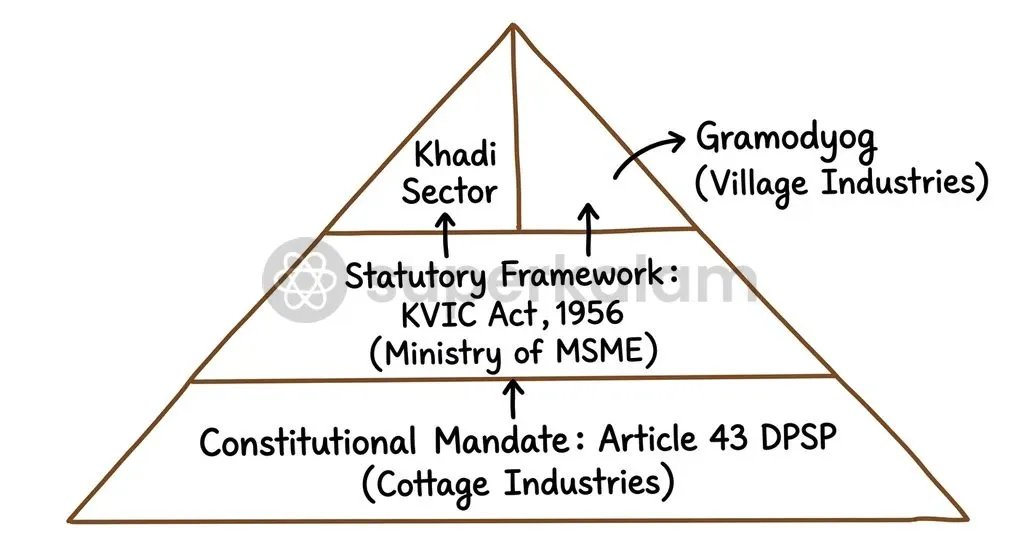
Article 43 of the Constitution of India provides the foundational constitutional directive for state intervention in traditional village manufacturing. Within Part IV's non-justiciable Directive Principles of State Policy, Article 43 explicitly directs the State to endeavour to promote cottage industries on an individual or co-operative basis in rural areas.
Parliament translated this constitutional aspiration into institutional reality by passing the Khadi and Village Industries Commission Act, 1956 (Act No. 61 of 1956). The statute established the Commission as an autonomous statutory body under the administrative oversight of what is today the Ministry of Micro, Small and Medium Enterprises.
The statutory framework defines both the physical standard of the craft and the operational responsibilities of the Commission:
- Statutory Definition of Khadi: Section 2(d) of the KVIC Act, 1956 restricts the definition of khadi strictly to any cloth woven on handlooms in India from cotton, silk, or woollen yarn handspun in India, or from a mixture of any two or all such yarns.
- Operational Mandate: Section 15 of the KVIC Act, 1956 charges the Commission with establishing raw material reserves, supplying tools and machinery, creating marketing networks, and advancing technical research in traditional village crafts.
This legal architecture reflects Mahatma Gandhi's swadeshi doctrine, which prioritised production by the masses over mass production. The statutory framework was designed to generate decentralised employment and stem rural distress migration by preserving artisanal self-reliance outside industrial urban factories.
How the Schemes Function: PMEGP, SFURTI, and Rural Clusters
The Prime Minister's Employment Generation Programme is the flagship credit-linked subsidy initiative administered nationally by the Commission. Under programme guidelines issued by the Ministry of Micro, Small and Medium Enterprises, the scheme finances micro-enterprises with project outlays up to ₹50 lakh in manufacturing and ₹20 lakh in service sectors.
Beneficiaries receive a margin money subsidy disbursed through participating financial institutions:
| Scheme Dimension | General Category Beneficiaries | Special Categories (SC/ST/OBC/Women/NER/Ex-Servicemen) |
|---|---|---|
| Urban Subsidy Rate | 15 percent of project cost | 25 percent of project cost |
| Rural Subsidy Rate | 25 percent of project cost | 35 percent of project cost |
| Beneficiary Contribution | 10 percent of project cost | 5 percent of project cost |
| Administering Agencies | KVIC (national nodal), KVIBs, DICs | KVIC (national nodal), KVIBs, DICs |
Between March 2008 and 2026, the programme generated cumulative employment opportunities for approximately 97.95 lakh people, according to the Press Information Bureau.
Beyond individual credit linkages, the Ministry of Micro, Small and Medium Enterprises deploys the Scheme of Fund for Regeneration of Traditional Industries to organise artisans into sustainable collectives. SFURTI guidelines provide financial grant assistance up to ₹2.5 crore for regular clusters supporting up to 500 artisans, and up to ₹5 crore for major clusters supporting over 500 artisans. These funds establish Common Facility Centres equipped with modern processing technologies and finance targeted skill upgradation.
Complementing these programmes, the Gramodyog Vikas Yojana aggregates non-textile rural interventions. Under this umbrella, initiatives like the Honey Mission have distributed over 2.27 lakh bee-boxes, while the Kumhar Sashaktikaran Yojana has delivered more than 39,000 electric pottery wheels to mechanise clay preparation and enhance rural potter productivity.
Discuss with Superkalam
Explain the operational differences between the PMEGP micro-credit model and the SFURTI cluster development model.
Ask NowThe Core Policy Conflict: Subsidised Cottage Craft vs Commercial Scale
The Planning Commission and NITI Aayog have documented the structural policy dilemma confronting rural industrialisation in India. At its core, the Commission is caught between two fundamentally distinct economic models:
- The Gandhian Welfare Imperative: This framework treats spinning and weaving as non-commercial social security instruments. The primary goal is maximising employment for underemployed agricultural labourers, even if production remains labour-intensive and yields low output per working hour.
- The Competitive Enterprise Model: This framework prioritises commercial competitiveness, product standardisation, export expansion, and fiscal self-reliance, requiring mechanisation, cost reduction, and market-driven supply chains.
The institutional debate over technological modernisation illustrates this philosophical friction. The Ministry of MSME launched Mission Solar Charkha with an outlay of ₹550 crore across 50 clusters, providing capital subsidies of up to ₹9.599 crore per cluster to install 10-spindle solar-powered charkhas.
Solar spindles dramatically augment output per spinner, but they challenge the foundational ethos of traditional hand-spinning. Per an evaluation report by NITI Aayog (as reported, June 2024), this technological shift has generated documented pushback from Gandhian institutions, who argue that introducing motorised spinning dilutes the strict manual production requirement established in Section 2(d) of the KVIC Act.
| Structural Feature | Traditional Gandhian Craft Model | Modern Commercialised Model |
|---|---|---|
| Primary Economic Objective | Maximising rural labour absorption | Maximising sales turnover and market share |
| Technology Base | Manual wooden charkhas and handlooms | Solar-powered charkhas and semi-automatic looms |
| Pricing Strategy | Cost-chart based with state subsidies | Competitive market-driven retail pricing |
| Capital Financing | Grant-dependent working capital grants | Credit-linked bank debt and corporate tie-ups |
| Labour Dynamic | Supplementary household livelihood for women | Full-time wage labour in aggregated clusters |
Discuss with Superkalam
How would you apply the subsidy parameters of PMEGP to design a project for a rural woman entrepreneur seeking to establish a ₹40 lakh manufacturing unit?
Ask NowDefending the Khadi Brand: Trademark Battles and Counterfeit Goods
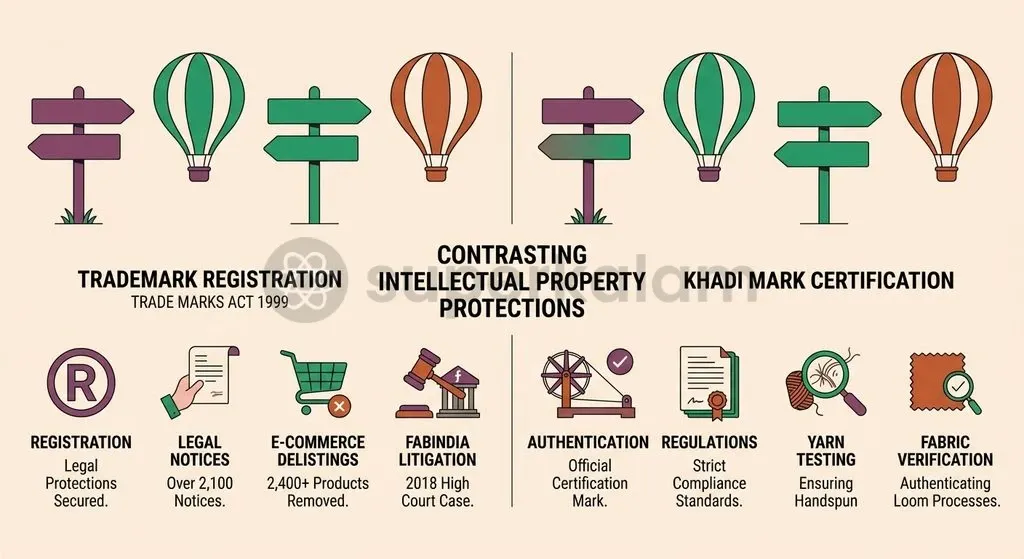
The Trade Marks Act, 1999 gives the Commission statutory authority to defend its intellectual property against commercial misappropriation. The Commission holds registered and exclusive ownership of the wordmark 'KHADI' alongside the iconic 'Charkha' symbol across multiple goods and services classes, restricting commercial usage exclusively to certified village institutions.
The Commission enforces its exclusive proprietary rights through both corporate litigation and digital marketplace crackdowns:
- Corporate litigation: In 2018, the Commission instituted a commercial damages suit for ₹525 crore in the Bombay High Court against ethnic retail giant Fabindia Overseas Pvt Ltd. The legal action challenged Fabindia's marketing of mass-produced, factory-woven apparel under the 'Khadi' brand name without obtaining statutory accreditation, which ultimately compelled the retailer to give an undertaking to halt unauthorised trademark usage.
- Digital platform enforcement: Enforcement has accelerated across digital platforms under the Khadi Mark Regulations, 2013. The Commission requires certified bodies to affix serialised authentication tags to prevent counterfeit synthetic blends from entering the market. Through regulatory enforcement, the Commission has issued over 2,100 legal notices to domestic violators and delisted more than 2,400 unauthorised product listings from prominent digital marketplaces, including Amazon and Flipkart.
Artisan Economics: Who Actually Benefits from Rising Khadi Turnover?
The Ministry of Micro, Small and Medium Enterprises reports that women comprise over 80 percent of all Khadi spinning artisans in registered institutions. Consequently, piece-rate remuneration policies directly govern gendered economic empowerment across non-farm rural communities.
Remuneration rates for spinning artisans were revised upward from ₹4 per hank in 2013–14 to ₹15 per hank effective April 2025, delivering an aggregate nominal wage enhancement of 275 percent.
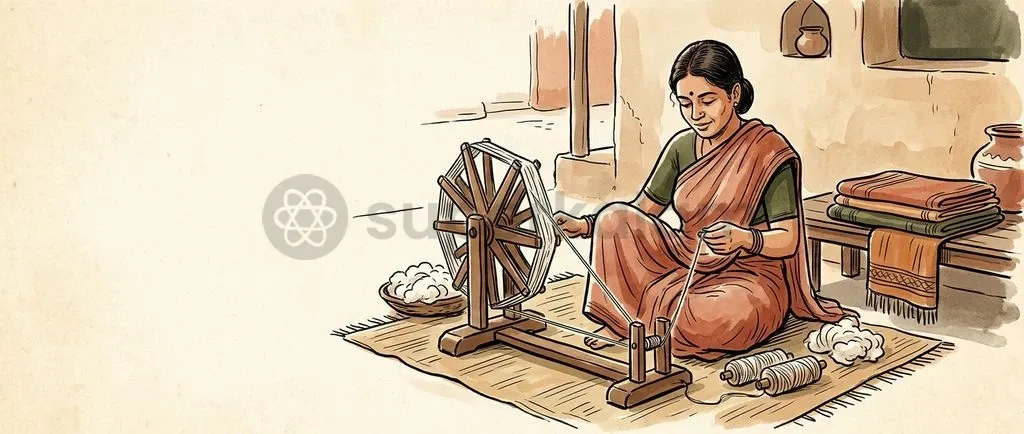
Despite this percentage adjustment, absolute household earnings continue to fall short of industrial wage standards. A typical artisan working on a traditional manual charkha produces between 15 and 20 hanks during a full working day.
At ₹15 per hank, daily earnings range between ₹225 and ₹300 per day. That compensation remains noticeably below statutory minimum daily wages across most industrialised Indian states.
Subsidies channelled through the Modified Market Development Assistance scheme seek to bridge this financial disparity. The scheme awards assistance pegged at 35 percent of Prime Cost for cotton, muslin, wool, and polyvastra, and 20 percent for silk. MMDA guidelines distribute these fiscal resources across three functional stakeholders:
- Producing Institutions: Receive 34 percent of the financial allocation to support infrastructure and operational running costs.
- Selling Institutions: Receive 17 percent of the allocation to fund promotional activities and retail overheads.
- Artisan Incentive Fund: Receives the remaining allocation to disburse direct wage bonuses to individual spinners and karyakartas.
In addition, the Interest Subsidy Eligibility Certificate scheme relieves borrowing costs for registered societies. Under the programme, khadi institutions pay a concessional 4 percent interest rate per annum on working capital loans, while the Commission finances the differential lending rate charged by commercial banks.
Discuss with Superkalam
Analyse the structural contradiction between achieving high commercial sales turnover and safeguarding artisanal living wages in rural cottage industries.
Ask NowModern Retail and Global Reach: GI Protection and Private Partnerships
The Geographical Indications of Goods (Registration and Protection) Act, 1999 provides legal mechanisms to preserve heritage handloom varieties from commercial imitation. KVIC combines these statutory protections with private sector retail channels:
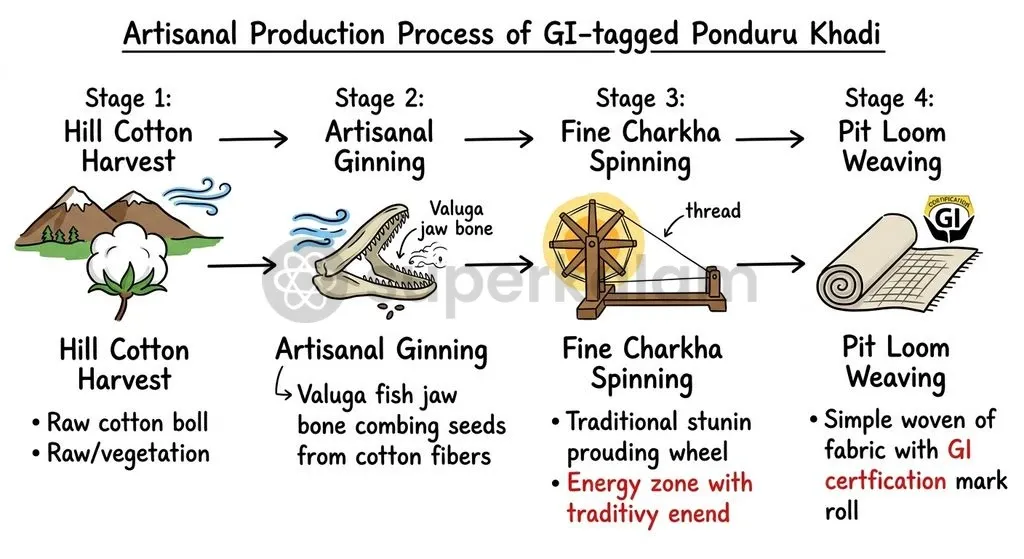
- Geographical Indication safeguards: In December 2025, the Geographical Indications Registry officially granted a GI tag to the Commission for Ponduru Khadi, originating from Srikakulam district in Andhra Pradesh. Artisans spin indigenous Punasa and Hill cotton varieties using fine-toothed jaws of the local Valuga fish to comb out debris manually. Securing GI status establishes premium international export pricing protections for the traditional craft collective.
- Commercial retail partnerships: The Commission has engaged in private sector retail collaborations to modernise distribution channels. The organisation has established commercial licensing agreements with prominent textile conglomerates, including Raymond and Arvind Mills, allowing certified handspun yarn to enter mainstream high-fashion apparel markets. Digital distribution has expanded concurrently through the proprietary eKhadiIndia e-commerce portal, connecting rural production societies directly to metropolitan consumer bases.
A Way Forward: How to Modernise KVIC Without Displacing Rural Artisans
Sustainable modernisation of the rural cottage sector requires aligning commercial growth with genuine artisan welfare. The structural imbalance between rising aggregate turnover and modest artisan compensation cannot be resolved by marketing campaigns alone.
- Index Artisan Remuneration to Cost of Living: Spinning piece-rates should be periodically indexed to the Consumer Price Index for Agricultural Labourers (CPI-AL). The Commission must ensure that full-time spinning generates remuneration comparable to the national floor minimum wage.
- Reform MMDA Direct Benefit Transfers: The share of Modified Market Development Assistance transferred directly to individual spinners should be increased. Depositing welfare subsidies directly into Aadhaar-linked bank accounts circumvents institutional intermediaries and reduces administrative delays.
- Clarify Hybrid Mechanisation Standards: Policymakers must resolve the statutory ambiguity between manual hand-spinning under Section 2(d) of the KVIC Act and solar-assisted charkhas. Creating distinct certification tiers—such as 'Heritage Handspun' alongside 'Solar Khadi'—can safeguard traditional manual artisans while unlocking higher productivity for commercial markets.
- Strengthen Intellectual Property Enforcement: With counterfeit handloom goods continuing to circulate online, the Commission should expand automated digital sweeps and leverage its registered trademarks to protect rural collectives from predatory commercial infringement.
Discuss with Superkalam
Evaluate whether introducing solar-powered charkhas under Mission Solar Charkha helps or harms the core objective of Article 43 of the Constitution.
Ask NowKey Takeaways
- Constitutional Mandate: Article 43 of the Constitution (a Directive Principle of State Policy) directs the State to promote rural cottage industries, forming the philosophical basis of the KVIC Act, 1956.
- Statutory Definition: Section 2(d) of the KVIC Act, 1956 strictly defines khadi as cloth handspun and handwoven in India from natural yarns, creating a legal standard that complicates the adoption of motorised and solar-powered spinning equipment.
- Turnover Expansion: Khadi and village industry sales crossed ₹1,87,105 crore in FY 2025–26, growing by 501 percent since 2013–14, with cumulative employment reaching 2.04 crore persons.
- Artisan Wage Disparity: Although nominal spinning wages reached ₹15 per hank in April 2025, daily earnings of ₹225 to ₹300 for traditional spinners (over 80 percent of whom are women) remain below statutory minimum industrial wages.
- Credit and Cluster Infrastructure: Flagship schemes including PMEGP (margin money subsidies of 15 to 35 percent) and SFURTI (cluster grants up to ₹5 crore) serve as primary operational mechanisms for generating rural non-farm employment.
- Brand Protection: The Commission actively enforces exclusive ownership over the 'KHADI' wordmark and charkha symbol under the Trade Marks Act, 1999, highlighted by its 2018 High Court action against Fabindia and GI tag protection for Ponduru Khadi.
Mains Question
"The constitutional mandate of Article 43 envisions cottage industries as instruments of rural self-reliance, yet modern state policy increasingly pushes Khadi towards commercial enterprise scale." In the light of the KVIC Act, 1956 and recent technological initiatives like Mission Solar Charkha, critically analyse this structural contradiction. (15 Marks)
Evaluate NowMains Question
Examine how institutional interventions such as PMEGP and SFURTI under the Ministry of MSME have facilitated rural non-farm employment generation and enterprise clustering. (10 Marks)
Evaluate NowPractice MCQs
QUESTION 1
With reference to the Khadi and Village Industries Commission Act, 1956, consider the following statements:
- Section 2(d) of the Act restricts the definition of khadi to cloth woven on handlooms in India from cotton, silk, or woollen yarn handspun in India, or a mixture of these yarns.
- The Commission is an autonomous statutory body functioning under the administrative oversight of the Ministry of Textiles.
- Section 15 mandates the Commission to establish raw material reserves and advance technical research in traditional crafts.
Which of the statements given above are correct?
QUESTION 2
Regarding the Prime Minister's Employment Generation Programme (PMEGP), consider the following statements:
- It provides financial assistance for micro-enterprises with maximum project costs up to ₹50 lakh in the manufacturing sector.
- For general category beneficiaries in rural areas, the margin money subsidy rate is 25 percent of the project cost.
- For special categories such as SC/ST/OBC and women setting up units in urban areas, the beneficiary contribution is fixed at 10 percent.
Which of the statements given above is/are correct?
QUESTION 3
Consider the following statements regarding schemes administered under the rural industries framework:
- Under the Scheme of Fund for Regeneration of Traditional Industries (SFURTI), regular clusters supporting up to 500 artisans can receive grant assistance up to ₹2.5 crore.
- Mission Solar Charkha provides capital subsidies to install 10-spindle solar-powered charkhas.
- The Honey Mission and Kumhar Sashaktikaran Yojana are sub-initiatives aggregated under the Gramodyog Vikas Yojana.
Which of the statements given above are correct?
QUESTION 4
Which Article of the Directive Principles of State Policy in the Constitution of India explicitly directs the State to endeavour to promote cottage industries on an individual or co-operative basis in rural areas?
QUESTION 5
Consider the following statements regarding the protection of the Khadi brand:
- The Khadi and Village Industries Commission holds registered ownership of the wordmark 'KHADI' and the 'Charkha' symbol under the Trade Marks Act, 1999.
- Under the Khadi Mark Regulations, 2013, certified institutions are required to affix serialised authentication tags to prevent counterfeit blends.
Which of the statements given above is/are correct?