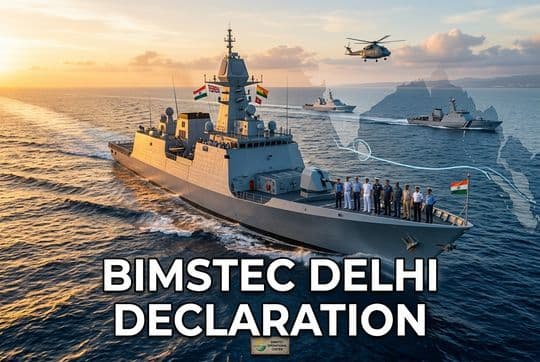
INS Samarthak: Multi-Purpose Vessel, Features and Roles
Built by L&T, Samarthak supports naval trials, target towing and unmanned operations. Commissioning is scheduled for 16 October 2026 at Karwar.
Oct, 2026
•9 min read
Context
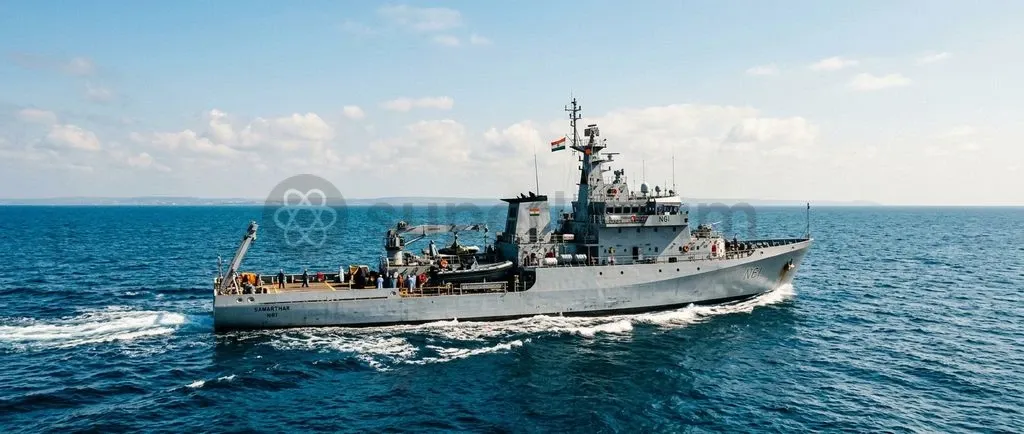
The delivery of INS Samarthak, the Indian Navy's first indigenously designed Multi-Purpose Vessel built by Larsen & Toubro, addresses a longstanding operational imbalance. It transfers secondary utility tasks away from frontline destroyers while establishing private shipyard participation in defence manufacturing under Aatmanirbhar Bharat. Contracted by the Ministry of Defence under the 'Buy (Indian)' category for approximately ₹887 crore, the 3,750-tonne vessel incorporates over 75 percent indigenous content. Modern navies rely heavily on auxiliary vessels to sustain blue-water deployments across expansive maritime theatres. By undertaking trial support, target towing, and unmanned mothership roles, the platform preserves high-end warship propulsion hours for sea-denial and sea-control tasks across the Indian Ocean Region.
The Auxiliary Gap: Why Frontline Warships Were Doing Routine Chores
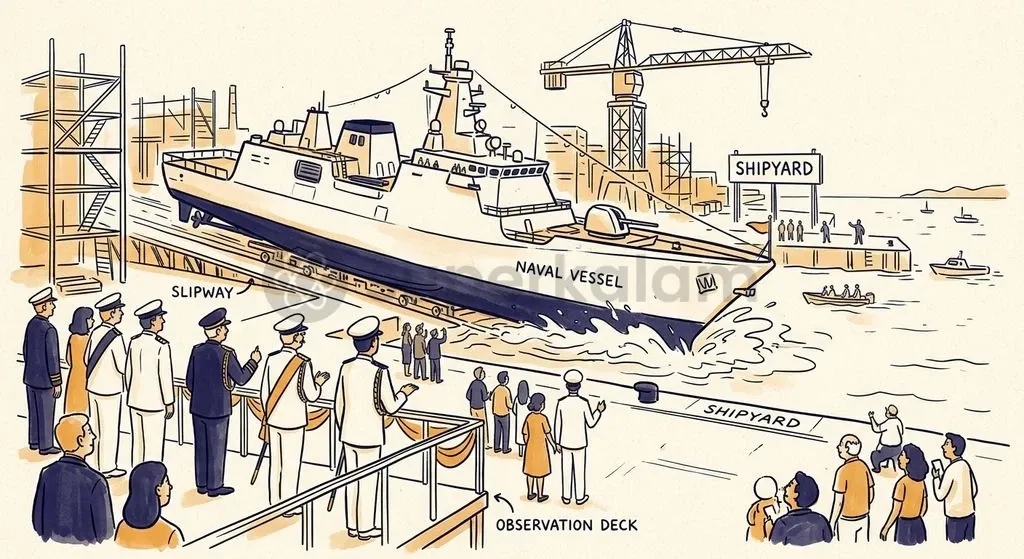
Dedicated support craft have long been in short supply across the fleet. Operational reviews from parliamentary bodies show that shortages previously forced guided-missile destroyers and frigates into routine, non-combat chores. Capital warships represent major national investments intended strictly for sea-denial, air defence, and surface combat. Diverting them to tow targets, retrieve practice torpedoes, or escort experimental platforms squanders high-end naval capabilities.
Using advanced combatants for mundane duties incurs steep operational penalties:
- Machinery wear: Running high-power gas turbines at low speeds triggers accelerated hull fatigue and drains limited propulsion life cycles.
- Readiness drops: Regular chore diversion pulls premier surface units away from vital patrols along strategic Sea Lines of Communication.
- Budget waste: Deploying multi-billion-rupee destroyers for secondary towing drives up operational expenditure without adding deterrence value.
Dedicated auxiliary ships eliminate this operational friction. By deploying mission-tailored platforms to absorb routine fleet-support chores, naval commands preserve the hull life and maintenance cycles of capital warships for genuine contingencies.
Discuss with Superkalam
Recall the three construction categories used to assess warship indigenisation under the Indian Naval Indigenisation Plan and state which one exceeds 90 percent domestic capability.
Ask NowRoles and Capabilities: How INS Samarthak Functions Across Multiple Missions
INS Samarthak displaces over 3,750 tonnes and carries specialised handling gear for trial evaluation, combat-support duties, and auxiliary tasks. Measuring approximately 107 metres in length with an 18.6-metre beam, the platform achieves a designed operational speed of 15 knots. The vessel achieves over 75 percent indigenous content, meeting domestic procurement targets set under Make in India guidelines.
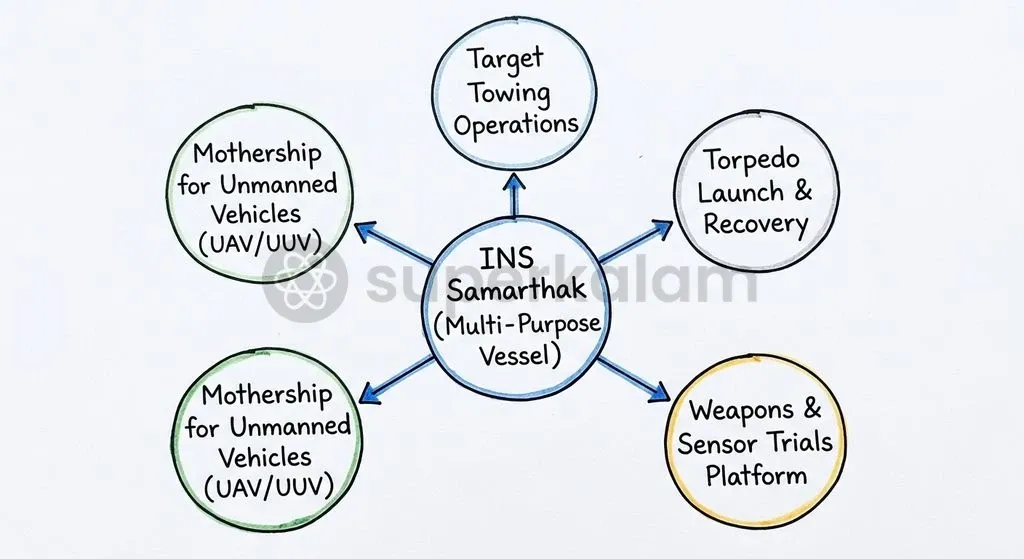
A primary peacetime duty of INS Samarthak is serving as a floating trial platform. The vessel offers plug-and-play architecture to test experimental domestic weapons, radars, and sonars under authentic maritime conditions. Operating as a testbed, it accelerates developmental evaluation for the Defence Research and Development Organisation and private firms without taking combatants off frontline duty.
Frontline Combatant vs Multi-Purpose Auxiliary Vessel
| Dimension | Frontline Combatant (Destroyer/Frigate) | Multi-Purpose Vessel (INS Samarthak) |
|---|---|---|
| Primary Mission | Sea control, strike warfare, and task-group air defence | Fleet support, trial testing, towing, and maritime utility |
| Propulsion Profile | High-speed gas turbine / combined gas arrangements | Fuel-efficient diesel arrangements optimised for endurance |
| Running Operating Cost | Extremely high per sea-hour | Low to moderate per sea-hour |
| Sensor & Combat Suite | Long-range 3D surveillance radars and surface-to-air missiles | Basic self-defence weapons, navigation radars, and decoy launchers |
| Auxiliary Task Capacity | Inefficient; accelerates machinery degradation | Purpose-built deck space and heavy winches for utility tasks |
The platform handles diverse maritime utility assignments. It tows disabled vessels, launches and retrieves expendable aerial and gunnery targets, and recovers practice torpedoes during fleet exercises. Naval architects also designed the platform to operate as an operational mothership to launch, command, and recover unmanned surface vessels, autonomous underwater craft, and remotely piloted aerial systems.
Maritime trade publications report that the vessel features a Dynamic Positioning System for station-keeping during precision salvage, target recovery, and unmanned vehicle operations. Furthermore, news reporting indicates that the aft flight deck accommodates rotary-wing platforms such as the Hindustan Aeronautics Limited Dhruv Advanced Light Helicopter, while defensive measures reportedly incorporate the Bharat Electronics Limited SANKET Mk III electronic support measures system and Kavach decoy launchers.
Discuss with Superkalam
Explain how running capital combatants with gas turbines at low speeds for secondary utility tasks incurs operational and financial penalties.
Ask NowThe Industrial Shift: Private Shipyards Breaking the State Monopoly
Defence procurement under the 'Buy (Indian)' framework enabled Larsen & Toubro to build INS Samarthak, opening an industrial space long reserved for state-owned shipyards. State-owned entities, including Mazagon Dock Shipbuilders Limited, Garden Reach Shipbuilders & Engineers, and Goa Shipyard Limited, remain heavily committed to constructing complex destroyers, frigates, and conventional submarines.
Contracting auxiliary platforms to private yards creates distinct structural advantages:
- Decongesting public yards: Offloading utility hulls relieves acute capacity bottlenecks at state facilities.
- Modular build methods: Larsen & Toubro applied modern modular construction and commercial yard efficiencies alongside naval standards at Kattupalli to compress delivery schedules.
- Industrial resilience: Sourcing through competitive tenders expands national shipbuilding capacity and draws tier-2 and tier-3 domestic suppliers into defence manufacturing.
The framework created for the Multi-Purpose Vessel programme extends beyond the lead vessel. Construction of the second ship, INS Utkarsh (Yard 18002), progressed concurrently at Kattupalli. It was launched in January 2025 and entered contractor sea trials ahead of its formal handover. Competition between private and public shipbuilders widens India's industrial base, spurs private capital investment, and expands domestic micro, small, and medium enterprise networks.
Discuss with Superkalam
Compare the structural benefits of offloading auxiliary vessel contracts to private shipyards against keeping all warship construction within public sector shipyards.
Ask NowStrategic Payoff: How Support Ships Free Up Combat Fleets in the Indian Ocean
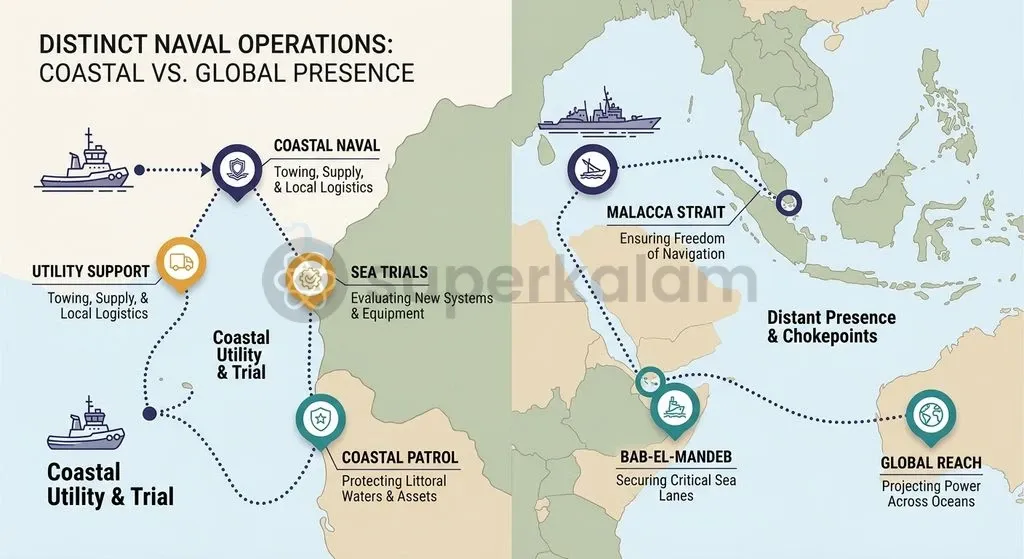
Dedicated support ships strengthen naval power projection by releasing frontline combatants to maintain deterrence across strategic Sea Lines of Communication. When auxiliary ships handle routine trials and constabulary duties, fleet commanders can station guided-missile destroyers at key choke points like the Strait of Malacca, the Bab-el-Mandeb, and the Mozambique Channel.
INS Samarthak supports regional security through several operational profiles:
- Offshore surveillance: Carries out maritime security patrols across India's Exclusive Economic Zone and island territories.
- Regional diplomacy: Provides flexible utility support aligned with India's Security and Growth for All in the Region doctrine.
- Disaster intervention: Adapts rapidly into a limited-capacity floating hospital for Humanitarian Assistance and Disaster Relief operations.
This rapid medical and salvage adaptability provides dependable disaster assistance across the Indian Ocean littoral. The navy can deliver regional aid without pulling frontline combatants away from critical security missions.
Industrial Headwinds: Supply Chains, Design Dependencies, and Shipyard Capacity
Parliamentary reviews indicate that Indian naval shipbuilding continues to face critical sub-tier import vulnerabilities despite achieving extensive indigenisation in structural hull fabrication. Modern naval vessels are assessed across three distinct construction tiers: Float, Move, and Fight. India has attained commendable domestic capability in the initial tier, but the remaining two tiers expose ongoing structural dependencies.
Under the Indian Naval Indigenisation Plan (2015–2030), the Float category consistently exceeds 90 percent domestic content through the use of indigenous DMR 249A and DMR 249B warship-grade steel manufactured by the Steel Authority of India Limited. This domestic material guarantees structural self-reliance for both surface combatants and support craft.
Significant vulnerabilities persist in the Move category. Parliamentary committee findings highlight that the domestic defence industrial base remains heavily dependent on foreign suppliers for high-power marine diesel engines, gas turbines, and complex propulsion gearboxes.
In the Fight category, domestic indigenisation stands between 70 and 75 percent, yet critical subcomponents such as advanced focal plane arrays for electro-optical sensors, specialised semiconductor modules, and missile seekers depend entirely on overseas vendors. Furthermore, procurement friction persists; INS Samarthak experienced an approximate 15-month lag, slipping from its original contractual delivery date of May 2025 to actual completion in August 2026.
Indian Naval Indigenisation Tiers: Current Capabilities & Gaps
| Indigenisation Tier | Current Domestic Content | Key Indigenous Strengths | Persisting Foreign Dependencies |
|---|---|---|---|
| Float | Above 90% | SAIL DMR 249A/B warship steel; modular hull construction | Specialised deck winches and heavy salvage gear |
| Move | Under 50% | Basic electrical distribution; auxiliary pumps; piping | Marine gas turbines; high-power diesel engines; gearboxes |
| Fight | Approximately 70–75% | Combat management software; electronic warfare; decoy systems | Focal plane arrays; specialised semiconductors; RF seekers |
Discuss with Superkalam
Weigh whether India's naval shipbuilding strategy should prioritise expanding frontline combatant numbers or closing the auxiliary support vessel gap to project power in the Indian Ocean Region.
Ask NowWay Forward: Creating a Balanced Fleet of Combatants and Support Vessels
The Indian Navy must institutionalise a balanced force structure by harmonising capital combatant production with commercial shipbuilding practices across both private and public shipyards. Achieving a balanced fleet requires naval procurement planners to maintain a healthy ratio between combat vessels and dedicated support platforms. Auxiliary ships provide the logistical stamina that sustains high-tempo sea operations during prolonged crises.
Policy planners should implement three practical procurement measures:
- Streamline procedural paths: Amend the Defence Acquisition Procedure to shorten lead times for auxiliary craft by integrating commercial off-the-shelf equipment.
- Balance shipyard orders: Reserve public shipyard capacity for complex surface combatants and submarines while awarding auxiliary hulls to private yards.
- Overcome propulsion bottlenecks: Build domestic joint ventures to license-produce high-power marine diesel engines and gas turbines within India.
By closing critical technology deficits in the Move and Fight tiers, India can secure an autonomous, self-sustaining auxiliary fleet capable of projecting naval power across the wider Indo-Pacific.
Key Takeaways
- INS Samarthak, built by Larsen & Toubro under an ₹887-crore contract signed in March 2022, is the Indian Navy's first dedicated Multi-Purpose Vessel, delivered on 27 August 2026.
- Operating with over 75 percent indigenous content, the 3,750-tonne platform relieves frontline destroyers and frigates from routine duties such as target towing, torpedo retrieval, and trial support.
- The platform functions as a trial evaluation bed for experimental domestic weapon systems and serves as an operational mothership for unmanned surface, underwater, and aerial craft.
- Constructing auxiliary vessels at private yards like L&T Kattupalli addresses building bottlenecks at state-owned shipyards, supporting broader domestic industrial capacity under Make in India.
- Despite reaching over 90 percent indigenisation in hull construction (Float tier), persistent dependencies remain in high-power marine engines (Move tier) and specialised sensor subcomponents (Fight tier).
Mains Question
'Diverting capital combatants to routine auxiliary chores squanders high-end naval capabilities and strains operational readiness.' In light of the induction of Multi-Purpose Vessels like INS Samarthak, examine the operational necessity of dedicated auxiliary support ships in securing India's maritime interests. (10 Marks)
Evaluate NowMains Question
Contracting the Multi-Purpose Vessel programme to a private shipyard under the 'Buy (Indian)' framework marks a departure from state-dominated warship construction. Discuss the structural advantages of private shipyard participation in defence manufacturing and critically analyse the industrial headwinds that persist in naval indigenisation. (15 Marks)
Evaluate NowPractice MCQs
QUESTION 1
Regarding the Multi-Purpose Vessel (MPV) project undertaken for the Indian Navy, consider the following statements:
- It was contracted by the Ministry of Defence under the 'Buy (Indian)' procurement category.
- Yard 18001 (Samarthak) and Yard 18002 (Utkarsh) were constructed by a private shipyard at Kattupalli.
- The design of INS Samarthak incorporates over 75 percent indigenous content. Which of the statements given above are correct?
QUESTION 2
With reference to the operational roles and specifications of INS Samarthak, consider the following statements:
- It is designed to function as an operational mothership for launching, commanding, and recovering unmanned surface and underwater vessels.
- It employs a high-speed gas turbine propulsion arrangement optimized primarily for blue-water strike warfare.
- It features plug-and-play architecture enabling it to serve as a floating trial platform for developmental weapons, radars, and sonars. Which of the statements given above is/are correct?
QUESTION 3
Consider the following statements regarding the 'auxiliary gap' and naval fleet management discussed in the context of the Indian Navy:
- Deploying capital combatants for non-combat utility tasks causes accelerated hull fatigue by running high-power gas turbines at low speeds.
- Utilizing dedicated auxiliary support ships preserves the hull life and propulsion maintenance cycles of frontline destroyers.
- Diverting guided-missile combatants to secondary towing reduces readiness along strategic Sea Lines of Communication. Which of the statements given above are correct?
QUESTION 4
Which of the following electronic and aviation systems is reported to be integrated or accommodated on INS Samarthak?
QUESTION 5
Under the Indian Naval Indigenisation Plan (2015–2030) framework cited in naval shipbuilding evaluations, which tier of naval vessel construction consistently exceeds 90 percent domestic capability?