ISRO NVS-03 Launch: NavIC L1 Upgrade and Strategic Autonomy
As constellation attrition threatens sovereign navigation, NVS-03 introduces standard L1 band signals to bridge strategic autonomy and civilian adoption.
Nov, 2026
•9 min read

Overview
The Indian Space Research Organisation designed the NVS-03 satellite to replenish India's sovereign NavIC constellation. The mission introduces the civilian L1 frequency band alongside an indigenous rubidium atomic clock, resolving severe orbital attrition while enabling direct compatibility with commercial smartphone chipsets.
Built on an I-2K satellite bus with a 12-year lifespan, the mission targets operational vulnerabilities caused by early atomic clock anomalies. Those failures reduced the operational constellation below the minimum mathematical threshold for independent positioning.
The structural upgrade shifts NavIC across two operational priorities:
- Consumer adoption: Integrating the standard L1 civilian band alongside existing L5 and S bands allows seamless integration with global mobile chipsets.
- Strategic resilience: Maintaining independent positioning, navigation, and timing infrastructure shields national territory and border zones from reliance on foreign constellations during crises.
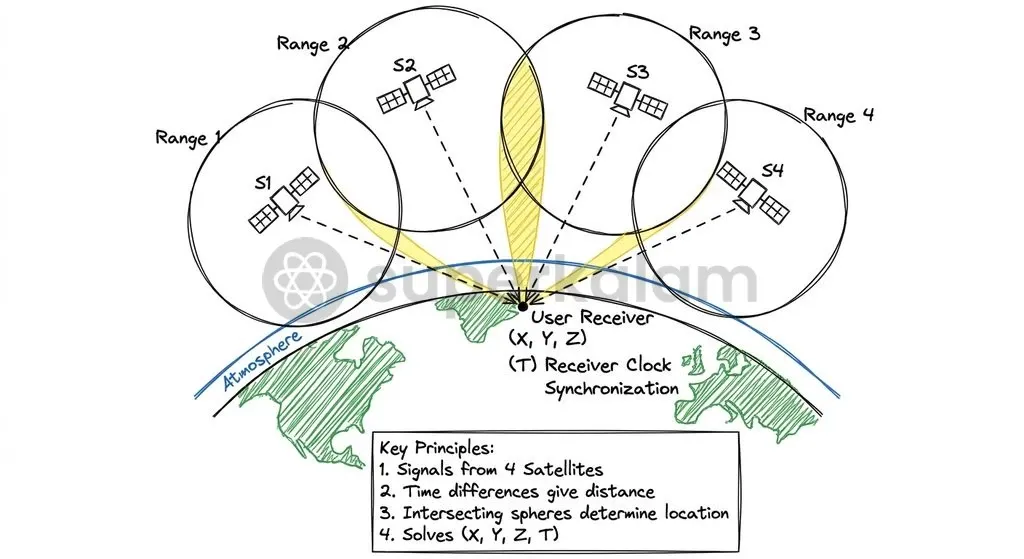
The operational urgency stems from constellation attrition. A written reply in the Lok Sabha by Union Minister of State Dr. Jitendra Singh revealed that sequential hardware anomalies reduced the first-generation Indian Regional Navigation Satellite System (IRNSS) to only three operational satellites providing Positioning, Navigation, and Timing (PNT) services by mid-2026. Because satellite navigation mathematically requires a minimum of four satellites in line-of-sight to compute an independent three-dimensional position fix, the constellation had fallen below its functional baseline.
The NVS-03 mission is therefore not a routine replenishment. The launch marks a critical turning point across two fronts:
- Constellation recovery: Rescuing the regional network from operational failure.
- Signal modernisation: Overhauling the transmission architecture to overcome the chronic lack of domestic consumer adoption.
What Makes NVS-03 Distinct: L1 Civilian Band and Indigenous Clocks
The NVS-03 satellite incorporates an indigenous Rubidium Atomic Frequency Standard alongside standard civilian L1 band transmission capabilities to address long-standing operational and compatibility bottlenecks. The Space Applications Centre (SAC) in Ahmedabad developed the space-qualified Rubidium Atomic Frequency Standard (RAFS) to replace imported components. This domestic clock provides the precise timing accuracy required to determine user range without reliance on external supply chains.
The payload upgrade also alters how the satellite communicates with consumer devices:
- Civilian L1 transmission: Technical documentation published by ISRO confirms that NVS-03 transmits civilian Standard Positioning Service (SPS) signals in the L1 frequency band centred at 1575.42 MHz.
- Legacy multi-band support: It maintains concurrent transmissions on the legacy L5 band (1176.45 MHz) and S band (2492.028 MHz).
The inclusion of the 1575.42 MHz frequency establishes direct interoperability with civilian signals from the United States Global Positioning System (GPS L1 C/A) and Europe's Galileo (E1). This adjustment targets the structural limitation of earlier satellites. Commercial receivers can now process NavIC signals alongside global constellations without custom radio front-ends.
Discuss with Superkalam
Recall the exact civilian frequency introduced by NVS-03 and identify the two international navigation systems that share this standard band.
Ask NowFrom IRNSS to NVS Series: Side-by-Side Architectural Upgrade
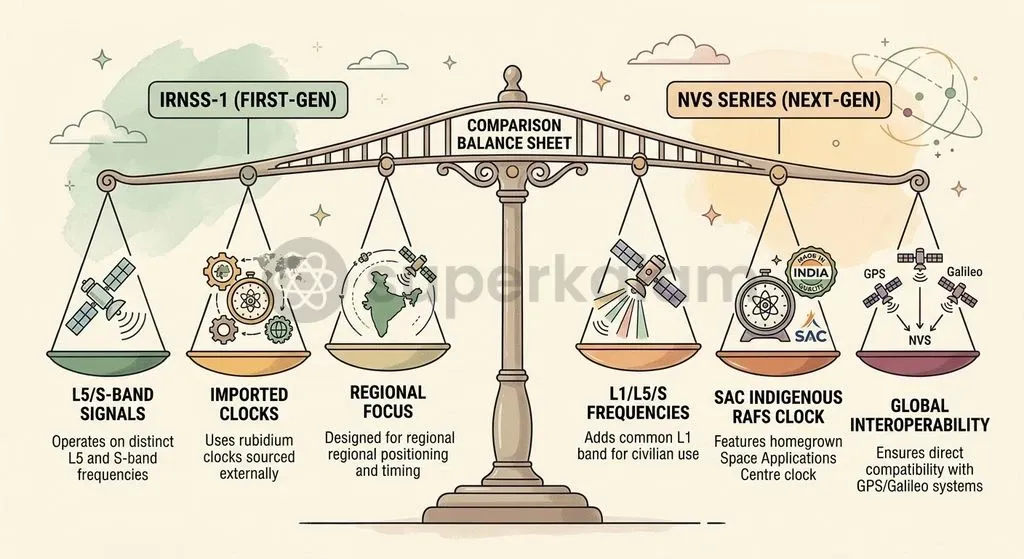
The second-generation NVS satellite architecture significantly upgrades payload standards, operational longevity, and transmission frequencies compared to India's original first-generation IRNSS spacecraft series. Operating on an I-2K satellite bus with a lift-off mass of approximately 2,250 kg, NVS-03 is engineered for a planned mission lifespan of 12 years.
The architectural evolution reflects lessons gathered from early operational hurdles:
| Technical Parameter | First-Generation IRNSS Series | Second-Generation NVS Series (NVS-03) |
|---|---|---|
| Civilian Transmission Bands | L5 band (1176.45 MHz) and S band (2492.028 MHz) | L1 band (1575.42 MHz), L5 band, and S band |
| Global Interoperability | Limited; required dedicated dual-band receiver antennas | High; shares primary civilian frequency with GPS (L1 C/A) and Galileo (E1) |
| Atomic Frequency Standard | Imported rubidium atomic clocks from SpectraTime, Switzerland | Space-qualified indigenous Rubidium Atomic Frequency Standard developed by SAC, Ahmedabad |
| Spacecraft Platform & Lifespan | Premature constellation degradation due to onboard clock anomalies | I-2K satellite bus, ~2,250 kg lift-off mass, planned 12-year design life |
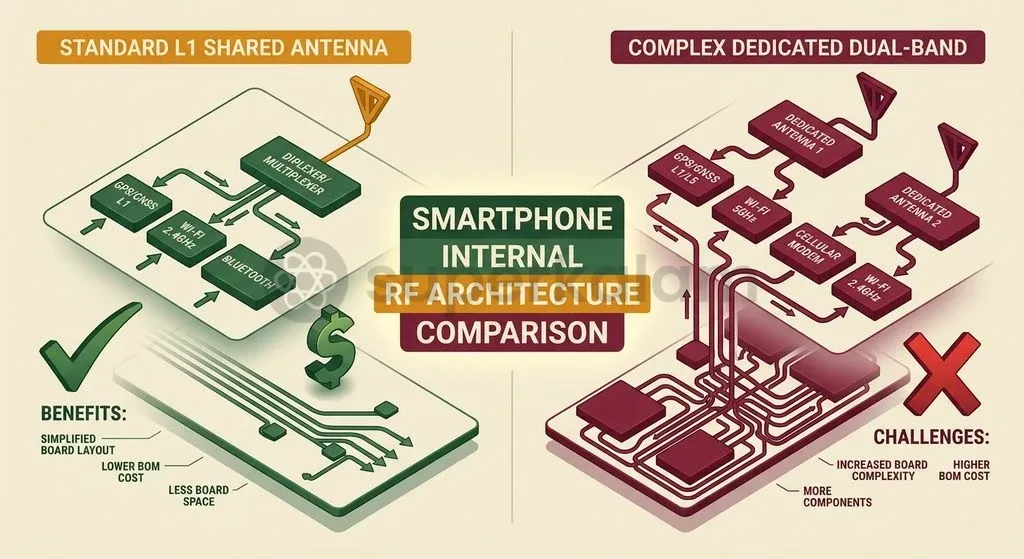
The transition to the L1 spectrum alters the economics of device integration. Early NavIC iterations mandated unique RF designs. In contrast, the shared L1 frequency allows commercial manufacturers to configure standard multi-constellation receivers with minimal hardware divergence.
Discuss with Superkalam
Explain why a navigation receiver requires signals from at least four satellites to establish an accurate three-dimensional fix rather than just three.
Ask NowThe Replenishment Race: Overcoming Legacy Satellite and Clock Failures
India's regional navigation network faced operational deficits when sequential atomic clock anomalies across first-generation spacecraft reduced the active constellation to only three functional satellites by mid-2026. A parliamentary reply by Union MoS Dr. Jitendra Singh verified that this attrition impaired civilian and defence position determinations across the service zone.
Satellite navigation relies on precise trilateration, where each satellite acts as an accurate space-based clock. A receiver measures the time delay of incoming signals from multiple spacecraft to calculate its precise distance from each transmitter:
- Three-dimensional coordinates: Determining latitude, longitude, and altitude requires signals from at least three separate satellites.
- Clock bias resolution: Consumer receivers contain inexpensive quartz oscillators rather than atomic standards; a fourth satellite signal is mathematically mandatory to reconcile receiver clock drift with system time.
The constellation shortfall traces back to hardware failures documented by the Press Information Bureau, which reported that imported rubidium atomic clocks supplied by SpectraTime of Switzerland suffered sequential on-orbit breakdowns. When onboard redundant clocks failed across early spacecraft, orbital geometry deteriorated. To establish durable operational depth, ISRO formulated plans to deploy follow-on satellites, including NVS-04 and NVS-05, ensuring continuous multi-satellite orbital redundancy.
The Consumer Adoption Bottleneck: Chipsets, Costs, and OEM Pushback
Consumer smartphone manufacturers historically resisted NavIC adoption because first-generation IRNSS signals required custom radio-frequency hardware that increased bill-of-materials costs without market interoperability. As documented in technical overviews by ISRO, first-generation satellites transmitted civilian signals exclusively over L5 and S bands, diverging from global commercial standards built around the L1 frequency.
Industry consultations reported by The Economic Times in September 2022 indicated that shifting civilian signals to the L1 band eliminates the need for dedicated dual-frequency (L5/S) front-ends and secondary internal antennas in budget handsets. However, integrating new bands created friction between regulatory timelines and device manufacturing reality:
- Cost escalation: Smartphone OEMs highlighted that mandatory domestic hardware inclusion increases total bill-of-materials (BOM) costs, as reported by The Indian Express in September 2023.
- Design overhead: Modifying phone architecture necessitates multi-month circuit redesign cycles that must synchronise with global semiconductor refresh cycles.
- Regulatory timelines: As reported by media briefings with Union Minister of State Rajeev Chandrasekhar in September 2023, MeitY proposed mandates requiring all 5G smartphones sold in India to support NavIC by 1 January 2025, with all L1-capable phones complying by late 2025.
Discuss with Superkalam
If you were advising the Ministry of Electronics and Information Technology, how would you design an incentive scheme to help smartphone OEMs meet mandatory NavIC integration deadlines without inflating consumer handset prices?
Ask NowDiscuss with Superkalam
Compare the operational and architectural limitations of the first-generation IRNSS series with the upgrades introduced in the second-generation NVS series.
Ask NowWay Forward: Aligning Regulatory Mandates with Chipset Ecosystems
Sustaining India's sovereign satellite navigation requires harmonising regulatory compliance deadlines with commercial silicon manufacturing cycles while accelerating the orbital deployment of replenishment spacecraft. Rebuilding the constellation back to full strength must proceed alongside industrial measures that encourage domestic adoption:
- Sustaining orbital density: The launch of NVS-03 must be followed swiftly by NVS-04 and NVS-05 to restore constellation geometry well above the mathematical threshold of four visible satellites, guaranteeing uninterrupted regional coverage.
- Commercial silicon integration: Government policy should incentivise leading global semiconductor fabricators to embed L1 NavIC processing within entry-level mobile processor designs, negating the bill-of-materials penalty raised by OEMs.
- Expanding sectoral mandates: Mandating NavIC hardware within public transportation, commercial fleet monitoring, and telecommunication timing base stations will create reliable non-consumer market scale.
- Standardisation across domestic electronics: MeitY and statutory standards organisations should work with domestic original design manufacturers to develop pre-certified reference boards, lowering engineering overhead for local hardware firms.
Through hardware indigenisation and signal interoperability, India can transform NavIC from a protective contingency into a globally competitive navigation standard.
Key Takeaways
- Launch mission details: ISRO scheduled NVS-03 aboard GSLV-F18 for 30 October 2026 from SDSC-SHAR Sriharikota, using an I-2K bus with a 12-year lifespan and ~2,250 kg launch mass.
- Critical replenishment: The launch restores a depleted constellation that declined to only three operational satellites by mid-2026, falling below the mathematical baseline of four satellites required for 3D positioning.
- Civilian L1 band upgrade: NVS-03 introduces standard civilian L1 band transmissions (1575.42 MHz) alongside legacy L5 and S bands, enabling seamless interoperability with GPS and Galileo.
- Indigenous clock standard: Space Applications Centre (SAC), Ahmedabad, engineered the space-qualified Rubidium Atomic Frequency Standard (RAFS) to replace vulnerable imported European clocks.
- Strategic autonomy: NavIC guarantees uninterrupted PNT services across India and 1,500 km beyond its borders, mitigating signal denial vulnerabilities like those experienced during the 1999 Kargil conflict.
Mains Question
"Sovereign satellite positioning is not merely a technological milestone but an indispensable pillar of strategic autonomy and national resilience." In light of the historical denial of GPS data during the 1999 Kargil conflict and the recent launch of NVS-03, elucidate. (15 Marks)
Evaluate NowMains Question
Examine the technical and commercial bottlenecks that historically hindered the civilian adoption of NavIC in India, and evaluate how the architectural transition in the NVS series addresses these challenges. (10 Marks)
Evaluate NowPractice MCQs
QUESTION 1
With reference to the Indian Regional Navigation Satellite System (NavIC) and the NVS-03 satellite, consider the following statements:
- NVS-03 introduces civilian Standard Positioning Service signals in the L1 frequency band centred at 1575.42 MHz.
- Unlike first-generation IRNSS spacecraft which used imported clocks, NVS-03 carries a space-qualified Rubidium Atomic Frequency Standard developed indigenously by the Space Applications Centre.
- A minimum of three satellites in line-of-sight is mathematically sufficient for a consumer receiver using a standard quartz oscillator to compute an independent three-dimensional position fix. Which of the statements given above are correct?
QUESTION 2
Consider the following statements regarding the frequency bands and interoperability of the NVS series of satellites:
- First-generation IRNSS satellites transmitted civilian signals exclusively over the L5 and S bands.
- The incorporation of the L1 band frequency at 1575.42 MHz in NVS-03 enables direct interoperability with signals from GPS L1 C/A and Galileo E1.
- The NVS-03 satellite is built on an I-2K bus with a planned mission lifespan of 12 years. Which of the statements given above are correct?
QUESTION 3
Regarding the operational mandate and coverage envelope of India's NavIC constellation, consider the following statements:
- NavIC provides Position, Navigation, and Timing services covering the Indian landmass and an operational envelope extending 1,500 km beyond national borders.
- Sequential on-orbit failures of imported atomic clocks reduced the active first-generation constellation to only three functional satellites by mid-2026.
- The Ministry of Electronics and Information Technology (MeitY) mandated that all 2G and 3G handsets support NavIC by 1 January 2025. Which of the statements given above is/are correct?
QUESTION 4
The denial of Global Positioning System (GPS) data during which historical event was a primary catalyst for India's pursuit of an autonomous regional navigation satellite system?
QUESTION 5
With reference to the indigenous technologies developed for the NVS-03 mission, which institution developed the space-qualified Rubidium Atomic Frequency Standard (RAFS) to replace imported components?