Gyan Bharatam Mission: Digitising India's Ancient Manuscript Heritage
India's push to digitise 1.19 crore manuscripts hinges on resolving an acute paleographic deficit while winning back the trust of traditional custodians.
Nov, 2026
•13 min read
Context
The Gyan Bharatam Mission represents a structural policy transition in India's cultural governance, shifting national strategy from passive physical preservation to an active digital knowledge commons that prioritises open scholarly access, machine-assisted transcription, and national intellectual sovereignty. Approved under the Union Budget 2025–26 with a ₹491.66 crore outlay for 2025–2031, the mission seeks to map, conserve, digitise, and translate an estimated corpus exceeding 1.19 crore manuscripts. The central challenge facing this ambitious initiative is that digitisation alone cannot unlock India's documentary heritage without resolving severe paleographic skill deficits and overcoming deep-seated mistrust among community custodians.
Why in the News: The Push for Gyan Bharatam Mission
The Ministry of Culture launched the Gyan Bharatam Mission following its announcement in the Union Budget 2025–26. As of August 2026, the Standing Finance Committee approved a dedicated financial outlay of ₹491.66 crore for the mission covering the 2025–2031 implementation window, according to a PIB Delhi release on the Gyan Bharatam Mission and Preservation of Manuscript Heritage.
The initiative addresses the historical neglect of India's documentary heritage. On 16 March 2026, the Ministry initiated the nationwide Gyan Bharatam National Manuscript Survey across all States and Union Territories. The exercise mapped over 1.19 crore manuscripts, substantially expanding earlier baseline estimates of 5 to 10 million Indic manuscripts worldwide.
Diplomatic integration followed quickly. On 26 October 2026, the Ministry of Culture signed a Memorandum of Understanding in Paris with the Bibliothèque nationale de France to locate, digitise, and share Indic manuscripts on India's National Digital Repository.
These operational moves rest upon clear constitutional foundations:
- Article 49 of the Constitution of India: Directs the State to protect monuments, places, and objects of artistic or historic interest of national importance from spoliation, destruction, removal, or unauthorized export. This non-justiciable directive under Part IV shapes heritage preservation policy.
- Article 51A(f) of the Constitution of India: Establishes a fundamental duty for every citizen to value and preserve the rich heritage of the nation's composite culture.
Discuss with Superkalam
Recall the two constitutional provisions cited in the article that underpin India's manuscript preservation framework.
Ask NowFrom Preservation to Access: How Gyan Bharatam Shifts Away from Past Failures
The Gyan Bharatam Mission fundamentally departs from the doctrine that governed its institutional predecessor. Launched in 2003, the National Mission for Manuscripts prioritised physical conservation, chemical treatment, and microfilming. According to the Ministry of Culture's Concept Note and Guidelines on the Gyan Bharatam Mission, this older framework resulted in isolated departmental catalogues and restricted access, turning public archives into passive storage vaults rather than active research hubs.
Correction: Diagrams must be specified in the image plan rather than rendered in ASCII text.
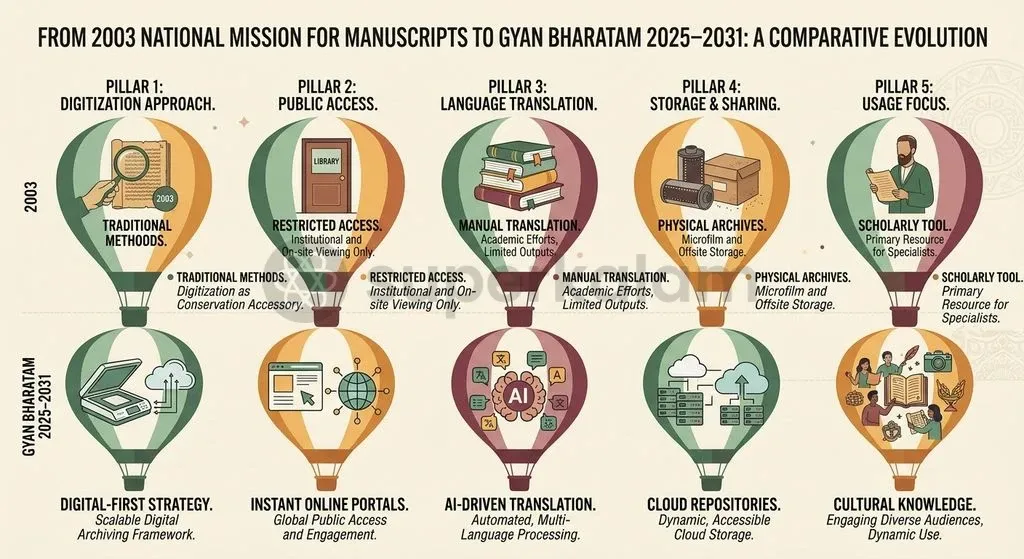
Gyan Bharatam replaces this fragmented approach with a strategy organised around five operational verticals:
- Survey and Cataloguing: Comprehensive baseline enumeration across regional repositories.
- Conservation and Capacity Building: Scientific preventive and curative treatment paired with vocational training.
- Technology and Digitization: Standardised high-resolution image capture and open metadata pipelines.
- Linguistics and Translation: Deciphering, transcribing, and translating classical scripts into modern vernaculars.
- Research, Publication, and Outreach: Academic monographs, open-access public repositories, and school curricula integration.
| Structural Dimension | National Mission for Manuscripts (2003) | Gyan Bharatam Mission (2025–2031) |
|---|---|---|
| Primary Objective | Passive physical preservation and microfilming | Active digital access, semantic search, and machine-assisted transcription |
| Cataloguing Standard | Isolated registry databases with limited public discovery | Machine-readable, standardized metadata tied to an interoperable national repository |
| Technological Stack | Analog microfilms and standard digital photography | Overhead cold-light scanning (400–600 DPI), TIFF v6.0 masters, and PDF/A access formats |
| Institutional Model | Centralised administration under designated nodal agencies | Decentralised hub-and-spoke delivery via Cluster Centres and Independent Centres |
| Knowledge Policy | Restrictive custodial access for institutional scholars | Public-facing knowledge commons supporting research and intellectual sovereignty |
To avoid bureaucratic bottlenecks, the mission relies on a decentralised network of Cluster Centres and Independent Centres embedded within universities, research institutions, and prominent regional libraries. By August 2026, participating institutions had digitised over 8 lakh manuscripts, uploading more than 4.40 lakh manuscripts in view mode onto the central portal for open scholarly review.
The Crisis on the Ground: Rotting Palm Leaves and India's Uncatalogued Wealth
The National Manuscript Survey revealed that official archives house only a small fraction of India's documentary heritage. The vast majority of surviving texts remain scattered across private mutts, temple bhandars, monastic libraries, and ancestral households, according to the National Portal of India's Spotlight on the Gyan Bharatam Mission.
These dispersed documents suffer continuous physical decay. Palm-leaf folios, birch bark (bhojpatra), and handmade paper degrade rapidly in tropical heat and high humidity:
- Fungal infestations and insect boring: Pests like silverfish consume organic cellulose, destroying critical lines of script.
- Flaking and ink erosion: Natural plant dyes fade under improper storage, causing permanent text loss.
- Scribal embrittlement: Unregulated microclimates make palm leaves brittle, snapping edges during physical handling.
The regulatory environment has worsened these preservation risks. Under Section 2(1)(a)(II) of the Antiquities and Art Treasures Act, 1972, any manuscript, record, or document of scientific, historical, literary, or aesthetic value existing for at least seventy-five years is classified as an antiquity.
According to reports from the Department-Related Parliamentary Standing Committee on Transport, Tourism and Culture, this statutory classification created perverse incentives for traditional keepers. Private custodians routinely avoided formal registration because they feared compulsory acquisition under Section 6 of the Act, alongside complex compliance requirements and potential administrative harassment.
This compliance burden pushed private collections underground. Unable to seek state conservation support, many families and monastic orders kept significant manuscripts hidden in damp cellars. In the worst cases, neglected collections were sold through illicit antique smuggling networks, violating domestic protection laws.
Discuss with Superkalam
Explain why Optical Character Recognition (OCR) systems struggle to decipher ancient Indic manuscripts without human paleographic oversight.
Ask NowBeyond Scanning: How AI and Open Repositories Create a True Knowledge Commons
The Ministry of Culture established strict technical benchmarks to ensure digital captures outlast technical obsolescence. Under the Gyan Bharatam technical digitisation guidelines, scanning teams must use non-destructive overhead scanners equipped with cold light sources. Imaging runs at a baseline resolution of 400 DPI, increasing to 600 DPI for micro-scripts. Captures are archived as uncompressed or LZW-compressed TIFF v6.0 master files for preservation, paired with lightweight PDF/A files for public access.
Raw digital images, however, do not make a usable digital library. Without machine-readable transcriptions, high-resolution scans remain mere photographs of illegible pages. To process these massive volumes of image data, the Ministry deployed a specialised suite of computational tools:
- Pandulipi Darpan: An optical character model developed for automated script recognition, transliteration, and translation across historical scripts.
- Gyan Mitram: A semantic engine that links cross-disciplinary subjects, annotates metadata, and traces conceptual lineages across varied texts.
- BharatiyaGPT: A conversational multimodal interface designed to allow researchers and students to query transcribed texts using natural voice or text prompts.
Correction: Diagrams must be specified in the image plan rather than rendered in ASCII text.
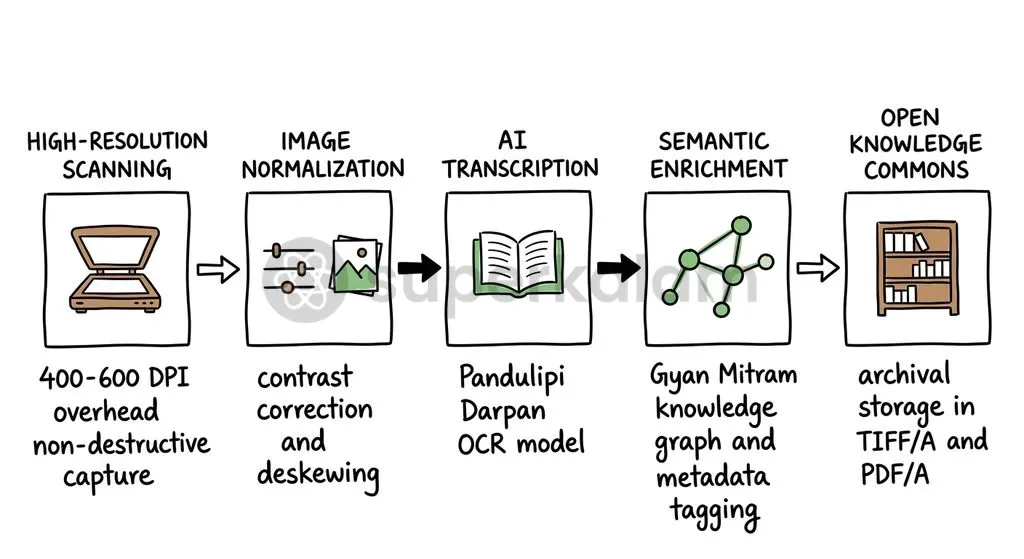
Applying Optical Character Recognition (OCR) and Handwritten Text Recognition (HTR) to ancient Indian manuscripts introduces steep technical hurdles. Historical scribes used complex, non-standardised ligatures (fused letters) and conjunct glyphs that confuse conventional character-segmentation models.
Furthermore, Indian collections feature severe language-script mismatches: Sanskrit works are routinely copied in regional scripts like Grantha, Telugu, Newari, or Sharada. Physical defects like holes, water stains, and ink bleeds create visual noise that standard machine-learning filters misidentify as character strokes. As a result, fully automated transcription requires extensive human paleographic oversight to correct recognition errors.
The Scholar Gap: Why Tech Cannot Replace Vanishing Paleographic Skills
Technological pipelines ultimately hit a human bottleneck: India faces an acute paleographic deficit. Proceedings from the First Gyan Bharatam International Conference note a critical shortage of certified scholars who can accurately read, edit, and translate regional and historical scripts.
Correction: Diagrams must be specified in the image plan rather than rendered in ASCII text.
India's most vulnerable scripts hold essential pieces of historical knowledge:
- Sharada: The primary medium for Kashmir's historical treatises on mathematics, philosophy, and poetics.
- Modi: The cursive script of administrative records across western India from the Yadava through Maratha eras.
- Grantha: The classical script used across Tamil-speaking regions to transcribe Sanskrit philosophical and scientific literature.
- Tigalari: The traditional script of coastal Karnataka and northern Kerala, holding critical Vedic and Ayurvedic texts.
- Newari: The historic script of the Kathmandu Valley, preserving early Buddhist philosophical canons.
Mass digitisation without academic translation risks creating vast dead digital archives—multi-terabyte servers storing millions of high-resolution images that no living scholar can interpret.
This human capital deficit stems from decades of university neglect. Indian higher education has largely phased out advanced epigraphy, manuscriptology, and paleography departments, offering few sustainable academic career tracks for young philologists. Rebuilding these university programs is essential; without skilled paleographers, India's AI models cannot access the verified training data required to decipher complex scripts accurately.
Discuss with Superkalam
How would you apply a non-custodial scanning model to convince traditional temple bhandars to open their uncatalogued archives for digitisation?
Ask NowCustody, Community Trust, and Illicit Trafficking: Who Owns Ancient Texts?
Because the vast majority of historical manuscripts remain in non-state hands, public-sector digitisation depends entirely on community trust. Drawing on lessons from earlier preservation efforts, the Gyan Bharatam survey framework is designed to be voluntary and non-intrusive. Field survey protocols explicitly guarantee that documenting and digitising a text does not alter its legal ownership or require surrendering the physical artifact.
Balancing public access with intellectual property protection presents another policy challenge. Open-access digitisation of traditional medicinal manuscripts creates serious biopiracy vulnerabilities if digital platforms operate without safeguards.
When uncodified tribal medical systems and regional Ayurvedic practices are placed online in open-access formats without prior patent registration, foreign entities can exploit that knowledge to file patent claims.
To prevent biopiracy, the Ministry coordinates with the Traditional Knowledge Digital Library (TKDL), managed by the Council of Scientific and Industrial Research. Under this arrangement, digitized medicinal folios are catalogued as confidential prior art within international patent classification systems. This structure allows global patent examiners to review Indic formulations and block improper patent claims, safeguarding domestic intellectual property without blocking legitimate academic research.
Discuss with Superkalam
Analyse how statutory compliance under the Antiquities and Art Treasures Act, 1972 created unintended disincentives for community heritage custodians.
Ask NowGlobal Lessons: What India Can Borrow from the Dunhuang and Vatican Projects
International initiatives offer proven models for managing massive manuscript digitisation efforts. Two initiatives demonstrate how to solve digital degradation, institutional fragmentation, and metadata standardization:
Correction: Diagrams must be specified in the image plan rather than rendered in ASCII text.
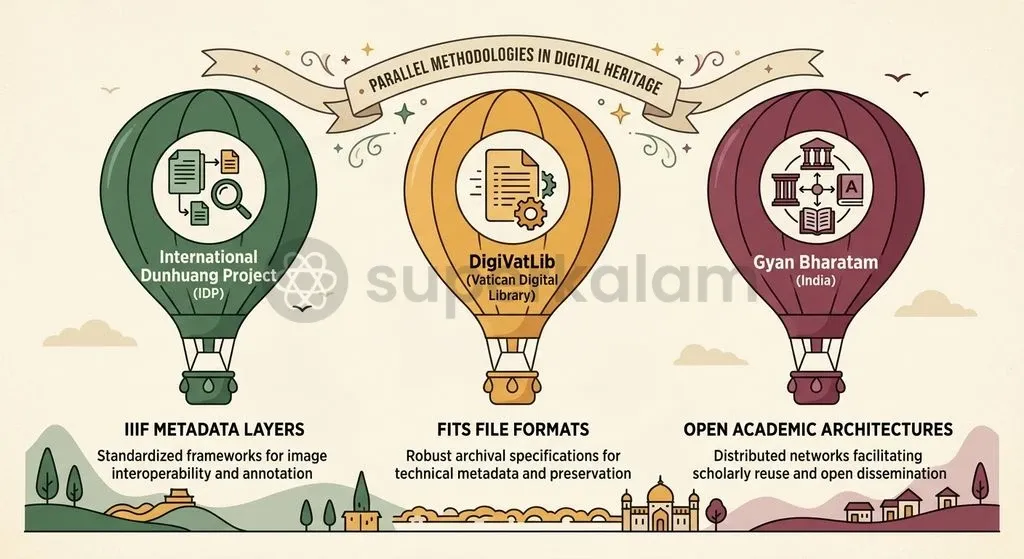
1. International Dunhuang Project (IDP)
The International Dunhuang Project, led by the British Library and partner institutions across China, France, Germany, and Russia, digitises and catalogues scattered Silk Road collections.
Because historical Silk Road documents are split across global collections, the IDP adopted the International Image Interoperability Framework (IIIF). This protocol lets researchers compare digital manuscript folios stored in different global institutions within a unified browser interface, eliminating the need to duplicate core server files.
2. DigiVatLib (Vatican Apostolic Library)
The Vatican Apostolic Library's digitization program (DigiVatLib) addresses the risk of digital file obsolescence. Commercial image formats often become unreadable as operating systems and proprietary viewing software evolve.
To guarantee long-term data survival, DigiVatLib uses the Flexible Image Transport System (FITS), an open-standard format originally developed by NASA and the International Astronomical Union. FITS stores raw pixel data alongside open metadata headers, ensuring files remain readable centuries after their initial scan regardless of changes in computing hardware.
| Archival Dimension | International Dunhuang Project (IDP) | Vatican Library (DigiVatLib) | Gyan Bharatam Mission Strategy |
|---|---|---|---|
| Institutional Framework | Distributed international consortium of libraries | Centralised pontifical research archive | Hub-and-spoke model via regional Cluster Centres |
| Interoperability Standard | Full IIIF compliance for distributed folio viewing | IIIF framework combined with open APIs | Centralised portal ingestion transitioning to open metadata schemas |
| Image Storage Format | High-resolution TIFF masters with Web derivatives | Astrophysics-grade FITS open-format masters | Uncompressed/LZW TIFF v6.0 masters and PDF/A access copies |
| Core Value | Uniting geographically dispersed imperial collections | Ensuring long-term digital preservation against format obsolescence | Scaling domestic survey reach, paleographic training, and digital sovereignty |
Way Forward: Bridging High-Tech Archiving with Grassroots Conservation
To turn 1.19 crore mapped manuscripts into a vibrant national knowledge commons, the Gyan Bharatam Mission must combine its technology investments with community-focused policies:
- Legislative Decriminalisation under the 1972 Act: Parliament should consider amending the Antiquities and Art Treasures Act, 1972. Replacing compulsory acquisition provisions under Section 6 with state-supported custodial care would encourage private families, mutts, and trusts to register valuable texts without fearing confiscation.
- Institutionalising University Epigraphy Cadres: The University Grants Commission (UGC) and state education ministries must establish dedicated, funded positions in classical paleography, manuscriptology, and philology. Creating viable academic careers for reading scripts like Sharada, Modi, and Grantha is essential to prevent digital archives from becoming unreadable data silos.
- Adopting Open Interoperability Standards: The National Digital Repository should fully adopt IIIF and open-source file architectures like FITS. These international protocols will allow Indian institutions to link domestic catalogues seamlessly with foreign collections, including those at the Bibliothèque nationale de France and the British Library.
- Mobile Digitisation Units: Many vulnerable collections cannot be moved from their home temples and mutts due to religious traditions or physical fragility. Deploying climate-controlled, mobile overhead scanning units across rural districts will allow technical teams to capture texts on site without disrupting local custodianship.
- Tight Coordination with the TKDL: All digitised medical, pharmacological, and botanical manuscripts must pass through systematic intellectual property screening before publication. Automatically registering these texts with the Traditional Knowledge Digital Library will protect community intellectual property while keeping the documents open for domestic study.
Key Takeaways
- Policy Reorientation: The Gyan Bharatam Mission (2025–2031, ₹491.66 crore outlay) marks a structural shift from passive physical storage to open digital access, machine translation, and national knowledge sovereignty.
- Massive Repository Scope: The National Manuscript Survey mapped over 1.19 crore manuscripts across States and Union Territories, establishing India as the largest repository of documentary heritage in the world.
- Constitutional Foundation: Public manuscript preservation efforts fulfill the state obligations set out in Article 49 (protecting monuments and objects of national importance) and support the civic duties established in Article 51A(f) (valuing composite culture).
- The Paleographic Deficit: Digitisation without scholarly decipherment creates unsearchable "dead digital archives." India faces a severe shortage of certified scholars who can read vital scripts like Sharada, Modi, Grantha, Tigalari, and Newari.
- Reforming Antiquity Laws: Historic fears of compulsory state acquisition under Section 6 of the Antiquities and Art Treasures Act, 1972 drove private collections underground; non-intrusive, voluntary survey protocols are critical to rebuilding community trust.
- Digital Preservation Protocols: To match international standards set by the International Dunhuang Project and the Vatican Library, India's technical teams rely on cold-light overhead scanners, uncompressed TIFF v6.0 master files, and ongoing integrations with the Traditional Knowledge Digital Library.
Mains Question
"The transition from the National Mission for Manuscripts to the Gyan Bharatam Mission marks a paradigm shift from passive physical preservation to an active digital knowledge commons." Elucidate. (10 Marks)
Evaluate NowMains Question
While digital technology offers unprecedented tools for preservation, digitisation alone cannot unlock India's documentary heritage without addressing ground-level regulatory barriers and human capacity deficits. Critically analyse. (15 Marks)
Evaluate NowPractice MCQs
QUESTION 1
With reference to the Gyan Bharatam Mission, consider the following statements:
- It was announced under the Union Budget 2025–26 with a dedicated financial outlay for the 2025–2031 period.
- It replaces the centralized administration of the National Mission for Manuscripts with a hub-and-spoke delivery model via Cluster Centres and Independent Centres.
- The mission exclusively restricts digital access to verified institutional scholars to safeguard national intellectual sovereignty. Which of the statements given above is/are correct?
QUESTION 2
Consider the following statements regarding the legal and technical aspects of manuscript preservation in India:
- Under the Antiquities and Art Treasures Act, 1972, any manuscript of historical or aesthetic value existing for at least seventy-five years is classified as an antiquity.
- The Gyan Bharatam Mission digitisation guidelines mandate scanning at a baseline resolution of 600 DPI using warm tungsten illumination to enhance ink contrast.
- Fear of compulsory acquisition under Section 6 of the Antiquities and Art Treasures Act, 1972, has historically disincentivised private custodians from registering ancient texts. Which of the statements given above is/are correct?
QUESTION 3
With reference to the computational tools deployed under the Gyan Bharatam Mission, consider the following pairs:
- Pandulipi Darpan : Automated script recognition, transliteration, and translation across historical scripts
- Gyan Mitram : Semantic engine for metadata annotation and linking cross-disciplinary subjects
- BharatiyaGPT : Microfilm digital scanning and physical folio restoration tool Which of the pairs given above is/are correctly matched?
QUESTION 4
Which of the following constitutional provisions directly support the state's mandate and citizens' obligations towards preserving India's ancient documentary and manuscript heritage?
- Article 49 of the Constitution of India
- Article 51A(f) of the Constitution of India
- Article 300A of the Constitution of India Select the correct answer using the code given below:
QUESTION 5
In the context of international cultural diplomacy and heritage preservation, the Ministry of Culture signed an MoU in October 2026 to locate, digitise, and share Indic manuscripts on India's National Digital Repository with which of the following institutions?