Coastal Salt Marshes: India's Bio-Shields Against Storm Surges
As cyclonic surges intensify along India's coastline, intertidal salt marshes provide dynamic bio-shields that challenge conventional seawall engineering.
Nov, 2026
•10 min read

Overview
Coastal salt marshes are dynamic, self-sustaining bio-shields. They attenuate up to 60 percent of storm wave energy through vegetation drag and bed friction. This mechanism offers India an ecologically grounded defence against cyclone-induced storm surges.
Unlike rigid concrete seawalls that exacerbate coastal scour and deteriorate under wave reflection, these intertidal herbaceous ecosystems trap sediments and accrete root matter. This accretion keeps pace with sea-level rise while storing blue carbon. However, tapping their protective potential requires acknowledging their physical thresholds during severe Category 4 and 5 cyclonic surges. It also demands swift reform of India's fragmented wetland regulatory frameworks.
Why in the News? The Push for Nature-Based Coastal Defenses
Cyclones and severe erosion along India's peninsular rim have forced a rethinking of coastal safety. The National Disaster Management Authority (NDMA) now prioritises nature-based solutions within disaster risk governance. As of August 2024, when India designated its 85th Ramsar Site, coastal salt marshes remained disproportionately underrepresented across officially notified wetland reserves despite their immense protective value, according to the Ministry of Environment, Forest and Climate Change.
Two core national and global frameworks now formally drive this policy shift:
- National Disaster Management Plan: Explicitly incorporates coastal wetland conservation and bio-shield establishment as primary instruments to reduce cyclone vulnerability.
- Sendai Framework (2015–2030): Directs signatories under Priority 3 and Priority 4 to invest in nature-based resilience to curb economic disaster losses.
Salt marshes provide dynamic, climate-adaptive protection whose hydrodynamic efficiency exceeds traditional grey infrastructure across moderate surges. Yet in India, their operational capacity remains constrained by rigid submergence thresholds and major statutory classification gaps.
Discuss with Superkalam
Which pioneer grass species colonises the lower intertidal mudflats in Indian salt marshes, according to the Botanical Survey of India?
Ask NowWhat Are Salt Marshes and Where Do They Thrive?
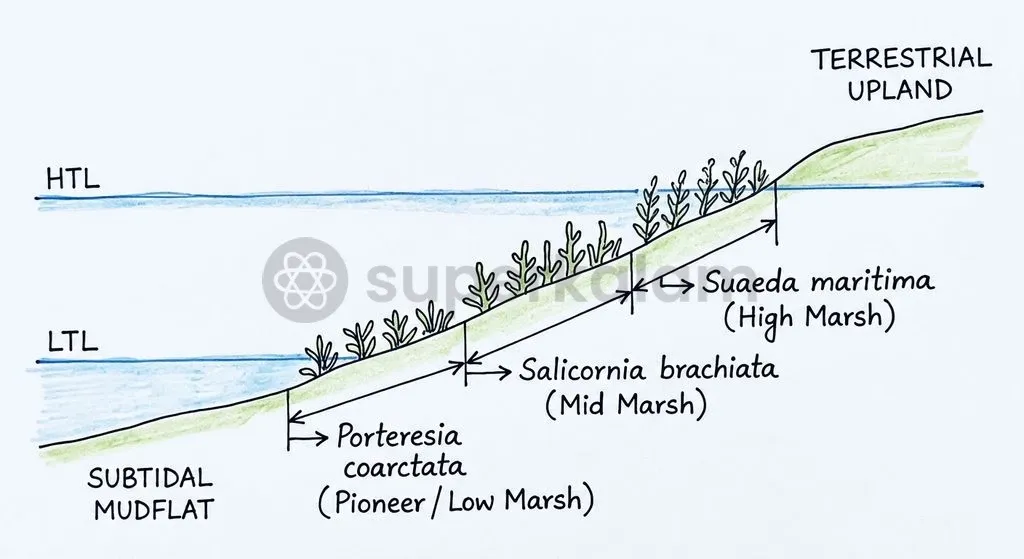
Salt marshes are intertidal ecosystems dominated by herbaceous halophytes—salt-tolerant grasses, sedges, and succulent low shrubs. They colonise sheltered estuarine shorelines, mudflats, and coastal lagoons across macro-tidal and sheltered micro-tidal regimes where fine sediment settles and periodic saltwater flooding occurs.
A clear vertical zonation pattern emerges along the intertidal gradient. This distribution is shaped directly by micro-elevation and tidal inundation frequency. According to the Botanical Survey of India, pioneer grasses like Porteresia coarctata colonise lower intertidal mudflats, whereas succulent halophytes like Salicornia brachiata and Suaeda maritima dominate higher marsh zones. Botanical Survey of India research shows that Salicornia brachiata tolerates extreme salinity via cellular succulence and vacuolar accumulation of sodium chloride.
| Parameter | Coastal Salt Marshes | Mangrove Forests |
|---|---|---|
| Vegetation Type | Herbaceous flora, grasses, succulents, low shrubs | Woody trees and large shrubs |
| Dominant Genera | Salicornia, Suaeda, Porteresia | Rhizophora, Avicennia |
| Climatic Preference | Thrives across temperate, arid, and semi-arid zones | Predominantly tropical and subtropical coastlines |
| Primary Location in India | Gulf of Kutch, Gulf of Khambhat, Kori Creek | Sundarbans, Bhitarkanika, Andaman and Nicobar Islands |
| Sediment Binding | Dense near-surface rhizomes and fibrous roots | Massive stilt roots, pneumatophores, and knee roots |
Data from the Space Applications Centre (ISRO) clarifies that unlike woody mangrove swamps dominated by tree halophytes like Rhizophora and Avicennia, salt marshes feature herbaceous vegetative mats. The two ecosystems frequently intergrade in tropical and subtropical transition belts, establishing complementary coastal protection buffers.
The Physics of Wave Attenuation: How Marsh Grasses Drain Storm Energy
Salt marsh plants attenuate hydrodynamic energy through fluid friction and frontal vegetation drag as incoming storm waves traverse the intertidal platform. The physical mechanisms mediating this natural damping operate through distinct hydrodynamic and sedimentological interactions:
- Vegetation Drag and Energy Dissipation: Emergent plant stems and dense leafy canopies exert frontal drag forces that interrupt the orbital trajectories of water particles. This frictional interaction extracts kinetic energy directly from the oscillating water column, suppressing wave heights.
- Bed Friction Amplification: Below the surface canopy, flexible stems generate boundary layer turbulence that increases bottom bed shear stress. The amplified friction across the shallow marsh shelf dissipates near-bed velocity pulses faster than bare estuarine mudflats.
- Subsurface Root Reinforcement: Dense subsurface networks of roots and rhizomes bind fine sediment particles together. According to findings published in Earth-Science Reviews, these subterranean root mats raise the critical erosion threshold, preventing sediment scouring during storm surges.
Controlled large-scale flume experiments by Möller et al. demonstrate that salt marsh vegetation accounts for up to 60% of total wave attenuation across a 40-metre marsh zone under storm surge water depths of up to 2 metres. Hydrodynamic modelling by Rezaie, Loerzel, and Ferreira shows that coastal wetlands reduce flood inundation and storm damages by up to 14%, generating protective flood-reduction values between $7,000 and $138,000 per square kilometre during severe storm events.
Discuss with Superkalam
Explain how the ratio of water depth to vegetative canopy height governs the hydrodynamic dissipation of wave energy across an intertidal platform.
Ask NowThe Breaking Point: When Storm Surges Overpower Coastal Marshes
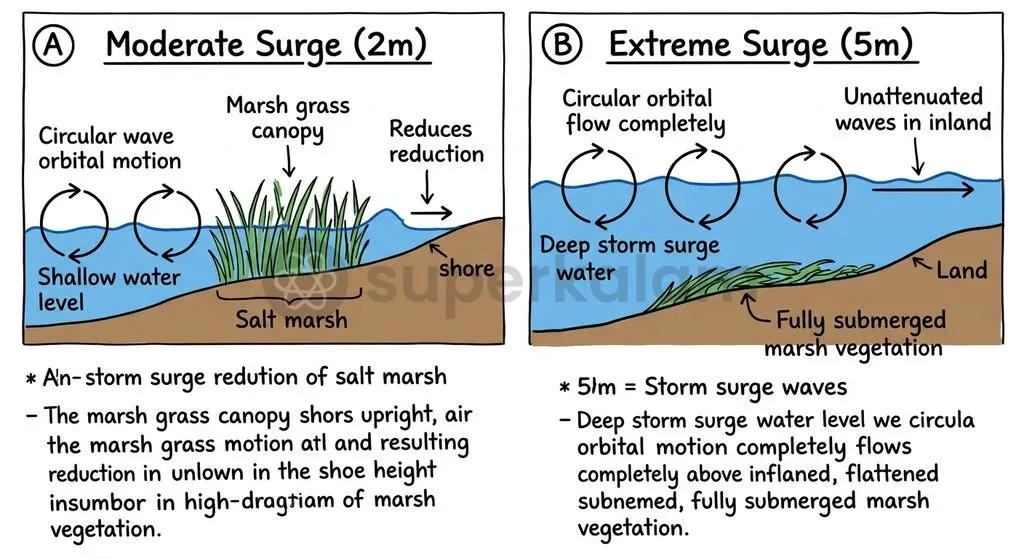
A salt marsh's damping capacity is finite, breaking down when hydrodynamic forcing exceeds physical thresholds. Wave attenuation depends directly on the ratio of local water depth to vegetative canopy height, as documented by fluid mechanics researcher H. M. Nepf. When water depth substantially exceeds canopy height, wave orbital velocities travel unimpeded above the submerged vegetative friction layer.
| Surge Condition | Hydrodynamic State | Damping Outcome |
|---|---|---|
| Moderate Surge (Depth ≤ Canopy) | Frontal drag fully engaged | Delivers up to 60% wave attenuation |
| Extreme Surge (Surge >> Canopy) | Deep submergence and high orbital velocities | Vegetation lodging and energy decoupling |
During extreme cyclonic storm surges of 4 to 6 metres, such as those generated by severe Category 4 and 5 cyclones, salt marsh vegetation suffers from severe lodging (flattening) and mechanical stem breakage. Lodged plant canopies lose their vertical profile, sharply diminishing frontal drag. Because of these meteorological limits, natural marshes cannot operate as a standalone panacea against Category 5 surges and must be integrated into comprehensive coastal defence architectures.
Green Buffers vs Concrete Seawalls: Costs, Durability, and Co-Benefits
Conventional coastal management historically favoured hard "grey" infrastructure such as reinforced concrete seawalls, revetments, and tetrapod groynes. Engineered grey barriers produce wave reflection, inducing toe scour and undermining shoreface stability over time. Furthermore, hard revetments cause coastal squeeze, blocking the natural landward migration of intertidal habitats as sea levels rise.
| Dimension | Nature-Based 'Green' Buffers (Salt Marshes) | Hard 'Gray' Infrastructure (Seawalls & Dykes) |
|---|---|---|
| Capital & Maintenance Costs | Lower initial capital outlay and minimal long-term maintenance costs | High upfront construction costs; continuous capital-intensive repairs against scour |
| Response to Sea-Level Rise | Dynamically accretes mineral sediments and root matter to gain elevation | Static crest height; faces increased wave run-up and catastrophic overtopping |
| Ecosystem Co-Benefits | Blue carbon sequestration, fishery nursery grounds, biodiversity habitats | Negligible ecological co-benefits; fragments natural coastal ecotones |
| Storm Failure Mode | Progressive vegetative lodging without catastrophic structural collapse | Abrupt structural breach or foundation undermining under extreme loading |
Salt marshes dynamically adjust to relative sea-level rise through continuous sediment accretion, trapping allochthonous mineral silts and accumulating autochthonous organic root matter. Beyond physical stabilisation, salt marshes are major blue carbon reservoirs. Research by Mcleod et al. shows that salt marshes sequester organic carbon at global average burial rates of approximately 218 grams of carbon per square metre per year (around 2.18 tonnes per hectare annually). According to Pendleton et al., water-saturated, anaerobic soils halt microbial respiration, locking carbon away for centuries.
Engineering assessments demonstrate that hybrid coastal infrastructure—combining a foreshore salt marsh buffer with a setback dike—allows engineers to lower the required structural height of seawalls while maintaining overtopping safety.
Discuss with Superkalam
Contrast the structural response and failure modes of concrete seawalls versus herbaceous salt marsh buffers during cyclonic storm surges.
Ask NowIndia's Coastline at Risk: High-Risk Zones and Existing Salt Marsh Pockets
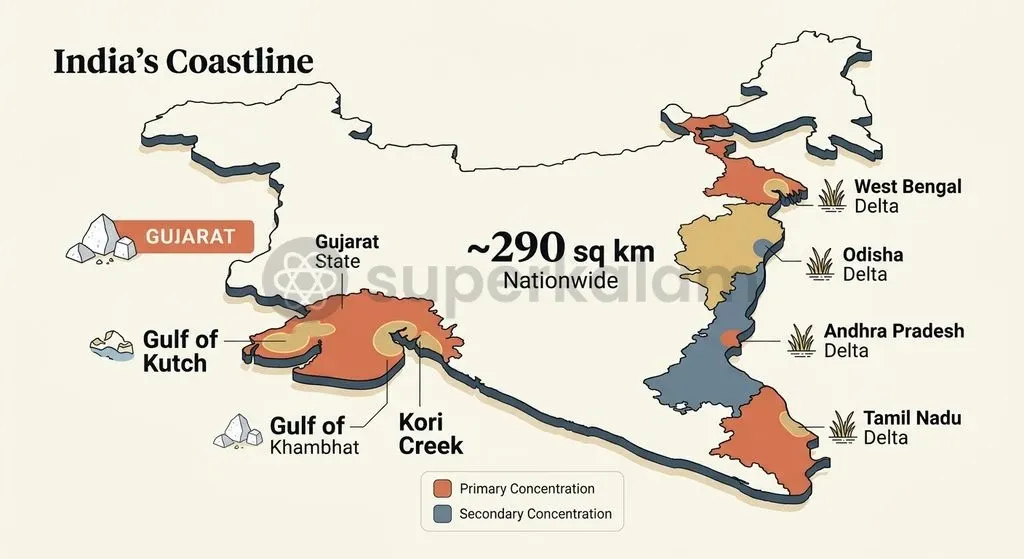
India's salt marsh geography is heavily skewed toward arid and semi-arid macro-tidal environments. An inventory by Gopi et al. estimates India's total salt marsh cover at approximately 290.49 square kilometres, representing a specialized ecological footprint.
The National Wetland Atlas prepared by the Space Applications Centre (ISRO) documents that the vast majority of India's salt marshes occur in Gujarat. These distributions break down regionally:
- Gujarat Strongholds: Expansive beds spread across the macro-tidal flats of the Gulf of Kutch, the Gulf of Khambhat, and the hypersaline expanses of Kori Creek.
- Deltaic Enclaves: Minor, fragmented patches colonise the deltaic fringes of West Bengal, Odisha, Andhra Pradesh, and Tamil Nadu.
The National Centre for Sustainable Coastal Management (NCSCM), Chennai, is legally tasked with mapping these sensitive habitats within state Coastal Zone Management Plans (CZMPs). Mapping accuracy remains vital for vulnerable maritime districts that face recurrent Arabian Sea and Bay of Bengal cyclonic landfalls.
Threats Facing India's Coastal Wetlands: Land Reclamation and Pollution
Anthropogenic expansion presents an immediate threat to the ecological integrity of India's salt marshes. Environmental accounts published in EnviStats India 2022 highlight severe habitat fragmentation caused by urban industrial expansions, extensive commercial salt production pans, and chemical aquaculture conversions, particularly across Thane Creek and the Gulf of Khambhat.
A major structural vulnerability stems from India's fractured environmental regulatory architecture:
- CRZ-IA Classification: Under the Coastal Regulation Zone (CRZ) Notification 2019, promulgated under the Environment (Protection) Act 1986, salt marshes are classified as Ecologically Sensitive Areas (CRZ-IA), prohibiting developmental and commercial projects. Permitted interventions are strictly limited to non-destructive traditional fishing and linear critical services like underground pipelines or transmission lines.
- The Wetlands Rules Exclusion: The Wetlands (Conservation and Management) Rules 2017 explicitly exclude coastal wetlands covered under CRZ notifications from their legal jurisdiction.
Because of this jurisdictional carve-out, salt marshes fall entirely outside the administrative purview of State Wetland Authorities. This regulatory exclusion deprives intertidal herbaceous ecosystems of specialised conservation plans, basin-scale hydrological protection, and targeted restoration funds.
Discuss with Superkalam
Given that salt marshes experience vegetative lodging in Category 4 and 5 cyclones, evaluate their role as standalone bio-shields versus hybrid coastal defence systems.
Ask NowWay Forward: Merging Nature-Based Solutions with Coastal Zone Planning
A forward-looking marine governance strategy must combine nature-based ecological solutions with existing civil defence planning. Adopting targeted policy interventions can elevate coastal resilience along vulnerable stretches:
- Bridge Regulatory Divides: The Ministry of Environment, Forest and Climate Change should establish institutional mechanisms to align State Wetland Authorities with Coastal Zone Management Authorities, ending the regulatory orphan status of intertidal salt marshes.
- Adopt Hybrid Green-Gray Engineering: State maritime boards should integrate vegetative foreshores with setback earthen dikes, using salt marshes to absorb initial wave run-up and reducing the concrete footprint of coastal protection structures.
- Expand Blue Carbon Protection: Coastal salt marsh complexes in Gujarat and Tamil Nadu should be proposed for Ramsar recognition, securing conservation financing and halting commercial land reclamation.
- Enforce Living Shoreline Buffers: State CZMPs must demarcate landward migration buffers behind existing salt marshes to prevent coastal squeeze caused by hard engineering.
Coastal protection in an era of intensifying cyclonic surges requires recognising both the physical power and natural thresholds of coastal ecosystems. By anchoring salt marshes within regional disaster risk planning, India can safeguard coastal populations while preserving vital marine biodiversity.
Key Takeaways
- Salt marshes attenuate up to 60% of wave energy across a 40-metre zone during storm surges through frontal vegetation drag and bed shear friction.
- Under Category 4 and 5 cyclonic surges exceeding 4 to 6 metres, salt marshes experience severe lodging, reducing near-surface wave dampening and exposing structural limits.
- India contains approximately 290.49 square kilometres of salt marshes, concentrated overwhelmingly in Gujarat's Gulf of Kutch, Gulf of Khambhat, and Kori Creek.
- While protected as Ecologically Sensitive Areas under CRZ-IA, salt marshes are excluded from the Wetlands (Conservation and Management) Rules 2017, leaving them outside State Wetland Authority mandates.
- Salt marshes provide living, climate-adaptive resilience by accreting sediment to match sea-level rise while storing approximately 2.18 tonnes of blue carbon per hectare annually.
Mains Question
"Nature-based solutions offer dynamic and cost-effective coastal defence against storm surges, yet their protective capacity breaks down under extreme hydrodynamic forcing." Elucidate the biophysical mechanisms of salt marsh wave damping and evaluate their viability during severe cyclonic events. (15 Marks)
Evaluate NowMains Question
Despite formal recognition under the National Disaster Management Plan and the Sendai Framework (2015–2030), coastal salt marshes remain under-protected in India's coastal conservation architecture. Critically analyse. (10 Marks)
Evaluate NowPractice MCQs
QUESTION 1
With reference to coastal salt marshes, consider the following statements:
- They are primarily dominated by woody tree halophytes such as Rhizophora and Avicennia.
- Pioneer grasses like Porteresia coarctata typically colonise lower intertidal mudflats.
- Salicornia brachiata tolerates high salinity through cellular succulence and vacuolar accumulation of sodium chloride.
Which of the statements given above are correct?
QUESTION 2
Consider the following statements regarding the hydrodynamics of wave attenuation by salt marshes:
- Salt marsh vegetation can attenuate up to 60 percent of storm wave energy across a 40-metre zone under water depths of up to 2 metres.
- The critical erosion threshold of estuarine sediments is lowered by subterranean root mats, facilitating bed scouring.
- Wave attenuation efficiency breaks down when storm surge depth significantly exceeds the height of the vegetative canopy.
Which of the statements given above is/are correct?
QUESTION 3
Consider the following pairs regarding coastal ecosystems in India:
- Primary location in India: Thrives predominantly in Gulf of Kutch and Gulf of Khambhat — Coastal Salt Marshes
- Primary location in India: Thrives predominantly in Sundarbans and Bhitarkanika — Mangrove Forests
- Sediment binding mechanism: Dense near-surface rhizomes and fibrous roots — Mangrove Forests
Which of the pairs given above is/are correctly matched?
QUESTION 4
In the context of coastal protection, which one of the following phenomena is associated with conventional 'grey' infrastructure like reinforced concrete seawalls?
QUESTION 5
With reference to disaster risk reduction frameworks and nature-based defenses, consider the following statements:
- The National Disaster Management Plan explicitly incorporates coastal wetland conservation and bio-shields to reduce cyclone vulnerability.
- Under Priority 3 and Priority 4, the Sendai Framework (2015–2030) directs signatories to invest in nature-based resilience to curb economic disaster losses.
Which of the statements given above is/are correct?