PM Viksit Gram Swaraj Yojana: Digital Panchayats and Grassroots Autonomy
While central portals enforce strict accounting, tech-driven rural governance risks turning self-governing village republics into mere data-entry outposts.
Nov, 2026
•10 min read
Context
India has pushed hard to digitise rural local governance through centralised platforms. This drive has strengthened administrative compliance and fiscal traceability. Yet it risks turning constitutional village republics into data-entry nodes rather than self-governing democratic bodies.
Under the Ministry of Panchayati Raj, platforms like eGramSwaraj, AuditOnline, and SVAMITVA now digitise planning, payments, and land records across more than 2.5 lakh Gram Panchayats. But tying digital accounting directly to the release of central grants enforces strict upward accountability to state and national dashboards.
Horizontal accountability to the Gram Sabha suffers as a result. Without structural decentralisation, software centralises authority instead of deepening local democracy.
Why in the News? The Push for Tech-Driven Village Governance
On 28 October 2026, the Union Cabinet approved the Pradhan Mantri Viksit Gram Swaraj Yojana (PM VGSY) as a Centrally Sponsored Scheme. It carries an outlay of ₹7,395.55 crore for 2026–27 to 2030–31, co-terminus with the Sixteenth Finance Commission period.
The scheme establishes clear digital governance targets:
- Universal Plan Uploads: Annual submission of at least 2.55 lakh holistic plans on eGramSwaraj across 32 lakh elected representatives and functionaries.
- Online Audit Verification: Annual completion of 2.55 lakh online audit plans via AuditOnline across rural local bodies.
- Multilingual Citizen Interface: Roll-out of PANCHAM, an AI-enabled WhatsApp platform in 17 Indian languages developed with UNICEF.
As of October 2026, these interventions represent an unprecedented techno-administrative infrastructure for rural local bodies. Yet, this digital push raises a serious constitutional question under Article 243G of the Constitution. That provision envisions Panchayats as autonomous institutions of self-government, not subordinate implementation arms of higher tiers of government.
The Digital Toolkit: What Tools Run in India's Panchayats Today?
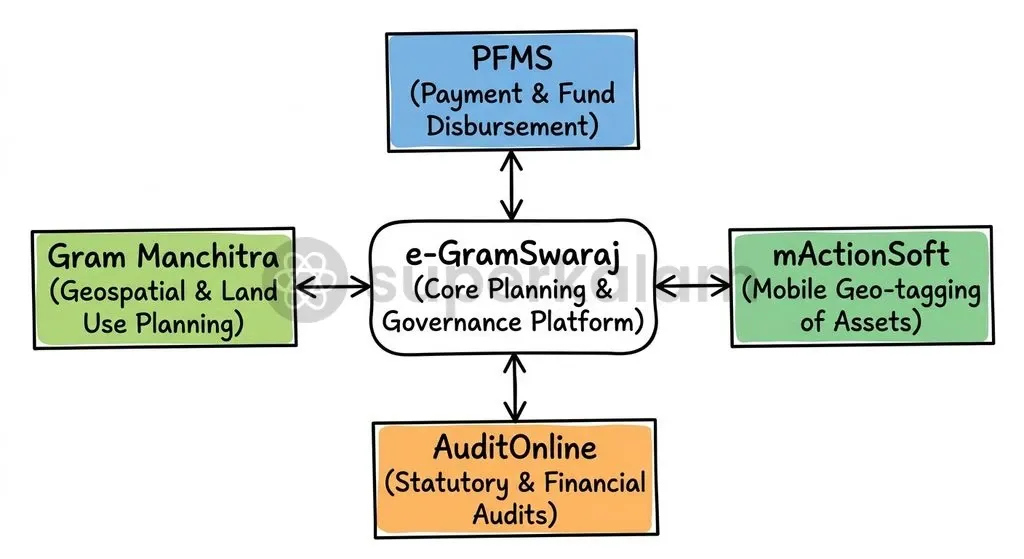
The Ministry of Panchayati Raj operates an integrated digital architecture designed to monitor the planning, physical execution, and financial auditing of local works.
The core platforms anchoring rural administration include:
- eGramSwaraj: A unified portal tracking work-based accounting, planning, and vendor payments. In FY 2025–26, 2,54,604 out of 2,64,211 Gram Panchayats (96.36%) uploaded their Gram Panchayat Development Plans (GPDPs), and 2,42,871 Panchayats disbursed ₹38,491 crore to vendors through its Public Financial Management System (PFMS) interface.
- mActionSoft: A mobile application enforcing stage-wise, geo-tagged visual evidence before any funds are released for assets created under local development plans.
- AuditOnline: An internal auditing tool where 2,40,435 out of 2,64,998 rural local bodies (90.73%) generated online audit reports for FY 2024–25.
- Gram Manchitra: A geospatial portal that integrated GP-level weather forecasts in October 2024 through collaboration with the India Meteorological Department.
- SVAMITVA Scheme: A drone-survey mapping initiative designed to issue rural property cards, establishing clear ownership in inhabited rural areas (Abadi).
Discuss with Superkalam
What are the two specific roles required to complete the dual-authorisation workflow for vendor payments on eGramSwaraj?
Ask NowThe Promise: How Digital Platforms Aim to Fix Grassroots Leakages
Centralised platforms aim to eliminate leakages, duplicate billing, and phantom infrastructure projects in rural spending. Under standard manual procedures, muster rolls and asset verification suffered from weak supervision. That gap invited unmonitored fund diversion.
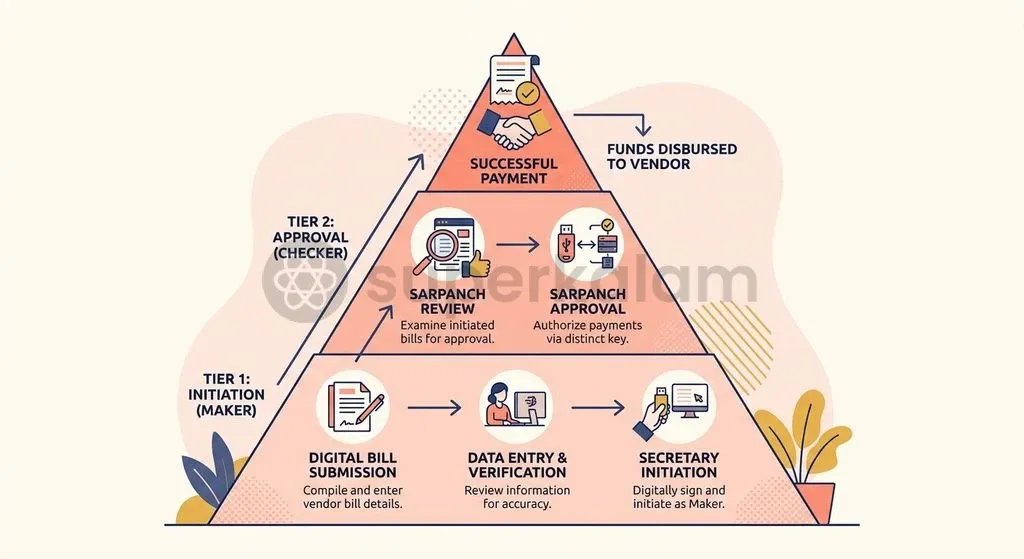
To fix fiscal vulnerabilities, the Ministry of Panchayati Raj instituted a dual-authorisation workflow on eGramSwaraj. Releasing vendor payments requires two distinct Class-3 Digital Signature Certificates (DSC): one from the Panchayat Secretary as Maker, and a second from the Gram Panchayat Sarpanch as Checker.
Financial transparency is reinforced through spatial verification. The mActionSoft application mandates geo-tagged photographic evidence across three distinct stages:
- Pre-work status: Visual documentation recorded before project commencement.
- During construction: Verification while physical work is underway.
- Completion stage: Final proof required before accounts settle.
Concurrently, the SVAMITVA scheme targets rural economic stagnation by clarifying land titles. As of August 2026, drone surveys covered 3.30 lakh villages, resulting in 3.24 crore property cards prepared for 1.97 lakh villages and approximately 2.72 crore cards distributed. The scheme aims to empower village residents to leverage property as a financial asset, reducing boundary litigation and expanding municipal property taxation.
The Field Reality: Are Panchayats Governing or Just Feeding Dashboards?
Despite high digital adoption metrics, field realities diverge from dashboard claims. The operational mechanics of the portals have established rigid administrative pathways that curb local decision-making.
A study by the ICAI Committee on Public & Government Financial Management found that centralised Management Information System (MIS) dashboards drive upward accountability toward line departments, bypassing downward accountability to village citizens in the Gram Sabha. Local priorities approved during the annual People's Plan Campaign (Sabki Yojana Sabka Vikas) must frequently be altered to match rigid digital templates and predefined expenditure budget heads.
Digital compliance is also enforced through strict financial sanctions. Rural local bodies can receive their Fifteenth Finance Commission grants only after uploading audited accounts to AuditOnline and closing daily day-books on eGramSwaraj.
Discretion over funds remains heavily constrained by central earmarks:
| Grant Component | Share of Allocation | Mandated Focus Area |
|---|---|---|
| Tied Grant (Water) | 30% | Drinking water supply and rainwater harvesting |
| Tied Grant (Sanitation) | 30% | Sanitation and open defecation free maintenance |
| Untied Basic Grant | 40% | Local discretion for village-specific priorities |
Because 60% of rural grants are tied, elected village representatives retain discretion over only 40% of their basic allocations.
The intended financial leverage of the SVAMITVA scheme also faces friction. By August 2026, commercial financial institutions had disbursed only 11,147 loans totalling ₹1,713 crore against rural property cards nationwide. This limited uptake illustrates that creating digital property titles does not automatically produce bankable collateral without institutional legal support.
Discuss with Superkalam
How does linking central grant disbursements to daily portal day-book closures alter the power relationship between line departments and Gram Panchayats?
Ask NowComparing the Models: Bottom-Up Local Democracy vs Upward Digital Monitoring
The divergence between the constitutional mandate of democratic decentralisation and centralised digital control forms the central institutional friction in Panchayati Raj governance.
| Dimension | Constitutional Model (Article 243G) | Digital Monitoring Model (eGramSwaraj / MIS) |
|---|---|---|
| Primary Accountability | Horizontal: accountable downward to the deliberative Gram Sabha | Upward: accountable to State and Union dashboards |
| Planning Mechanism | Participatory local appraisal via Eleventh Schedule subjects | Standardised digital modules structured around centrally tied schemes |
| Discretion over Funds | Unrestricted budgeting based on distinct local geography and needs | Conditionality-bound releases linked to closing daily financial day-books |
| Verification Basis | Direct social audit by village residents in open assemblies | Automated verification via mActionSoft geo-tagging |
| Operational Control | Elected Panchayat members backed by sanctioned administrative staff | Technocratic workflows requiring specialised digital hardware and network access |
This structural comparison reveals a fundamental tension. While portals provide administrative precision, they risk transforming autonomous constitutional bodies into mere implementation units for centrally designed programmes.
Discuss with Superkalam
If a remote Panchayat experiences frequent optical fibre cuts, what institutional risks arise when Sarpanches share cryptographic dongles with cyber café operators?
Ask NowThe Missing Foundation: Why Software Cannot Substitute for Funds and Staff
Digital workflows presume reliable telecommunications, continuous electricity, and literate public functionaries. In practice, India's rural administrative infrastructure remains uneven.
Under the BharatNet project, approximately 2.21 lakh Gram Panchayats were reported service-ready by June 2026. However, the transition to resilient ring topology under the Amended BharatNet Programme covered only 13,494 Panchayats. Many village offices rely on linear optical fibre links susceptible to frequent cuts, forcing staff to travel to urban blocks to complete daily portal log-ins.
This infrastructural deficit breeds an informal ecosystem of intermediaries. Field governance reviews by the Ministry of Panchayati Raj and NITI Aayog note that elected Sarpanches frequently hand over their physical cryptographic dongles and security PINs to private Common Service Centre (CSC) operators or unaccredited computer clerks.
This workaround bypasses the Maker-Checker framework, shifting administrative power into private commercial hands:
- Intended Protocol: The Panchayat Secretary creates the entry using Maker DSC, followed by Sarpanch verification via Checker DSC for secure PFMS vendor payment.
- Field Reality: Physical dongles and PINs are surrendered to private CSC operators, bypassing genuine checks and centralising local authority outside the council.
At the same time, village local bodies face fiscal dependency. Reserve Bank of India studies show that Gram Panchayats generate barely 1% of their revenue through Own Source Revenue (OSR), relying almost entirely on state and central devolution.
Fiscal vulnerability intensified when the Ministry of Finance halted Fifteenth Finance Commission grant disbursements to states that failed to establish State Finance Commissions (SFCs) under Article 243I. When basic administrative infrastructure is lacking, digital requirements create operational paralysis instead of clean governance.

Discuss with Superkalam
Considering that 60% of rural Finance Commission grants are tied to water and sanitation, evaluate whether digital tracking enhances fiscal discipline or curtails local autonomy.
Ask NowWay Forward: Turning Digital Tools into Servants of Local Democracy
Reconciling digital efficiency with constitutional decentralisation requires redesigning technology to empower local bodies, rather than treating them as passive data conduits.
The 2nd Administrative Reforms Commission, in its 6th Report on Local Governance, emphasised that institutional interventions must guarantee the devolution of the 3Fs (Funds, Functions, and Functionaries) under Article 243G of the Constitution. Rather than remaining central monitoring instruments, platforms like eGramSwaraj must become planning tools managed directly by local councils.
To correct current structural imbalances, policy execution should focus on four institutional steps:
- Strengthening Dedicated Gram Panchayat Cadres: End administrative delegation to unaccredited third-party cyber cafes by recruiting full-time, state-funded digital assistants who report directly to the elected Panchayat council.
- Expanding Untied Development Grants: The Sixteenth Finance Commission should lower tied grant mandates from 60%, granting Gram Sabhas broader fiscal latitude to allocate funds toward pressing local priorities.
- Institutionalising Digital Social Audits: Mandate that all financial statements, vendor invoices, and mActionSoft geo-tagged imagery be displayed publicly in physical Gram Sabha assemblies prior to final portal sign-off.
- Decentralising Data Governance: Guarantee that village councils retain ownership of local records compiled through SVAMITVA and Gram Manchitra, using this spatial data to assess local property taxes and grow Own Source Revenue (OSR).
Key Takeaways
- The Union Cabinet approved the PM Viksit Gram Swaraj Yojana with an outlay of ₹7,395.55 crore for 2026–27 to 2030–31 to digitise rural governance.
- The Fifteenth Finance Commission tied 60% of rural local grants to national drinking water and sanitation goals, leaving just 40% for untied local priorities.
- Over 96% of Gram Panchayats uploaded annual development plans on eGramSwaraj in FY 2025–26, and more than 90% generated digital audit reports via AuditOnline.
- Limited connectivity—with only 13,494 Panchayats converted to stable ring topology under BharatNet by mid-2026—spurs reliance on private cyber cafe operators.
- Gram Panchayats generate barely 1% of total revenue from Own Source Revenue, leaving them heavily reliant on central and state fiscal devolution.
Mains Question
"While centralised platforms like eGramSwaraj and AuditOnline have strengthened fiscal compliance and upward monitoring, they risk transforming Panchayats from institutions of self-government under Article 243G into mere implementation nodes." Critically examine. (150 words) (10 Marks)
Evaluate NowMains Question
The Pradhan Mantri Viksit Gram Swaraj Yojana (PM VGSY) seeks to build an unprecedented techno-administrative infrastructure for rural local bodies. In light of field realities regarding digital connectivity and financial autonomy, evaluate the efficacy of software-driven solutions in deepening democratic decentralisation. (250 words) (15 Marks)
Evaluate NowPractice MCQs
QUESTION 1
Regarding digital governance platforms in rural India, consider the following statements:
- Releasing vendor payments via eGramSwaraj mandates a dual-authorisation workflow using Class-3 Digital Signature Certificates from both the Panchayat Secretary and the Sarpanch.
- The mActionSoft application mandates geo-tagged photographic evidence across pre-work, during construction, and completion stages before funds are settled.
- The Pradhan Mantri Viksit Gram Swaraj Yojana (PM VGSY) is a Central Sector Scheme funded entirely by the Union Budget.
Which of the statements given above are correct?
QUESTION 2
With reference to the SVAMITVA scheme and rural governance platforms, consider the following statements:
- SVAMITVA uses drone surveys to map inhabited rural areas (Abadi) and issue property cards.
- Gram Manchitra integrated Gram Panchayat-level weather forecasting through collaboration with the India Meteorological Department.
- AuditOnline is an external auditing mechanism exclusively managed by the Comptroller and Auditor General of India.
Which of the statements given above is/are correct?
QUESTION 3
Under the recommendations of the Fifteenth Finance Commission as highlighted in the article, what proportion of rural local body grants are tied to specific sectors like drinking water, rainwater harvesting, and sanitation?
QUESTION 4
Consider the following statements regarding the institutional mechanisms of Panchayati Raj digital governance:
- Gram Panchayats can access their Fifteenth Finance Commission grants only after closing daily day-books on eGramSwaraj and uploading audited accounts to AuditOnline.
- Under the Amended BharatNet Programme, a majority of Gram Panchayats have successfully transitioned to resilient ring topology.
- The PANCHAM initiative is an AI-enabled WhatsApp platform launched in 17 Indian languages in collaboration with UNICEF.
Which of the statements given above is/are correct?
QUESTION 5
Consider the following statements about accountability in rural local governance:
- The constitutional framework under Article 243G envisions Panchayats primarily as autonomous institutions of self-government with horizontal accountability to the Gram Sabha.
- Centralised digital MIS dashboards have reinforced downward accountability by enabling direct community social audits over line departments.
Which of the statements given above is/are correct?
Discuss with Superkalam
How would you redesign rural e-governance platforms so that digital audit trails strengthen social audits by the Gram Sabha instead of replacing them?
Ask Now