India-Mexico PTA: Nearshoring Gateway or Prudent Half-Measure?
While a positive-list trade pact shields domestic sectors, it risks missing the wider industrial window opened by North American nearshoring.
Nov, 2026
•9 min read
Overview
India and Mexico formally launched negotiations for a bilateral Preferential Trade Agreement on 28 October 2026. The move establishes an institutional framework to deepen commercial ties between New Delhi and its largest trading partner in Latin America.
While the proposed pact offers immediate tariff relief on goods like automobiles and pharmaceuticals, its positive-list structure is primarily a pragmatic confidence-building step rather than a full mechanism to capture shifting North American supply chains.
As of October 2026, annual bilateral trade stands at approximately $7.83 billion, yielding an Indian trade surplus of $3.62 billion according to the Directorate General of Commercial Intelligence and Statistics. The agreement provides a legal foundation under multilateral trade rules to reduce targeted tariffs without exposing sensitive domestic sectors to sudden tariff elimination.
Yet this modest ambition reflects an ongoing policy dilemma:
- Tariff protection: Incremental pacts shield domestic producers from foreign competition.
- Nearshoring risks: Narrow agreements risk missing the broader manufacturing shift toward the Americas.
Why India and Mexico Are Eyeing an Incremental Trade Pact Now
Bilateral trade momentum between New Delhi and Mexico City accelerated after a diplomatic breakthrough at the G7 Summit in June 2025. India and Mexico reached a political consensus in Canada to institutionalise trade ties through formal negotiations, as noted in a release by the Press Information Bureau.
Trade officials built on that executive understanding on 28 October 2026, signing formal Terms of Reference in Mexico City.
According to the Ministry of Commerce and Industry, the agreed negotiating framework outlines seven substantive areas:
- Market access for goods
- Rules of origin
- Customs procedures and trade facilitation
- Dispute settlement
- Sanitary and phytosanitary measures
- Technical barriers to trade
- Trade remedies
A targeted Mexican business delegation plans to visit India in the first quarter of 2027 to build business-to-business linkages across priority industrial sectors.
According to the Directorate General of Commercial Intelligence and Statistics, Mexico represents India's largest trading partner in Latin America. In fiscal year 2023-24, Mexico ranked as India's 23rd largest global export destination, absorbing 1.22% of total Indian outbound shipments.
Trade data for fiscal year 2026 reveals a highly concentrated merchandise exchange:
- Indian Outbound Shipments: Total Indian exports reached $5.73 billion, anchored heavily by automobiles, which totalled approximately $1.92 billion as India's single largest export product to Mexico.
- Mexican Inbound Shipments: Indian imports stood at $2.11 billion, creating an Indian trade surplus of $3.62 billion.
- Resource Dependency: Crude petroleum constitutes roughly 75% of Mexico's total merchandise shipments to India.
Discuss with Superkalam
Recall the legal provision under the GATT through which developing nations negotiate Preferential Trade Agreements without extending concessions to all WTO members.
Ask NowBeyond Textbooks: How a PTA Differs from an FTA in Real Trade Policy
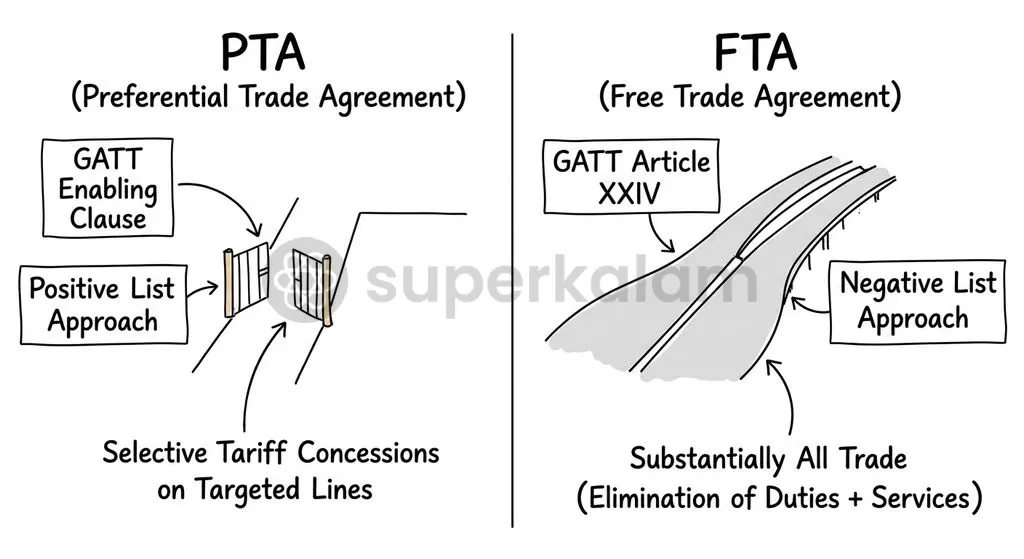
International trade law establishes distinct legal thresholds and structural commitments for preferential arrangements compared to comprehensive free trade agreements. Developing nations negotiate Preferential Trade Agreements under the Enabling Clause, formally known as the 1979 GATT Decision on Differential and More Favourable Treatment, Reciprocity and Fuller Participation of Developing Countries.
This legal mechanism permits developing economies to grant mutual tariff concessions without extending identical margins to developed World Trade Organization members.
In contrast, Free Trade Agreements fall under the stricter legal regime of Article XXIV:8(b) of the General Agreement on Tariffs and Trade. GATT Article XXIV mandates that signatories eliminate duties and restrictive regulations on substantially all the trade between constituent territories within a reasonable duration, typically interpreted as a ten-year transition window.
| Dimension | Preferential Trade Agreement (PTA) | Free Trade Agreement (FTA / CEPA) |
|---|---|---|
| WTO Legal Basis | 1979 GATT Enabling Clause (Decision L/4903) | GATT Article XXIV:8(b) and |
| Scope of Coverage | Limited positive list of negotiated lines | Substantially all trade across negative lists |
| Tariff Obligation | Selective margin-of-preference duty cuts | Progressive elimination of duties to zero |
| Regulatory Depth | Basic trade facilitation and customs rules | Deep disciplines on services, IPR, and investment |
| Domestic Exposure | Low exposure for import-sensitive domestic sectors | Broad exposure requiring phased domestic adjustment |
According to the WTO Secretariat's interpretation of GATT disciplines, a Preferential Trade Agreement operates on a positive list approach. Participating governments lower tariffs only on specific, enumerated tariff lines, leaving all unlisted goods at standard Most-Favoured-Nation rates.
Comprehensive trade pacts utilise negative lists, where all tariff lines face eventual duty elimination unless specifically shielded under an exclusion list.
Discuss with Superkalam
Explain how the 'positive list' mechanism of a Preferential Trade Agreement differs fundamentally from the 'negative list' approach of a comprehensive Free Trade Agreement.
Ask NowThe Nearshoring Magnet: Why Mexico Matters to India's Global Footprint
Mexico is now the premier manufacturing hub for the Western Hemisphere following extensive supply chain realignments. Data from the U.S. Census Bureau demonstrates that annual bilateral merchandise trade between the United States and Mexico exceeds $800 billion, establishing Mexico as the top merchandise trading partner of the United States. This corridor benefits from geographical proximity, integrated logistics routes, and preferential tariff treatment under North American trade frameworks.
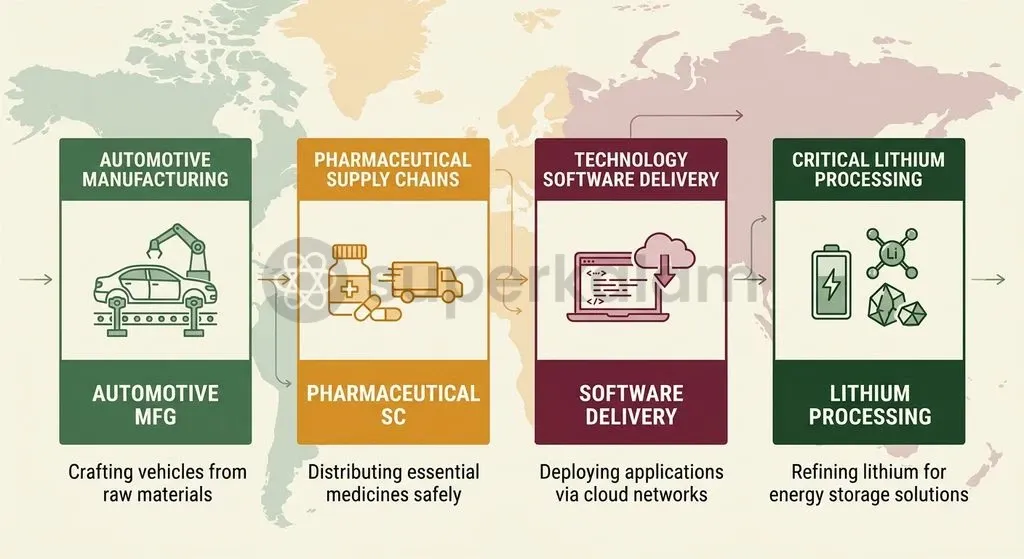
Indian manufacturing conglomerates view Mexico as an essential gateway to expand their international footprint across several strategic industrial clusters:
- Automotive and Transportation: With Indian automobile exports to Mexico reaching $1.92 billion in fiscal year 2026, Indian original equipment manufacturers require deeper institutional access to supply local Mexican assembly plants.
- Active Pharmaceutical Ingredients (APIs): Indian pharmaceutical producers seek predictable regulatory pathways and harmonised sanitary standards to distribute generic formulations and bulk drugs across Latin American public health systems.
- Critical Minerals and Clean Energy: Bilateral cooperation expanded following a 2023 Memorandum of Understanding between India and Mexico focusing on technological collaboration in the lithium sector and electric mobility development, as documented by the Confederation of Indian Industry.
- Information Technology Services: Indian software enterprises leverage Mexican delivery centres in Guadalajara and Monterrey to provide real-time IT support to North American enterprise clients in matching time zones.
Discuss with Superkalam
An Indian auto-component manufacturer wishes to set up an assembly unit in Mexico to supply the US market. Apply the USMCA rules of origin requirements to determine what hurdles this venture would face.
Ask NowPragmatic Trust-Builder or Timid Half-Measure? Weighing the PTA Route
Trade strategists disagree on whether an incremental trade agreement is a prudent first step or an inadequate response to global economic shifts.
- The Case for a PTA: Proponents argue that an incremental agreement establishes vital institutional dialogue while shielding vulnerable Indian sectors. A positive-list pact lets negotiators test administrative dispute mechanisms, clarify technical standards, and build regulatory trust without triggering pushback from domestic manufacturing lobbies.
- The Risk of Inaction: Trade economists at the Brookings Institution suggest that settling for a partial-scope agreement risks locking India into a low-ambition tariff framework while East Asian competitors consolidate their supply-chain presence in Mexico. While a limited pact cuts duties on select goods, it omits modern rules on cross-border data flows, intellectual property protections, government procurement, and investment guarantees.
Historical precedents across South America highlight the structural limitations of incremental pacts:
- India-MERCOSUR PTA: Entered into force on 1 June 2009, covering tariff concessions on merely 450 Indian tariff lines and 452 MERCOSUR tariff lines, according to the Department of Commerce.
- India-Chile PTA: Data published by the Press Information Bureau indicates this expanded pact encompasses only 1,798 Chilean tariff lines and 1,031 Indian tariff lines.
These limited scopes restricted trade expansion compared to the comprehensive trade partnerships pursued by competing Asian economies.
Ground Obstacles: Distance, USMCA Rules of Origin, and Regulatory Friction
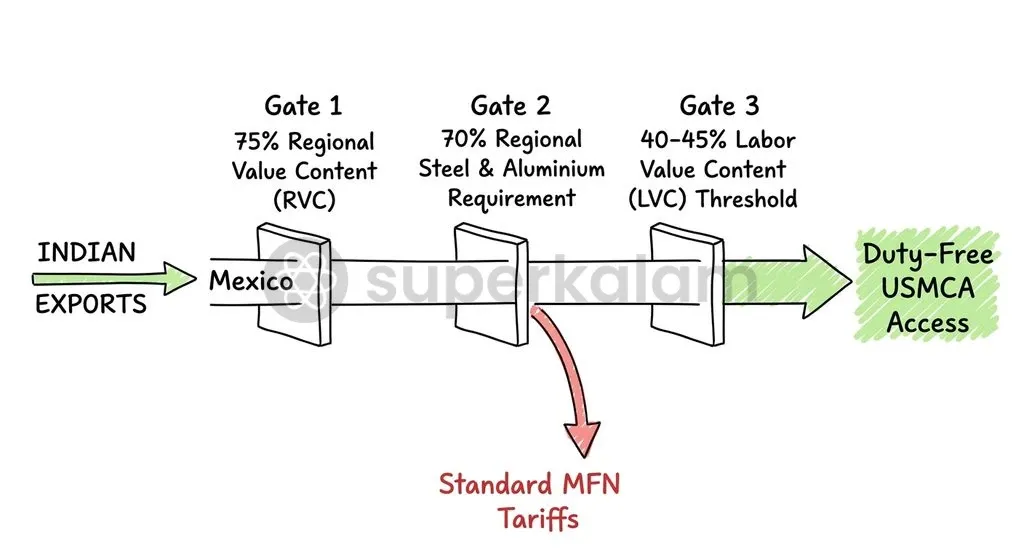
The United States-Mexico-Canada Agreement enforces stringent rules of origin that prevent third-party exporters from using Mexican territory as a simple tariff backdoor into North America. Chapter 4 of the USMCA mandates a 75% Regional Value Content requirement for passenger vehicles and light trucks, representing a substantial increase from the 62.5% benchmark under the former North American Free Trade Agreement.
Beyond overall regional content, the USMCA imposes complex manufacturing stipulations that Indian component exporters cannot easily bypass:
- Steel and Aluminium Sourcing: At least 70% of a vehicle manufacturer's steel and aluminium purchases must originate within the three North American territories, according to USTR documentation.
- Labour Value Content: Automotive regulations enforce a Labor Value Content threshold requiring 40% to 45% of vehicle value to be produced in facilities paying a minimum base wage of $16 per hour.
- Substantial Transformation Restraints: Simple assembly, packaging, or minimal processing within Mexican maquiladora export zones fails substantial transformation tests, preventing Indian exporters from circumventing American tariffs via trade arbitrage, as analysed by the Brookings Institution.
Geographic and logistical bottlenecks compound these legal constraints. Maritime transit between western Indian ports and Mexican Pacific hubs like Manzanillo requires transshipment and extended sailing schedules. Divergence between Mexican regulatory authorities and Indian compliance agencies on sanitary, phytosanitary, and industrial standards also imposes continuous administrative friction.
Discuss with Superkalam
Analyse the key trade-offs between pursuing a low-ambition Preferential Trade Agreement and negotiating a comprehensive Free Trade Agreement with Mexico.
Ask NowWay Forward: Upgrading India's Strategic Playbook in Latin America
Bridging the geographical divide between New Delhi and Mexico City demands moving beyond traditional merchandise tariff cuts toward integrated industrial co-production. While concluding the initial seven negotiating areas defined in the Terms of Reference remains the immediate priority, policymakers should structure the bilateral agreement with explicit built-in sunset and expansion clauses. Such legal mechanisms would require regular reviews to convert positive tariff concessions into broader sectoral liberalisation.
To build long-term economic resilience, Indian strategy should focus on three practical shifts:
- Local Joint Ventures: Indian automotive component suppliers should establish joint manufacturing facilities directly within central Mexican industrial corridors. This satisfies USMCA regional value content and labour thresholds while anchoring Indian engineering designs into North American automotive supply chains.
- Critical Mineral Partnerships: Bilateral cooperation should operationalise the 2023 technological partnership on critical minerals. Joint exploration and processing initiatives focused on Mexican lithium reserves can feed India's domestic electric vehicle battery manufacturing ecosystem.
- Regulatory Convergence: Governments should conclude mutual recognition agreements on pharmaceutical inspections and introduce streamlined digital customs procedures. This will ensure that this preferential pact evolves into a dynamic commercial bridge connecting Indian enterprise to the broader Americas.
Key Takeaways
- Bilateral negotiations for an India-Mexico Preferential Trade Agreement formally commenced on 28 October 2026, guided by agreed Terms of Reference spanning seven negotiating pillars.
- Preferential Trade Agreements operate legally under the 1979 GATT Enabling Clause using positive lists, whereas Free Trade Agreements derive from GATT Article XXIV:8(b) and mandate the elimination of duties on substantially all trade.
- Annual bilateral trade stood at $7.83 billion in fiscal year 2026, delivering an Indian trade surplus of $3.62 billion, with automobiles representing India's largest export at $1.92 billion and crude oil forming 75% of Mexican shipments.
- Strict USMCA rules of origin, including a 75% Regional Value Content rule and a $16 per hour Labor Value Content threshold for automobiles, preclude third countries from using Mexican assembly for simple tariff arbitrage.
- Historical precedents from the India-MERCOSUR pact (450 Indian lines) and the India-Chile agreement (1,031 Indian lines) underscore the risk that narrow positive lists fail to capture sweeping nearshoring opportunities.
Mains Question
"Settling for a partial-scope Preferential Trade Agreement risks locking developing economies into low-ambition tariff frameworks while competing regional players integrate deeper supply chains." In the context of India's recent trade negotiations with Mexico, critically analyse this statement. (10 Marks)
Evaluate NowMains Question
The United States-Mexico-Canada Agreement (USMCA) enforces rigorous origin and manufacturing criteria for North American value chains. Examine the structural constraints these regulations pose for Indian exporters seeking nearshoring opportunities via Mexico. (15 Marks)
Evaluate NowPractice MCQs
QUESTION 1
With reference to multilateral trade rules governing trade agreements, consider the following statements:
- Preferential Trade Agreements (PTAs) between developing nations are negotiated under the 1979 GATT Enabling Clause.
- Article XXIV of the General Agreement on Tariffs and Trade (GATT) mandates the elimination of duties on substantially all trade for Free Trade Agreements.
- Unlike Free Trade Agreements which typically use a positive list approach, Preferential Trade Agreements operate primarily on negative lists. Which of the statements given above are correct?
QUESTION 2
Regarding the rules of origin under the United States-Mexico-Canada Agreement (USMCA), consider the following statements:
- The USMCA mandates a 75% Regional Value Content requirement for passenger vehicles and light trucks.
- Vehicle manufacturers must source at least 70% of their steel and aluminium purchases from North American territories.
- The Labor Value Content regulation requires 40% to 45% of vehicle value to be produced in facilities paying a minimum base wage of $16 per hour. Which of the statements given above are correct?
QUESTION 3
Consider the following statements regarding the bilateral trade profile between India and Mexico:
- Mexico is India's largest trading partner in Latin America.
- India maintains a merchandise trade deficit in its bilateral trade with Mexico.
- Automobiles constitute India's single largest merchandise export product to Mexico. Which of the statements given above is/are correct?
QUESTION 4
The formal Terms of Reference signed between India and Mexico in October 2026 identify seven substantive negotiating areas for the proposed Preferential Trade Agreement. Which of the following is NOT among these seven areas?
QUESTION 5
Consider the following statements regarding India's historical trade pacts in Latin America:
- The India-MERCOSUR Preferential Trade Agreement entered into force in 2009 covering fewer than 500 tariff lines per side.
- The expanded India-Chile Preferential Trade Agreement covers over 5,000 tariff lines for each country. Which of the statements given above is/are correct?
Discuss with Superkalam
Formulate a policy roadmap that allows Indian exporters to move beyond merchandise tariff cuts and achieve integrated industrial co-production in Latin America.
Ask Now