Rhodamine B in Food: Why Street Food Raids Fail to Stop Toxic Dyes
Targeting vulnerable street vendors cannot fix toxic chemical adulteration while wholesale industrial dye supply chains remain unregulated across India.
Nov, 2026
•10 min read
Overview
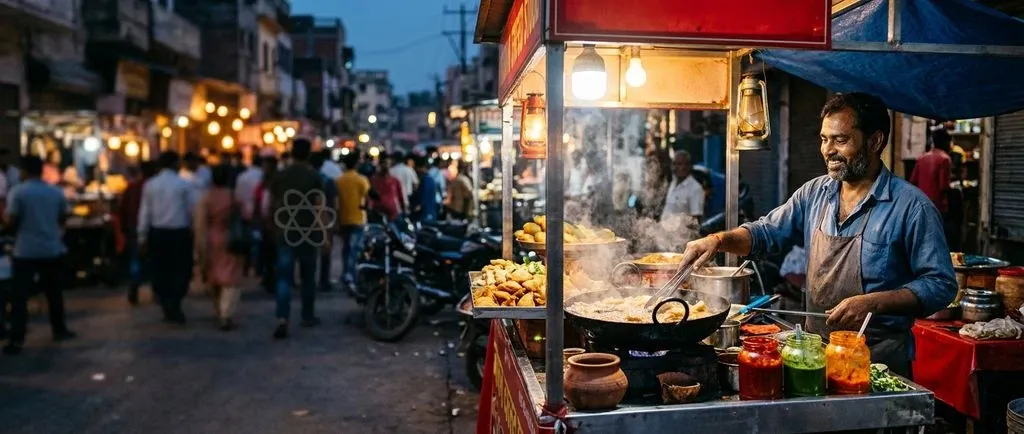
Rhodamine B is a synthetic industrial dye used in textiles and paper manufacturing. State food regulators have repeatedly seized it in street foods like cotton candy and Gobi Manchurian across India, sparking public health alerts and punitive vendor raids. While municipal authorities routinely confiscate pushcarts and seize prepared snacks, punishing downstream informal micro-enterprises does not fix the underlying crisis.
Industrial-grade colourants leak freely from chemical factories into wholesale kirana networks due to non-existent cradle-to-grave tracking. Eliminating toxic additives from Indian street food requires structural chemical market regulations, accessible food-grade colour subsidies, and portable field screening under the Food Safety and Standards Authority of India rather than intermittent street policing.
Why Rhodamine B is in the News: The Street Food Crackdown
State food safety authorities across India initiated coordinated crackdowns against toxic chemical colourants in roadside delicacies throughout 2024. As of November 2024, multiple state governments have invoked emergency powers to curb widespread adulteration in informal eateries.
The enforcement wave began in February 2024 when the Government of Tamil Nadu banned the manufacture, packaging, import, sale, and distribution of cotton candy laced with Rhodamine B under the Food Safety and Standards Act, 2006. Shortly after, the Mapusa Municipal Council in North Goa resolved to ban roadside vendors from preparing and selling Gobi Manchurian due to persistent adulteration with industrial dyes and unhygienic cooking conditions.
The regulatory net expanded further across southern and northern states:
- In March 2024, Karnataka's Food Safety and Standards Department prohibited Rhodamine B in cotton candy and banned all artificial food colourings in Gobi Manchurian after 107 out of 171 tested samples failed laboratory safety standards.
- In June 2024, the Karnataka Health Department extended its crackdown by banning artificial colouring agents in vegetarian and non-vegetarian kebabs after laboratory analysis revealed non-permitted usage of Sunset Yellow and Carmoisine in eight out of 39 collected samples.
- In October 2024, the Uttar Pradesh Food Safety and Drug Administration issued statewide directives targeting prohibited industrial dyes like Rhodamine B, Metanil Yellow, and Auramine in street staples including samosa chutneys, biryani, and regional sweets.
These actions spotlight how industrial chemical additives have penetrated everyday informal food chains. Consequently, municipal food safety officers have escalated aggressive search-and-seizure operations against roadside stalls.
What is Rhodamine B and Why is it Used in Food?
Rhodamine B is a synthetic xanthene fluorescent industrial dye manufactured primarily for dyeing silk, cotton, wool, paper, leather, and for acting as an industrial tracing agent. Registered chemically as Colour Index Basic Violet 10 (CAS No. 81-88-9), the compound exhibits extreme water solubility and high tinctorial strength, producing an intense, visually appealing fluorescent pink-red hue.
Vendors turn to Rhodamine B because industrial-grade dyes are commercially traded in wholesale markets at an estimated 60% to 80% discount compared to certified food-grade synthetic colours, per Chemical Industry News (as reported on 19 October 2024). This steep price disparity creates a powerful financial incentive for price-sensitive street cooks operating on razor-thin operating margins.
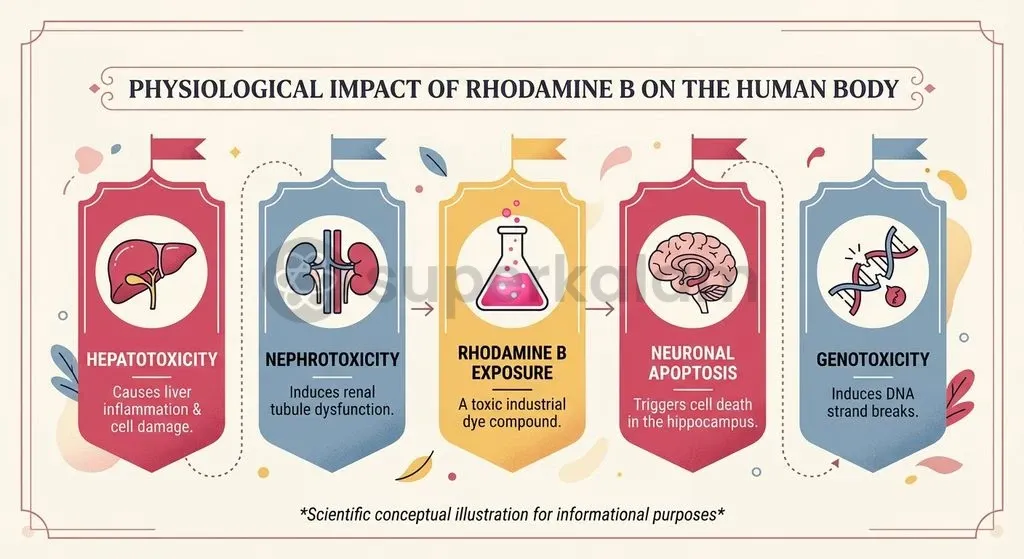
The medical risks associated with ingesting this chemical are severe. The International Agency for Research on Cancer classifies Rhodamine B in Group 3, meaning it is not classifiable as to its carcinogenicity to humans due to limited clinical trials, yet chronic animal studies consistently demonstrate mutagenicity, tumorigenesis, and cellular cytotoxicity.
Oral ingestion generates reactive oxygen species (unstable oxygen molecules that damage cellular components). This process induces oxidative stress, liver damage (hepatotoxicity), kidney dysfunction (nephrotoxicity), and programmed brain cell death (neuronal apoptosis) in the hippocampus.
Discuss with Superkalam
Recall the eight synthetic food colours currently permitted by FSSAI and identify the four colour categories they belong to.
Ask NowWhat the Law Allows: FSSAI Permitted Colours vs Prohibited Industrial Dyes
The Food Safety and Standards Authority of India establishes a strict regulatory perimeter that distinguishes food-grade synthetic additives from non-edible industrial pigments. Under the Food Safety and Standards (Food Products Standards and Food Additives) Regulations, 2011, India permits only eight synthetic food colours across tightly specified food categories.
These eight permitted synthetic colours fall into four distinct hues:
- Red: Ponceau 4R, Carmoisine, and Erythrosine.
- Yellow: Tartrazine and Sunset Yellow FCF.
- Blue: Brilliant Blue FCF and Indigo Carmine.
- Green: Fast Green FCF.
The regulatory framework imposes strict volumetric ceilings on these permitted additives. According to FSSAI Regulation 2.1.2, synthetic colours cannot exceed 100 mg/kg (ppm) in general finished food products, with an upper limit of 200 mg/kg allowed exclusively in specific canned fruit and beverage products.
Crucially, statutory regulations completely prohibit adding any synthetic colouring matter to unprocessed foods, basic grocery staples, and freshly prepared restaurant dishes. Adding even an approved colour like Tartrazine or Sunset Yellow to freshly cooked biryani, samosa chutney, or roadside curries constitutes a clear regulatory violation.
| Regulatory Parameter | Permitted Synthetic Food Colours | Prohibited Industrial Dyes (e.g., Rhodamine B, Metanil Yellow) |
|---|---|---|
| Legal Status | Permitted exclusively within eight approved molecules under FSSAI 2011 Regulations | Completely banned from human food production under the FSS Act, 2006 |
| Permissible Dose | Strictly capped at 100 mg/kg (up to 200 mg/kg in specific canned products) | Zero tolerance; any detectable trace renders the sample legally unsafe |
| Permitted Food Categories | Packaged confectioneries, thermal-processed desserts, and manufactured beverages | None; restricted to textiles, leather, paper, ink, and industrial tracing |
| Fresh Street Foods | Completely prohibited in freshly cooked dishes like gravies, kebabs, and chutneys | Completely prohibited across all food items |
| Primary Toxicological Risk | Safe at regulated thresholds; potential hyperactivity in hyper-sensitive individuals | Direct cellular cytotoxicity, organ toxicity, and tissue damage via reactive oxygen species |
The statutory consequences for deploying prohibited dyes are stringent. Section 59 of the Food Safety and Standards Act, 2006 prescribes criminal penalties for selling unsafe food, ranging from six months' imprisonment and a fine of ₹1 lakh for violations causing no injury, up to life imprisonment and a minimum fine of ₹10 lakh where consumption results in death.
In Ram Nath v. State of Uttar Pradesh (2024), the Supreme Court clarified that Section 89 of the FSS Act gives the statute overriding effect over other food-related laws. This ruling bars police authorities from invoking Sections 272 and 273 of the Indian Penal Code for food adulteration.
Discuss with Superkalam
Explain why adding an approved food colour like Tartrazine to freshly prepared biryani or street-side curries remains a statutory violation under FSSAI rules.
Ask NowThe Enforcement Blind Spot: Upstream Supply Leaks vs Downstream Vendor Raids
Municipal enforcement against food adulteration in India suffers from an asymmetrical design flaw that targets end-point sellers while ignoring wholesale chemical leakages. Informal street food vendors constitute an asymmetric regulatory target. Downstream municipal raids penalise unlettered vendors for chemical adulteration without disrupting the unregulated upstream wholesale distribution of industrial dyes, according to a NITI Aayog policy brief (reported in May 2024).
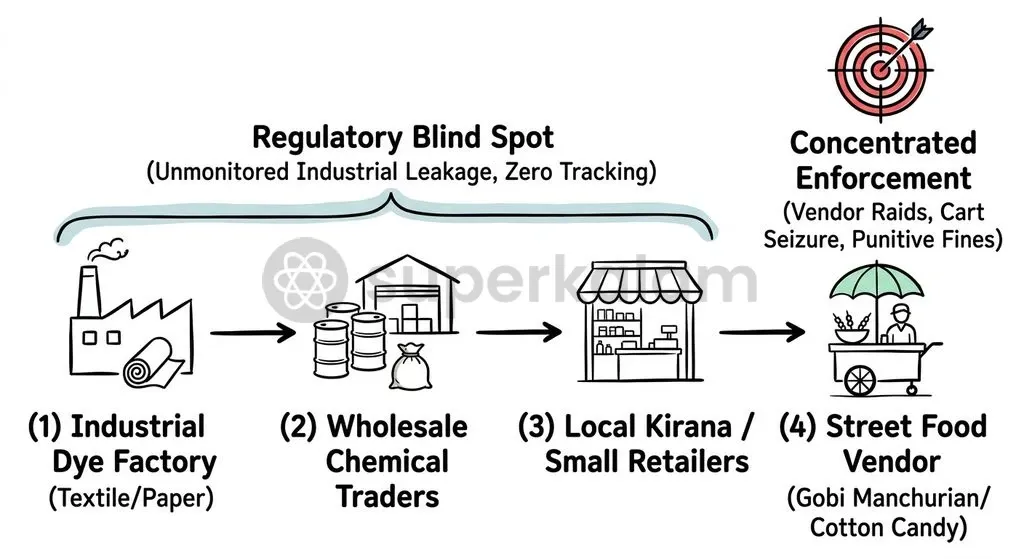
Industrial dyes enter the informal food system through an unmonitored commercial pipeline:
- Bulk Manufacturing: Chemical plants synthesise textile dyes in bulk quantities without mandatory food-safety markings on industrial sacks.
- Wholesale Repackaging: Intermediate traders purchase commercial barrels and divide them into unlabelled polybags, selling them via local spice markets.
- Retail Adulteration: Small shopkeepers market these industrial powders as "super-red food colour" to unsuspecting or price-pressured cooks.
- Consumer Exposure: Street vendors mix the high-potency chemical into sauces and batters, passing the toxic load to the final consumer.
The root cause of this distribution failure is an absence of cradle-to-grave chemical tracking. Non-food industrial dyes leak into retail markets due to an absence of end-to-end digital batch traceability and end-user verification under the Manufacture, Storage and Import of Hazardous Chemical Rules, 1989.
Industrial chemical suppliers face no legal mandate to verify whether downstream purchasers hold an FSSAI licence. As a result, industrial pigments move freely into general retail. Confiscating a pushcart destroys a vendor's immediate livelihood, yet it leaves the wholesale chemical distribution network completely intact to supply the next food stall.
Discuss with Superkalam
If you were assigned as a District Food Safety Officer, how would you design an inspection protocol that targets upstream chemical traders rather than roadside pushcarts?
Ask NowConstitutional and Ethical Dilemma: Public Health vs Informal Livelihoods
The state's enforcement drive against adulterated street food sits directly at the intersection of conflicting constitutional mandates. The Supreme Court established in Centre for Public Interest Litigation v. Union of India (2013) that any food article that is hazardous or injurious to public health infringes upon the fundamental right to life guaranteed under Article 21 of the Constitution.
This fundamental right is reinforced by the non-justiciable Directive Principles of State Policy. Under Article 47, the State is guided by a primary duty to raise the level of nutrition and improve public health. As a non-enforceable directive, Article 47 guides statutory lawmaking and regulatory standards rather than conferring direct judicial remedies.
On the other side of this constitutional equation is the socio-economic vulnerability of the informal workforce. Street vendors possess a constitutionally protected right to practise their trade under Article 19(1)(g), subject to reasonable restrictions under Article 19(6) on grounds of public interest. To protect these vulnerable urban micro-entrepreneurs, Parliament enacted the Street Vendors (Protection of Livelihood and Regulation of Street Vending) Act, 2014, providing statutory safeguards against arbitrary eviction and confiscation of goods.
The administrative dilemma emerges when public health interventions turn into blunt punitive measures. When local bodies enforce wholesale bans on specific street foods—such as Mapusa's prohibition on Gobi Manchurian—they disproportionately wipe out honest livelihoods alongside dishonest practices. The regulatory challenge is to secure safe nutrition without criminalising poverty.
Discuss with Superkalam
Contrast the legal protections given to food safety under the FSS Act, 2006 with the socioeconomic realities of informal vendors operating on razor-thin profit margins.
Ask NowInstitutional Bottlenecks: Lab Deficits and Inadequate Field Testing
State food safety departments face severe institutional bottlenecks that impede rapid, objective enforcement at the street level. Primary among these hurdles is the prolonged turnaround time required for wet-chemical analysis in state testing laboratories, which delays decisive regulatory action.
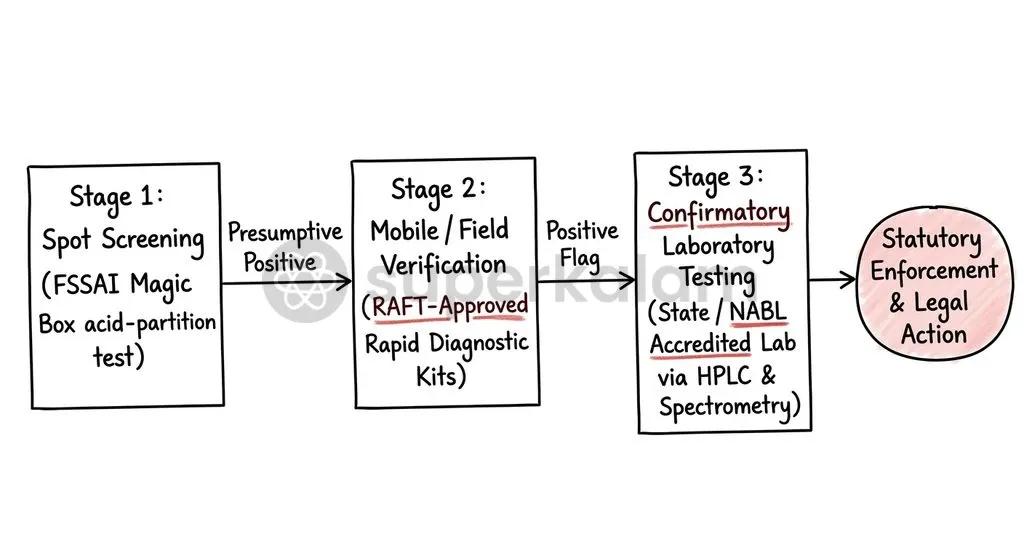
To overcome infrastructure gaps, the central regulator has introduced portable testing alternatives:
- FSSAI developed the Detect Adulteration with Rapid Test (DART) manual and the Food Safety Magic Box, which contain quick screening protocols to detect non-permitted dyes using basic acid-phase and liquid-partitioning tests.
- The regulator operates the Rapid Analytical Food Testing (RAFT) scheme to validate and fast-track portable, kit-based diagnostic tools for field enforcement by state food safety officers.
Despite these innovations, frontline food safety officers frequently lack access to rapid diagnostic kits during market sweeps. Officers are forced to rely on visual suspicion and formal wet-chemistry sampling. This operational gap creates an enforcement lag that allows adulterated products to remain on sale while samples navigate laboratory queues.
The Way Forward: Regulating Dual-Use Chemicals and Protecting Street Vendors
Transforming India's food safety regime requires shifting focus from roadside seizures to comprehensive chemical supply regulation, formal education, and institutional support.
A durable policy response requires four integrated interventions:
- Upstream Chemical Tracking: Amend regulatory guidelines to introduce mandatory colour-coded packaging and digital batch tracking for industrial-grade dyes under the chemical control framework, preventing textile colourants from entering food supply markets.
- Vendor Education via FoSTaC: Expand FSSAI's Food Safety Training and Certification (FoSTaC) programme to systematically educate informal food business operators on the toxicological hazards of industrial chemicals.
- Infrastructure Upgrades under Clean Street Food Hubs: Scale up the Clean Street Food Hub initiative to certify clustered urban vending zones, combining basic civic amenities with collective regulatory compliance rather than punitive confiscation.
- Leveraging the PM SVANidhi Platform: Use the Ministry of Housing and Urban Affairs' PM Street Vendor's AtmaNirbhar Nidhi (PM SVANidhi) database to provide subsidised, pre-tested food-grade colour kits directly to registered street vendors.
Replacing sporadic municipal raids with structural chemical market controls will protect both public health under Article 21 and informal workers' livelihoods under Article 19(1)(g).
Key Takeaways
- Rhodamine B is a toxic synthetic fluorescent industrial dye (CAS No. 81-88-9) meant for textiles and paper that is strictly prohibited in food due to proven cytotoxicity, hepatotoxicity, and neurotoxicity.
- FSSAI regulations permit only eight synthetic food colours capped at 100 mg/kg, completely prohibiting their addition to freshly cooked street foods and unprocessed staples.
- Section 59 of the FSS Act, 2006 establishes severe penalties for selling unsafe food, ranging up to life imprisonment and a ₹1 lakh to ₹10 lakh minimum fine where adulteration causes death.
- Upstream wholesale leakage of industrial dyes, driven by an estimated 60% to 80% price discount compared to food-grade colours, remains the root cause of street-level adulteration.
- Effective food safety governance demands chemical supply-chain tracking, deployment of rapid field test kits, and vendor support through PM SVANidhi and FoSTaC programmes.
Mains Question
"Downstream search-and-seizure operations against roadside vendors penalise informal livelihoods while leaving upstream industrial chemical leakages unchecked." In light of this observation, critically analyse the enforcement architecture under the Food Safety and Standards Act, 2006. (15 Marks)
Evaluate NowMains Question
Elucidate the key statutory distinctions established by the Food Safety and Standards Authority of India (FSSAI) between permitted synthetic food colours and prohibited industrial chemical dyes. (10 Marks)
Evaluate NowPractice MCQs
QUESTION 1
With reference to the Food Safety and Standards (Food Products Standards and Food Additives) Regulations, 2011, consider the following statements:
- FSSAI permits only eight synthetic food colours across specified food categories.
- Permitted synthetic food colours are allowed in freshly cooked restaurant dishes and street foods up to a limit of 100 mg/kg.
- Sunset Yellow FCF and Tartrazine are among the approved synthetic colours under statutory limits. Which of the statements given above is/are correct?
QUESTION 2
Regarding the legal and regulatory framework governing food adulteration in India, consider the following statements:
- Section 89 of the Food Safety and Standards Act, 2006 gives the Act overriding effect over other food-related laws.
- Under the Supreme Court's ruling in Ram Nath v. State of Uttar Pradesh (2024), police authorities are barred from invoking Sections 272 and 273 of the Indian Penal Code for food adulteration.
- Section 59 of the FSS Act, 2006 provides for penalties extending up to life imprisonment where adulteration results in death. Which of the statements given above are correct?
QUESTION 3
Consider the following statements regarding the industrial dye Rhodamine B:
- It is chemically registered as Colour Index Basic Violet 10 and classified as a synthetic xanthene fluorescent dye.
- The International Agency for Research on Cancer (IARC) classifies Rhodamine B as a Group 1 confirmed human carcinogen.
- Ingestion of Rhodamine B generates reactive oxygen species leading to hepatotoxicity and nephrotoxicity. Which of the statements given above is/are correct?
QUESTION 4
Consider the following pairs of synthetic food colours and their approved colour groups under FSSAI regulations:
- Ponceau 4R : Red
- Fast Green FCF : Green
- Indigo Carmine : Yellow Which of the pairs given above is/are correctly matched?
QUESTION 5
Under FSSAI Regulation 2.1.2, what is the maximum permissible limit for permitted synthetic colours in general finished food products?
Discuss with Superkalam
Evaluate whether introducing cradle-to-grave digital tracking under hazardous chemical rules would be more effective in stopping food adulteration than punitive municipal search-and-seizure raids.
Ask Now