Sentencing Council in India: Ending Disparities in Criminal Sentencing
As trial sentencing resembles a judicial lottery, establishing statutory guidelines is vital to align criminal justice with constitutional fairness.
Nov, 2026
•10 min read

Overview
India needs a permanent, statutory Sentencing Council. Such a body would establish standardised sentencing guidelines, objective culpability bands, and consistent aggravating and mitigating metrics across criminal courts.
Without a structured statutory framework, criminal sentencing in India is an unpredictable judicial lottery. Identical criminal conduct yields starkly disparate penalties depending on the subjective inclinations of individual presiding judges.
As of May 2024, the Supreme Court of India has formally urged the Union Government to establish an institutional mechanism for a comprehensive national sentencing policy. The Court grounded this reform in the constitutional guarantees of equality and fundamental fairness under Articles 14 and 21.
Creating a multidisciplinary Sentencing Council balances judicial discretion with systemic predictability. It ensures criminal punishments reflect constitutional proportionality rather than personal whim.
Why in the News: The Push for Structured Sentencing in India
The Supreme Court of India in Sunita Devi v. State of Bihar (2024) urged the Union Government to set up a Sentencing Commission to study a national sentencing policy. The bench held that penal sanctions must never operate as a knee-jerk reaction or a judicial lottery for convicted persons.
As of May 2024, the Court formally anchored the institutional necessity for uniform sentencing guidelines in Articles 14 and 21 of the Constitution. Key developments following this judgment include:
- Constitutional Scrutiny: Unwarranted disparities in criminal sentencing directly violate fundamental trial fairness and equal protection under the law.
- Executive Review: Following the ruling, the Union Government has reportedly tasked research bodies, including the Law Commission of India, with assessing the feasibility of a national sentencing framework, per the Hindustan Times (as reported on 27 June 2024).
This judicial push establishes the core thesis of structural reform: criminal justice administration cannot secure public trust when penal outcomes hinge entirely on unguided judicial subjectivity rather than statutory standards.
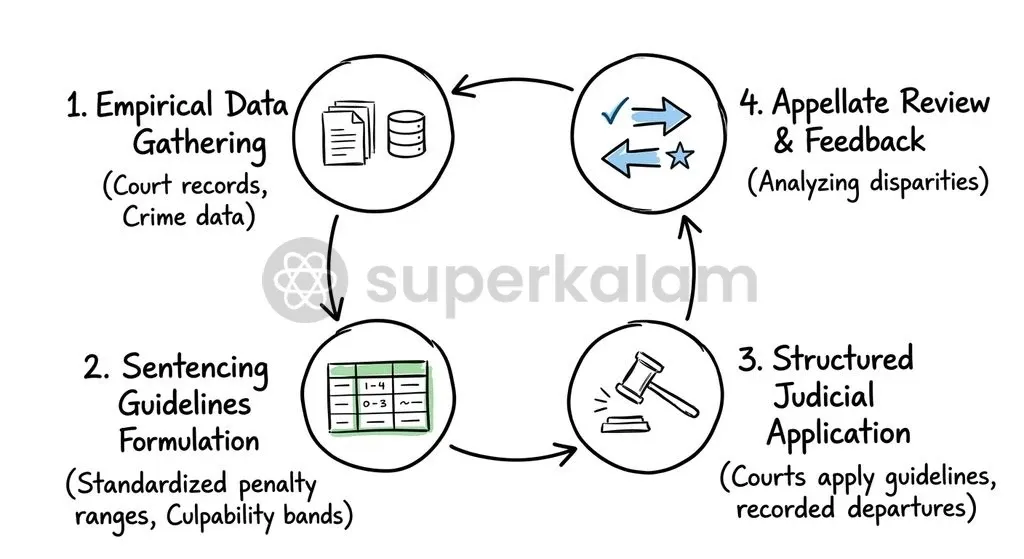
What Is a Sentencing Council and How Would It Work?
A Sentencing Council is a permanent statutory body mandated to formulate structured guidelines, indicative penalty ranges, and standardised mitigating criteria for criminal courts. Rather than stripping trial judges of authority, the body establishes transparent starting points and offence-specific bands to guide penal discretion.
Operating through an evidence-based institutional mandate, the body drafts detailed criteria for evaluating offence gravity and personal blameworthiness. Presiding judges retain the discretion to depart from indicative bands whenever unique circumstances warrant it, provided they record written reasons. An institutional sentencing body would typically execute several integrated functions:
- Formulating Offence Bands: Drafting indicative starting points and ranges of punishment based on tangible degrees of harm and offender culpability.
- Standardising Sentencing Factors: Specifying non-exhaustive lists of aggravating and mitigating elements to guide bifurcated sentencing hearings.
- Empirical Impact Assessment: Tracking systemic prison populations and trial-level penal trends to update judicial guidelines periodically.
- Encouraging Non-Custodial Sanctions: Establishing clear criteria for community service, probation, and restitution orders to reduce unnecessary incarceration.
Discuss with Superkalam
Recall the two expert committees from 2003 and 2007 mentioned in the article that recommended a statutory sentencing policy.
Ask NowThe Core Problem: Unguided Judicial Discretion and Disparate Punishments
The Bharatiya Nyaya Sanhita, 2023 provides wide statutory minimum and maximum sentences for offences without prescribing culpability bands or relative factor weightings. The Indian Penal Code, 1860 operated under this identical structural void for over a century. Consequently, two trial judges handling comparable offences often hand down vastly different penalties, ranging from immediate probation to maximum custodial imprisonment.
Section 258(2) of the Bharatiya Nagarik Suraksha Sanhita, 2023 mandates a separate post-conviction sentencing hearing, yet provides no statutory formula to evaluate competing submissions. This procedural provision mirrors former Section 235(2) of the Code of Criminal Procedure, 1973. While the statute guarantees the defence an opportunity to present mitigating evidence, judges lack institutional metrics to weigh socio-economic distress against offence brutality.
In practice, statutory non-custodial alternatives under Sections 401 and 402 of the Bharatiya Nagarik Suraksha Sanhita, 2023 remain deeply underutilised in trial courts. Presiding judges routinely bypass the reformative mandates of the Probation of Offenders Act, 1958 due to the absence of binding policy directions. Uncontrolled discretion causes trial courts to view severe custodial imprisonment as the default penal response, bypassing social reintegration.
| Dimension | Current Statutory Model (BNS / BNSS) | Structured Council Model |
|---|---|---|
| Statutory Guidance | Wide gaps between statutory minimums and maximums | Defined offence bands with specific starting points |
| Mitigating Factors | Discretionary consideration during post-conviction hearings | Standardised checklists with statutory weighting criteria |
| Judicial Disparity | High variance driven by individual judge-centric philosophies | Constrained variance through institutional penalty bands |
| Reasons for Deviation | Minimal justification required for choosing terms within statutory caps | Mandatory written justification required to depart from bands |
| Non-Custodial Use | Ad hoc reliance on probation or release provisions | Structured criteria triggering non-custodial rehabilitation |
Discuss with Superkalam
Explain how the UK's Coroners and Justice Act 2009 balances statutory sentencing guidelines with judicial discretion.
Ask NowWhat Landmark Committees and Courts Have Recommended
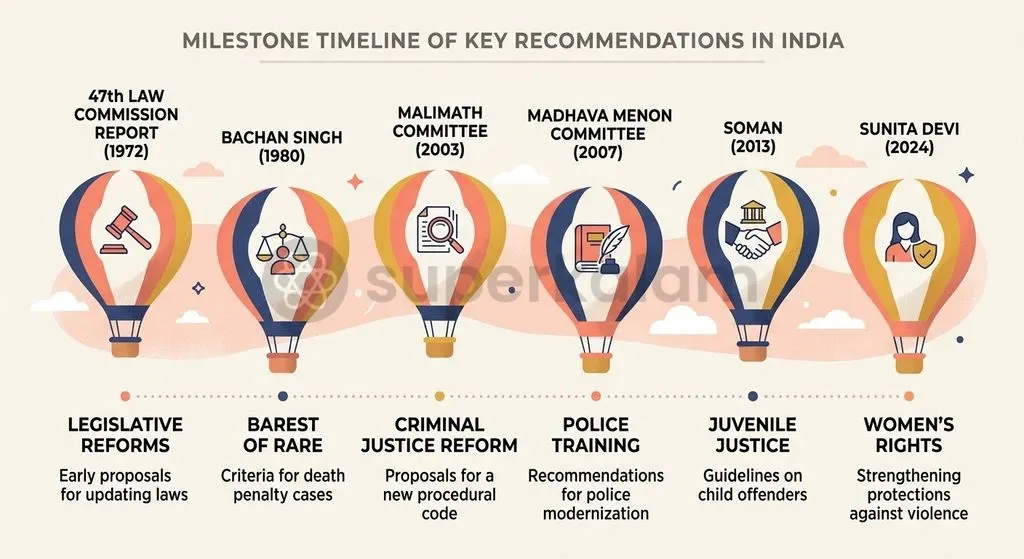
Sentencing consistency has been an unresolved legislative question for over five decades. Key judicial rulings and expert committees have consistently identified the need for statutory guidance:
- Law Commission 47th Report (1972): Flagged widespread sentencing disparities as an urgent legislative priority, warning that subjective judicial views undermined the social purpose of criminal penalties.
- Malimath Committee (2003): The Justice V.S. Malimath Committee recommended creating a statutory body to establish comprehensive sentencing guidelines.
- Madhava Menon Committee (2007): Reasserted that a statutory sentencing policy was necessary to replace individual judge-centric outcomes.
- Bachan Singh v. State of Punjab (1980): Established the rarest of rare doctrine and introduced an individualised balance sheet approach weighing crime brutality against mitigating factors.
- Manoj v. State of Madhya Pradesh (2022): Ordered trial courts to collect comprehensive psychiatric and socio-economic pre-sentence reports before passing sentence.
- Soman (2013) & Prem Sagar (2008): In Soman v. State of Kerala, the Court called punishment determination the weakest part of criminal justice. In State of Punjab v. Prem Sagar, it cited Malimath and Menon to urge legislative action.
How Other Democracies Do It: Lessons from the UK and US Models
The United Kingdom established the Sentencing Council for England and Wales under Part 4 of the Coroners and Justice Act 2009. As an independent public body, it issues evidence-based guidelines across offence categories. Under Section 125(1) of the Act, every sentencing court must follow relevant guidelines unless doing so contradicts the interests of justice. This statutory design preserves contextual judicial discretion while ensuring systemic consistency.
The United States established the United States Sentencing Commission under the Sentencing Reform Act of 1984. The American system developed a rigid 258-cell matrix that cross-referenced offence gravity levels with prior criminal history categories. However, in United States v. Booker (2005), the United States Supreme Court severed portions of the statute, ruling that mandatory guidelines violated Sixth Amendment trial rights and converting the grid into an advisory sentencing framework.
| Design Feature | United Kingdom Model | United States Federal Model | Proposed Indian Model |
|---|---|---|---|
| Governing Statute | Part 4, Coroners and Justice Act 2009 | Sentencing Reform Act of 1984 | Proposed Central Sentencing Legislation |
| Institutional Form | Independent Sentencing Council | Permanent United States Sentencing Commission | Multidisciplinary Statutory Council |
| Guideline Nature | Presumptive with an interests-of-justice departure clause | Advisory post-Booker ruling | Indicative offence bands with written departure reasons |
| Metric Structure | Narrative offence categories and culpability bands | Arithmetic 258-cell sentencing grid | Harm and culpability ranges linked to statutory terms |
Discuss with Superkalam
How would a trial judge apply a bifurcated sentencing hearing when balancing socio-economic distress against offence brutality under current Indian laws?
Ask NowThe Core Debate: Structured Rules Versus Judicial Independence
The tension between statutory uniformity and trial discretion remains at the heart of sentencing debates:
- Arguments for Preserving Broad Judicial Discretion: Independence advocates argue that rigid frameworks ignore human context. Real trials feature complex socio-economic deprivation, emotional trauma, and marginalisation that mathematical formulas cannot gauge. Stripping judges of leeway risks turning reasoned individualised justice into mechanical administrative work.
- Risks of Rigid Mandatory Grids: Historical evidence from the United States shows that formulaic guidelines fueled mass incarceration. Mandatory rules often shift discretion from open courtrooms to prosecutors via charge selection, hardening social inequalities into fixed prison terms.
- The Case for Indicative Bands: Reformers respond that unchecked discretion is merely unaccountable subjectivity. Treating identical offenders with starkly differing prison terms violates institutional fairness. A modern model uses indicative guideline bands rather than mandatory numerical formulas, leaving trial courts fully empowered to depart when equity demands it.
Constitutional and Ethical Stakes: Proportionality, Equality, and Due Process
Unchecked sentencing discretion directly engages three core constitutional safeguards:
- Proportionality as Substantive Justice: The principle of proportionality demands that penal severity matches offender blameworthiness and societal harm. Without statutory metrics, punishments often fluctuate with public outrage or personal bias. Proportionality is an ethical bulwark against both excess retribution and arbitrary leniency.
- Equal Protection under Article 14: Uncontrolled disparities undermine equality under Article 14 of the Constitution. Article 14 prohibits arbitrariness in state action and demands that equals be treated equally. Penal consequences cannot depend on the judge who presides over a roster without violating equality before the law.
- Fair Procedure under Article 21: Any state procedure depriving a person of liberty must remain just, fair, and reasonable. The absence of objective standards leaves individual liberty vulnerable to judicial chance. A statutory Sentencing Council protects substantive due process by setting transparent metrics.
Discuss with Superkalam
Analyse the structural differences between the rigid sentencing grid used in the US and the contextual guideline model adopted in the UK.
Ask NowThe Way Forward: Designing a Practical Sentencing Framework for Indian Courts
Parliament must enact dedicated legislation establishing a permanent, multidisciplinary Sentencing Council of India. Following the Supreme Court's guidance in Sunita Devi v. State of Bihar, the body must include sitting and retired judges, criminologists, sociologists, psychologists, public prosecutors, and legal scholars. A broad composition ensures that guideline development draws upon real-world insights rather than narrow judicial mechanics.
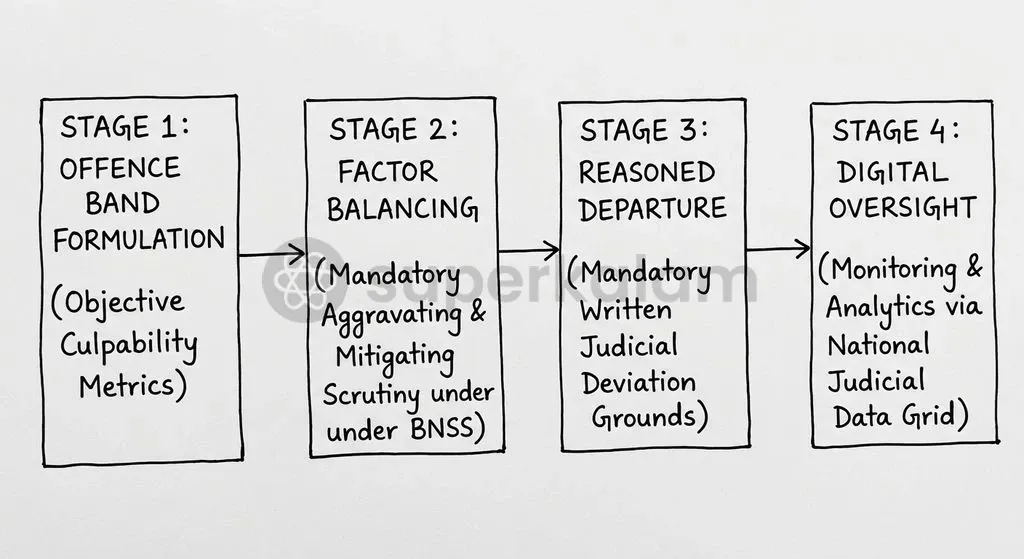
The operational architecture of the Sentencing Council should follow a phased, four-step institutional implementation pathway:
- Drafting Indicative Offence Bands: The Council should categorise offences under the Bharatiya Nyaya Sanhita, 2023 into structured culpability tiers. Each tier should provide an indicative penalty range, while reserving statutory maximums for the most egregious conduct.
- Codifying Mitigating Checklists: Section 258(2) hearings under the Bharatiya Nagarik Suraksha Sanhita, 2023 must be anchored to standardised checklists. Courts must explicitly record mitigating factors, including age, socio-economic background, and psychiatric evaluations as mandated in Manoj v. State of Madhya Pradesh.
- Preserving Departures with Written Reasons: Presiding judges must retain statutory authority to depart from indicative bands whenever the interests of justice require. However, trial judges must provide mandatory written justifications to make departures transparent and subject to appellate review.
- Harnessing Digital Analytics: The Council must continuously evaluate sentencing data drawn from the e-Courts project and the National Judicial Data Grid. Ongoing empirical tracking will allow the Council to refine guideline bands systematically.
Key Takeaways
- The Supreme Court in Sunita Devi v. State of Bihar (2024) requested the Union Government to establish an institutional mechanism to prepare a comprehensive national sentencing policy.
- Statutory penal frameworks under the Bharatiya Nyaya Sanhita, 2023 provide broad minimum and maximum sentences without statutory culpability bands or standardised weighting for mitigating factors.
- Institutional guidelines were strongly recommended by the Malimath Committee (2003) and the Madhava Menon Committee (2007) to eliminate judge-centric sentencing disparities.
- Arbitrary sentencing variations infringe equal protection under Article 14 and substantive due process requirements under Article 21 of the Constitution.
- The UK Sentencing Council offers a viable statutory precedent by deploying indicative offence bands while preserving judicial authority to depart in the interests of justice.
Mains Question
"Without a structured statutory framework, criminal sentencing operates as an unpredictable judicial lottery violating Articles 14 and 21 of the Constitution." In light of Sunita Devi v. State of Bihar (2024), examine the structural limitations of unguided judicial discretion under the Bharatiya Nyaya Sanhita and Bharatiya Nagarik Suraksha Sanhita. (10 Marks)
Evaluate NowMains Question
Drawing comparative lessons from the United Kingdom's Coroners and Justice Act 2009 and the United States federal sentencing guidelines, evaluate the feasibility and design of establishing a permanent, statutory Sentencing Council for the Indian criminal justice system. (15 Marks)
Evaluate NowPractice MCQs
QUESTION 1
With reference to criminal sentencing frameworks in India, consider the following statements:
- Section 258(2) of the Bharatiya Nagarik Suraksha Sanhita, 2023 provides a statutory mathematical formula for trial judges to balance mitigating and aggravating circumstances.
- In Bachan Singh v. State of Punjab (1980), the Supreme Court introduced an individualised balance sheet approach weighing crime brutality against mitigating factors.
- The Justice V.S. Malimath Committee (2003) recommended the creation of a statutory body to establish comprehensive sentencing guidelines. Which of the statements given above are correct?
QUESTION 2
Consider the following statements regarding comparative international models of sentencing:
- The Sentencing Council for England and Wales was established under Part 4 of the Coroners and Justice Act 2009 as an independent public body.
- Under the UK model, sentencing courts are mandated to follow guidelines unless doing so contradicts the interests of justice.
- In United States v. Booker (2005), the US Supreme Court rendered the federal sentencing guidelines mandatory for all federal trial judges. Which of the statements given above is/are correct?
QUESTION 3
Consider the following judicial decisions and committee reports regarding sentencing in India:
- Sunita Devi v. State of Bihar (2024)
- Manoj v. State of Madhya Pradesh (2022)
- 47th Report of the Law Commission of India (1972) How many of the above specifically addressed the need for structured sentencing guidelines or pre-sentence socio-economic/psychiatric evaluation?
QUESTION 4
In Sunita Devi v. State of Bihar (2024), on which constitutional provisions did the Supreme Court primarily ground the institutional necessity for uniform sentencing guidelines?
QUESTION 5
Consider the following statements regarding the statutory framework of sentencing in India:
- The Bharatiya Nyaya Sanhita, 2023 prescribes precise offence-specific culpability bands and factor weightings for every offence.
- Sections 401 and 402 of the Bharatiya Nagarik Suraksha Sanhita, 2023 contain statutory non-custodial alternatives.
- The Probation of Offenders Act, 1958 provides a reformative mandate that is often bypassed by trial courts due to an absence of binding policy directions. Which of the statements given above are correct?
Discuss with Superkalam
Evaluate whether introducing statutory sentencing guidelines would unconstitutionally curtail judicial independence in Indian criminal trials.
Ask Now