Polypharmacy in India: Meaning, Causes and Health Risks
Polypharmacy commonly means using five or more medicines. Appropriate treatment differs from harmful drug combinations and needs regular medication review.
Oct, 2026
•10 min read

Overview
Polypharmacy in India is an escalating public health challenge commonly described as the concurrent routine use of five or more medications. This pattern converts multi-morbidity care into hazardous iatrogenic toxicity for older patients exposed to inappropriate regimens.
According to the World Health Organization, clinical practice must distinguish appropriate polypharmacy—prescribing optimised for complex conditions—from inappropriate regimens lacking therapeutic indications or exceeding safety margins.
In India, unchecked multi-drug regimens stem from twin structural vulnerabilities:
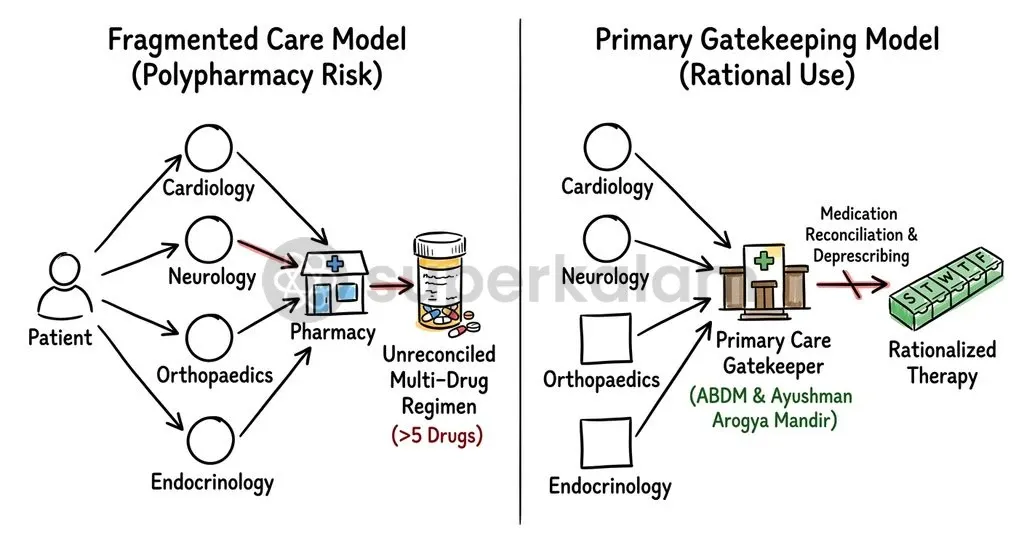
- Fragmented Specialist Care: The absence of general practitioner gatekeeping forces patients across independent organ specialists without centralised medication reconciliation.
- Lax OTC Dispensing: Retail over-the-counter sales under the Drugs and Cosmetics Rules, 1945 fuel severe prescription cascades, organ strain, and debilitating cognitive impairment among older citizens.
Polypharmacy is therefore not merely a personal clinical misfortune. It represents a structural failure of primary care gatekeeping that turns essential pharmacology into unmonitored risk. Resolving this crisis requires shifting public health policy from uncoordinated specialty consultations toward well-equipped primary clinics, digital prescription tracking, and routine clinical deprescribing protocols.
Why in the News? The Surging Toll of Pill Cascades in an Aging India
India faces an escalating public health crisis as rapid demographic ageing collides with unmonitored multi-drug regimens across tertiary healthcare facilities. As of July 2026, clinical data indicates that excessive medicine consumption is severely compromising geriatric safety:
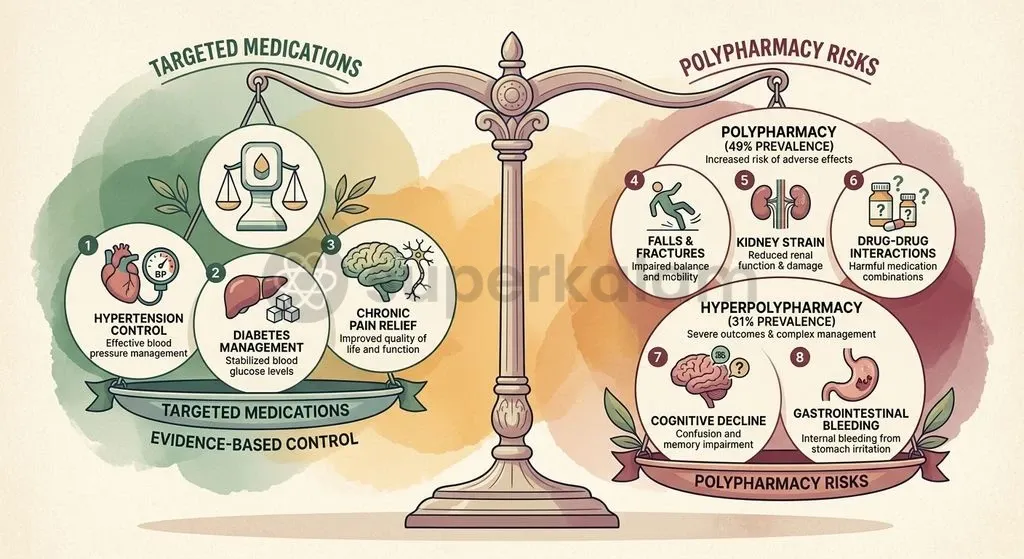
- High Geriatric Prevalence: A nationwide systematic review and meta-analysis published in Frontiers in Pharmacology revealed a pooled polypharmacy prevalence of 49% in the included studies and a hyperpolypharmacy prevalence of 31% among older adults aged 60 years and above.
- Urban Exposure: A multi-city cross-sectional study across six Indian cities, published in Nature Scientific Reports, reported that 33.7% of community-dwelling older adults experienced polypharmacy, while 28.8% received Potentially Inappropriate Medications (PIMs).
- Regulatory Action: On June 20, 2026, the Ministry of Health and Family Welfare prohibited the manufacture, sale, and distribution of 16 Fixed Dose Combinations under Section 26A of the Drugs and Cosmetics Act, 1940, citing an absence of therapeutic rationale and serious potential health risks.
These regulatory bans highlight how urgent the problem has become. Without intervention, preventable drug-induced harm will continue to overwhelm hospital wards.
What Is Polypharmacy, and When Does Necessary Treatment Turn Toxic?
There is no universal numerical definition of polypharmacy. WHO notes that it is commonly described as the routine use of five or more medications; ten or more is often termed hyperpolypharmacy. Multiple medications are often clinically indispensable for older patients presenting with co-occurring non-communicable diseases, such as hypertension, type 2 diabetes, and ischaemic heart disease. The critical public health concern arises when therapeutic necessity deteriorates into irrational pharmacology.
Clinical guidelines distinguish rational medication management from regimens that inflict preventable bodily damage. The World Health Organization formally differentiates appropriate polypharmacy—prescribing optimised for complex or multiple conditions in line with best evidence—from inappropriate polypharmacy, where medicines lack evidence-based indications, carry disproportionate adverse risks, or fail to achieve therapeutic goals.
| Clinical Dimension | Appropriate Polypharmacy | Inappropriate Polypharmacy |
|---|---|---|
| Therapeutic Objective | Meets explicit, evidence-based targets for multi-morbidity | Lacks verified clinical indications or therapeutic benefit |
| Drug Interactions | Potential interactions are monitored and mitigated | Cumulative interactions cause severe iatrogenic toxicity |
| Prescribing Process | Subject to periodic medication reconciliation | Expands unchecked through independent multi-doctor visits |
| Patient Capacity | Matched to financial means and operational competence | Overwhelms patients, leading to non-adherence and errors |
| Primary Risk | Manageable, calculated adverse reaction profiles | Triggers compounding prescription cascades and falls |
Discuss with Superkalam
Recall the numerical thresholds established by the World Health Organization to distinguish polypharmacy from hyperpolypharmacy.
Ask NowIndia's Dual Reality: Rural Drug Deprivation Meets Urban Overmedication
The Ministry of Health and Family Welfare oversees a stark pharmaceutical divide between under-served rural districts and aggressively medicated metropolitan centres. Public health delivery in India does not suffer from a uniform medicine distribution challenge. Instead, the domestic landscape presents two opposing structural failures operating simultaneously across different geographic and economic tiers:
- Rural Under-Medication: According to findings reported in a 2025 systematic review on medicine access disparities, India exhibits an acute geographic pharmaceutical paradox where rural regions endure under-medication and lack of essential therapies. Vulnerable rural patients frequently travel substantial distances only to find essential antihypertensives or insulin absent from local dispensary shelves.
- Urban Over-Prescribing: Commercialised urban areas face aggressive over-prescribing and unmonitored polypharmacy. Affluent and middle-class households frequently consume overlapping branded drugs, nutrient supplements, and unvetted gastrointestinal formulations.
This structural divide imposes severe economic consequences on families. According to the National Health Accounts Estimates for India 2022-23 released in May 2026, Out-of-Pocket Expenditure accounts for 43.4% of Total Health Expenditure, with retail pharmaceutical purchases persisting as the primary driver of household spending. This financial drain reflects unnecessary pill consumption that strains family budgets without delivering measurable health gains.
How the Disappearance of Family Doctors Fuels Multi-Specialist Pill Stacking
The National Medical Commission oversees a medical training and delivery framework where primary care general practice has suffered severe institutional erosion. In earlier decades, the family doctor maintained a patient's complete diagnostic history and reviewed all pharmaceutical treatments. Losing this clinical anchor opened the door to uncoordinated treatments.
Specialist bypass drives runaway drug regimens in Indian urban centres through three distinct institutional failures:
- Lack of Gatekeeping: Research published in the Journal of Family Medicine and Primary Care notes that the absence of a mandatory general practitioner gatekeeping structure enables patients to bypass primary healthcare and doctor-shop across independent, uncoordinated organ specialists.
- Uncoordinated Multi-Specialist Care: An elderly citizen with multiple chronic conditions routinely visits a cardiologist, an endocrinologist, a nephrologist, and an orthopaedic surgeon within the same month.
- Antagonistic Prescribing: Fragmented consultations occur without shared electronic medical records or coordinated communication. Each specialist prioritises single-disease clinical targets; cardiologists may prescribe beta-blockers, while pulmonologists introduce bronchodilators, generating unrecognised antagonistic interactions.
This unmonitored accumulation of chemical agents transforms modern specialised care into a fragmented system of competing therapies.
Discuss with Superkalam
How does the misdiagnosis of a common side effect, such as amlodipine-induced peripheral oedema, trigger a harmful prescription cascade?
Ask Now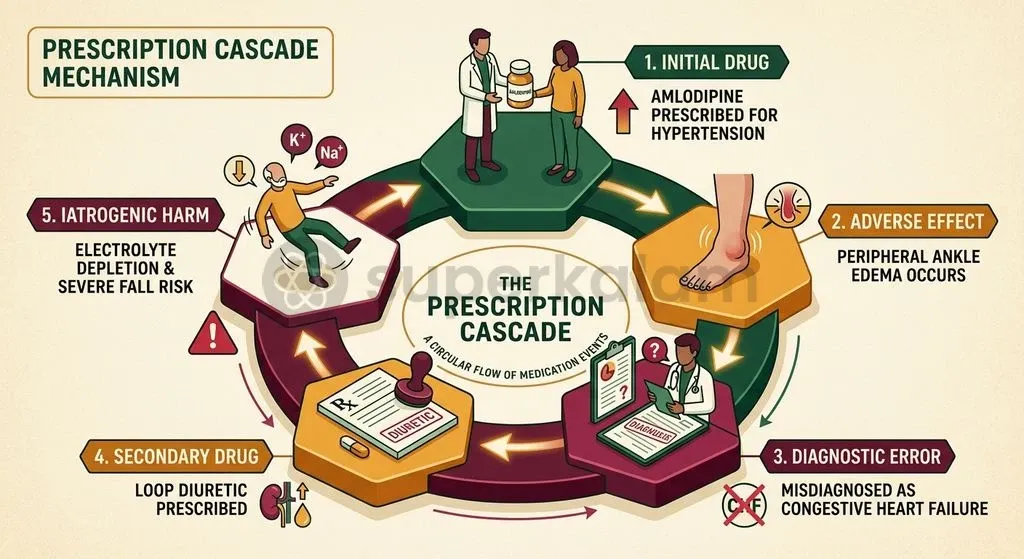
Discuss with Superkalam
If you were advising an urban public hospital, how would you operationalise a routine deprescribing protocol for multi-morbid geriatric patients?
Ask NowBehind the Counter: Why Lax Pharmacy Rules and Pharma Push Enable Overuse
The Central Drugs Standard Control Organisation enforces the Drugs and Cosmetics Rules, 1945, yet retail pharmacies routinely dispense prescription medicines over the counter. Four structural issues drive this unchecked availability:
- Retail Dispensing Violations: Under the Drugs and Cosmetics Rules, 1945, the retail sale of Schedule H substances (comprising over 500 drugs) and Schedule H1 substances without a prescription from a Registered Medical Practitioner is an explicit statutory violation. Despite these prohibitions, community drugstores regularly provide potent analgesics, sedatives, and systemic antimicrobials without demanding physician documentation.
- Weak Register Audits: Schedule H1 regulations mandate that pharmacies record every dispensing transaction of 46 restricted substances—including third- and fourth-generation cephalosporins, carbapenems, and psychotropics—in a dedicated register preserved for at least three years. Weak state drug control inspectorates fail to audit retail logbooks systematically, enabling retail pharmacies to operate as informal outpatient dispensaries.
- Commercial Marketing Pressure: The Department of Pharmaceuticals notified the Uniform Code for Pharmaceutical Marketing Practices (UCPMP 2024) to curb unethical inducements, prohibited gifts, travel facilities, and financial hospitality extended by pharmaceutical companies to medical practitioners. In addition, the Central Government previously prohibited 344 irrational Fixed Dose Combinations under Section 26A of the Drugs and Cosmetics Act following the recommendations of the Kokate Expert Committee.
- Self-Medication Patterns: A cross-sectional study in Nature Scientific Reports found that 19.7% engaged in unsupervised self-medication. Alarmingly, 65.3% of those self-medicating demonstrated poor knowledge regarding drug risks and interactions.
When self-prescribed remedies interact with specialist prescriptions, dangerous pharmacological collisions become inevitable.
Reclaiming Gatekeeping: Digital Prescriptions, Deprescribing, and Stronger Clinics
The Ayushman Bharat Digital Mission provides the technological foundation to curb polypharmacy by standardising longitudinal health records across Indian clinical networks.
Under this framework, the Ayushman Bharat Digital Mission incorporates the Indian Patient Summary standard based on HL7 FHIR specifications to enable longitudinal electronic health record sharing and digital medication reconciliation across multi-specialty providers. An interoperable digital prescription architecture alerts consulting specialists to active prescriptions, eliminating inadvertent duplicate prescribing.
Clinical protocols must institutionalise formal medication subtraction alongside drug initiation. Deprescribing is defined in clinical pharmacology as the planned and supervised process of dose reduction or stopping of medication that might be causing harm, or may no longer be providing benefit, to improve patient outcomes. Geriatric treatment regimens can systematically adopt validated clinical criteria to filter out high-risk medicines:
- STOPP/START Version 3 Criteria: Updated in 2023, this consensus framework encompasses 190 explicit clinical indicators (133 STOPP rules and 57 START rules) categorised by physiological system to guide clinicians in identifying potentially inappropriate medications and prescribing omissions in older adults.
- American Geriatrics Society Beers Criteria: Provides explicit lists of medications to avoid in older adults across diverse outpatient and inpatient environments.
- Routine Medication Reconciliation Audits: Mandates that general physicians review every active drug molecule at six-month intervals to identify drug-drug interactions.
Primary healthcare infrastructure must be restored as the mandatory first point of clinical contact. The operationalisation of over 1.76 lakh Ayushman Arogya Mandirs (formerly Ayushman Bharat Health and Wellness Centres) aims to decentralise chronic disease management and institutionalise primary care gatekeeping with expanded packages of free essential drugs. Equipping community health officers with comprehensive treatment algorithms will ensure that elderly citizens receive rational, evidence-based medication regimens near their doorsteps.
Discuss with Superkalam
Compare the underlying drivers of rural medicine deprivation with urban overmedication in India. What common systemic governance gap links them both?
Ask NowKey Takeaways
The Central Drugs Standard Control Organisation and healthcare providers must coordinate to address polypharmacy through systematic clinical and regulatory reforms:
- Clinical Thresholds: WHO notes that no standard definition exists; five or more medicines is a common threshold, with ten or more often called hyperpolypharmacy. Appropriate and inappropriate treatment must be distinguished.
- Widespread Prevalence: A meta-analysis of included Indian studies reported pooled estimates of 49% for polypharmacy and 31% for hyperpolypharmacy. These are study-based pooled estimates, not a census of all older Indians.
- Prescription Cascades: Adverse drug events misdiagnosed as new illnesses lead to additional prescriptions, exemplified by amlodipine-induced edema being mismanaged with diuretics.
- Primary Gatekeeping Failure: The lack of a mandatory general practitioner gatekeeper encourages multi-specialist doctor-shopping and fragmented drug stacking.
- Statutory Enforcement: Retail sales of Schedule H and Schedule H1 drugs without valid prescriptions violate the Drugs and Cosmetics Rules, 1945, requiring rigorous enforcement alongside UCPMP 2024 compliance.
- Digital and Clinical Solutions: Implementing the Ayushman Bharat Digital Mission's Indian Patient Summary standard alongside STOPP/START Version 3 deprescribing guidelines provides a viable roadmap to restore rational prescribing.
Mains Question
"Polypharmacy in India represents not merely a clinical misfortune, but a structural failure of primary care gatekeeping." Critically analyse. (15 Marks)
Evaluate NowMains Question
Highlighting the geographic divide between rural drug deprivation and urban over-prescribing, examine the socio-economic and clinical implications of inappropriate polypharmacy in India. (10 Marks)
Evaluate NowPractice MCQs
QUESTION 1
What numerical thresholds are commonly used for polypharmacy and hyperpolypharmacy, although no universal definition exists?
QUESTION 2
Consider the following statements regarding medication patterns and health expenditure in India:
- A nationwide meta-analysis in Frontiers in Pharmacology showed a pooled polypharmacy prevalence of nearly 49% among older adults aged 60 and above.
- According to the National Health Accounts Estimates for India 2022-23, Out-of-Pocket Expenditure accounts for less than 20% of Total Health Expenditure.
- The Ministry of Health and Family Welfare prohibited 16 Fixed Dose Combinations under Section 26A of the Drugs and Cosmetics Act, 1940, due to lack of therapeutic rationale. Which of the statements given above are correct?
QUESTION 3
Consider the following statements regarding 'prescription cascades' in clinical pharmacology:
- It refers to a clinical phenomenon where an adverse drug reaction is misinterpreted as a new medical illness, prompting an additional drug prescription.
- Inappropriate polypharmacy occurs when medicines lack verified clinical indications, carry disproportionate adverse risks, or fail to achieve therapeutic goals.
- Misdiagnosing calcium channel blocker-induced peripheral oedema as heart failure and prescribing diuretics is a classic manifestation of a prescription cascade. Which of the statements given above is/are correct?
QUESTION 4
Consider the following statements regarding the structural factors enabling polypharmacy in India:
- The presence of a mandatory general practitioner gatekeeping structure legally restricts patients from directly consulting super-specialists.
- Retail over-the-counter dispensing practices under the Drugs and Cosmetics Rules, 1945, contribute to unmonitored drug cascades.
- Fragmented multi-specialist care without medication reconciliation or shared electronic health records can produce antagonistic drug interactions. Which of the statements given above is/are correct?
QUESTION 5
With reference to the physiological impacts of geriatric polypharmacy, which of the following risks are specifically highlighted in the context of heightened anticholinergic and sedative burdens?