BIMSTEC Delhi Declaration 2026: Security Cooperation
The first BIMSTEC Home Ministers' Meeting adopted the Delhi Declaration in New Delhi on 13 October 2026, covering terrorism and transnational crime.
Oct, 2026
•9 min read

Overview
Adopted at the inaugural BIMSTEC Home Ministers' Meeting in New Delhi on 13 October 2026, the Delhi Declaration marks an institutional pivot for the Bay of Bengal Initiative for Multi-Sectoral Technical and Economic Cooperation. It elevates regional security, counter-terrorism, and maritime policing alongside traditional trade integration.
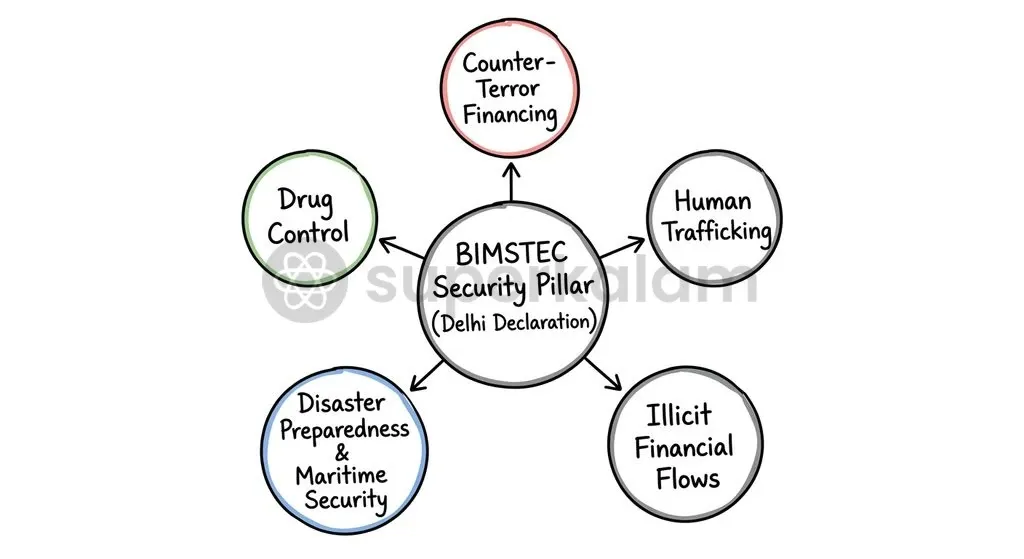
Under India's leadership as the designated anchor for the security pillar, the seven-nation bloc approved five regional security initiatives. These target illicit financial flows, human trafficking, terror financing, drug enforcement, and disaster response. The declaration transitions the grouping from non-binding dialogue toward formalised mutual legal assistance treaties and operational domain awareness. This shift directly addresses growing transnational maritime crime, ungoverned cyber-fraud networks, and strategic choke-point vulnerabilities across the wider Indian Ocean region.
Why in the News: The Delhi Declaration and BIMSTEC's Security Push
India hosted the inaugural BIMSTEC Home Ministers' Meeting in New Delhi on 13 October 2026, culminating in the unanimous adoption of the Delhi Declaration. As of October 2026, the declaration formalises a regional security architecture pursued since the 4th BIMSTEC Summit in Kathmandu in August 2018 mandated regular home ministerial meetings.
The Delhi Declaration unequivocally condemned terrorism in all manifestations, explicitly censuring cross-border terrorism and calling for the full implementation of United Nations Security Council sanctions, particularly under the 1267 Sanctions Committee. The meeting also operationalised directives from the 4th BIMSTEC National Security Chiefs Meeting held in Nay Pyi Taw in July 2024.
For Indian policymakers, the conclave marks a strategic transition:
- Shifting a sub-regional grouping historically slowed by trade negotiations into an actionable littoral security community.
- Anchoring counter-terror oversight across South and Southeast Asian borders through regular ministerial reviews.
From Trade Forum to Security Pact: What the Delhi Declaration Outlines
The Bangkok Declaration founded BIMSTEC on 6 June 1997 as an economic bloc. Over time, the grouping has progressively re-anchored its mandate toward collective maritime stability. The Delhi Declaration reflects this evolution by establishing five targeted regional security initiatives:
- Human trafficking interdiction: Establishing uniform mechanisms to dismantle syndicates operating across land and maritime borders.
- Drug control coordination: Sharing tactical intelligence to curtail narcotics trafficking originating from Southeast Asian production hubs.
- Capacity building on terror financing: Aligning investigative capabilities to interdict money laundering channels feeding regional insurgencies.
- Illicit financial flow countermeasures: Strengthening tracing mechanisms to neutralise illicit capital transfers across borders.
- Regional disaster preparedness: Setting up dedicated coordination frameworks for humanitarian assistance and disaster relief (HADR).
According to the Ministry of External Affairs, India assumed formal responsibility as the Lead Country for the Security pillar during the 5th BIMSTEC Summit in Colombo in March 2022. This portfolio encompasses counter-terrorism, transnational crime, energy security, and disaster management.
To anchor institutional humanitarian coordination, India announced during the ministerial meeting that the planned BIMSTEC Centre for Disaster Management is being established in Jamnagar, Gujarat. The ministers also urged the early adoption of a Plan of Action by the BIMSTEC Sub-Group on Cooperation in Countering Radicalisation and Terrorism.
Discuss with Superkalam
Which city hosts the Information Fusion Centre - Indian Ocean Region (IFC-IOR), and what year was BIMSTEC originally founded?
Ask NowThe Operational Grid: Maritime Surveillance, Crime Networks, and Police Cooperation
The Information Fusion Centre - Indian Ocean Region (IFC-IOR) at Gurugram is the primary operational hub for real-time Maritime Domain Awareness (MDA) across the Bay of Bengal. India maintains bilateral White Shipping Information exchange agreements with littorals including Bangladesh, Sri Lanka, and Myanmar to monitor non-military commercial shipping movements. Integrating these data streams allows member states to detect vessels operating with disabled automated identification transponders.
Police and regulatory integration gained additional traction through new multilateral linkages:
- Observer status at APG: The Delhi Declaration welcomed the BIMSTEC Secretariat securing observer status at the Asia/Pacific Group on Money Laundering (APG).
- Global law enforcement pacts: Ministers directed the Secretariat, based permanently in Dhaka since 2014, to formalise operational pacts with the United Nations Office on Drugs and Crime (UNODC), the International Criminal Police Organization (INTERPOL), and the Financial Action Task Force (FATF).
- Anti-scam enforcement: Member states coordinated against transnational cyber-scam compounds operating in Southeast Asia that trap trafficked workers in forced digital fraud.
Addressing cyber syndicates requires standardising operational procedures across police forces. The Delhi Declaration advanced this by mandating a regional Standard Operating Procedure (SOP) for the rescue, repatriation, and reintegration of human trafficking victims.
Discuss with Superkalam
How does the Delhi Declaration transition BIMSTEC from a traditional trade-focused grouping into an actionable littoral security community?
Ask Now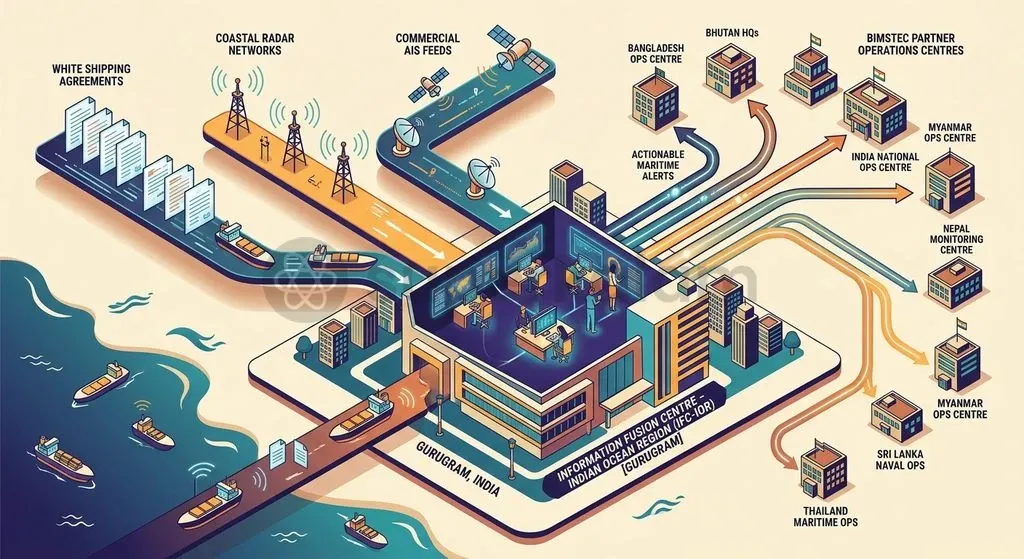
Legal Teeth: How Mutual Legal Assistance and Treaties Back the Pacts
The BIMSTEC Convention on Mutual Legal Assistance in Criminal Matters (MLAT), signed at the Colombo Summit in March 2022, is the legal cornerstone for cross-border evidentiary exchanges. The Delhi Declaration pressed all seven member states—Bangladesh, Bhutan, India, Myanmar, Nepal, Sri Lanka, and Thailand—to complete national ratifications. Swift ratification enables law enforcement agencies to obtain valid foreign warrants, depose witnesses, and attach crime proceeds without bureaucratic deadlocks.
The regional criminal justice framework remains incomplete because key legal conventions remain in draft form. Member states in New Delhi called for the expedited finalisation of three pending treaties: the BIMSTEC Convention on Extradition, the Convention on the Transfer of Sentenced Persons, and the Convention Against Trafficking in Persons. These instruments build on the BIMSTEC Convention on Combating International Terrorism, Transnational Organised Crime and Illicit Drug Trafficking, which entered into legal force in March 2021.
| Legal Instrument / Convention | Adoption / Signing Date | Current Legal Status | Primary Operational Focus |
|---|---|---|---|
| Convention on Combating International Terrorism, Transnational Organised Crime and Illicit Drug Trafficking | March 2021 (entered into force) | Fully in force | Counter-terrorism intelligence, interdiction of regional narcotics syndicates |
| BIMSTEC Convention on Mutual Legal Assistance in Criminal Matters (MLAT) | March 2022 (signed at 5th Summit) | Signed; pending complete operationalisation | Cross-border judicial evidence, asset freezing, witness deposition |
| Agreement on Maritime Transport Cooperation (AMTC) | 3–4 April 2025 (signed at 6th Summit) | Signed | Harmonisation of port access, coastal shipping rules, and maritime logistics |
| BIMSTEC Convention on Extradition | Under negotiation | Draft stage (expedited finalisation urged) | Formal transfer of fugitives and cross-border criminal suspects |
| Convention Against Trafficking in Persons | Under negotiation | Draft stage (expedited finalisation urged) | Standardised prosecution of trafficking rings and rescue SOPs |
All security measures under the BIMSTEC framework operate within explicit international legal constraints. The Delhi Declaration affirmed that regional cooperation remains grounded in sovereign equality, territorial integrity, political independence, non-interference in internal affairs, non-aggression, and mutual benefit.
Discuss with Superkalam
How could the standard operating procedure (SOP) mandated under the Delhi Declaration be applied to dismantle cyber-scam syndicates operating across Southeast Asia?
Ask NowFriction on the Ground: How Regional Crises Test Joint Action
Regional enforcement faces three distinct structural headwinds:
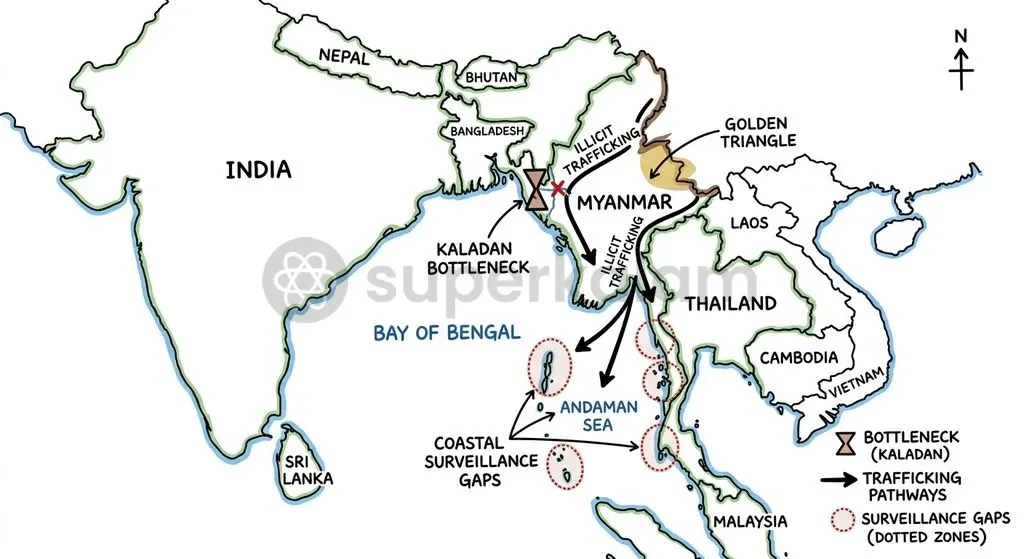
- The Myanmar conflict: The ongoing civil conflict following the 2021 military coup presents persistent enforcement challenges along India's eastern frontier, as reported by The Hindu on 13 October 2026. Armed clashes have disrupted cross-border infrastructure initiatives, including the Kaladan Multi-Modal Transit Transport Project, while escalating illicit narcotics flows across the Golden Triangle corridor.
- Political transitions: Shifting domestic politics within member states also affect regional diplomatic participation. Bangladesh was represented at the New Delhi ministerial by its Home Affairs Senior Secretary, as reported by The Hindu on 13 October 2026. This bureaucratic delegation reflected ongoing domestic political realignment in Dhaka.
- Operational capacity gaps: Material disparities between littorals complicate day-to-day integration. According to an Observer Research Foundation Track 1.5 dialogue report from May 2024, significant gaps in naval radar coverage, deep-water patrol vessels, and coastal surveillance craft separate India from smaller member states.
These technical imbalances obstruct the creation of a seamless, real-time Common Operating Picture across national maritime operations centres.
The Big Picture: Countering Sea-Lane Threats and Strategic Rivalry
The Bay of Bengal is a vital maritime highway funneling traffic directly toward the Strait of Malacca. It accommodates over 80,000 transiting commercial vessels annually. Securing these Sea Lanes of Communication (SLOCs) against piracy, maritime terrorism, and illicit trafficking is an economic necessity for all seven members.
Strategic competition across the basin centres on key dual-use assets:
- Hydrographic deployments: External powers have increased the deployment of hydrographic survey vessels across regional waters, as noted in a Ministry of External Affairs strategic review from June 2025.
- Dual-use port investments: Projects such as Kyaukphyu port in Myanmar and Hambantota port in Sri Lanka illustrate how commercial maritime infrastructure can intersect with strategic surveillance considerations.
To prevent the Bay of Bengal from fracturing into uncoordinated maritime zones, member states signed the Agreement on Maritime Transport Cooperation (AMTC) at the 6th BIMSTEC Summit in Bangkok on 3–4 April 2025. The AMTC streamlines port procedures and logistical access, providing commercial underpinning to the security arrangements negotiated in New Delhi.
Discuss with Superkalam
Analyse how the ongoing conflict in Myanmar impacts both transnational crime flows and strategic connectivity projects like the Kaladan Multi-Modal Transit Transport Project.
Ask NowKey Takeaways
- The inaugural BIMSTEC Home Ministers' Meeting in New Delhi on 13 October 2026 adopted the Delhi Declaration, formalising a regional security architecture led by India.
- The declaration established five regional security initiatives addressing human trafficking, drug trafficking, terror financing, illicit financial flows, and regional disaster response.
- Law enforcement cooperation hinges on operationalising the 2022 BIMSTEC MLAT and finalising three pending conventions on extradition, sentenced persons, and human trafficking.
- Maritime domain coordination relies on India's IFC-IOR at Gurugram and bilateral White Shipping Information exchange agreements with Bangladesh, Sri Lanka, and Myanmar.
- Geopolitical hurdles include conflict-driven enforcement gaps in Myanmar, domestic political realignments in Bangladesh, and maritime capability imbalances across littorals.
- Strategic priorities centre on protecting Sea Lanes of Communication feeding the Malacca Strait, which sees more than 80,000 transits annually, amidst external maritime footprint expansions.
Mains Question
"The adoption of the Delhi Declaration marks a decisive institutional pivot for BIMSTEC from an economic forum into an actionable littoral security community." Elucidate. (10 Marks)
Evaluate NowMains Question
While the BIMSTEC Convention on Mutual Legal Assistance in Criminal Matters provides legal backing to regional security pacts, deep operational and geopolitical fissures continue to test joint action in the Bay of Bengal. Critically analyse. (15 Marks)
Evaluate NowPractice MCQs
QUESTION 1
With reference to the Bay of Bengal Initiative for Multi-Sectoral Technical and Economic Cooperation (BIMSTEC) and the Delhi Declaration adopted in October 2026, consider the following statements:
- The Delhi Declaration was adopted during the inaugural BIMSTEC Home Ministers' Meeting held in New Delhi.
- India serves as the designated Lead Country for the Security pillar within the BIMSTEC framework.
- The planned BIMSTEC Centre for Disaster Management is being established in Gurugram, Haryana. Which of the statements given above is/are correct?
QUESTION 2
Consider the following statements regarding the legal instruments and regional frameworks of BIMSTEC:
- The BIMSTEC Convention on Combating International Terrorism, Transnational Organised Crime and Illicit Drug Trafficking entered into legal force in March 2021.
- The BIMSTEC Convention on Mutual Legal Assistance in Criminal Matters (MLAT) was signed at the 5th Summit in Colombo in March 2022.
- The BIMSTEC Convention on Extradition has already entered into full legal force across all seven member states. Which of the statements given above is/are correct?
QUESTION 3
With reference to maritime security and regional coordination under the BIMSTEC framework, consider the following statements:
- The Information Fusion Centre - Indian Ocean Region (IFC-IOR) at Gurugram serves as the primary operational hub for real-time Maritime Domain Awareness in the Bay of Bengal.
- India maintains White Shipping Information exchange agreements with BIMSTEC littorals to monitor non-military commercial shipping.
- The BIMSTEC Secretariat, permanently headquartered in Colombo, secured observer status at the Asia/Pacific Group on Money Laundering. Which of the statements given above is/are correct?
QUESTION 4
The 'Delhi Declaration', adopted by the BIMSTEC member states in October 2026, explicitly approved five regional security initiatives. Which of the following is NOT one of these five initiatives?
QUESTION 5
Consider the following statements regarding the institutional background and institutional principles of BIMSTEC:
- BIMSTEC was originally established via the Bangkok Declaration on 6 June 1997 as an economic bloc.
- The Delhi Declaration affirmed that regional security cooperation remains grounded in sovereign equality, non-interference in internal affairs, and territorial integrity. Which of the statements given above is/are correct?