Starlink in India: Satellite Internet Licence and Security
Satellite internet in India requires space authorisation, a telecom licence, spectrum assignment and security compliance before commercial operations.
Oct, 2026
•12 min read

Overview
SpaceX’s Starlink, Bharti-backed Eutelsat OneWeb, and Reliance’s Jio Satellite Communications are competing to operationalise commercial satellite broadband across India. This deployment operates under the statutory framework established by the Telecommunications Act, 2023.
The policy marks a structural transition from terrestrial-only cellular networks to space-based communications. It balances sovereign security mandates and domestic market parity against the developmental urgency of connecting remote frontier zones.
While satellite constellations unlock broadband delivery across disconnected terrains, they raise distinct regulatory dilemmas. Policymakers must reconcile non-auction administrative spectrum assignment with lawful interception protocols and strategic safeguards against foreign corporate points of failure.
Why the Race for Satellite Internet in India Is Heating Up
India presents an enormous commercial and strategic frontier for satellite internet providers seeking to capture underserved broadband markets. According to connectivity indicators from the Telecom Regulatory Authority of India and the Ministry of Communications, India registered over 1.1 billion broadband subscribers with nationwide teledensity exceeding 95% by late 2026.
Yet physical geography continues to impede total digital coverage across the subcontinent:
- Unconnected Habitations: Despite rapid urban 5G rollout, roughly 10,000 remote villages remain entirely disconnected from terrestrial cellular coverage.
- Capital and Right-of-Way Hurdles: Deploying terrestrial optical fibre under BharatNet faces severe capital constraints and right-of-way bottlenecks, as noted in Digital Bharat Nidhi assessments by the Department of Telecommunications.
- Terrain Vulnerabilities: Terrestrial cables suffer recurring cuts across border stretches in Ladakh, Uttarakhand, the North-East, and Left-Wing Extremism affected forested corridors.
Commercial satellite communications offer an operational bypass around these physical barriers. As reported to the Lok Sabha in March 2026, three major commercial entities—Bharti-backed Eutelsat OneWeb, Reliance’s Jio Satellite Communications, and SpaceX’s Starlink—have secured GMPCS licences, pending final demonstration of national security compliance.
Discuss with Superkalam
What orbital altitude range defines Low Earth Orbit constellations compared to Geostationary satellites?
Ask NowHow Satellite Internet Works: Low Earth Orbit vs Traditional Satellites
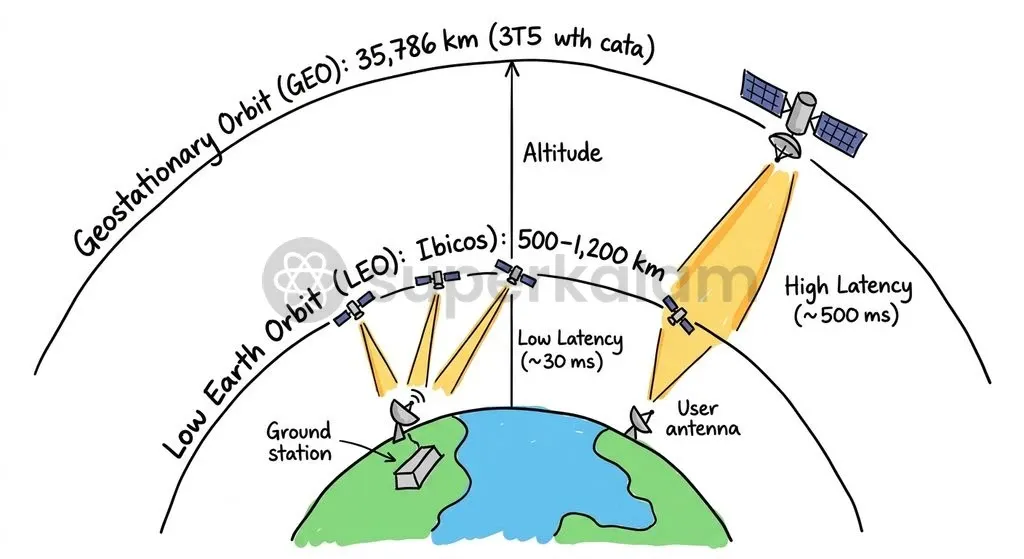
Satellite broadband transmits radio signals between orbital transponders, terrestrial earth station gateways, and user terminals. Traditional commercial communication satellites operate in Geostationary Earth Orbit, remaining stationary relative to the surface of the Earth.
Geostationary satellites cover expansive geographic areas with minimal spacecraft. However, their high altitude introduces latency exceeding 500 milliseconds. In contrast, modern mega-constellations deploy thousands of mass-manufactured satellites into Low Earth Orbit, cutting signal travel times to under 50 milliseconds.
| Architecture Dimension | Geostationary Earth Orbit (GEO) | Low Earth Orbit (LEO) Constellations |
|---|---|---|
| Orbital Altitude | Approximately 35,786 km above Earth | 500 km to 1,200 km above Earth |
| Round-Trip Latency | High latency (~500–700 ms) | Low latency (~25–50 ms) |
| Constellation Size | Few large satellites provide regional coverage | Thousands of mass-manufactured satellites |
| Terminal Architecture | Fixed parabolic dishes pointed at fixed coordinates | Phased-array electronic steerable antennas |
| Civil & Strategic Role | Broadcast media, weather, and fixed backhaul | High-speed retail broadband, mobility, and tactical data |
Low Earth Orbit satellites travel rapidly across the sky. Because of this velocity, user terminals require phased-array steerable antennas to track spacecraft and hand off beams continuously.
This low-latency architecture enables interactive voice, video, and enterprise workflows. Consequently, satcom has emerged as a direct substitute for terrestrial fixed-line and mobile connections.
The Statutory Gatekeepers: IN-SPACe Clearance and the Telecommunications Act 2023
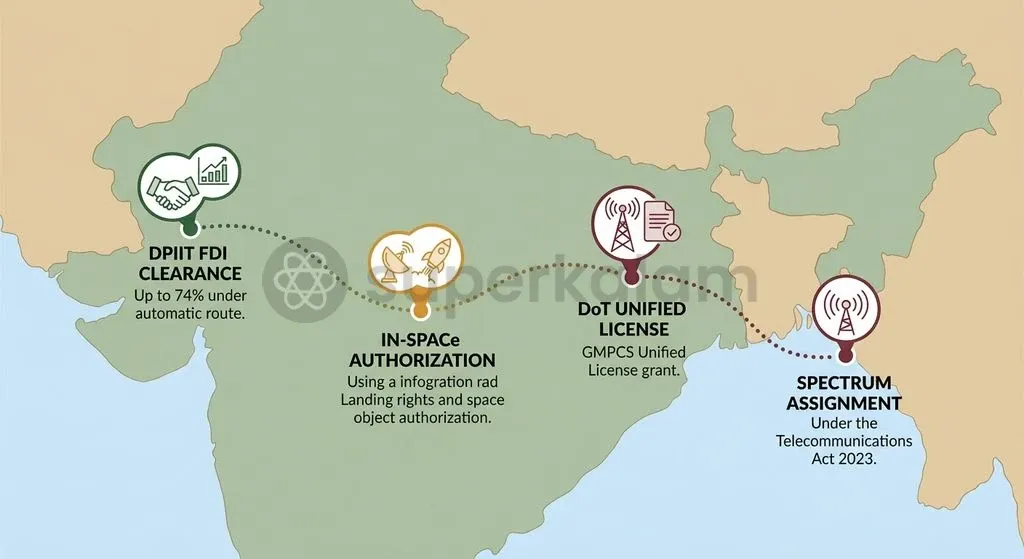
Foreign satellite operators must navigate a multi-tiered regulatory approvals process before turning on commercial transmissions across Indian airspace. Under the Indian Space Policy 2023, the Indian National Space Promotion and Authorisation Centre is the autonomous single-window nodal agency under the Department of Space to authorise all non-government space activities.
IN-SPACe exercises statutory authority over space asset operations, landing rights approvals, and ground stations across India. According to the Norms, Guidelines and Procedures issued by IN-SPACe in May 2024, foreign operators cannot directly offer satellite capacity without an Indian corporate entity and multi-agency security vetting.
The regulatory clearance process involves sequential approvals across multiple statutory and administrative bodies:
- Foreign Direct Investment Clearance: Compliance with Department for Promotion of Industry and Internal Trade guidelines under Press Note 1 (2024 Series), allowing up to 74% foreign direct investment under the automatic route for satellite operations.
- Space Asset Authorisation: Submission of technical constellation parameters, orbital inclination, and radio frequency filings to IN-SPACe for technical validation and security clearance.
- Telecommunications Licensing: Securing a Global Mobile Personal Communication by Satellite authorisation from the Department of Telecommunications under the Unified License regime.
- Spectrum Assignment: Securing dedicated frequency authorisations under the Telecommunications Act, 2023, subject to pricing terms formulated by the Telecom Regulatory Authority of India.
The Department for Promotion of Industry and Internal Trade liberalised the space sector in 2024 by notifying up to 74% foreign direct investment under the automatic route for satellite manufacturing and data operations, and up to 49% for launch vehicle systems. Foreign constellations must nevertheless clear strict inter-ministerial security vetting coordinated by IN-SPACe before receiving operational landing rights.
Discuss with Superkalam
Why does the physical nature of radio frequency sharing in satellite constellations make administrative allocation technically distinct from terrestrial spectrum auctioning?
Ask NowThe Spectrum Allocation Battle: Administrative Assignment vs Public Auction
The mechanism for allocating satellite spectrum ignited a major legal and economic debate in India. Domestic telecom operators initially demanded open competitive auctions, arguing that administrative allocation violates equal access to public resources.
The Parliament of India settled the statutory mechanism through the Telecommunications Act, 2023. Section 4(4) read with Entry 16 of the First Schedule of the Act explicitly mandates administrative assignment for satellite-based communication services, exempting satcom bands from mandatory public spectrum auctions.
This statutory carve-out reflects the distinct physics of space-based transmission. Terrestrial mobile networks slice spectrum into exclusive geographic blocks to prevent interference. In contrast, multiple satellite constellations share the same frequency bands through directional beam-steering and angular separation.
| Spectrum Regime | Primary Allocation Mechanism | Spectrum Sharing Model |
|---|---|---|
| Terrestrial Cellular | Competitive public auction | Exclusive frequency slice per operator (no radio sharing) |
| Satellite Communications | Administrative assignment | Shared frequency band across multiple operators via ITU power limits |
The Supreme Court of India established in Centre for Public Interest Litigation v. Union of India (2012) that natural resources must ordinarily be alienated via transparent public auctions to prevent cronyism and revenue loss. However, the subsequent landmark ruling in Natural Resources Allocation In Re, Special Reference No. 1 of 2012 clarified that auctions are not an absolute constitutional imperative across all categories of public assets, affirming the sovereign discretion of the State to adopt administrative assignment where public interest and technical constraints warrant it.
To implement the statutory mandate, the Ministry of Communications notified the Telecommunications (Spectrum Assignment by Administrative Process) Rules, 2026 under G.S.R. 494(E). These rules formally operationalise the technical and administrative parameters for satcom spectrum assignment under the First Schedule of the Act.
Level Playing Field: Why Domestic Telecom Giants Are Pushing Back
Incumbent telecom service providers Reliance Jio and Bharti Airtel raised regulatory parity objections before the Telecom Regulatory Authority of India. The incumbents contend that high-throughput satellite constellations do not simply serve remote mountain outposts, but directly substitute terrestrial networks in high-value enterprise, banking, and urban residential broadband markets.
During regulatory consultations conducted by the Telecom Regulatory Authority of India in September 2024, terrestrial telcos demanded the strict enforcement of the same service, same rules principle. Indian cellular operators face substantial regulatory costs, including an 8% Unified License fee assessed on Adjusted Gross Revenue, alongside statutory contributions to the Digital Bharat Nidhi governed by the Telecommunications (Administration of Digital Bharat Nidhi) Rules, 2024.
Domestic operators argue that granting administratively assigned spectrum to foreign satellite providers creates market distortions:
- Capital Expenditure Asymmetry: Terrestrial operators invested trillions of rupees acquiring cellular spectrum through competitive auctions, alongside building physical towers and fibre networks.
- Universal Service Levies: Domestic telcos bear statutory Digital Bharat Nidhi revenue deductions to finance rural infrastructure, which they insist satellite operators must match.
- Retail Broadband Substitution: Modern phased-array user terminals enable satellite systems to compete directly for high-ARPU enterprise contracts, corporate backhaul, and maritime connectivity.
In response to these industry concerns, the Department of Telecommunications issued a formal reference to the Telecom Regulatory Authority of India under Section 11(1)(a) of the TRAI Act, 1997, seeking recommendations on pricing, terms, and technical measures to maintain competitive parity between satellite communication operators and terrestrial access licensees.
Discuss with Superkalam
How might a district administration in a terrain-vulnerable border district like Ladakh utilize LEO satellite broadband during critical optical fibre outages?
Ask NowSovereignty and the Strategic Risk of Private Foreign Mega-Constellations
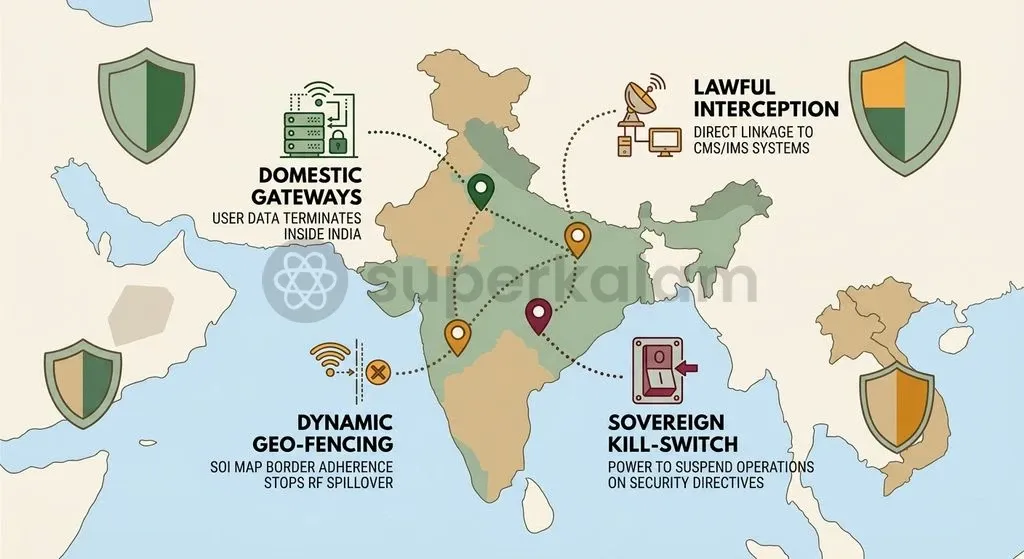
National security considerations remain the primary friction point regarding foreign-owned communication constellations. On May 5, 2025, the Department of Telecommunications issued comprehensive security instructions under Office Memorandum File No. 60-1/IMC/GMPCS/2024-SAT, establishing non-negotiable security conditionalities for all Global Mobile Personal Communication by Satellite licensees.
The framework imposes strict data sovereignty obligations on all licensed operators:
- Territorial Gateway Mandate: Operators must locate network control centres, satellite earth station gateways, and user data routing infrastructure within the physical territory of India.
- Foreign Routing Ban: Clause 2 of the framework strictly bars satellite operators from routing domestic Indian data traffic through foreign gateways or serving terminals outside Indian territory.
- Interception Integration: Licensees must integrate their Lawful Interception System and Lawful Interception and Monitoring platforms with India's Centralised Monitoring System and Integrated Monitoring System prior to commercial rollout.
- Geo-Fencing and Kill-Switches: Operators must enforce automated geo-fencing aligned with official Survey of India cartographic maps, deploy beam-shaping to prevent cross-border leakage, and support an immediate kill-switch on state directive.
Beyond data sovereignty, geopolitical events have revealed the strategic hazards of private corporate dominance over orbital networks. An analysis by the Observer Research Foundation documented that during the Ukraine conflict, Ukrainian forces suffered a severe communications blackout during a planned naval drone operation when SpaceX leadership unilaterally declined to activate Starlink coverage over Crimea.
Strategic dependence on single-owner private constellations exposes sovereign nations to unilateral corporate vetoes, operational denial-of-service, and foreign sanctions during national crises. For India's security establishment, domestic ground gateways, local command nodes, and independent Indian-owned satellite alternatives represent essential strategic buffers against external corporate leverage.
Discuss with Superkalam
Compare the economic burdens borne by terrestrial telecom licensees with those faced by foreign satellite internet entrants under the current regulatory framework.
Ask NowGlobal Space Rules: ITU Radio Regulations and Orbital Congestion
Domestic spectrum assignment cannot occur in isolation from international orbital governance. The International Telecommunication Union, a specialised agency of the United Nations, manages global radio spectrum and orbital slot assignments to ensure non-interference across borders.
Rights to satellite spectrum and orbital planes are registered through advance publication, coordination, and notification procedures under the ITU Constitution and Convention read with Chapter III of the ITU Radio Regulations. Spectrum priority operates strictly on a priority-in-time basis, requiring sovereign nations to harmonise domestic frequency allocations with the Master International Frequency Register.
Article 22 of the ITU Radio Regulations establishes binding limits on non-geostationary satellite constellations:
- EPFD Compliance: Non-geostationary constellations must comply with Equivalent Power Flux Density thresholds to ensure aggregate radio emissions do not cause harmful interference to established Geostationary Earth Orbit satellites.
- Coordination Obligations: New Low Earth Orbit operators must execute technical coordination agreements with sovereign space agencies operating geostationary networks in shared bands.
- Orbital Slot Priority: Priority filings registered earlier in time hold legal right-of-way over subsequent satellite deployments in identical radio frequency envelopes.
With tens of thousands of satellites planned for Low Earth Orbit deployment, mega-constellations also escalate the danger of orbital debris collisions in space. Managing international radio interference and space situational awareness requires ongoing coordination between India's space tracking infrastructure and global surveillance networks.
Discuss with Superkalam
Should the government mandate identical universal service levies and adjusted gross revenue fees on satellite operators to maintain market parity? Justify your stance.
Ask NowWay Forward: Balancing National Security, Fair Competition, and Rural Access
Integrating satellite internet into India's digital architecture requires balancing security sovereignty, market parity, and developmental inclusion. Regulatory policy must position space-based broadband as a complementary layer designed to close persistent access gaps rather than an adversary to cellular infrastructure.
Policy execution should focus on three coordinated regulatory imperatives:
- Strict Enforcement of DoT Security Instructions: The Ministry of Communications must ensure that all Global Mobile Personal Communication by Satellite licensees deploy physical gateways within India and connect verified lawful interception systems to national monitoring centres prior to issuing commercial spectrum.
- Calibrated Administrative Spectrum Pricing: The Telecom Regulatory Authority of India should establish spectrum usage charges that prevent predatory undercutting of terrestrial broadband while avoiding punitive fees that keep satellite terminal hardware unaffordable for rural schools, border primary health centres, and village administrative councils.
- Building Sovereign Low Earth Orbit Capabilities: While authorising global commercial operators to meet immediate frontier demand, India must leverage Indian Space Research Organisation capabilities and private domestic aerospace startups under the Indian Space Policy 2023 to develop sovereign low-latency communication constellations.
By maintaining strict statutory compliance, ensuring domestic data localisation, and preserving equitable competition across terrestrial and space networks, India can deploy advanced satellite broadband to bridge its deepest digital divides without compromising national security or strategic autonomy.
Key Takeaways
- Statutory Allocation Mechanism: The Telecommunications Act, 2023 explicitly mandates administrative assignment for satellite spectrum under Entry 16 of its First Schedule, exempting satcom bands from mandatory public auctions in line with the Supreme Court's 2012 Presidential Reference ruling.
- Dual-Tiered Regulatory Clearance: Satellite operators require mandatory landing rights and technical authorisation from the Indian National Space Promotion and Authorisation Centre (IN-SPACe) under the Indian Space Policy 2023 before obtaining telecom service authorisations from the Department of Telecommunications.
- Domestic Ground Gateways: Department of Telecommunications security mandates issued on May 5, 2025, require satellite operators to maintain physical earth station gateways within India, prohibit the foreign routing of domestic traffic, and integrate lawful interception tools with India's Centralised Monitoring System.
- Level Playing Field Concerns: Domestic telecom incumbents Reliance Jio and Bharti Airtel have petitioned the Telecom Regulatory Authority of India for regulatory parity, seeking comparable license fee obligations and Digital Bharat Nidhi contributions to prevent competitive distortions.
- Strategic Autonomy Safeguards: Unilateral corporate disruptions observed during foreign military flashpoints demonstrate the pressing necessity for national geo-fencing controls, local security command overrides, and long-term domestic low-orbit satellite infrastructure.
Mains Question
'The statutory carve-out for administrative assignment of satellite spectrum under the Telecommunications Act, 2023 balances technological realities against public revenue considerations.' Elucidate. (10 Marks)
Evaluate NowMains Question
"Enforcing the 'same service, same rules' principle is vital to prevent market distortion between terrestrial telecom operators and foreign satellite mega-constellations." Critically analyse. (15 Marks)
Evaluate NowPractice MCQs
QUESTION 1
With reference to the statutory framework governing satellite communications in India, consider the following statements:
- The Telecommunications Act, 2023 mandates competitive public auctions as the sole mechanism for assigning radio spectrum to satellite-based communication services.
- In 'Natural Resources Allocation In Re (2012)', the Supreme Court held that public auction is not an absolute constitutional imperative for alienating all categories of natural resources.
- The Telecommunications (Spectrum Assignment by Administrative Process) Rules, 2026 were notified under G.S.R. 494(E) to operationalise satcom spectrum assignment. Which of the statements given above are correct?
QUESTION 2
Consider the following statements regarding satellite communication architectures:
- Geostationary Earth Orbit (GEO) satellites exhibit round-trip latency exceeding 500 milliseconds due to their high orbital altitude.
- Low Earth Orbit (LEO) mega-constellations rely on fixed parabolic dishes pointed at stationary coordinates to maintain continuous service links.
- Unlike terrestrial cellular networks which require exclusive frequency slices, multiple satellite constellations can share the same frequency bands via angular separation and beam-steering. Which of the statements given above is/are correct?
QUESTION 3
Regarding the regulatory regime for space activities and Foreign Direct Investment (FDI) in India, consider the following statements:
- IN-SPACe serves as the autonomous single-window nodal agency under the Department of Space to authorise non-government space activities.
- Under current FDI guidelines, up to 74% foreign direct investment is permitted under the automatic route for launch vehicle systems.
- Foreign operators are permitted to offer commercial satellite capacity directly in India without establishing an Indian corporate entity, provided they secure technical landing rights. Which of the statements given above is/are correct?
QUESTION 4
Which of the following regulatory levies and statutory contributions do terrestrial access telecom licensees in India bear, as cited by domestic operators demanding a level playing field with satellite broadband providers?
- An 8% Unified License fee assessed on Adjusted Gross Revenue (AGR)
- Universal service levies under the Digital Bharat Nidhi rules
- Mandatory terrestrial cable right-of-way offsets Select the correct answer using the code given below:
QUESTION 5
Under which provision of the Telecom Regulatory Authority of India (TRAI) Act, 1997 did the Department of Telecommunications seek recommendations on pricing, terms, and competitive parity between satellite operators and terrestrial licensees?