DAY-NULM and NULM 2.0: Urban Livelihoods and Funding Gap
DAY-NULM ended on 30 September 2024. The DJAY-S pilot began in 25 cities to study six vulnerable groups as states sought continued livelihood funding.
Oct, 2026
•11 min read
Overview
India's urban anti-poverty architecture faces an acute fiscal squeeze. Rapid urbanisation continually outpaces minimal central allocations, leaving millions of informal labourers without a viable safety net. While rural welfare enjoys statutory backing and generous outlays, urban schemes face protracted transition delays and chronic underfunding.
Bridging this divide means rethinking city welfare from the ground up. Doing so requires devolving real financial authority to Urban Local Bodies (ULBs) and addressing three core priorities:
- Dependable municipal revenues to insulate local services from central budget contractions.
- Unified delivery systems across ministries to secure inter-state welfare portability.
- Statutory livelihood protections that shield informal labour from macroeconomic volatility.
Why NULM 2.0 Is in the Spotlight: Transition Delays and Budget Strains
Urban welfare delivery faces sharp scrutiny as administrative delays and funding cuts stall the revamped National Urban Livelihoods Mission. As of October 2026, state-level implementation has experienced severe disruption following the conclusion of the original mission tenure on 30 September 2024. To plug the gap, the central government rolled out an interim framework on 1 October 2024—the Deendayal Jan Aajeevika Yojana-Shehari—to pilot restructured models across selected urban centres.
This prolonged policy hiatus has triggered major institutional fallout:
- Inter-governmental friction: According to official inter-state communications reported by The Indian Express, five states—including Tamil Nadu and Madhya Pradesh—petitioned the central ministry in 2026 for over ₹539 crore in pending central funding to settle legacy liabilities and sustain basic community mobilisation.
- Erosion of community infrastructure: While the previous mission mobilised over 1 crore urban poor women into more than 10 lakh Self-Help Groups by 30 September 2024, institutional momentum slowed once central operational outlays ceased.
- Municipal administrative strain: Urban local bodies have struggled to pay community resource persons, administer revolving funds, and sustain city-level federations.
Discuss with Superkalam
Recall the six Vulnerable Occupational Groups targeted under the NULM 2.0 (DJAY-S) pilot framework.
Ask NowThe Rural-Urban Spending Divide: Why Cities Get a Fraction of Anti-Poverty Funds
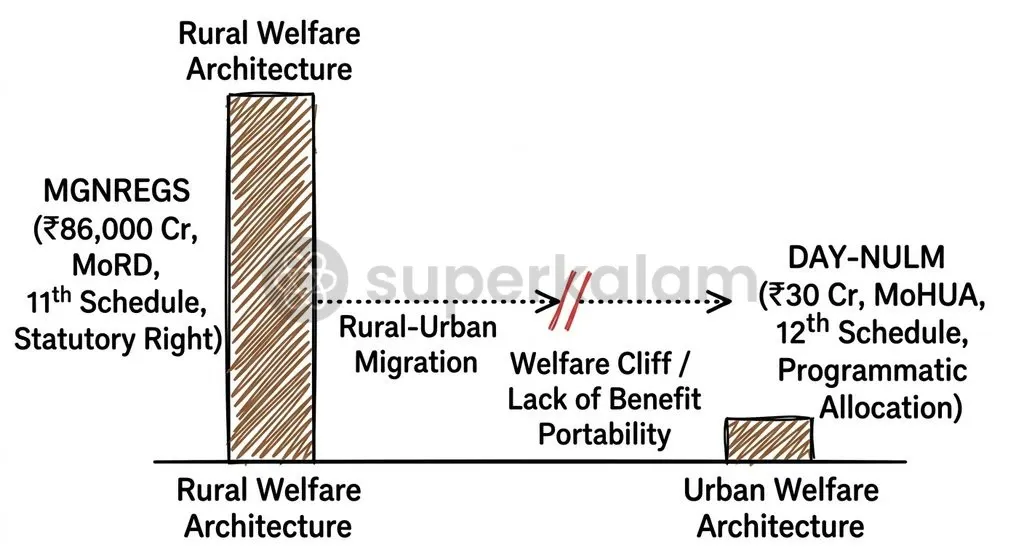
India's Union Budget maintains a stark imbalance between rural welfare programmes and urban anti-poverty interventions administered by the Ministry of Housing and Urban Affairs. According to Statement 4 of the Union Budget 2025-26 Expenditure Profile, the Mahatma Gandhi National Rural Employment Guarantee Scheme received ₹86,000 crore in both the 2024–25 and 2025–26 fiscal cycles. In stark contrast, the core urban livelihoods mission was allocated just ₹30 crore in the 2025–26 Budget Estimates.
This fiscal chasm stems from a persistent policy assumption that Indian poverty is overwhelmingly rural. Over its entire ten-year operational lifespan from 2014 to 2024, total central expenditure under DAY-NULM reached approximately ₹5,387 crore against an approved outlay of ₹6,404 crore. Put plainly, the central government spent less on urban livelihoods over an entire decade than rural job schemes disburse in a single month.
| Dimension | Rural Livelihoods Architecture (MoRD) | Urban Livelihoods Architecture (MoHUA) |
|---|---|---|
| Primary Statutory Anchors | MGNREGA, 2005; Eleventh Schedule (Article 243G) | Twelfth Schedule (Article 243W); non-statutory schemes |
| Flagship Missions | MGNREGS and DAY-NRLM | DAY-NULM / NULM 2.0 (DJAY-S) |
| Annual Central Outlay | Over ₹86,000 crore under MGNREGS alone (2025–26 BE) | ₹30 crore allocated under DAY-NULM (2025–26 BE) |
| Targeting Mechanism | Universal rural demand-driven work; village-wide SHGs | Targeted occupational groups; urban micro-enterprises |
| Institutional Delivery | Gram Panchayats and block administrative machinery | Urban Local Bodies and City Livelihood Centres |
Institutional fragmentation deepens this fiscal gap. Anti-poverty governance suffers from rigid administrative silos, as documented in a 2024 NITI Aayog report titled Moving Towards Effective City Government. MoHUA oversees urban poverty schemes, whereas the Ministry of Rural Development manages rural safety nets.
This ministerial divide breaks down in peri-urban belts and fast-growing census towns. Crucially, it prevents portability of social security entitlements for circular and seasonal migrants moving between rural homesteads and city labour markets. Seasonal workers forfeit rural work guarantees the moment they migrate, yet find no safety net waiting in urban hubs.
Inside NULM 2.0: Moving Beyond Self-Help Groups to Gig Workers and Migrants
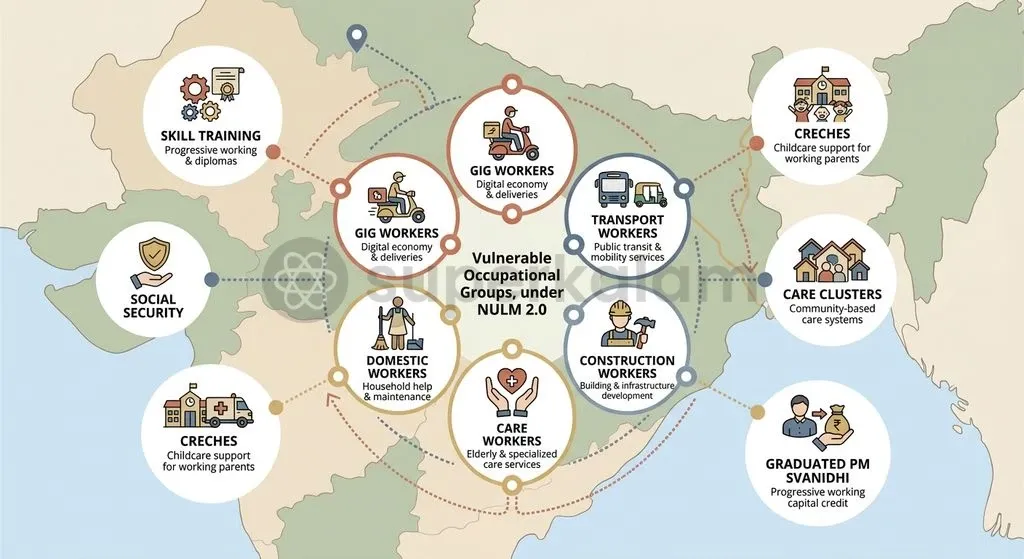
The Deendayal Jan Aajeevika Yojana-Shehari framework restructures urban poverty alleviation by shifting focus from general geographic coverage to six specific Vulnerable Occupational Groups. In official guidelines issued by the Ministry of Housing and Urban Affairs, the revised design departs from the traditional model centred almost exclusively on women's neighbourhood Self-Help Groups.
Under the NULM 2.0 pilot framework, the ministry identifies six priority occupational segments:
- Platform and gig workers engaged in app-based delivery, logistics, and domestic services
- Transport workers, including auto-rickshaw drivers, e-rickshaw operators, and informal transit staff
- Construction and allied labourers, encompassing daily-wage manual workers in infrastructure
- Informal waste pickers and sanitation workers engaged in municipal solid waste collection
- Care workers, comprising private attendants, crèche assistants, and elderly care providers
- Domestic workers employed in urban residential households
Operational guidelines introduce targeted infrastructure interventions to relieve informal employment vulnerabilities. To ease the heavy burden of unpaid care work on female informal workers, the reported operational blueprint proposes central assistance of up to ₹15 lakh per day-care centre or crèche alongside capital support of up to ₹2.5 crore for multi-generational care clusters. Because these caps remain part of an evolving pilot framework, their final nationwide financial guidelines await formal cabinet notification.
NULM 2.0 also seeks to modernise elements inherited from DAY-NULM. The legacy mission provided a revolving fund grant of ₹10,000 to eligible women's SHGs and offered a one-time non-recurring establishment grant of ₹25 lakh in three instalments to set up municipal City Livelihood Centres. The Self-Employment Programme also extended an interest subvention over and above 7% per annum on bank credit up to ₹2 lakh for individual micro-enterprises and ₹10 lakh for group ventures.
Discuss with Superkalam
Explain how ministerial administrative silos between MoHUA and MoRD hinder social security portability for seasonal migrants.
Ask NowThe revamped mission ties these credit mechanisms directly to the PM Street Vendor's AtmaNirbhar Nidhi, launched in June 2020. PM SVANidhi institutionalised graduated, collateral-free working capital micro-loans of up to ₹15,000, ₹25,000, and ₹50,000 across three successive borrowing cycles.
Borrowers earn an annual interest subsidy of 7% on timely repayments, along with digital cashbacks of up to ₹1,200 each year. Uptake expanded quickly. According to MoHUA, as on 20 January 2026, more than 1.05 crore loans amounting to around ₹16,100 crore had been disbursed to over 71.5 lakh street vendors.
Through the 'SVANidhi Se Samridhi' initiative, authorities have linked verified street vendor households to eight major central welfare schemes. These include the Pradhan Mantri Jeevan Jyoti Bima Yojana, the Pradhan Mantri Suraksha Bima Yojana, and the portability provisions of the National Food Security Act.
Why Municipal Finances Fail Urban Anti-Poverty Programs
Urban Local Bodies struggle to implement poverty alleviation mandates under the Twelfth Schedule of the Constitution due to revenue stagnation and rigid establishment costs. When Parliament enacted the 74th Constitutional Amendment Act, 1992, it incorporated Item 11 into the Twelfth Schedule, listing urban poverty alleviation as an illustrative function for state legislatures to devolve to municipal corporations, municipal councils, and nagar panchayats.
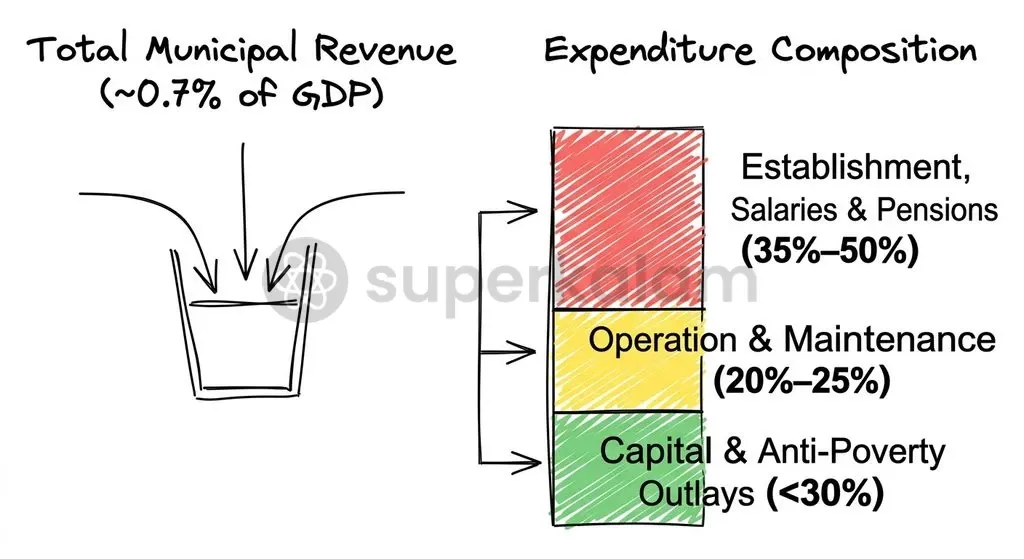
Despite this constitutional mandate, State Finance Commissions and urban development departments have largely failed to devolve genuine financial resources to city administrations. According to the Reserve Bank of India's Report on Municipal Finances, the total revenue receipts of Indian municipal corporations have stagnated at an alarming 0.61% to 0.72% of GDP. This performance trails municipal revenue mobilisation in other major emerging economies, where local municipal receipts reach approximately 6% of GDP in South Africa and nearly 7% in Brazil.
The composition of municipal expenditure further undermines grassroots social welfare delivery:
- Rigid establishment liabilities: Reserve Bank of India municipal budgetary analyses confirm that salaries, wages, and staff pensions consume between 35% and 50% of total revenue expenditure in surveyed municipal corporations.
- Depressed capital outlays: Productive municipal capital expenditure on developmental infrastructure and community asset creation represents less than 30% of total municipal disbursements.
- Restricted intergovernmental transfers: The 15th Finance Commission recommended an aggregate grant allocation of ₹1,21,055 crore for Urban Local Bodies over the 2021–2026 period.
These transfers come with strict earmarks. The 15th Finance Commission mandated 100% tied challenge grants for 50 Million-Plus urban agglomerations—tied strictly to measurable improvements in air quality, urban drinking water supply, and sanitation. For Non-Million Plus cities, the Commission designated 60% as tied grants and reserved only 40% as untied funds. Consequently, city administrators cannot deploy central finance commission grants toward localised poverty interventions, emergency wage support, or urban shelter management without violating statutory grant conditions.
Discuss with Superkalam
How would you apply the PM SVANidhi graduated micro-credit and digital cashback mechanism to support gig and platform workers under NULM 2.0?
Ask NowShould India Introduce a National Urban Employment Guarantee?
State-level initiatives such as Rajasthan's Indira Gandhi Shahari Rozgar Yojana and Kerala's Ayyankali Urban Employment Guarantee Scheme have intensified debate over a statutory national urban livelihood guarantee. Urban labour markets exhibit pronounced seasonal volatility and widespread underemployment, yet informal labourers in cities lack the legal safety net provided to rural workers under the Mahatma Gandhi National Rural Employment Guarantee Act, 2005.
The Case for a National Urban Work Guarantee
Proponents argue that urban informal employment is characterised by insecure contracts, hazardous working environments, and acute vulnerability to macroeconomic shocks. A statutory urban employment guarantee provides several key benefits:
- Automatic social safety net: It creates counter-cyclical wage insurance during urban economic downturns or infectious disease outbreaks.
- Formalisation of municipal work: Guaranteed work schemes create institutional avenues to regularise and fairly compensate informal workers performing public tasks like sanitation, drain maintenance, and urban forestry.
- Labour market wage floors: An urban guarantee prevents predatory wage exploitation in the private informal sector by setting an enforceable wage floor.
Structural and Fiscal Constraints
Conversely, fiscal policy analysts and urban economists highlight substantial execution challenges that differentiate cities from rural districts:
- Prohibitive fiscal cost: Replicating a 100-day statutory employment guarantee across India's urban areas would require significant central budgetary support, competing directly with capital investments in urban public transport, storm-water drainage, and public healthcare.
- Risk of rural-urban distress migration: An urban guarantee offering wages substantially higher than rural statutory rates could accelerate unmanageable distress migration, overwhelming already stressed municipal infrastructure.
- Asset verification difficulties: Unlike rural panchayats that construct water-harvesting bunds or rural link roads, municipal corporations struggle to identify labour-intensive public works that do not require skilled private contractors and heavy capital equipment.
- .
Reforming Urban Welfare: Reliable Budgets, Better Data, and Stronger City Councils
Reforming India's urban anti-poverty architecture requires MoHUA to address inter-ministerial silos, secure predictable funding, and empower municipal councils. Moving from ad-hoc programmatic revisions to enduring urban social security demands structural interventions across three distinct governance dimensions:
- Predictable budgetary foundations: Operating national urban poverty missions on token allocations of ₹30 crore undermines administrative confidence and forces state departments to divert limited local funds. Central outlays must expand to match India's rapid urban growth, ensuring that targeted credit subventions, care infrastructure grants, and community federations receive sustained, multi-year funding commitments.
- Cross-ministerial digital integration: Policymakers must bridge administrative divides between MoHUA and the Ministry of Rural Development. Linking the e-Shram informal worker database with municipal welfare rolls and rural job cards will unlock universal entitlement portability, allowing circular migrants to access subsidised food grains, maternity benefits, and emergency micro-credit anywhere in India.
- Fiscal devolution to Urban Local Bodies: State legislatures must honour the spirit of the 74th Constitutional Amendment Act by expanding local financial autonomy. In line with Finance Commission recommendations, states must enact predictable property tax reforms, expand municipal user charges, and transfer untied developmental grants directly to city councils so elected local leaders can sustain City Livelihood Centres effectively.
Discuss with Superkalam
Analyse why municipal corporations in India spend less than 30% of their disbursements on capital assets while establishment costs consume up to half of revenue expenditure.
Ask NowKey Takeaways
- Constitutional Mandate vs Fiscal Reality: Item 11 of the Twelfth Schedule under the 74th Constitutional Amendment Act assigns urban poverty alleviation to Urban Local Bodies, yet municipal revenue receipts stagnate at just 0.61% to 0.72% of GDP.
- Severe Rural-Urban Welfare Disparity: The Union Budget allocated ₹86,000 crore to MGNREGS in 2025–26 while DAY-NULM received only ₹30 crore, reflecting an ongoing policy bias that underfunds urban informal poverty.
- Transition Friction and Funding Deficits: Following the expiration of DAY-NULM on 30 September 2024, transition delays in launching NULM 2.0 led five states to petition the Centre in 2026 for more than ₹539 crore in pending operational dues.
- Targeting Transformation in NULM 2.0: The revised framework shifts from general community mobilization to six Vulnerable Occupational Groups—including gig workers, waste pickers, and domestic labourers—supplemented by proposed crèche assistance up to ₹15 lakh.
- Scale of Street Vendor Credit: The PM SVANidhi scheme has bridged critical working capital gaps, disbursing around ₹16,100 crore across more than 1.05 crore loans as on 20 January 2026 with an annual interest subvention of 7%.
- Research Gaps: Reliable nationwide evaluations of third-tranche PM SVANidhi default rates, micro-credit uptake among gig platforms, and national fiscal modeling for urban work guarantees remain absent from verified public data.
Mains Question
"The persistent disparity in budgetary allocations between rural and urban anti-poverty programmes reflects an outdated assumption that poverty in India is exclusively rural." In light of the fiscal divide between MGNREGS and DAY-NULM, critically analyse the institutional challenges hindering urban welfare delivery. (15 Marks)
Evaluate NowMains Question
Examine how the structural weaknesses of municipal finances in India constrain Urban Local Bodies from discharging their constitutional mandate under Item 11 of the Twelfth Schedule. (10 Marks)
Evaluate NowPractice MCQs
QUESTION 1
With reference to urban poverty alleviation missions in India, consider the following statements:
- The Deendayal Jan Aajeevika Yojana-Shehari framework transitions away from exclusive reliance on women's Self-Help Groups to target six specific Vulnerable Occupational Groups.
- Platform and gig workers, care workers, and informal waste pickers are among the priority occupational segments identified under NULM 2.0.
- The legacy DAY-NULM provided a revolving fund grant of ₹25 lakh to eligible women's Self-Help Groups. Which of the statements given above is/are correct?
QUESTION 2
Regarding the PM Street Vendor's AtmaNirbhar Nidhi (PM SVANidhi) scheme, consider the following statements:
- It offers collateral-free working capital loans of up to ₹15,000, ₹25000, and ₹50,000 across three successive borrowing tranches.
- Beneficiaries who repay loans on time are entitled to an annual interest subsidy of 7%.
- Through the 'SVANidhi Se Samridhi' initiative, verified vendors are linked to central schemes, including the portability benefits under the National Food Security Act. Which of the statements given above is/are correct?
QUESTION 3
Consider the following statements regarding the finances of Urban Local Bodies (ULBs) in India:
- Under the Twelfth Schedule of the Constitution, urban poverty alleviation is listed as an illustrative devolved function under Item 11.
- According to the Reserve Bank of India, total revenue receipts of Indian municipal corporations hover between 0.61% and 0.72% of GDP.
- Salaries, wages, and pensions account for less than 15% of the total revenue expenditure in surveyed municipal corporations. Which of the statements given above is/are correct?
QUESTION 4
In the context of fiscal outlays for anti-poverty programmes in the 2025–26 Budget Estimates, what was the allocation for the core urban livelihoods mission administered by the Ministry of Housing and Urban Affairs?
QUESTION 5
Consider the following statements regarding urban versus rural livelihood architectures in India:
- MGNREGS is backed by a statutory guarantee under the Eleventh Schedule framework, whereas urban livelihoods missions under MoHUA are non-statutory.
- Over its ten-year lifespan from 2014 to 2024, DAY-NULM central expenditure exceeded its total approved outlay.
- The 15th Finance Commission recommended a grant allocation exceeding ₹1.2 lakh crore for Urban Local Bodies for 2021–2026. Which of the statements given above is/are correct?