HT-Bt Cotton in India: Biosafety Regulation, Farm Economics, and Agronomic Risks
As soaring manual weeding costs drive unapproved transgenic seeds across cotton belts, India faces a critical test of biosafety oversight and farm economics.
Oct, 2026
•10 min read
Overview
Herbicide-Tolerant Bt cotton cultivation has proliferated across major Indian agrarian belts without statutory environmental clearance. This shift exposes an unviable disconnect between high farm-level manual weeding expenses and India's rigid biosafety regulatory apparatus. Operating through informal commercial channels, unapproved transgenic seeds allow growers to spray broad-spectrum herbicides directly over standing crops to slash agricultural expenditure.
Yet this uncontrolled expansion bypasses mandatory ecological scrutiny. It accelerates herbicide resistance, threatens conventional cotton germplasm, and challenges statutory oversight mandated under the Environment (Protection) Act, 1986.
Why in the News: The Silent Spread of Unapproved Seeds Across Cotton Belts
The Genetic Engineering Appraisal Committee continues to confront the extensive proliferation of unapproved Herbicide-Tolerant Bt (HT-Bt) cotton across central and southern Indian cotton belts. The unauthorised seed trade has outpaced statutory interdictions, establishing an entrenched agronomic reality on the ground.
Field surveys highlight the scale of this expansion across major production tracts:
- Current Acreage (2025–26): As of early 2026, field assessments conducted by the South Asia Biotechnology Centre and the Federation of Seed Industry of India estimate that unapproved HT-Bt cotton covers between 24 and 30 percent, or roughly 65 to 72 lakh acres, of national cotton acreage.
- Official 2018 Baseline: Findings released by the Ministry of Agriculture and Farmers Welfare show that the Field Inspection and Scientific Evaluation Committee under the Department of Biotechnology identified that unapproved HT-Bt accounted for approximately 15 percent of cotton acreage across Andhra Pradesh, Telangana, Maharashtra, and Gujarat, alongside 5 percent in Punjab.
Transgenic cotton hybrids carrying unapproved genetic modifications now circulate widely across regional markets. This movement defies federal containment orders, creating deep institutional friction between farm economics and environmental oversight.
Discuss with Superkalam
Which bacterial donor organism supplies the cp4-epsps gene found in illicit HT-Bt cotton variants?
Ask NowTechnical Differences: How HT-Bt Cotton Differs from Approved Bt Cotton
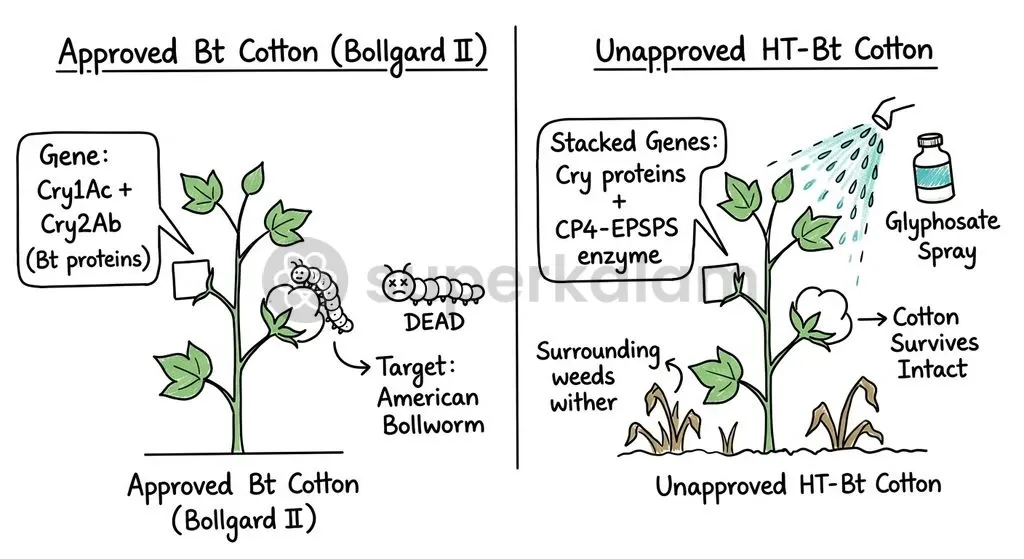
Approved genetically engineered cotton in India targets lepidopteran pests like bollworms. Unauthorised HT-Bt variants go further: they carry extra genetic mechanisms to survive direct applications of non-selective systemic herbicides. The Ministry of Environment, Forest and Climate Change has sanctioned only two commercial transgenic events: MON 531, expressing the Cry1Ac insecticidal protein, and MON 15985, commonly known as Bollgard II, which stacks Cry1Ac and Cry2Ab genes derived from the soil bacterium Bacillus thuringiensis to control bollworms.
In contrast, unapproved HT-Bt cotton carries the cp4-epsps gene isolated from Agrobacterium tumefaciens strain CP4, corresponding to transgenic event MON 88913, as documented by the Central Institute for Cotton Research. This bacterial gene produces an insensitive 5-enolpyruvylshikimate-3-phosphate synthase enzyme. The enzyme allows cotton plants to withstand glyphosate sprays that clear surrounding vegetative weeds. Comprehensive laboratory evaluations by the Field Inspection and Scientific Evaluation Committee established that several black-market hybrids also feature the unapproved Vip3A insecticidal gene alongside cp4-epsps.
| Dimension | Approved Bt Cotton (Bollgard II) | Unauthorised HT-Bt Cotton |
|---|---|---|
| Transgenic Event | MON 15985 | MON 88913 (frequently stacked with Cry events) |
| Target Trait | Insect resistance against bollworms | Broad-spectrum herbicide tolerance plus insect resistance |
| Donor Organism | Bacillus thuringiensis | Agrobacterium tumefaciens strain CP4 |
| Expressed Proteins | Cry1Ac and Cry2Ab endotoxins | CP4-EPSPS (and occasionally unapproved Vip3A) |
| Chemical Interaction | Vulnerable to direct systemic herbicide sprays | Resistant to direct glyphosate application |
| Regulatory Status | Approved by GEAC for commercial release | Not approved by GEAC for environmental release |
Official meeting minutes from the Genetic Engineering Appraisal Committee confirm that neither the cp4-epsps herbicide-tolerant trait nor its stacked combinations have ever received biosafety clearance for open environmental cultivation in India. Cultivating these seeds without regulatory approval represents a direct statutory breach of Indian biosafety law.
Why Farmers Adopt It: High Weeding Costs and the Farm-Level Fait Accompli
Escalating rural wage rates and persistent manual labour shortages push cotton growers towards illicit herbicide-tolerant hybrids. Farm-level economics create strong incentives to bypass official channels:
- High Manual Weeding Expenses: Reports from the Commission for Agricultural Costs and Prices indicate that manual weeding constitutes 15 to 20 percent of total cotton production expenditure, requiring recurrent labour deployments that cost between ₹3,000 and ₹5,000 per acre each season.
- Direct Herbicide Savings: Operational field data from the Central Institute for Cotton Research demonstrates that applying glyphosate over standing HT-Bt cotton suppresses weed management expenditure by an estimated ₹2,000 to ₹3,000 per acre compared to deploying manual farm labour. By eliminating repeated cycles of manual weeding, farmers achieve substantial per-acre operational savings during critical vegetative growth stages.
- Agrarian Defiance and Supply Shifts: Farmer collectives such as Maharashtra's Shetkari Sanghatana have launched organised civil disobedience campaigns, publicly sowing unapproved seeds to assert farmer technological sovereignty and protest protracted regulatory approvals. In addition, the Ministry of Agriculture capped seed prices and trait royalties under the Cotton Seeds Price (Control) Order, 2015. Major commercial trait developers then suspended domestic regulatory submissions. This created an unregulated commercial void that uncertified hybrid suppliers rapidly stepped in to exploit.
Discuss with Superkalam
How does the expression of the CP4-EPSPS enzyme allow cotton crops to survive glyphosate applications while surrounding weeds perish?
Ask NowEcological and Agronomic Risks: Superweeds, Glyphosate Drift, and Soil Health
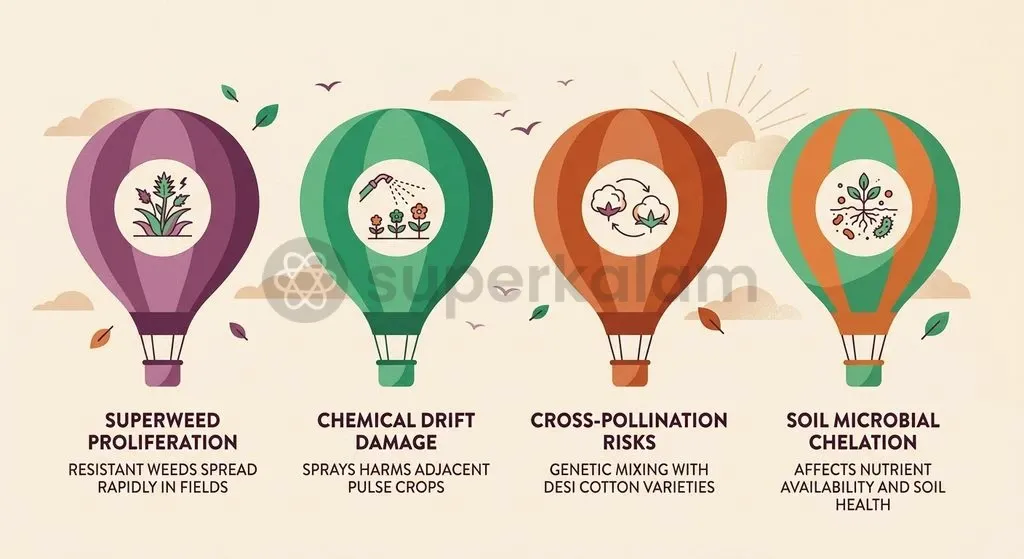
Continuous and uncalibrated applications of glyphosate across unapproved cotton acreage generate severe long-term agronomic hazards. Technical advisories published by the Directorate of Weed Research warn that repeated, blanket spraying of non-selective herbicides without integrated weed management accelerates the selection and rapid emergence of herbicide-resistant weed biotypes, commonly termed superweeds.
Unregulated chemical applications also threaten regional crop diversity and food safety. Agronomic assessments from the Indian Agricultural Research Institute record that uncalibrated glyphosate spraying leads to physical spray drift and severe non-target phytotoxicity on adjacent sensitive crops, including pulses, vegetable plots, and traditional intercrops.
| Ecological Dimension | Primary Hazard Mechanism | Long-Term Agricultural Consequence |
|---|---|---|
| Weed Ecology | Intense glyphosate selection pressure | Proliferation of intractable herbicide-resistant biotypes |
| Surrounding Flora | Unregulated airborne spray drift | Phytotoxic stunting and destruction of pulses and vegetables |
| Genetic Biodiversity | Pollen-mediated adventitious gene flow | Transgenic contamination of native non-GM Desi cotton |
| Soil Microenvironment | Chemical chelation of vital micronutrients | Disruption of beneficial rhizosphere fungi and bacteria |
Genetic purity in traditional landraces faces comparable degradation. Studies by the National Bureau of Plant Genetic Resources show that unmonitored transgenic cultivation creates adventitious gene flow and cross-pollination into native Desi cotton species (Gossypium arboreum and Gossypium herbaceum) as well as certified organic cotton fields. Below the surface, research documented in the Indian Journal of Agricultural Sciences reveals that chronic glyphosate accumulation in topsoil alters beneficial microbial rhizosphere communities and suppresses plant nutrient uptake by chelating essential micronutrients including manganese, zinc, and iron.
India's Biosafety Architecture: Statutory Oversight Under the 1989 Rules
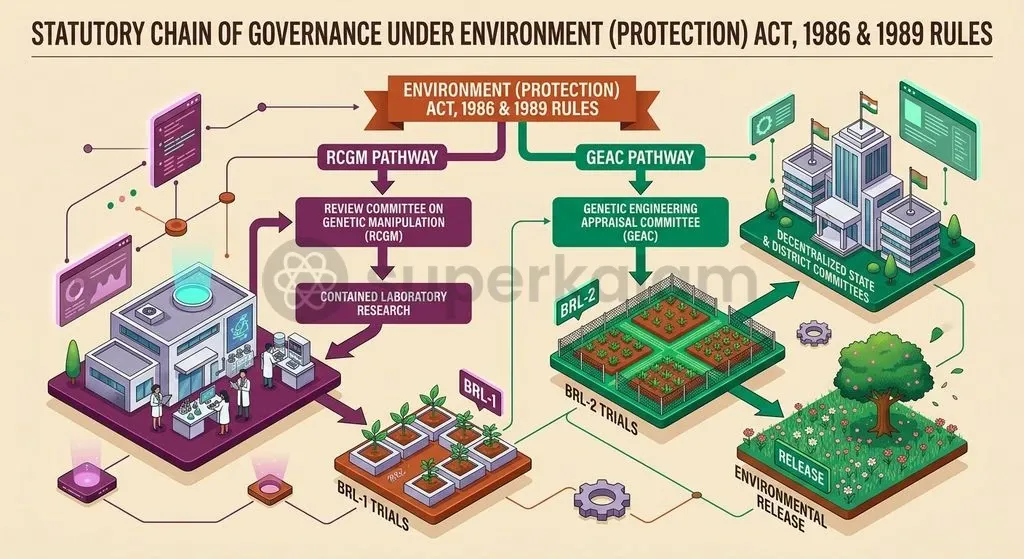
Genetically modified organisms in India fall under the 1989 Rules notified pursuant to the parent provisions of the Environment (Protection) Act, 1986. Officially titled the 'Rules for the Manufacture, Use, Import, Export and Storage of Hazardous Microorganisms/Genetically Engineered Organisms or Cells, 1989', this statutory framework sets up a multi-tiered administrative structure. It supervises recombinant DNA applications across research and commercial sectors.
Under this regulatory architecture, research oversight and environmental release responsibilities are divided between two key institutional bodies:
- Review Committee on Genetic Manipulation (RCGM): Operating under the Department of Biotechnology in the Ministry of Science and Technology, the RCGM evaluates contained laboratory experiments and sanctions confined Biosafety Research Level-1 (BRL-1) field trials.
- Genetic Engineering Appraisal Committee (GEAC): Operating under the Ministry of Environment, Forest and Climate Change, the GEAC is the apex authority approving large-scale confined field trials (BRL-2) and granting environmental clearance for commercial cultivation.
Statutory compliance penalties underwent substantial structural reform following recent legislative revisions. The Jan Vishwas (Amendment of Provisions) Act, 2023 amended Section 15 of the Environment (Protection) Act, 1986, replacing custodial imprisonment provisions with civil monetary penalties spanning ₹10,000 to ₹15 lakh for non-compliance. To enforce these revised provisions, the central government notified the Environment Protection (Manner of Holding Inquiry and Imposition of Penalty) Rules, 2024 to formalise adjudicating officers and structure statutory inquiries.
Discuss with Superkalam
If a farmer switches from manual weeding to glyphosate on HT-Bt cotton, how might surrounding vegetable and pulse intercrops be impacted by airborne drift?
Ask NowEnforcement Breakdown: Federal Friction and the Porous Grey Market Seed Network
Decentralised monitoring committees established under Indian biosafety rules suffer from operational dormancy and inter-departmental fragmentation. Rule 4 of the 1989 Rules mandates that State Biotechnology Coordination Committees headed by State Chief Secretaries, alongside District Level Committees led by District Magistrates, inspect unauthorised releases and enforce biosafety directives.
Parliamentary evaluations confirm an extensive implementation breakdown across cotton-growing states. A report by the Parliamentary Standing Committee on Science and Technology highlighted that State Biotechnology Coordination Committees and District Level Committees rarely meet or remain entirely non-functional, leaving an acute institutional void at ground level.
Operational and jurisdictional constraints further paralyse field inspections:
- Statutory Authority Disconnect: Agricultural seed inspectors appointed under the Seeds Act, 1966 lack delegated enforcement powers under the Environment (Protection) Act, 1986 without specific central gazette notifications.
- Informal Distribution Channels: Unapproved seeds circulate through unbranded 450-gram packets and unlabelled polythene pouches sold under vernacular labels such as '4G', '5G', or 'Chor BT', originating from clandestine breeding plots and unmonitored ginning mill residues.
- Chemical Misalignment: The Ministry of Agriculture issued the 'Restriction on use of Glyphosate Order, 2022' restricting glyphosate handling to licensed Pest Control Operators, yet illegal in-crop cotton spraying continues unabated.
- Off-Label Herbicide Use: Regulatory approvals from the Central Insecticides Board and Registration Committee permit glyphosate strictly within tea plantations and non-cropped industrial land, making agricultural application on cotton fields legally unauthorised off-label spraying.
Way Forward: Reconciling Precautionary Biosafety with On-Ground Agricultural Needs
Judicial directives and institutional reforms must establish a cohesive national policy reconciling agricultural realities with ecological containment. In July 2024, a split bench of the Supreme Court of India in the GM mustard litigation directed the Union Government to formulate an overarching national policy on genetically modified crops within four months following extensive stakeholder consultations.
Public policy must harmonise this national roadmap with established environmental jurisprudence. The Supreme Court firmly embedded the Precautionary Principle into Indian environmental law in Vellore Citizens' Welfare Forum (1996), obligating administrative agencies to avert potential ecological damage even when scientific consensus remains incomplete. Furthermore, the World Health Organization's International Agency for Research on Cancer classified glyphosate as probably carcinogenic to humans under Group 2A in 2015, reinforcing the biosafety justification for stringent precautionary checks before authorising widespread chemical-tolerant agriculture.
To transition beyond the current regulatory deadlock, governance mechanisms require multi-pronged structural intervention:
- Inter-Agency Enforcement Integration: Grant designated agricultural inspectors under the Seeds Act, 1966 concurrent summary search and seizure powers under the Environment Protection Rules, 2024 to dismantle underground supply chains.
- Reactivation of Decentralised Biosafety Panels: Mandate scheduled quarterly meetings for State Biotechnology Coordination Committees and District Level Committees, backed by dedicated central oversight reporting.
- Traceability in Cotton Ginning: Institute mandatory genetic strip testing across commercial ginning mills and seed processing hubs to identify and quarantine parent seed stocks carrying the cp4-epsps trait.
- Viable Agronomic Alternatives: Expand public agricultural extension programmes focused on mechanical de-weeders, cover cropping, and integrated weed management to reduce manual weeding expenditures without encouraging unmonitored chemical saturation.
Discuss with Superkalam
Compare the ecological hazards of glyphosate resistance with the immediate operational cost savings experienced by cotton growers.
Ask NowKey Takeaways
- Regulatory Status: India has authorised only two commercial transgenic cotton events: MON 531 (Cry1Ac) and MON 15985 (Cry1Ac + Cry2Ab), both conferring lepidopteran pest resistance; HT-Bt cotton (MON 88913) remains unapproved.
- Economic Motivation: Manual de-weeding represents 15 to 20 percent of total cotton cultivation expenditure (₹3,000 to ₹5,000 per acre); applying glyphosate over unauthorised HT-Bt hybrids cuts weeding costs by ₹2,000 to ₹3,000 per acre.
- Ecological Hazards: Unchecked HT-Bt farming risks selecting glyphosate-resistant superweeds, triggering chemical drift damage on pulses and vegetables, contaminating native Desi cotton germplasm, and disrupting soil microbiome balance.
- Statutory Framework: Genetically engineered organisms are regulated under the 1989 Rules framed under the Environment (Protection) Act, 1986; Section 15 of the Act was amended in 2023 to institute civil penalties ranging from ₹10,000 to ₹15 lakh.
- Enforcement Gaps: Field-level monitoring is impeded because State Biotechnology Coordination Committees and District Level Committees remain largely inactive, while agricultural seed inspectors lack delegated authority under environmental statutes.
Mains Question
"The widespread cultivation of unapproved HT-Bt cotton reflects an acute disconnect between statutory biosafety regulation under the 1989 Rules and the microeconomics of farm labour." Critically analyse. (15 Marks)
Evaluate NowMains Question
Elucidate the environmental and agronomic hazards posed by the uncalibrated adoption of herbicide-tolerant transgenic crops in India. (10 Marks)
Evaluate NowPractice MCQs
QUESTION 1
Consider the following statements regarding the transgenic mechanisms in cotton cultivation in India:
- The commercial event MON 15985 expresses Cry1Ac and Cry2Ab endotoxins derived from Bacillus thuringiensis to target lepidopteran pests.
- Unapproved HT-Bt cotton utilizes the cp4-epsps gene isolated from Agrobacterium tumefaciens strain CP4 to confer tolerance against glyphosate.
- The Genetic Engineering Appraisal Committee (GEAC) has granted approval for commercial environmental release of the stacked MON 88913 event. Which of the statements given above is/are correct?
QUESTION 2
Consider the following statements regarding the regulatory oversight of genetically engineered organisms in India:
- Genetically modified organisms are regulated under rules framed pursuant to the parent provisions of the Environment (Protection) Act, 1986.
- The Review Committee on Genetic Manipulation (RCGM) functions under the Ministry of Environment, Forest and Climate Change.
- Confined Biosafety Research Level-1 (BRL-1) field trials are sanctioned by the RCGM. Which of the statements given above is/are correct?
QUESTION 3
With reference to the ecological and agronomic concerns associated with the uncalibrated application of glyphosate on HT-Bt cotton crops, consider the following statements:
- Continuous application accelerates the selection pressure leading to the emergence of herbicide-resistant weed biotypes.
- Chronic accumulation of glyphosate in the topsoil suppresses plant nutrient uptake by chelating essential micronutrients such as manganese, zinc, and iron.
- Unregulated cultivation creates adventitious gene flow into native Desi cotton species like Gossypium arboreum and Gossypium herbaceum. Which of the statements given above are correct?
QUESTION 4
According to reports by the Field Inspection and Scientific Evaluation Committee (FISEC) and field surveys, unapproved HT-Bt cotton hybrids circulating in the informal market have been detected carrying which of the following genetic components?
- cp4-epsps gene
- Vip3A gene
- Cry1Ac and Cry2Ab genes Select the correct answer using the code given below:
QUESTION 5
Which of the following legal instruments prompted major commercial trait developers to suspend domestic regulatory submissions, inadvertently creating a commercial void exploited by unapproved seed suppliers?