NALSA and Free Legal Aid: Article 39A and Undertrials
Article 39A directs the State to provide free legal aid. The Legal Services Authorities Act sets eligibility and delivery through NALSA, SLSAs and DLSAs.
Oct, 2026
•13 min read

Overview
India's constitutional promise of equal access to justice collapses at the magisterial threshold. Here, the National Legal Services Authority (NALSA) consistently fails to convert formal statutory mandates into effective courtroom advocacy for indigent undertrial prisoners. Statutory machinery exists across every district, yet under-resourced legal aid structures leave hundreds of thousands trapped in pre-trial detention without meaningful legal representation.
This institutional deficit turns routine judicial custody into punitive incarceration before guilt is ever established. India's undertrial crisis is not primarily an issue of substantive criminal law. Instead, it reflects a structural delivery failure of state-funded legal aid that abandons marginalised citizens when state scrutiny is most severe.
Why in the News? The Undertrial Paradox in India's Jails
As of March 2026, official justice audits reveal a widening gap between constitutional guarantees and empirical reality in Indian penal facilities. According to the National Crime Records Bureau's Prison Statistics India 2023 report, undertrial prisoners accounted for 73.5%—totalling 3,84,000 inmates—of the 5,30,333 individuals confined across Indian jails. This high proportion has driven the national prison occupancy rate to 120.8%, with regional infrastructure strain pushing occupancy in Delhi jails to an acute 200%.
| Inmate Category | Inmate Count | Share of Total Jailed Population |
|---|---|---|
| Undertrial Prisoners | 3,84,000 | 73.5% |
| Convicted / Others | 1,46,333 | 26.5% |
| Total Inmates | 5,30,333 | 100.0% |
This carceral burden falls unevenly across society. Empirical justice audits and the National Crime Records Bureau document that approximately 66% of undertrial prisoners belong to Scheduled Caste, Scheduled Tribe, and Other Backward Class communities.
Furthermore, roughly 63% possess educational attainment below Grade 10. These figures demonstrate that pre-trial detention acts as a direct penalty on structural poverty and social marginalisation, severely undermining the institutional performance of district-level legal defence frameworks.
Discuss with Superkalam
Which Supreme Court judgment established that conducting a criminal trial without offering free legal aid to an indigent accused renders the conviction void?
Ask NowThe Constitutional Baseline: Article 39A and Supreme Court Rulings on Free Defense
The substantive foundation for state-funded criminal defence in India emerged from the interplay between Directive Principles of State Policy and fundamental rights jurisprudence. Article 39A of the Constitution of India, inserted by the 42nd Constitutional Amendment Act of 1976, directs the State to secure that the legal system promotes justice on a basis of equal opportunity. The provision specifically mandates free legal aid through suitable legislation or schemes. Although Article 39A is non-justiciable under Part IV, the Supreme Court elevated its principles into enforceable fundamental rights under Part III.
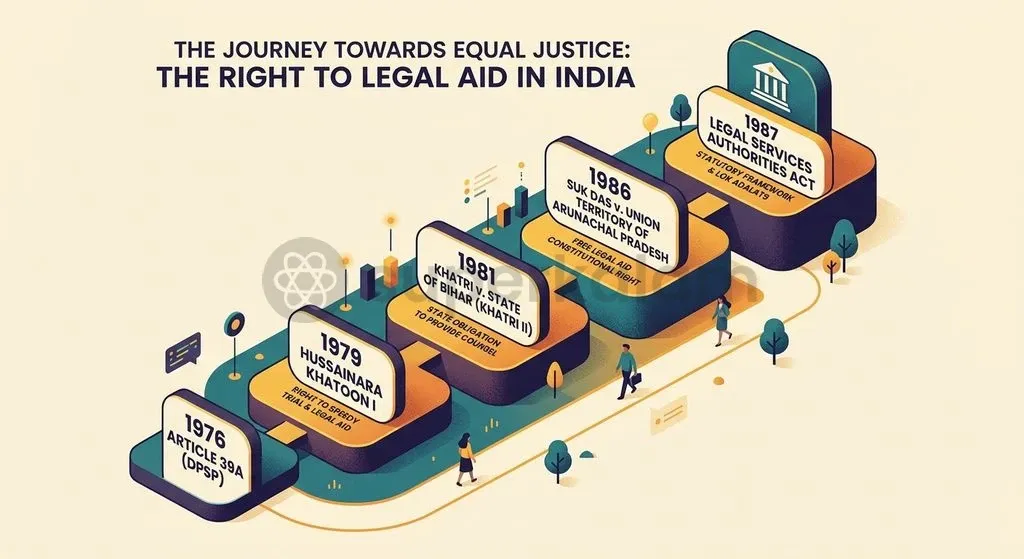
Through a series of rulings, the Supreme Court linked state-funded legal assistance directly to Article 21's guarantee of life and personal liberty:
- Hussainara Khatoon (I) v. Home Secretary, State of Bihar (1979): The Supreme Court held that the right to a reasonably expeditious trial and state-funded free legal service to an indigent accused is an essential ingredient of "reasonable, fair and just" procedure under Article 21.
- Khatri (II) v. State of Bihar (1981): The Court ruled that the constitutional obligation to provide free legal services begins when the accused is produced for the first time before the magistrate and continues through subsequent remand stages. The ruling imposed an affirmative judicial duty on magistrates to inform unrepresented accused persons of this entitlement.
- Suk Das v. Union Territory of Arunachal Pradesh (1986): The Supreme Court ruled that conducting a criminal trial without offering free legal representation to an indigent accused violates Article 21, rendering the resulting conviction void.
To give statutory effect to Article 39A and institutionalise these judicial mandates, Parliament enacted the Legal Services Authorities Act, 1987, which formally came into force across India on November 9, 1995. The statute erected a four-tier delivery mechanism comprising NALSA at the apex level, State Legal Services Authorities (SLSAs) at High Courts, District Legal Services Authorities (DLSAs), and Taluk Legal Services Committees (TLSCs).
Section 12 of the Legal Services Authorities Act, 1987 enumerates the categories of persons eligible for free legal aid. These include members of Scheduled Castes and Scheduled Tribes, victims of human trafficking or begar, women, children, persons with disabilities, victims of mass disasters, and industrial workmen. Importantly, under Section 12(g), any person placed in custody—including police or judicial detention, juvenile homes, or psychiatric facilities—is entitled to free legal assistance regardless of their personal financial means or statutory income ceilings.
| Legal Instrument / Precedent | Core Mechanism / Ratio | Constitutional or Statutory Anchor |
|---|---|---|
| Article 39A (1976) | Mandates the State to provide free legal aid through legislation or executive schemes | Directive Principles of State Policy (Part IV) |
| Hussainara Khatoon (1979) | Declares speedy trial and free defense services non-negotiable elements of fair procedure | Fundamental Right under Article 21 |
| Khatri (II) (1981) | Fixes the obligation of free legal aid at the first remand hearing before a magistrate | Article 21; Magisterial Duty |
| Suk Das (1986) | Holds that trials conducted without offering legal counsel to indigent accused are void | Supreme Court ruling; Article 21 |
| Legal Services Authorities Act, 1987 | Creates statutory four-tier architecture (NALSA, SLSA, DLSA, TLSC) and Section 12 eligibility criteria | Act No. 39 of 1987 (Enforced Nov 9, 1995) |
Discuss with Superkalam
How does the absence of duty counsel at the initial remand hearing directly contribute to prison overcrowding in India?
Ask NowThe Remand Stage Breakdown: Where Legal Aid Goes Missing at the First Hearing
The constitutional architecture breaks down most severely during initial production before magistrates under Section 167 of the Code of Criminal Procedure (CrPC), now superseded by Section 187 of the Bharatiya Nagarik Suraksha Sanhita (BNSS), 2023. Field findings consolidated in the India Justice Report 2022 demonstrate that DLSAs routinely fail to assign duty counsels during the vital 24-hour post-arrest window.
Magistrates frequently conduct remand hearings mechanically. When an arrested individual appears without private counsel, courts regularly issue initial and successive remand orders without resistance. The absence of duty counsels at this juncture removes any early challenge to unlawful arrest procedures, police excess, or unjustified custody requests.
This procedural vacuum produces three severe systemic harms:
- Foregone Early Bail Applications: Defence applications for regular bail, default bail, or bail on personal bonds are rarely submitted during initial magisterial production.
- Unchecked Custodial Requests: Police demands for physical custody go largely uncontested because unrepresented defendants lack the legal knowledge to challenge remand applications.
- Institutional Passivity: Magistrates routinely overlook their affirmative duty under Khatri (II). They treat legal aid as an optional trial facility rather than an immediate constitutional right during remand.
Consequently, impoverished individuals charged with minor, bailable offences are routinely remanded directly into judicial custody. Once admitted to overcrowded prisons, administrative hurdles delay their access to DLSAs. This transforms short-term detention into months of incarceration.
Discuss with Superkalam
If you were appointed as the Secretary of a District Legal Services Authority (DLSA), what protocol would you implement to ensure 100% legal aid coverage during the 24-hour remand stage?
Ask NowInside the Courtroom: Why Legal Aid Counsel Underperform Private Lawyers
The historical reliance of NALSA on the Assigned Counsel System created persistent operational deficiencies within district trial courts. Under this model, DLSAs empanelled private legal practitioners to manage indigent defence alongside their private dockets. The National Legal Services Authority (Free and Competent Legal Services) Regulations, 2010 (as amended) set sub-market honorariums for assigned lawyers, offering nominal honorarium fees that lagged behind private rates.
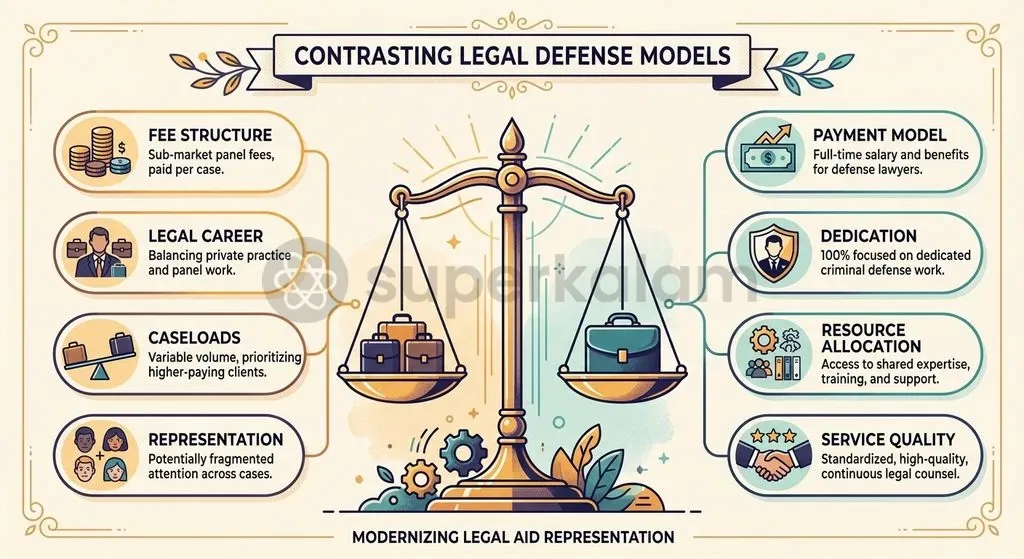
Empanelled lawyers faced contradictory economic incentives. Private caseloads generated market fees, while legal aid matters offered negligible remuneration paid after lengthy administrative delays. As a result, empanelled advocates prioritised private retainers, which led to chronic absenteeism and neglected filings in state-assisted cases. Panel lawyers rarely visited undertrials in prison to take instructions, and institutional mechanisms to track their trial preparation remained minimal.
To address these systemic flaws, NALSA introduced the Legal Aid Defense Counsel System (LADCS) as a Central Sector Scheme modelled on professional public defender offices. Unlike the ad-hoc panel system, the LADCS engages full-time, salaried legal defence counsels who are strictly barred from private practice. According to the Ministry of Law and Justice, functional LADCS offices had been established across 680 district legal services authorities nationwide by December 31, 2025.
| Parameter | Assigned Panel Counsel Model | Legal Aid Defense Counsel System (LADCS) |
|---|---|---|
| Employment Structure | Ad-hoc, case-by-case private advocates | Full-time salaried institutional personnel |
| Private Practice | Permitted simultaneously without restriction | Strictly barred during tenure |
| Accountability & Monitoring | Fragmented; minimal performance evaluation | Monitored by Chief Legal Aid Defense Counsel and DLSA |
| Remuneration Model | Sub-market honorariums paid after administrative delays | Fixed monthly institutional salaries |
| Focus of Practice | Mixed civil and criminal private dockets | Exclusively dedicated to criminal indigent defense |
Despite this institutional rollout, structural pushback has emerged from traditional bar associations. In August 2026, the Supreme Court of India issued notice on a writ petition challenging NALSA's administrative directive that halted contract renewals for incumbent Legal Aid Defence Counsels across Punjab, Haryana, and Chandigarh, following strikes and protests by local bar associations against state-funded defense counsel offices, as reported by LiveLaw and LawBeat in August 2026. This friction highlights a persistent institutional challenge: traditional private bars often view dedicated, state-funded public defender offices as commercial threats to magistrate-court litigation.
Stalled Releases: Why Section 436A and Under-Trial Review Committees Fall Short
Even when undertrials complete long terms of pre-trial detention, statutory decarceration mechanisms operate sluggishly. Historically, Section 436A of the Code of Criminal Procedure, 1973 provided that an undertrial prisoner detained for more than one-half of the maximum sentence for their charged offence—excluding capital crimes—was entitled to mandatory release on personal bond.
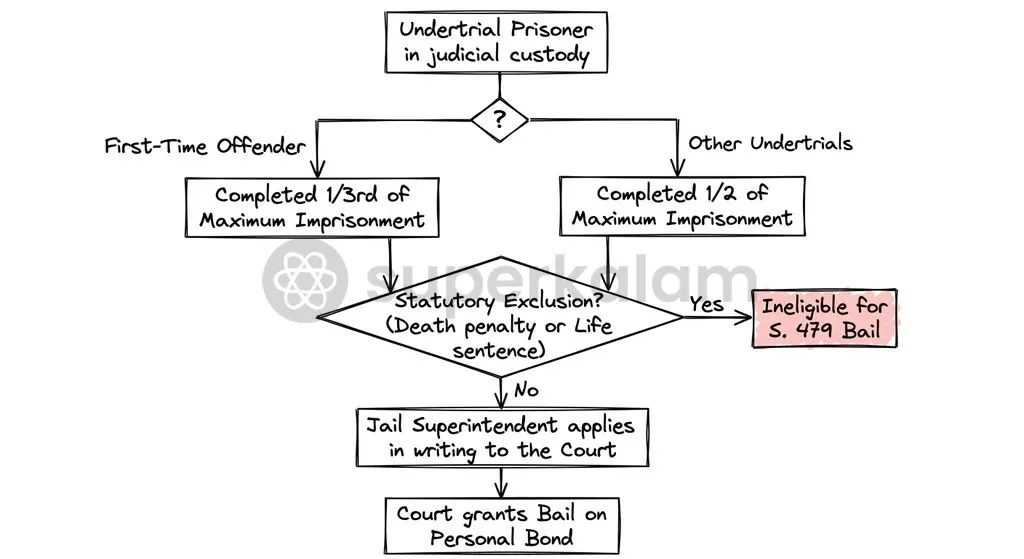
With the implementation of the Bharatiya Nagarik Suraksha Sanhita (BNSS), 2023 on July 1, 2024, Section 479 replaced Section 436A CrPC, introducing several statutory changes:
- First-Time Offender Concession: Section 479(1) introduces a relaxation entitling a first-time offender who has never been previously convicted of any offence to release on bond upon completing detention extending to one-third of the maximum sentence.
- Mandatory Jail Authority Application: Section 479(3) casts an express statutory duty on the Superintendent of Jail to apply in writing to the court for bail once an undertrial completes the required detention period.
- Retrospective Application: On August 23, 2024, the Supreme Court ruled in Re: Inhuman Conditions in 1382 Prisons that Section 479 of the BNSS applies retrospectively, benefiting all undertrials whose cases were registered prior to July 1, 2024.
However, these benefits are limited by statutory exclusions. Under Section 479(1) and Section 479(2) of the BNSS, the concession does not apply to offences punishable by death or life imprisonment. Specifically, release is barred where multiple cases or offences are pending against the individual during investigation, inquiry, or trial. Because low-income accused individuals frequently face multiple petty charges across different police jurisdictions, Section 479(2) often disqualifies the very undertrials most in need of relief.
Simultaneously, the institutional framework of Under-Trial Review Committees (UTRCs) struggles with bureaucratic inertia. Mandated by the Supreme Court in 2015, UTRCs must convene quarterly across every district to review eligible undertrials across 16 categories. These committees comprise the District Judge, District Magistrate, Superintendent of Police, DLSA Secretary, and Jail Superintendent. Yet, recommendations generated by UTRCs are frequently held up by poor inter-agency coordination between prison administrations and magistrate courts.
This breakdown is compounded by poverty-induced surety failure. The Supreme Court observed in In Re Policy Strategy for Grant of Bail (2023) that thousands of undertrials granted bail remain incarcerated for months because they cannot furnish local sureties, land revenue records, or cash bail bonds.
To counter this issue, the Ministry of Home Affairs launched the 'Support to Poor Prisoners' Scheme in 2023 with an annual allocation of Rs. 20 crore to assist impoverished prisoners who cannot pay court fines or bail bonds. In December 2025, following directives from the Supreme Court in Satender Kumar Antil v. CBI, the Ministry revised its guidelines to name the DLSA Secretary as the Convener of District Empowered Committees, aiming to speed up fund disbursals for destitute undertrials.
Discuss with Superkalam
Weigh the comparative merits and systemic drawbacks of transitioning entirely from the ad-hoc Assigned Counsel System to the full-time salaried LADCS model.
Ask NowFixing the Delivery Pipeline: From Full-Time Public Defenders to Early Intervention
Resolving India's undertrial dilemma requires converting legal defence from an intermittent social service into a professional, institutionalised public function. The rollout of LADCS across 680 districts provides a foundation, but its effectiveness depends on structural accountability and active early intervention.
| Pipeline Stage | Operational Mandate | Legal / Institutional Anchor |
|---|---|---|
| 1. Custody (Within 24 Hours) | Mandatory LADCS duty counsel intervention prior to court presentation | Early access before initial remand |
| 2. Initial Magisterial Production | Active bail contestation and immediate challenge to custodial remand | Section 187 BNSS (formerly Sec 167 CrPC) |
| 3. Automated Carceral Audit | Automated digital bail filing upon completing threshold detention | Section 479(1) & 479(3) BNSS |
| 4. Release Facilitation | Direct financial relief for indigent bail bonds and local sureties | MHA Support to Poor Prisoners Scheme (rev. 2025) |
Early defence intervention must be made procedurally binding. DLSAs must deploy full-time LADCS defence advocates directly to police stations and magistrate courts before initial production occurs under Section 187 BNSS. Remand orders issued without the recorded participation of a defence counsel should be treated as procedural violations under the doctrine established in Suk Das.
Second, the administrative capacity of Under-Trial Review Committees needs digitisation. Jail management software should automatically flag undertrials as soon as they complete one-third of their maximum permissible detention, generating automated bail petitions under Section 479(3) BNSS without requiring manual initiation by overburdened prison clerks.
Third, financial relief systems must operate efficiently. The designation of the DLSA Secretary as Convener of District Empowered Committees under the revised 2025 'Support to Poor Prisoners' guidelines offers a path to bypass bureaucratic delays. By pairing statutory release mechanisms with direct financial relief for bail sureties, the legal system can begin to dismantle the structural barriers that equate poverty with prolonged incarceration.
Key Takeaways
- Pervasive Pre-Trial Detention: Undertrials account for 73.5% (3,84,000 inmates) of India's prison population per NCRB Prison Statistics India 2023, causing a national prison occupancy rate of 120.8%.
- Constitutional Jurisprudence: Article 39A directs the State to secure free legal aid, which the Supreme Court translated into enforceable Article 21 fundamental rights across Hussainara Khatoon (1979), Khatri (II) (1981), and Suk Das (1986).
- Universal Custodial Right: Under Section 12(g) of the Legal Services Authorities Act, 1987, any person placed in custody is legally entitled to state-funded counsel irrespective of income ceilings.
- Remand Stage Failure: DLSAs regularly fail to provide effective representation during initial 24-hour productions before magistrates, resulting in routine remand orders issued without bail opposition.
- Transition to LADCS: To resolve the shortcomings of the poorly remunerated panel lawyer system, NALSA expanded the Legal Aid Defense Counsel System across 680 DLSAs by December 31, 2025, deploying full-time salaried defenders barred from private practice.
- Statutory Bail Under Section 479 BNSS: Replacing Section 436A CrPC, Section 479 BNSS allows first-time offenders release after serving one-third of their maximum sentence, applies retrospectively per the Supreme Court, and makes bail applications a statutory duty for Jail Superintendents under Section 479(3).
Mains Question
"The constitutional obligation to provide free legal services begins when the accused is produced for the first time before the magistrate." In light of the procedural mandate under Khatri (II) v. State of Bihar and Section 167 of the CrPC (now Section 187 of the BNSS), critically analyse the institutional breakdowns at the remand stage that lead to prolonged pre-trial incarceration. (15 Marks)
Evaluate NowMains Question
Evaluate the Legal Aid Defense Counsel System (LADCS) as an institutional reform to overcome the structural deficiencies of the traditional Assigned Counsel System in India's district judiciary. (10 Marks)
Evaluate NowPractice MCQs
QUESTION 1
With reference to the Legal Services Authorities Act, 1987, consider the following statements:
- Under Section 12(g), any person in custody is entitled to free legal services, irrespective of financial means or statutory income ceilings.
- The Act establishes a four-tier institutional structure comprising NALSA, SLSAs, DLSAs, and Taluk Legal Services Committees.
- The Act came into force immediately upon receiving the assent of the President in 1987.
Which of the statements given above are correct?
QUESTION 2
Consider the following judicial rulings and their associated constitutional principles regarding legal aid:
- Khatri (II) v. State of Bihar: Cast an affirmative judicial duty on magistrates to inform unrepresented accused of their right to legal aid at the first remand hearing.
- Suk Das v. Union Territory of Arunachal Pradesh: Held that conducting a criminal trial without providing free legal representation to an indigent accused renders the conviction void.
- Hussainara Khatoon (I) v. Home Secretary, State of Bihar: Held that state-funded free legal service and speedy trial are essential ingredients of Article 21.
Which of the statements given above are correct?
QUESTION 3
Regarding the Legal Aid Defense Counsel System (LADCS) introduced by NALSA, consider the following statements:
- It functions as a Central Sector Scheme modeled on professional public defender offices.
- Lawyers engaged under LADCS are permitted to handle private civil litigation alongside assigned criminal defence.
- The scheme engages full-time, salaried legal defence personnel monitored by the Chief Legal Aid Defense Counsel and the DLSA.
Which of the statements given above is/are correct?
QUESTION 4
According to the National Crime Records Bureau's Prison Statistics India 2023 report cited in official justice audits, which of the following is correct regarding undertrial prisoners in India?
QUESTION 5
Under Section 12 of the Legal Services Authorities Act, 1987, which of the following categories of persons are entitled to free legal aid?
- Members of Scheduled Castes and Scheduled Tribes
- Victims of human trafficking or begar
- Industrial workmen
- Persons in custody in a police or judicial detention facility
Select the correct answer using the code given below: